



Rating and value of paintings by Marguerite Gérard

Key takeaways
- Marguerite Gérard (1761–1837), a leading 19th-century painter of portraits and genre scenes, has works that sell for between €20 and €1,057,760 at auction.
- Oil-on-canvas paintings, the artist’s preferred medium, fetch prices ranging from €115,160 to €1,057,760 and are particularly sought after by French collectors for their refined interior scenes.
- Drawings and engravings fetch more modest prices (€1,490 to €3,900), while her market value remains stable, driven by growing demand from museums and historians specializing in women’s art.
If you own a work by or after the artist Marguerite Gérard, and would like to know its value, our state-approved experts and auctioneers will offer you their appraisal services.
Our specialists will work to carry out a free appraisal of your work, and will provide you with an accurate estimate of its value on the current market.
Then, if you wish to sell your work, we will direct you to the best possible arrangement to obtain the optimum price.
Rating and value of the artist Marguerite Gérard
Marguerite Gérard is a major portrait artist of the 19th century. Now, prices for her works are rising under the auctioneers' gavel.
Her oils on canvas are particularly prized, especially by French buyers, and the price at which they sell on the art market ranges from €20 to €1,057,760, a considerable delta but one that speaks volumes about the value that can be attributed to the artist's works.
An oil on canvas entitled La mauvaise nouvelle was sold for €1,057,760, while it was estimated at between €470,000 and €705,000. Its value is on the rise.
Order of value from a simple work to the most prestigious
Technique used | Result |
|---|---|
Drawing - watercolor | From €1,490 to €2,130 |
Estamp - multiple | From 20 to 2,740€ |
Miniature | From 240 to €3,900 |
Oil on canvas | From €115,160 to €1,057,760 |
Estimate in less than 24h
Style and technique of artist Marguerite Gérard
Marguerite Gérard (1761 - 1837)was an artist active under the Ancien Régime, the Revolution and the Empire as a painter and engraver. She is known for her refined genre scenes and portraits.
She works mainly in oil on canvas and panel, favoring small to medium-sized formats suitable for private interiors. She also creates engravings and etchings, sometimes in collaboration with Jean-Honoré Fragonard, her brother-in-law and mentor.
She practices preparatory drawing, with graphite and black stone, before moving on to oil. The finish is smooth and polished, with few visible brush marks. Gérard works in thin superimposed layers and glazes, to achieve effects of transparency and luminosity.
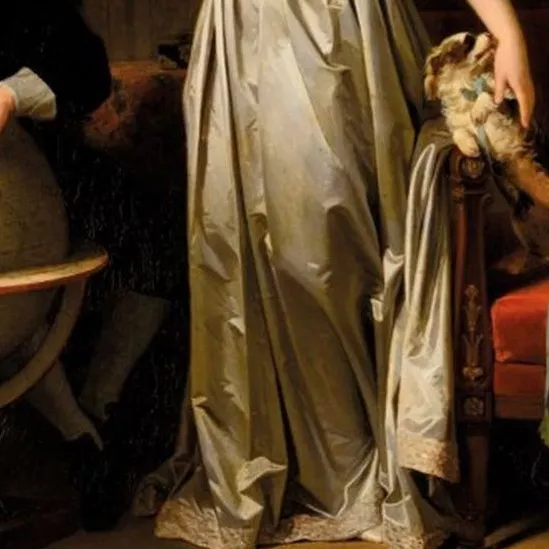
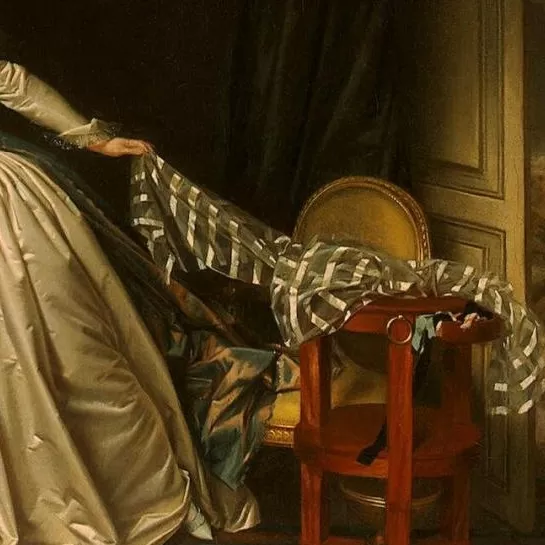
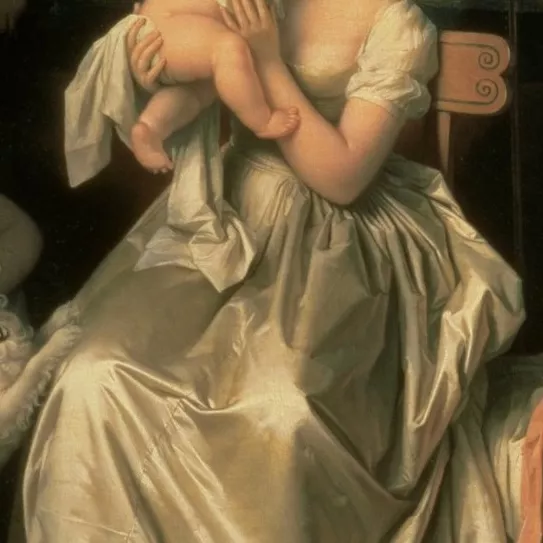
Her work shows extreme precision in rendering details, with the folds of fabrics, reflections on objects and domestic textures. She often depicts interior scenes, often framed in small, intimate spaces.
Her organization is clear and balanced, inherited from classicism, but enriched by a meticulous observation of everyday life. The artist uses architectural perspective (doors, windows, curtains) to structure space and guide the eye.
The figures are elegantly arranged, often in a natural posture, which accentuates the impression of realism. Her palette is refined, dominated by warm, luminous tones (ochres, browns, beiges, reds), balanced by bright whites and delicate blues.
She makes use of subtle contrasts designed to highlight faces and hands, such as Louise Adelaïde Desnos, Marie Denise Villiers or even Louise Hersent, and pays particular attention to skin tone and drapery, with soft harmonies reminiscent of 17th-century Dutch painting.
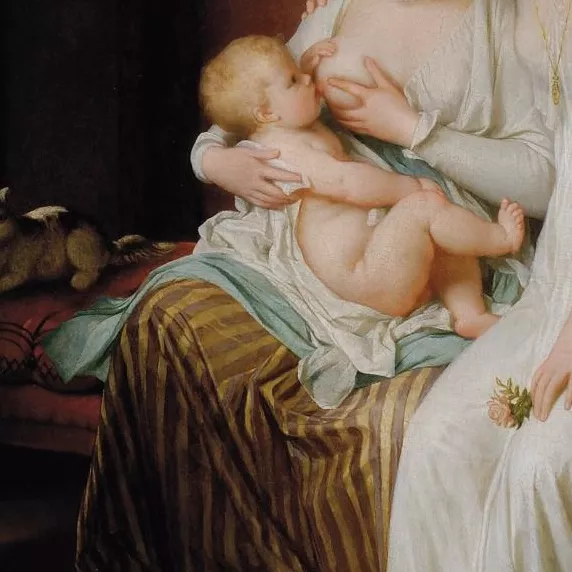
She paints genre scenes, namely scenes of everyday life, bourgeois interiors, maternity scenes, children and music. The rendering is sensitive and the observation of domestic life takes precedence over the grand heroic narrative.
Her work thus combines academic rigor, inherited from the classical school, and narrative sensibility, inherited from Fragonard and the Dutch painters ; and is marked by a soft, elegant and sometimes slightly sentimental atmosphere.
Marguerite Gérard's work follows in the footsteps of 17th-century Dutch painting (Vermeer, Metsu, de Hooch), adapted to the French tastes of the late 18th century. She is the heiress and collaborator of Fragonard, from whom she takes on certain codes while asserting her own identity in genre scenes.
Marguerite Gérard thus represents an intimate, refined style of painting, in contrast to the great neoclassical and Romantic currents.
.
Marguerite Gérard, a singular trajectory
Marguerite Gérard was born in Grasse, into a family of perfumers. After the death of her relatives in 1775, she joined her sister Marie-Anne Gérard, wife of Jean-Honoré Fragonard, in Paris.
She then trained entirely with her brother-in-law, becoming both his pupil and collaborator, and thus benefited from privileged access to Fragonard's studio and library, enabling her to develop an autonomous style.
Her first works were in collaboration with Fragonard (drawings, engravings, small-scale paintings). She also worked as an engraver, with several etchings that had been attributed to Fragonard now recognized as her own.
Attribution disputes of this kind were quite classic for the period, with the same issues found with Prudhon and Constance Mayer or Marie-Denise Villiers and Jacques-Louis David.
From the outset, she specialized in genre scenes and portraits rather than history painting, and came to prominence in the late 1780s for her intimate, refined scenes, which appealed to the bourgeoisie and aristocracy.
Marguerite Gérard achieved growing fame during the Directoire, Consulate and Empire periods, thanks to her style adapted to the taste of a society in search of elegant interiors. She exhibited regularly at the Paris Salon, and was one of the few women to be accepted there.
Her clientele included aristocratic and bourgeois circles, who appreciated her attention to detail and the quality of her portraits. She remained single throughout her life, devoting her time to painting.
The artist shared much of her time with Fragonard and her sister, maintaining a lifelong artistic closeness to her master, yet establishing a stylistic independence, even though posterity has long seen her work as an extension of Fragonard's.
She continued to work and exhibit until the 1820s, and died in Paris in 1837, aged 76. Her studio and works remain relatively confidential after her death. Today, Marguerite Gérard is recognized as one of the first professional women painters of the late 18th and early 19th centuries.
She was rediscovered in the 20th century thanks to studies of women artists and the redefinition of the genre scene in France. Her work is now analyzed as a fusion of Dutch intimism and French elegance, with documentary value on bourgeois domestic life.
She is considered an important figure in the artistic transition between the rococo spirit of Fragonard and the intimist taste of post-revolutionary society.
Margerite Gérard's market segmentation and standing
Marguerite Gérard is best appreciated for her oil paintings. The most sought-after segment is that of small, refined canvases of bourgeois interiors, mothers and children, or young women in everyday life.
Prices generally range from €30,000 to €250,000, depending on subject, state of preservation and provenance. Finished compositions of great decorative refinement sometimes fetch higher prices (in excess of 300,000€).
Large-format paintings are rarer in his corpus and often linked to specific commissions. They are rarely seen in the salesroom, but estimates generally rise higher than for small formats, as they illustrate his academic ambition.
For preparatory drawings and engravings, the secondary market is less sustained but regular for all that. Drawings range from €2,000 to €10,000, depending on the quality and authenticity of the attribution.
His collaborative engravings with Fragonard trade around €1,000 to €5,000, especially if they come from old collections. Her quotation is relatively stable, remaining solid but discreet, without spectacular surges.
She is being rediscovered by museums and art historians ; with all the research on women artists of the 18th and 19th centuries, which tends to reinforce institutional demand.
Collectors specializing in the French gender scene or in the history of women painters are particularly attentive to her works. Prestigious provenance (aristocratic or museum collections) is also a determining factor in the rise in auctions.
Recognizing the artist's signature
Marguerite Gérard often signs her name at the bottom of her drawings, or oils on canvas. Copies may exist, which is why expertise remains important.
Knowing the value of a work
If you happen to own a work by Marguerite Gérard or after the artist, don't hesitate to request a free appraisal using our form on our website.
A member of our team of experts and chartered auctioneers will contact you promptly to provide you with an estimate of the market value of your work, as well as ad hoc information about it.
If you are considering selling your work, you will also be accompanied by our specialists in order to benefit from alternatives for selling it at the best possible price, taking into account the inclinations of the market.
.Estimate in less than 24h
Discover in the same theme

Rating and value of works, paintings and drawings by Baron J...
Baron Jean-Antoine Gros was a history painter during the Empire. He later turned to Romanticism. His works are of great value.
Learn more >

Rating and value of paintings by Rachel Ruysch
Rachel Ruysch is a Dutch artist of the Golden Age who produced still lifes that are highly valued at auction.
Learn more >

Rating and value of prints by Utagawa Toyokuni
Utagawa Toyokuni is a Japanese artist and the founder of the Utagawa school, a pioneer in Japanese woodblock printing. His works are highly valued.
Learn more >
Paintings from the same period sold at auction

Estimated 1.000 - 2.000
Virginie Demont-Breton (1859-1935): Carrying donkey in an alley. Oil on panel.

Estimated 10.000 - 15.000
ABBÉMA Louise, 1853-1927 Portrait of Mme ***, 1879 Oil and gold paint on canvas

Estimated 1500€ - 2000€
French neoclassical school, circa 1800 Head of expression of...

Estimated 800€ - 1200€
Attributed to Jean-François Garneray (Paris 1755-1837 Auteuil) Portrait of...

Estimated 100€ - 200€
19th century French school, after Jean-Honoré Fragonard...

Secure site, anonymity preserved

Auctioneer approved by the State

Free and certified estimates
Frequently asked questions
-
Who is Marguerite Gérard, and what is her artistic background?Marguerite Gérard (1761–1837) was a leading 19th-century painter of portraits and genre scenes. Trained by her brother-in-law Jean-Honoré Fragonard, she specialized in refined interior scenes and portraits, blending Dutch intimism with French elegance. She was among the first recognized professional female painters, exhibiting regularly at the Paris Salon and enjoying a prestigious clientele from the aristocracy and the bourgeoisie.
-
What is the price range for Marguerite Gérard's works?The prices of Marguerite Gérard’s oil-on-canvas paintings range from €115,160 to €1,057,760. The small, refined works depicting bourgeois interiors, mothers, and children generally sell for between €30,000 and €250,000, while her accomplished compositions of great decorative refinement can exceed €300,000. Drawings and engravings range from €1,490 to €2,130 and from €20 to €2,740, respectively.
-
How can you authenticate a work by Marguerite Gérard?To authenticate a work attributed to Marguerite Gérard, we recommend that you request a free appraisal from Auctie's. Our state-certified experts and auctioneers will provide a no-obligation estimate based on an analysis of the signature, technique, provenance, and condition. Our team will contact you within 48 hours with a detailed appraisal.
-
Is this the right time to sell a work by Marguerite Gérard?Yes, now is a good time to sell a work by Marguerite Gérard. The artist is enjoying a growing academic resurgence thanks to contemporary research on women artists, which is driving demand from institutions and specialized collectors. Her market value remains strong and is gradually rising, particularly for high-quality oil paintings with prestigious provenance.
-
How does the appraisal and sale of a work of art take place at Auctie's?The appraisal is free and non-binding: fill out our online form, and an expert will contact you within 48 hours with an accurate valuation. If you decide to sell, Auctie's will guide you every step of the way, from the appraisal to the auction, by identifying the best sales strategy to maximize the price of your artwork based on current market trends.
