



Rating and value of paintings by Rachel Ruysch

Key takeaways
- Rachel Ruysch (1664–1750), a Dutch painter of the Golden Age who specialized in floral still lifes featuring insects, is gaining increasing worldwide recognition.
- Oil-on-canvas paintings range in price from €1,190 to €1,631,700 depending on their complexity, while watercolor drawings range from €800 to €2,500.
- Her style combines quasi-scientific botanical precision and a refined technique with dark backgrounds that highlight the flowers, along with symbolism reflecting the vanity of passing time.
If you own a work by or after the artist Anne Vallayer-Coster, and would like to know its value, our state-approved experts and auctioneers will offer you their appraisal services.
Our specialists will work to carry out a free appraisal of your work, and will provide you with an accurate estimate of its value on the current market.
Then, should you wish to sell your work, we will direct you to the best possible arrangement to obtain the optimum price.
Rachel Ruysch artist's rating and value
Rachel Ruysch is a well-known artist among still life enthusiasts. Now, prices for her works are rising at the auctioneers' gavel.
Her oils on canvas are particularly prized, especially by Dutch buyers, and the price at which they sell on the art market ranges from €1,190 to €1,631,700, a large delta but one that speaks volumes about the value that can be attributed to the artist's works.
In 2013, his oil on canvas Nature morte de roses, tulipes, un tournesol et autres fleurs dans un vase en verre avec une abeille, un papillon et d'autres insectes sur un rebord en marbre sold for €1,631,700, whereas it was estimated at €1,100,000 to €1,750,000. Its value is on the rise.
Order of value from a simple work to the most prestigious
Technique used | Result |
|---|---|
Drawing - watercolor | From €800 to €2,500 |
Oil on canvas | From €1,190 to €1,631,700 |
Estimate in less than 24h
Style and technique of artist Rachel Ruysch
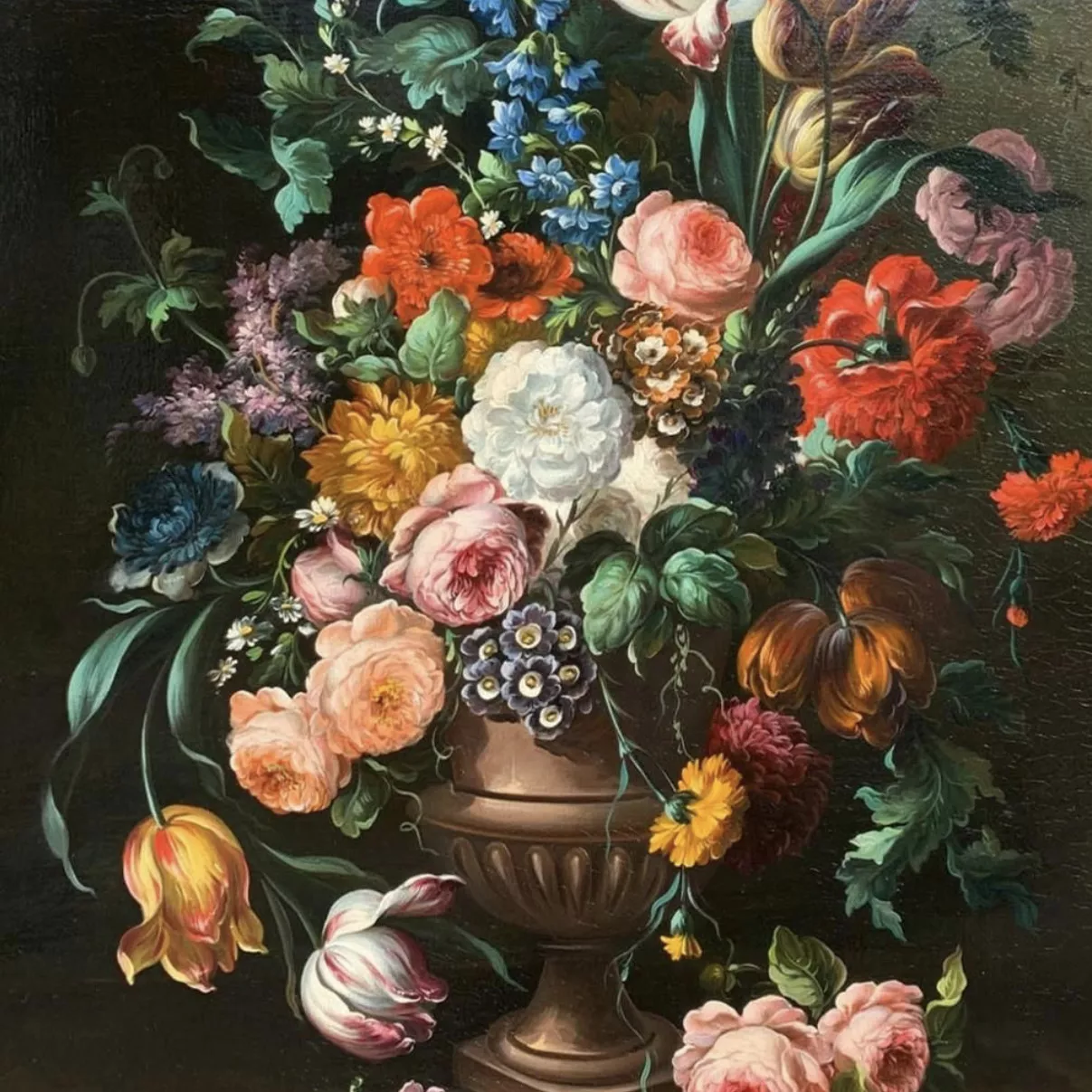
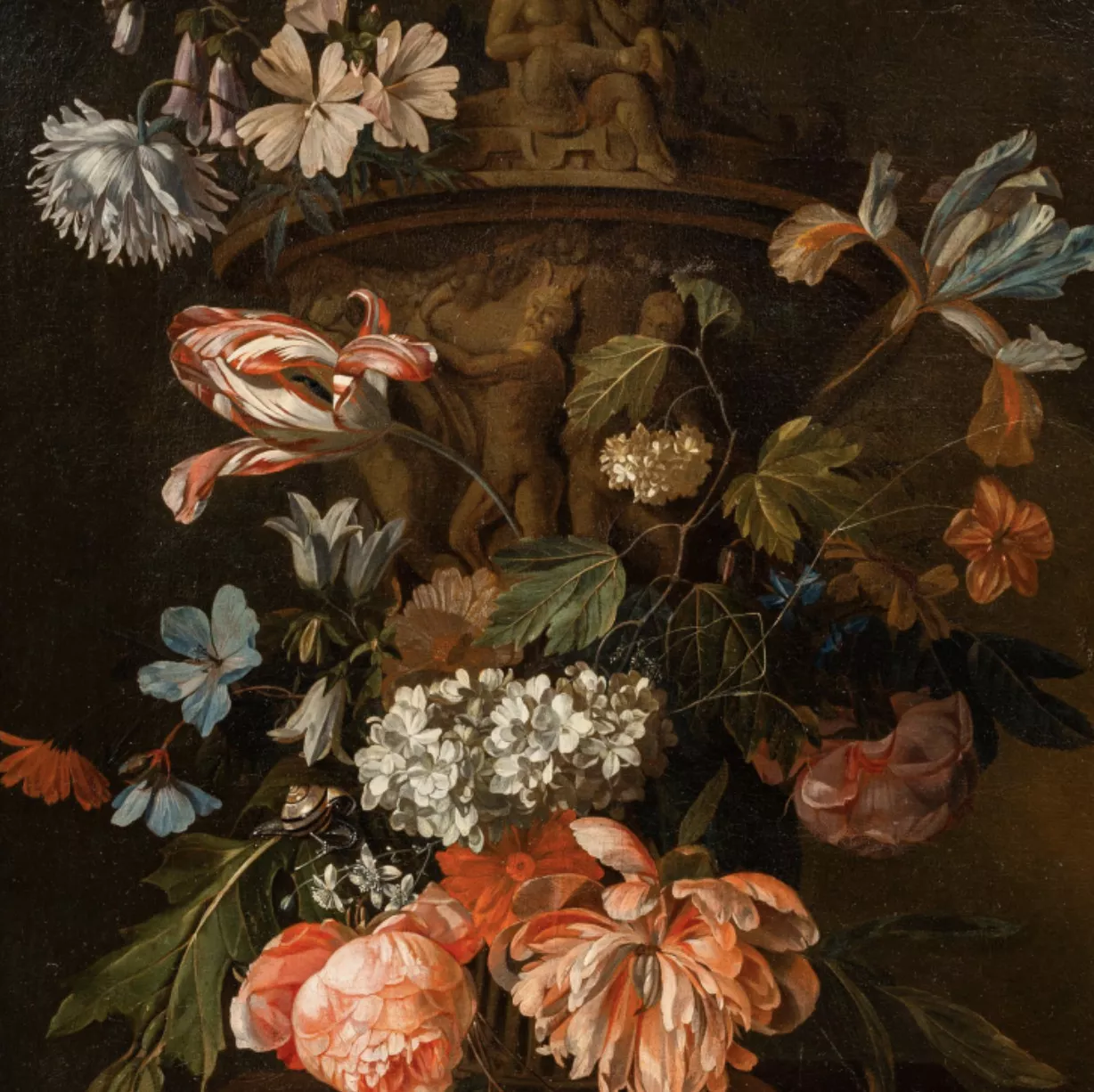
Rachel Ruysch (1664 - 1750) was a Dutch painter of the Golden Age. She adopted a naturalistic and scientific approach, meticulously observing flora and fauna. She depicts each species accurately (stems, petals, insects) without idealization but with almost botanical precision.
She was scientifically influenced as the daughter of a botanical anatomist, so she had access to her father's collections and botanical gardens, feeding her paintings with rigorous knowledge.
Painting technique is refined she uses fine brushwork and details (filaments, veins, veins, translucent wings) with a clear, soft, flawless finish.
She makes innovative use of natural materials, sometimes incorporating real moss or butterfly wings to texturize the canvas, enhancing its realism.
The background is generally dark to highlight the vivid colors and delicate modeling of flowers and insects. Anne Vallayer Coster would adopt this principle, as would later Henri Fantin-Latour and Victoria Fantin-Latour.
She often chose to break strict symmetry with dynamic compositions, balancing spontaneity and rigor in this way. She aims for chromatic harmony using a subtle palette, with dominant whites, pinks and greens, creating vibrant, luminous bouquets.
Her works stand out for a fusion of genres : her still lifes belong to both the Baroque tradition and the decorative rococo spirit, combining scientific realism and pictorial elegance.
Each work becomes a microcosm, with insects, mosses, fruits and flowers from different seasons, evoking, among other things, time and vanity.
The life of Rachel Ruyst
Rachel Ruyst was born in The Hague into an intellectual family: her father, Frederik Ruysch, was a famous botanical anatomist.
She was introduced to scientific drawing and nature observation at an early age, thanks to her father's botanical and anatomical collections. At the age of 15, she became a pupil of the Amsterdam painter Willem van Aelest, who introduced her to still life painting, chiaroscuro and floral arrangements.
He developed a personal style, highly detailed and lively, focusing on floral compositions with insects, fruits and shells. By the 1680s, she was recognized as an accomplished painter, signing her works (which was very rare for a woman at the time.
She worked for wealthy merchants, collectors and art lovers, and her works were prized in the United Provinces and in Germany.
In 1708, she was appointed official painter to Elector Palatine Johann Wilhelm in Düsseldorf, and worked there for over a decade.
When she returned to Amsterdam, she continued to paint for a prestigious clientele until the end of her life.
Her career spanned almost 70 years, which is quite exceptional in 17th-century art history.
She married the ornamental painter Juriaen Pool in 1693, and had ten children (several of whom died young). She succeeded in reconciling a career as an independent painter with a large family, a feat much admired by her contemporaries.
She died in 1750 at the age of 86, after a long career marked by success and recognition. She was forgotten in the 19th century, then rediscovered in the 20th as one of the few major female painters of the Dutch Golden Age, alongside Judith Leyster.
Today, she remains one of the most appreciated female artists of early painting, alongside Sophie Allart and Adélaïde Labille-Guiard.
Focus on Vase of Flowers, Rachel Ruysch, circa 1700
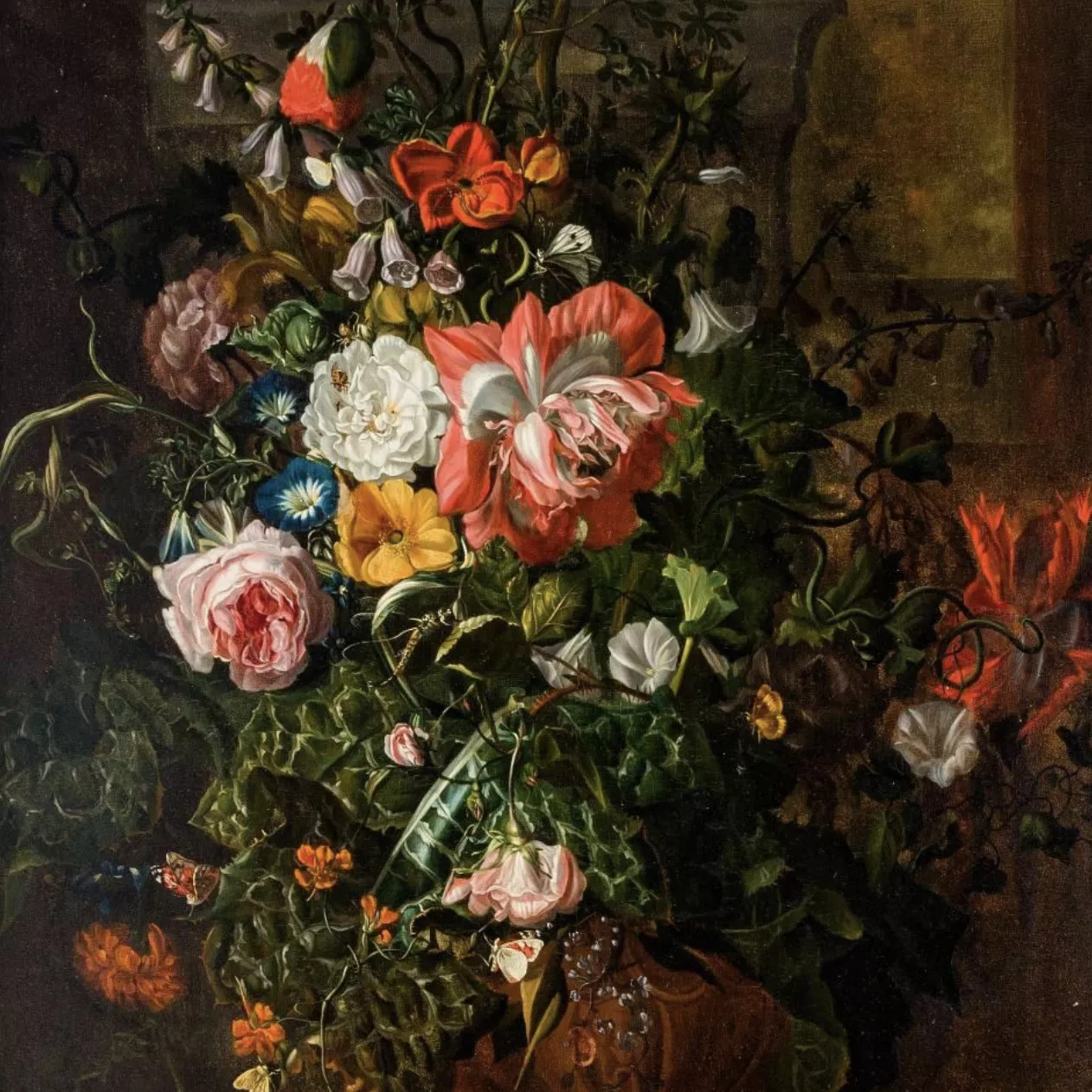
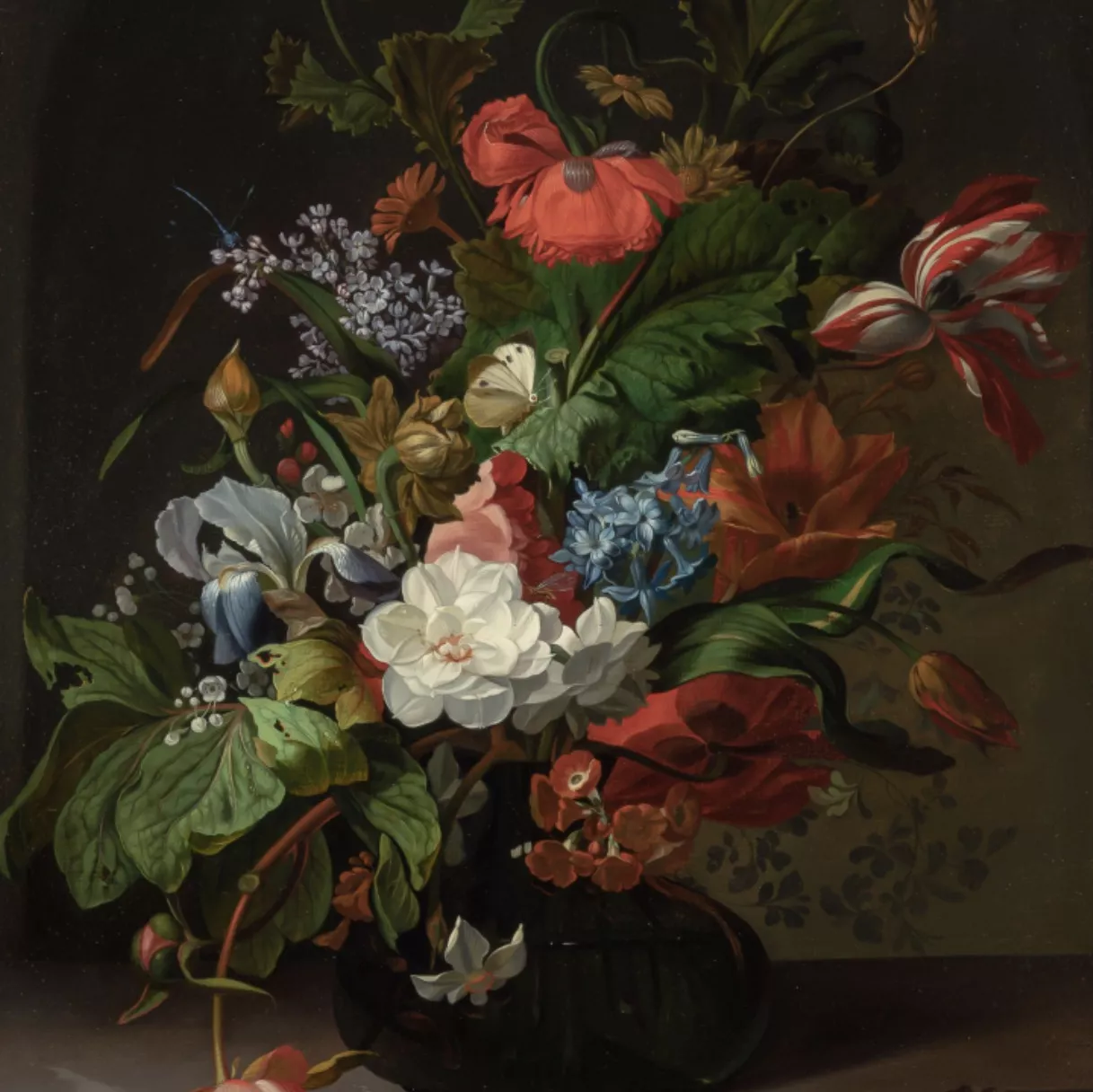
Vase of Flowers by Rachel Ruysch is an oil on canvas in the Rijksmuseum in Amsterdam, measuring approximately 75 x 60 cm. It depicts a sumptuous bouquet of flowers from different seasons in a vase set on a stone ledge, complete with insects and natural elements.
The bouquet brings together peonies, tulips, roses, campanulas, foxgloves and carnations (some flowers cannot coexist naturally).
The artist treats them with a keen sense of detail : each petal and leaf vein is rendered with finesse, without stylization. She also depicts insects (beetles, butterflies, flies), adding a touch of realism and recalling the influence of her father, an anatomist and naturalist.
The arrangement is dynamic, with stems crossing each other diagonally, and flowers escaping from the vase, creating an effect of natural but mastered profusion. The dark background, typical of her style, enhances the clarity of the flowers and accentuates the chromatic contrast. She also plays with depth effects by superimposing planes, and working with subtly measured plays of light and shadow.
She uses a rich but natural palette, gradations of whites, yellows, pinks, reds, blues and cool greens. Each hue is carefully modulated to evoke transparency, thickness, freshness or aging of the flower. The low-angled light gives an almost tactile dimension to the plant material.
Despite the beauty of the bouquet that the artist wanted to convey, certain clues (wilted flowers, the presence of a moth) are there to recall the theme of vanity and the passing of time.
The work balances scientific naturalism and Baroque aesthetics in this way, illustrating the art of bringing observation and composition into dialogue. The painting thus embodies the culmination of the Dutch floral still life, while affirming Rachel Ruysch's singular signature.
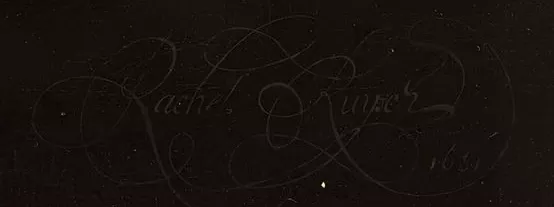
Recognizing the artist's signature
Rachel Ruysch does not necessarily sign her works. Copies may exist, which is why expertise remains important.
Knowing the value of a work
If you happen to own a work by Rachel Ruysch or after the artist, don't hesitate to request a free valuation using our form on our website.
A member of our team of experts and chartered auctioneers will contact you promptly to provide you with an estimate of the market value of your work, as well as ad hoc information about it.
If you are considering selling your work, you will also be accompanied by our specialists in order to benefit from alternatives for selling it at the best possible price, taking into account the inclinations of the market.
.Estimate in less than 24h
Discover in the same theme

Rating and value of works in Sèvres porcelain: vases, servic...
Sèvres porcelain, famous and appreciated throughout the world, has value on the auction market. Estimate in less than 24h.
Learn more >

Rating and value of drawings, prints and paintings by Louis...
Louis de Carmontelle was an 18th-century French draughtsman who produced works that are highly valued on the art market.
Learn more >

Rating and value of paintings by Marguerite Gérard
Marguerite Gérard is a painter and engraver, a pupil of Fragonard. Today, her works are highly valued.
Learn more >
Paintings from the same period sold at auction

Estimated 2 000 € - 4 000 €
DANISH SCHOOL circa 1790, entourage of Jens JUEL Presumed portrait of Sophie of Hesse-Cassel, Queen Consort of Denmark.

Estimated 4.000 - 6.000
Atelier d'Antoine Jean, baron GROS (Paris 1771-1835 Meudon), oil on canvas

Estimated 6.000 - 8.000
Michel Martin DRÖLLING (1786-1851), Portrait of Dominique Alexandre "Charles" Legrand (1790-1808), oil on canvas

Estimated 1.000 - 2.000
Late 19th century American school, follower of Gilbert Stuart (Saunderstown 1755-1828 Boston) Bust portrait of George Washington after the 1803 copy

Estimated 400 - 600
Early 19th century French school Portrait of Monseigneur Martial Louis de Beaupoil de Saint-Aulaire (1719-1798), then Bishop of Poitiers (1759-1791) Oil on canvas

Estimated 500 - 800
French school of the second half of the 18th century, follower of Hyacinthe Rigaud (Perpignan 1659-1743 Paris) Portrait in cuirass of a Marshal of France

Secure site, anonymity preserved

Auctioneer approved by the State

Free and certified estimates
Frequently asked questions
-
Who is Rachel Ruysch, and what is her artistic background?Rachel Ruysch (1664–1750) was a Dutch painter of the Golden Age who specialized in floral still lifes. The daughter of a botanist and anatomist, she combined scientific rigor with pictorial elegance, signing her works at a time when this was rare for a woman. Her exceptional career spanned nearly 70 years, during which she worked for prestigious collectors and was appointed official painter to the Elector Palatine.
-
What is the price range for Rachel Ruysch's paintings?The prices of Rachel Ruysch's works vary considerably depending on the medium and quality. Watercolor drawings sell for between €800 and €2,500, while oil paintings on canvas range from €1,190 to over €1.6 million for major works. Her market value is on the rise, particularly among Dutch buyers.
-
How can you authenticate a work by Rachel Ruysch?To authenticate a work attributed to Rachel Ruysch, we recommend that you request a free appraisal from Auctie's using our online form. A certified expert or auctioneer will examine your work and provide you with an estimate within 48 hours, with no obligation on your part.
-
Is this a good time to sell a painting by Rachel Ruysch?Yes, now is a good time to sell a work by Rachel Ruysch. Her market value is currently on the rise, particularly for oil-on-canvas works, and her floral still lifes are attracting growing interest from collectors, especially in the Netherlands. Auctie's will help you get the best possible price for it.
-
How does the appraisal and sale process work at Auctie's?The appraisal is free and non-binding: simply fill out an online form, and an expert will contact you and provide you with an appraisal within 48 hours. If you’d like to sell, our specialists will guide you toward the best options for selling your artwork at the best price, taking current market trends into account.
