



Rating and value of paintings by Jean-Baptiste Siméon Chardin

Key takeaways
- Chardin has dominated the still-life market since the 18th century, with high and stable prices; his paintings have fetched up to 23 million euros at auction.
- Prices vary considerably depending on the medium: prints range from 20 to 600 euros, drawings from 810 to 27,260 euros, and paintings from 1,400 to 23 million euros.
- A renowned master of form and light (1699–1779), Chardin revolutionized the academic hierarchy by elevating the still life to the status of a history painting through his rigorous technique and visual dignity.
If you own a work by the artist Jean-Baptiste Siméon Chardin or based on his work and would like to know its value, our state-approved experts and auctioneers will guide you.
Our specialists will carry out a free appraisal of your work, and provide you with a precise estimate of its value on the current market.
Then, should you wish to sell your work, we will direct you to the best possible arrangement to obtain the optimum price.
Artist's rating and value
Popular in his lifetime and especially famous for his still lifes, Jean-Baptiste Siméon Chardin made his mark on the art market as early as the 18th century. Today, the artist's quotation is high and stable, despite his low market presence.
Highly prized by still-life painting enthusiasts, some of his works can fetch millions of euros at auction.
His painting Le melon entamé was sold for €23,000,000 in 2024, while it was estimated at between €8,000,000 and €12,000,000.
Order of value from the most basic to the most prestigious
Technique used | Result |
|---|---|
Estamp - multiple | From €20 to €600 |
Drawing - watercolor | From €810 to €27,260 |
Painting | From €1,400 to €23,000,000 |
Estimate in less than 24h
The style and technique of Jean-Baptiste Siméon Chardin
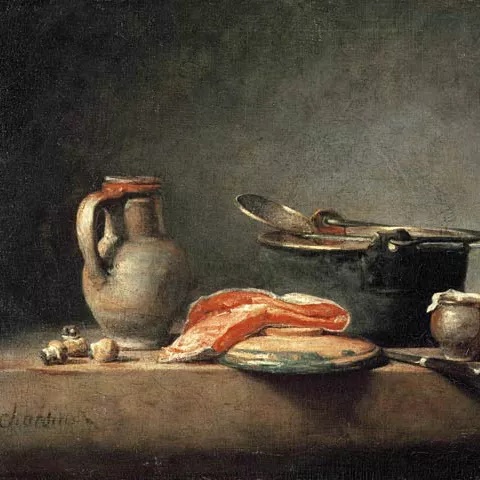
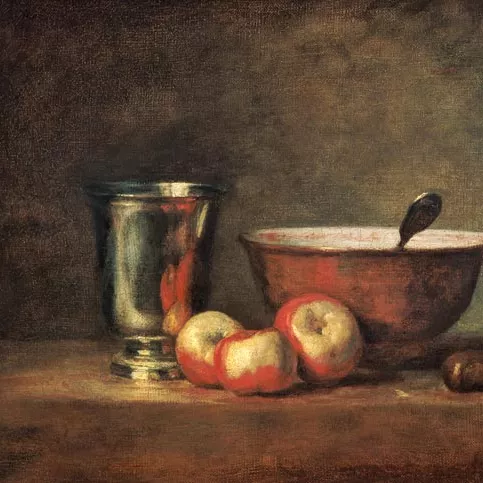
Jean-Baptiste Siméon Chardin (1699 - 1779) was a master of still life and domestic scenes in the 18th century, breaking with the prevailing taste for history painting. He sought a silent truth and controlled simplicity, far removed from the brilliant virtuosity of the rococo.
He placed central importance on the material presence of objects and their atmosphere. The paint layer is thick, often applied in small, tight strokes, creating a dense, tactile texture. He meticulously works the surfaces, creating a dense, tactile texture, and also uses localized impasto to capture reflections and points of light without ostentation.
The chromatic range is deliberately restrained, with muted grays, browns, ochres and blues, and a refusal of baroque brilliance. Harmony is built on fine transitions and half-tone nuances. Internal luminosity is achieved through subtle superimpositions rather than sharp contrasts.
The light is soft and diffused, with no identifiable direct sources, with a workshop lighting effect. The volume is emphasized by shadows that are enveloped and never harsh. The emphasis is on breathing between light and shadow, to give an almost physical presence to the object.
The organization is stable is weighted, often centered, with a very controlled balance of masses. There's an absence of anecdote, with the object presented as a subject in itself. Note the importance of the verticality of the neutral background, which isolates the elements and reinforces their calm monumentality.
The geometric rigor is discreet, with minimal diagonals, strong horizontal lines and simple visual architecture. Chardin shows a preference for working slowly, in successive layers, allowing the surface to acquire a particular density.
The touch is discreet, visible up close but melted away at a distance, with an optical effect of natural modeling. He makes measured use of glaze to unify light and stabilize half-tones.
The artist's aesthetic intention is to give dignity to humble things (teapot, basket, bread and game become objects of contemplation). Chardin wanted to inscribe his still lifes in a suspended time, without narrative and close to a visual meditation, and to produce a " moral " painting in the classical sense ; sobriety, economy and truth of appearances.
The life of Jean-Baptiste Siméon Chardin
Jean-Baptiste Siméon Chardin (1699 - 1779) was born in Paris into a family of craftsmen, with a master carpenter as his father, in an environment conducive to material sensitivity and manual labor. He received a modest upbringing, with no spectacular social climbing, which nurtured his taste for humble subjects.
He apprenticed with two established painters: Pierre-Jacques Cazes and Noël-Nicolas Coypel. He did not attend the Académie as a privileged pupil, but succeeded in establishing himself through practice, and studied in depth the effects of matter and light rather than narrative style.
His first public recognition came in 1728 with the presentation of La Raie and Le Buffet at the Académie royale. He was admitted as " peintre de natures mortes " then as a full academician in 1728, and was quickly celebrated for his originality in a context where history painting still dominated.
He was an active member of the Académie royale, where he established a stable and respected place. From 1757, he was appointed " tapissier " to the king, with responsibility for hanging the official Salons. This position ensured his financial stability, but limited his creative time.
His period of large-scale still lifes extended from the 1720s to the 1740s. Around the 1740s, he developed genre scenes (children, mothers, domestic activities). In his last years, he produced portrait pastels, due to weakened eyesight and a more suitable technique.
He led a discreet life, not very worldly, and a personality reputed to be humble and focused on his studio. His health was fragile at the end of his life, notably due to deteriorating eyesight. After his death, he was immediately respected as a master of the still life, but less valued in the 19th century in the face of Romantic taste.
He was rediscovered in the 20th century by historians and museums, who saw in him a silent modernity. Today, he is recognized as one of Europe's greatest painters of matter and light.
Focus on La Raie, Jean-Baptiste Siméon Chardin
The composition of this work is organized in a pyramidal fashion around the large suspended ray, with a dominant vertical axis and an almost architectural structure. The peripheral objects (shells, copper pot, knife, cat) are arranged in successive planes, creating a stable visual triangle.
The light is oblique, subdued and focused on the stingray's wet surfaces and metallic reflections. The dark background is structured by brown-gray gradations, eliminating any narrative distraction to reinforce the intensity of the volumes.
The visual rendering is extremely varied, with translucent viscera, gelatinous skin, polished metal, the cat's fur, bread and fabrics. The effect of material presence is reinforced by thick paste, slightly visible strokes and dense modeling.
The cat, which is stretched towards the fish, introduces minimal narrative tension, but enough to break the pure stasis. This detail confers a character of vigilance, a silent tension but without tipping over into anecdote.
The still life is here elevated to the rank of " tableau d'histoire ". The work's monumentality overturns the academic hierarchy: still life becomes an important subject, endowed with an almost sacred gravity. The suspended stingray visually evokes an upside-down crucifixion, a comparison often used by art historians.
The stingray, thanks to its realistic treatment, arouses both pictorial fascination and rejection. This emotional ambiguity is one of the hallmarks of Chardin's genius, who seeks not decorative beauty but material truth.
Everyday objects acquire a symbolic dimension through modesty, austerity and confrontation with raw material. Presented in 1728 at the Académie, it impresses with its audacity and technical mastery, and marks the decisive turning point that establishes Chardin as the master of French still life.
It establishes a pictorial language that will influence all his production, with a dignity of the simple object, a certain silence and a material density. La Raie is thus a demonstration of Chardin's ability to magnify the ordinary, playing on monumentality, chiaroscuro and dense materiality.
The work establishes a poetics of the real, stripped down and almost meditative. It represents an essential stage in the revival of still life painting in the 18th century, and a pivotal point in pictorial modernity.
This work elevates Chardin to the ranks of the great names in still life painting of all periods, including Maurice de Vlaminck, Clara Peeters or Fantin-Latour.
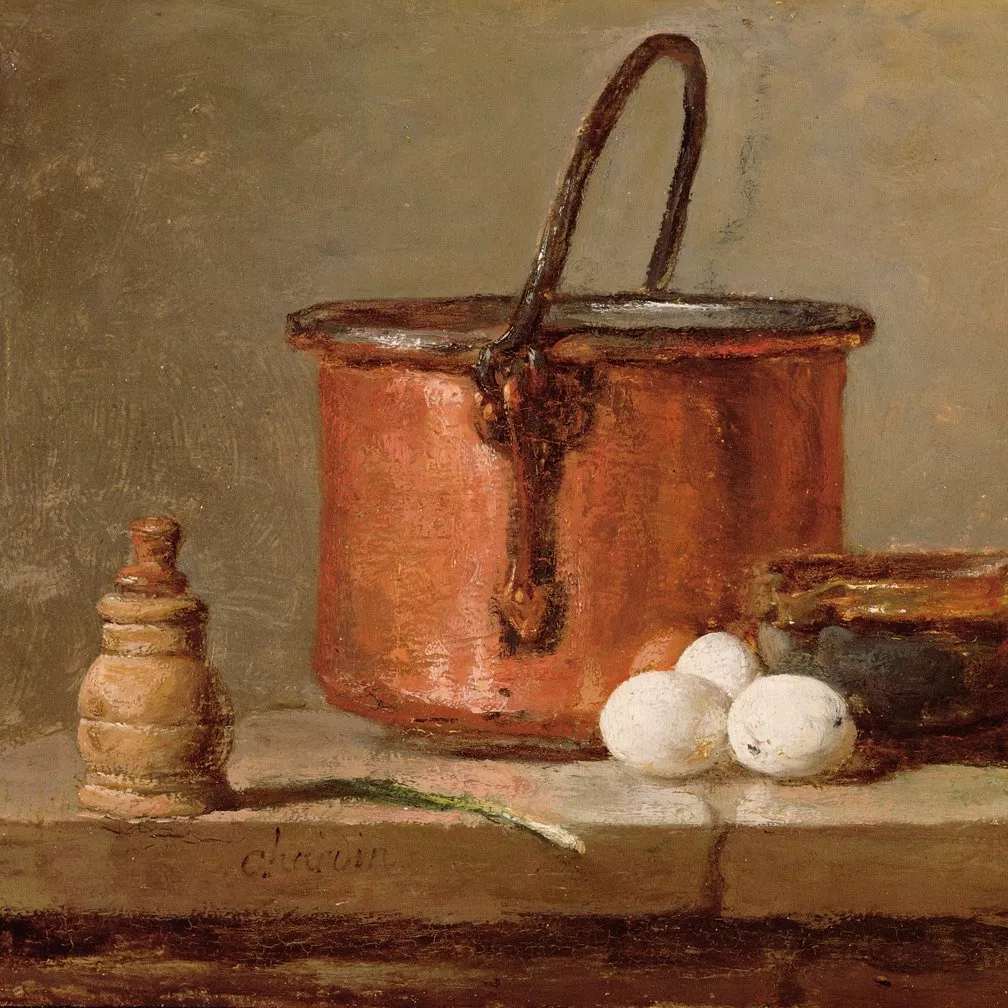
His signature
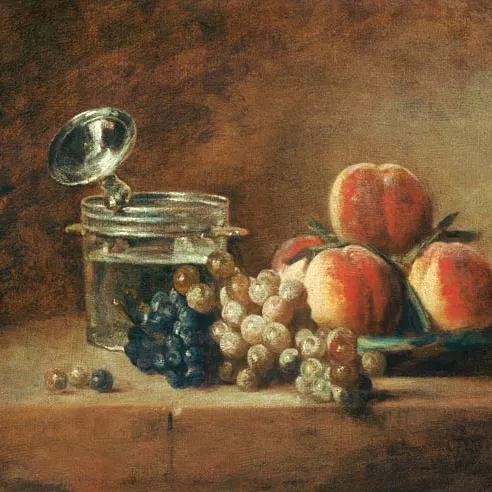
Not all works by Jean-Baptiste Siméon Chardin are signed. Moreover, copies may exist, which is why expertise remains important.

Expertise your property
If you own a work by Jean-Baptiste Siméon Chardin, don't hesitate to request a free appraisal by filling out our online form.
A member of our team of experts and certified auctioneers will contact you to provide an estimate of the market value of your work.
If you are considering selling your work, our specialists will also guide you through the various alternatives available to obtain the best possible price, taking into account market trends and the specific features of each work.
Estimate in less than 24h
Discover in the same theme

Rating and value of works, drawings, paintings by Anne Valla...
Anne Volleyer-Coster was an 18th-century painter, famous for her still-life paintings of flowers, which were very popular at auction.
Learn more >

Rating and value of paintings by Rachel Ruysch
Rachel Ruysch is a Dutch artist of the Golden Age who produced still lifes that are highly valued at auction.
Learn more >

Rating and value of prints by Utagawa Toyokuni
Utagawa Toyokuni is a Japanese artist and the founder of the Utagawa school, a pioneer in Japanese woodblock printing. His works are highly valued.
Learn more >
D'autres natures mortes vendues aux enchères

Estimated 15.000 - 20.000
Anthony II CLAESZ (1616-1642), Still life of flowers, oil on canvas

Estimated 8.000 - 12.000
Guillaume FOUACE (1837 - 1895), Still life with lobster, oil on canvas

Estimated 8.000 - 15.000
Maurice de VLAMINCK (1876-1958), Still life with jugs and leeks, oil on canvas

Estimated 4.000 - 6.000
Guillaume FOUACE (1837-1895), Still life with Roquefort cheese, Oil on canvas

Estimated 12.000 - 15.000
Paul AIZPIRI (1919-2016), Still life of flowers, Oil on canvas

Estimated 800 - 1.500
Pascal DAGNAN-BOUVERET (Paris 1852-1929 Quincey) Still life with apple and books, Oil on cardboard

Secure site, anonymity preserved

Auctioneer approved by the State

Free and certified estimates
Frequently asked questions
-
Who was Jean-Baptiste Siméon Chardin, and what is his significance in art history?Jean-Baptiste Siméon Chardin (1699–1779) was an 18th-century master recognized as one of Europe’s greatest painters of form and light. He revolutionized still life by conferring upon it a dignity equal to that of historical subjects, creating a pictorial language based on restraint, the truth of appearances, and silent visual contemplation. Long underappreciated in the 19th century, he was rediscovered in the 20th century by art historians and museums, who see in his work a timeless modernity.
-
What are the prices and values of Chardin's works, broken down by type and technique?Chardin’s works span a wide price range depending on the medium: prints range from €20 to €600, drawings and watercolors from €810 to €27,260, and paintings from €1,400 to several million euros. Some major paintings, such as “Le Melon entamé,” fetched 23 million euros at auction in 2024. The artist’s market value remains high and stable despite a limited presence on the market.
-
How can a work attributed to Chardin be authenticated?Since not all of Chardin’s works are signed and copies exist, an expert appraisal is essential. Auctie's offers a free, no-obligation appraisal conducted by certified auctioneers and experts. Simply fill out an online form to be contacted by a member of the team, who will provide a comprehensive evaluation of your artwork.
-
What is Jean-Baptiste Siméon Chardin's characteristic painting style?Chardin is distinguished by a subtle touch, a limited color palette (grays, browns, ochres, muted blues), soft, diffused light, and meticulous surface work that creates a dense, tactile texture. He uses successive layers and localized impasto to capture reflections without ostentation. His approach emphasizes half-tones, subtle harmony, and quiet grandeur, far removed from the dazzling virtuosity of the Rococo.
-
How does Auctie's assist sellers in selling a work by Chardin?Auctie's offers a free, no-obligation appraisal conducted by certified experts and auctioneers, with a response within 48 hours. If you’re looking to sell, our specialists will guide you through the various options to help you get the best price, taking into account market trends and the unique characteristics of your artwork—from initial consultation through to the auction.
