



Rating and value of Vietnamese lacquer panels

Key takeaways
- 20th-century Vietnamese lacquer panels sell for between €10 and €19,000, with a record price of €19,000 set in 2020 for a work by Alix Aymé.
- This ancient technique, developed beginning in the 13th century, combines resin from tropical trees, mollusk shells, and gold leaf in a polishing process that can take several months.
- The panels are particularly sought after by Vietnamese buyers and are recognized as major artistic expressions that rival Western painting on the international market.
If you own a Vietnamese lacquer panel, and would like to know its value, our state-approved experts and auctioneers will offer you their appraisal services.
Our specialists will carry out a free appraisal of your work, and provide you with an accurate estimate of its value on the current market.
Then, should you wish to sell your work, we will direct you to the best possible arrangement to obtain the optimum price.
Rating and value of Vietnamese lacquer panels
Vietnamese lacquer panels are highly valued on the auction market, regardless of the period. There are many works from the 20th century.
Nowadays, prices for these works are reaching unprecedented amounts at auctioneers' gavels. They are especially prized by Vietnamese buyers.
The price at which they sell on the art market ranges from €10 to €19,000, a considerable delta but one that speaks volumes about the value that can be attributed to Vietnamese lacquer panels.
In 2020, a lacquer panel by Alix Aymé sold for €19,000 while it was estimated at between €3,000 and €4,000.
Order of value from a simple work to the most prestigious
Object | Result |
|---|---|
Vietnamese lacquer panel 20th | From €10 to €19,000 |
Estimate in less than 24h
The origins of Vietnamese lacquer paints
Vietnamese lacquer panels are rooted in ancestral know-how, handed down over the centuries.
As early as the 13th century, Vietnam, while influenced by China, forged its own lacquer art, which gradually distinguished itself from Chinese methods by adding local particularities.
Resin, extracted from tropical trees, is combined with materials such as mollusc shells, sand, and sometimes gold.
This mixture is worked in a long and painstaking process, sometimes lasting several months, to create perfectly smooth, brilliantly shiny panels.
From the 17th century, under the Nguyễn dynasty, Vietnamese lacquerware reached an unrivalled level of refinement.
Vietnamese craftsmen succeeded in virtuously blending painting and relief carving, giving rise to richly detailed motifs.
Vietnam then distinguished itself with a unique iconography, combining Buddhist symbolism, mythological scenes, landscapes and natural elements, all in a rich palette of colors and materials.
The evolution of Vietnamese lacquer takes shape in lively scenes full of movement, where characters and natural elements are fluidly superimposed.
Used to decorate palaces, elite homes or temples, these panels are not only decorative, but also spiritual, expressing a deep connection between Vietnamese culture and natural and supernatural forces.
The technique of lacquerware, which began in a relatively simple way, became more complex in the 18th century, giving it a central place in Vietnamese decorative art.
This period marked a major turning point, when Vietnamese craftsmen, by reinterpreting Chinese traditions, infused lacquerware with an aesthetic specificity still present in contemporary works.
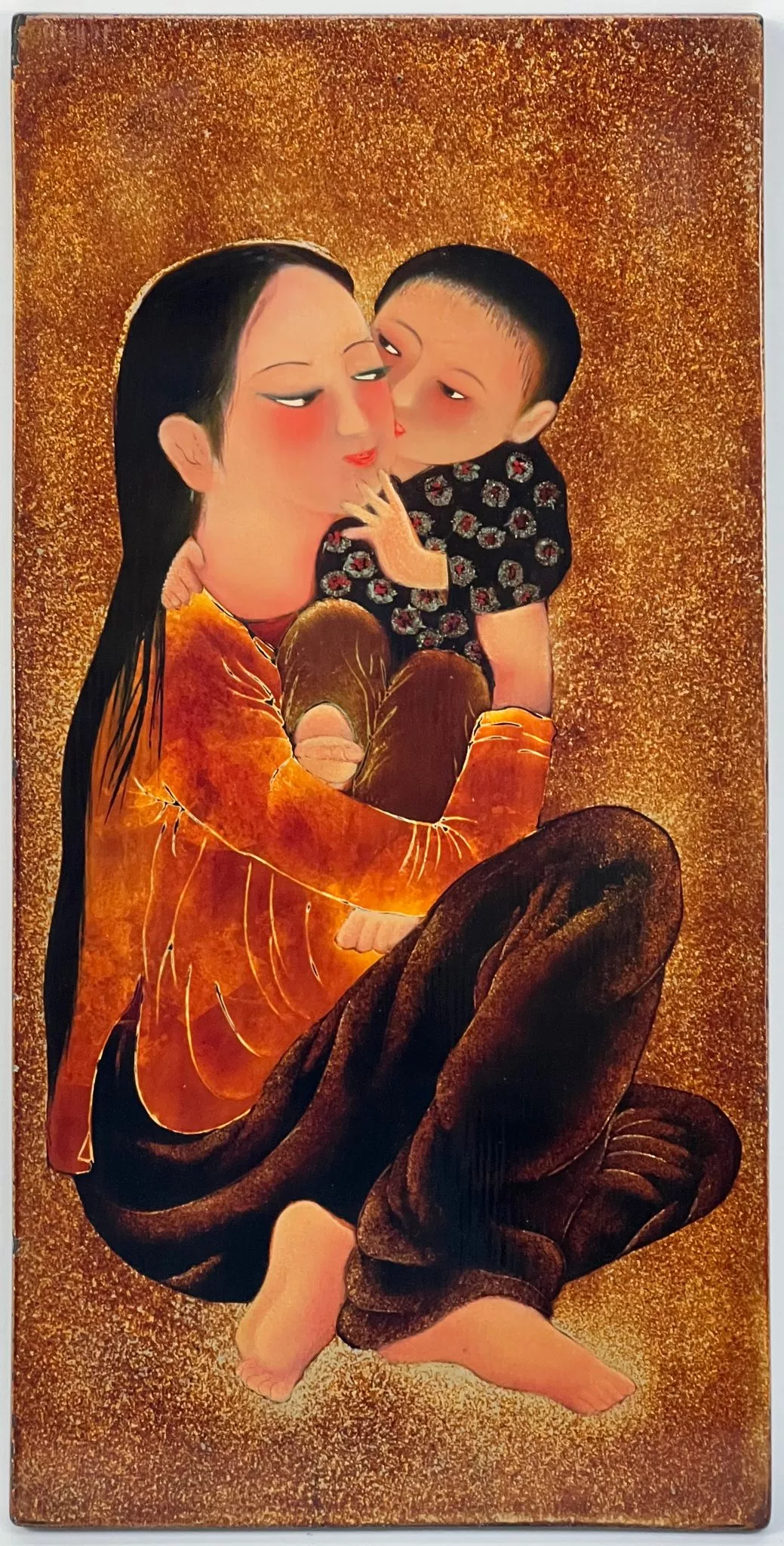
Techniques for creating Vietnamese lacquer paintings
Vietnamese lacquer panels, like many traditional decorative arts, have managed to transform an ancient technique into a refined and distinctive art.
As early as the 13th century, the influence of China is felt, but it's in Vietnam that lacquer takes its own path, enriching it with local characteristics that make it unique.
Vietnamese craftsmen didn't simply take over Chinese lacquer-making methods; they systematized the use of materials such as resin, sand and mollusc shells, and gave them a new dimension.
Their works, often made up of multiple layers of lacquer, go through a painstaking polishing process, sometimes over several months, which produces an intense shine.
It's not simply the lacquer technique that stands out, but the way it has been codified and transformed to incorporate decorative and symbolic elements of unprecedented richness.
Mythological, Buddhist or nature-inspired scenes are juxtaposed with astonishing fluidity, both geometric and organic, creating a dynamic between depth and surface.
Thus, these panels become more than mere decorative objects: they embody a vision of the world, a perception of the sacred and the everyday.
When observing these works, one finds the roots of this art in ancient traditions, but it is in the modern interpretation of these techniques that Vietnamese lacquer takes on its full scope.
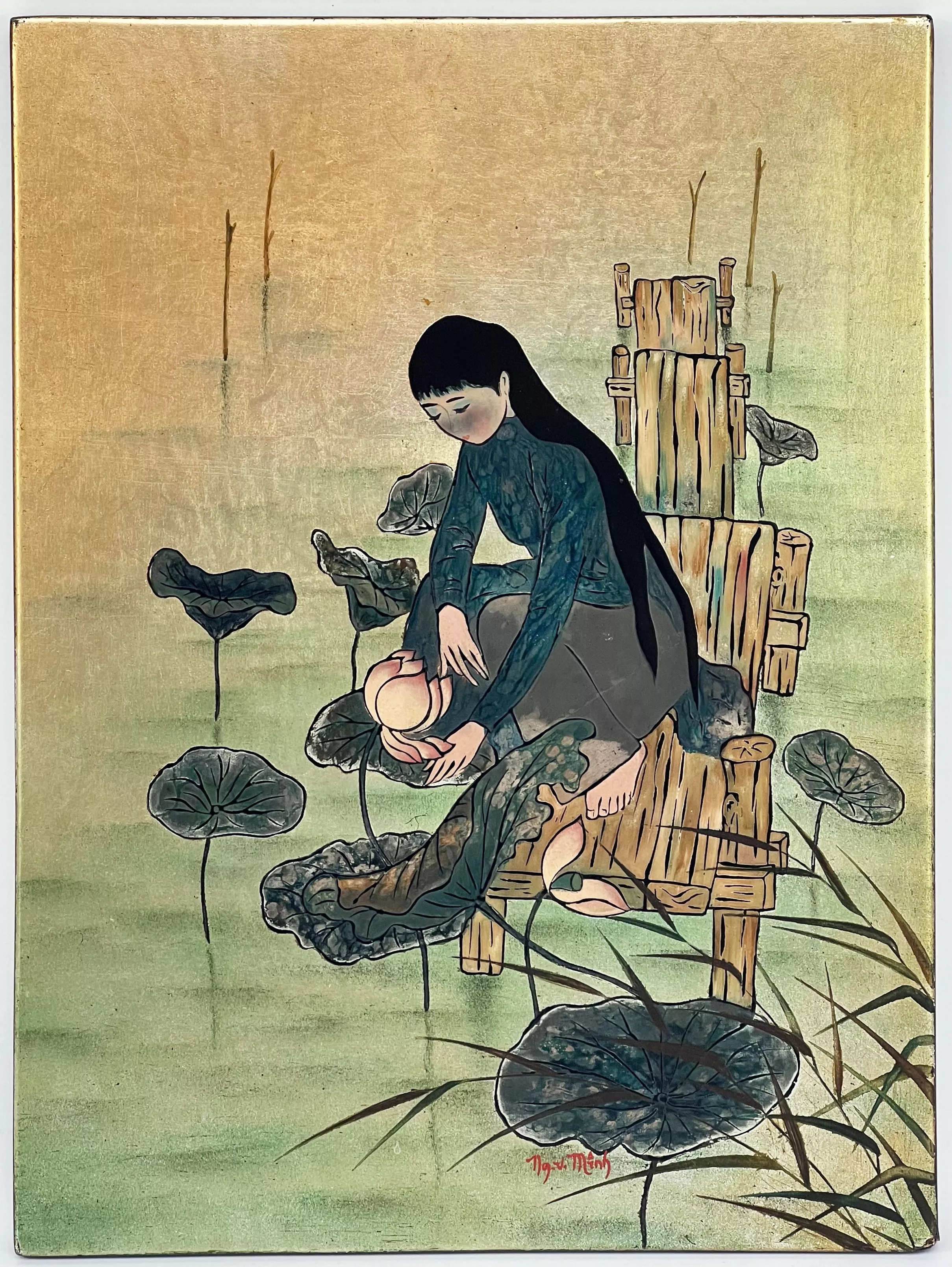
Significance and symbolism of Vietnamese lacquer paintings
Vietnamese lacquer paintings are more than just works of art, they also carry deep cultural and symbolic significance. Each motif and color has a particular meaning.
For example, yellow symbolizes royalty and power, while red is associated with luck and prosperity.
Lotus flower, carp and dragon motifs are common in Vietnamese art and also carry specific symbolic meanings.
Lacquered paintings are also used to tell stories and perpetuate Vietnamese legends. According to the country's mythology, the Vietnamese are descended from a dragon and a mountain nymph.
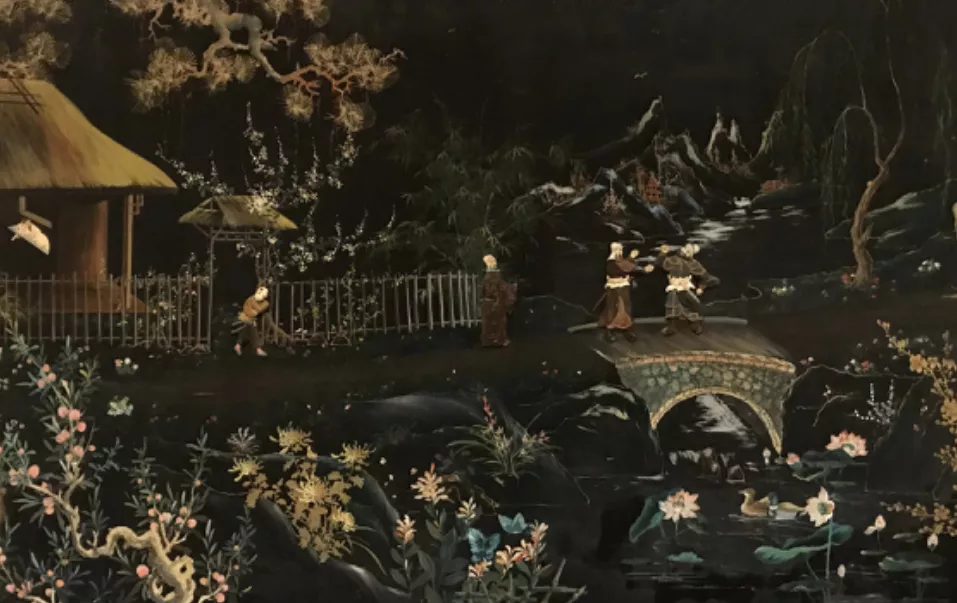
The living heritage of Vietnamese lacquer painting
Today, the art of Vietnamese lacquer painting continues to flourish, passed down with passion from generation to generation by meticulous craftsmen.
The latter strive to keep ancestral techniques alive while integrating contemporary touches, thus breathing new life into this ancestral art.
Through this fusion, Vietnamese lacquer art manages to reinvent itself, appealing to an ever-wider audience, both local and international.
Lacquered paintings are now an emblem of Vietnamese cultural identity, occupying a central place in the country's artistic heritage.
Their reach extends far beyond the borders of Vietnam, capturing worldwide attention, as much for the beauty of their compositions as for the richness of their history.
In the final analysis, Vietnam's lacquer paintings are a living treasure that bear witness to the country's soul and history.
Their refinement, profound symbolism and unique aesthetics continue to fascinate and captivate, embodying the ingenuity and talent of Vietnamese craftsmen through the ages.
Focus on The Young Woman in the Garden, Nguyen Gia Tri
With The Young Woman in the Garden, Nguyễn Gia Trí goes beyond simple ornamentation to elevate Vietnamese lacquer to an autonomous, modern art form.
This work is structured around the slender figure of a woman, barely sketched, but anchored in a harmony where nature and abstraction coexist.
The background, saturated with foliage and plant motifs inlaid with gold and silver leaf, composes a luminous weave that captures and diffracts light.
The surface, polished with extreme meticulousness, becomes a vibrant scene where every detail contributes to an almost musical aesthetic.
Nguyễn Gia Trí doesn't just extend Vietnamese craft traditions: he transcends them.
Playing on subtle contrasts between shadow and shine, matte and gloss, he constructs a work where the accumulation of lacquer layers evokes sculptural work, a patient and skilfully mastered superimposition.
The use of metallic leaves, far from being a simple ornament, structures space and imposes a rhythm, asserting a modernity that borrows as much from symbolism as from European modernism.
This work testifies to a breakthrough: it frees lacquer from its purely decorative functions to make it an artistic medium in its own right.
More than a panel, The Young Woman in the Garden becomes a manifesto, reconciling the formal richness of traditional Vietnam with the aesthetic ambition of contemporary art in search of the universal.
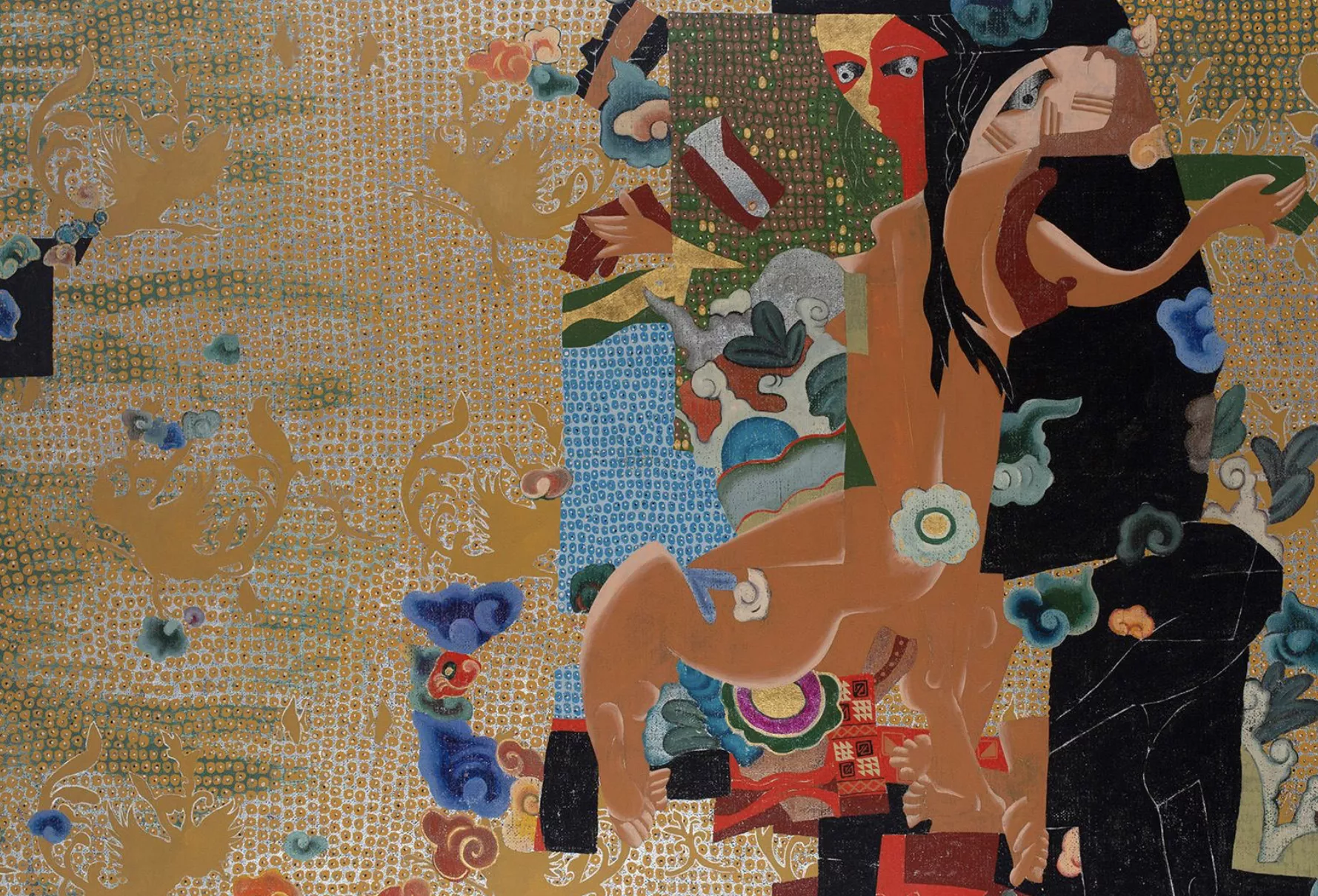
The success of Vietnamese lacquer panels on the art market
On the art market today, Vietnamese lacquer panels are establishing themselves as masterpieces, coveted as much for their technical refinement as for their historical aura.
Their success lies in this unique ability to combine the age-old tradition of meticulous craftsmanship with the aesthetic aspirations of modern, universal art.
The creations of masters such as Nguyễn Gia Trí or Phạm Hậu are fetching record prices at international auctions, testifying to a growing craze.
This phenomenon is not limited to the rarity of these works: it is rooted in a fascination with the luxurious materiality of the panels, with their mirrored surfaces, and with their narrative depth, which reinvents Vietnamese cultural motifs in a perspective that is both intimate and monumental.
This ascendancy also reflects a broader movement, that of the recognition of Asian decorative arts as expressions in their own right, fit to rival Western painting or sculpture.
Dating your lacquer panel
The lacquer panels on the auction market almost all date from the 20th century, and were produced after the creation of the Indochina School of Fine Arts, founded in 1925 by the French colonial government, French artists moved to Vietnam, such as Victor Tardieu, in cooperation with Nguyen Nam Son, a Vietnamese artist.
Estimate in less than 24h
Knowing the value of a work
If you happen to own a Vietnamese lacquer panel, or think your object might be one, don't hesitate to request a free appraisal using our form on our website.
A member of our team of experts and licensed auctioneers will contact you promptly to provide you with an estimate of the market value of your work, not forgetting to send you ad hoc information about it.
If you wish to sell your work, you will also be accompanied by our specialists in order to benefit from alternatives to sell it at the best possible price, taking into account market inclinations.
More Asian art at auction

Estimated 15.000 - 20.000
ZAO WOU-KI (1921-2013) Composition, 1972, Brush and Indian ink on Asian paper.

Estimated 2.000 - 4.000
VIETNAM, 20th century. Lacquer on panel, fishermen and sampans on a river. Signed Thanh and dated 55

Estimated 50 - 100
CHINA, Compagnie des Indes, Qing dynasty, Jiaqing period (1796-1820), Enameled porcelain dessert dish

Estimated 800 - 1.500
CHINA, late Ming dynasty or transitional period, 17th century. Pair of double gourd-shaped porcelain vases

Estimated 1.000 - 2.000
CHINA, reign of Kangxi (1662-1722). Porcelain bidong brush pot with blue underglaze decoration of an assembly of scholars

Estimated 300 - 600
CHINA, 19th century. Large 8-leaf folding screen in red lacquered wood
Discover in the same theme

Get a free appraisal of your Chinese jades
This precious mineral is rooted in a deep and complex history of Chinese civilization. But what is the value of Chinese jades?
Learn more >

Get a free estimate for your Chinese, Asian and imperial dre...
Chinese dresses are unique and fascinating pieces of art. Having them appraised by an impartial expert is essential.
Learn more >

Rating and value of Japanese screens
Japanese folding screens are art objects in vogue on the auction market. They are appreciated for their elegance and refinement.
Learn more >

Secure site, anonymity preserved

Auctioneer approved by the State

Free and certified estimates
Frequently asked questions
-
What are the defining characteristics of Vietnamese lacquer panels, and where does this artistic tradition come from?Vietnamese lacquer panels are refined works of art rooted in an ancestral craft dating back to the 13th century. Although influenced by China, Vietnamese artisans have developed their own distinctive technique, combining resin extracted from tropical trees with mollusk shells, sand, and sometimes gold. These panels are characterized by multiple layers of lacquer meticulously applied over several months, creating a dazzling luster and incorporating mythological, Buddhist, and natural scenes with remarkable fluidity.
-
What is the price range for Vietnamese lacquer panels on the market?Vietnamese lacquer panels range in price from €10 to €19,000, depending on their quality, provenance, and artist. This wide range reflects variations related to the period of creation, the condition of the piece, and the artist’s reputation. Prices have reached unprecedented levels in recent years, particularly for works by masters such as Nguyễn Gia Trí and Phạm Hậu, who are enjoying growing success on the international market.
-
How can I have my Vietnamese lacquer panel appraised and authenticated?Auctie's offers a free, no-obligation appraisal of your Vietnamese lacquer panel. Simply fill out a form on our website, and a member of our team of experts and certified auctioneers will contact you within 48 hours to provide you with an accurate assessment of your artwork’s market value, along with all relevant details regarding its authentication.
-
Is this a good time to sell a Vietnamese lacquer panel?Yes, this is an excellent time to sell a Vietnamese lacquer panel. The art market for these works is experiencing remarkable growth, with Asian decorative arts gaining increasing recognition as major artistic expressions. Prices are reaching record highs at international auctions, and demand remains strong, particularly among Vietnamese buyers and an international audience fascinated by the technical and narrative richness of these pieces.
-
How does the sale of a Vietnamese lacquer panel work at Auctie's?At Auctie's, we guide you every step of the way, from the initial appraisal to the final auction. After receiving a free appraisal of your artwork from our experts and licensed auctioneers, our specialists will offer you options tailored to your situation to sell your piece at the best possible price, taking current market trends into account.
