



Rating and value of Japanese screens

Key takeaways
- Japanese folding screens sell for between €110 and €15,000, with exceptional pieces fetching over €200,000 at auction.
- Four main schools define the styles: Yamato-e, the Kanō School, the Rimpa School, and Namban, each with its own distinct characteristics and price ranges.
- The presence of gilding indicates a date from the 17th century onward, a key criterion for determining the screen’s authenticity and market value.
If you own a Japanese folding screen, and would like to know its value, our state-approved experts and auctioneers will offer you their appraisal services. Our specialists will carry out a free appraisal of your work, and provide you with an accurate estimate of its value on the current market.
Then, if you wish to sell your work, we will direct you to the best possible arrangement to obtain the optimum price.
Rating and value of Japanese screens
Japanese screens are highly valued on the auction market, whatever the period. Now, prices for these works are reaching unprecedented amounts at auctioneers' gavels.
They are particularly prized above all by Japanese buyers. The price at which they sell on the art market ranges from €110 to €15,000, a considerable delta but one that speaks volumes about the value that can be attributed to Japanese screens.
In 2018, a Kano School-style screen depicting the Kyoto Imperial Palace sold for €10,140.
Order of value from a simple work to the most prestigious
Type of folding screen | Result |
|---|---|
Folding screen Yamato-e | From €320 to €2,600 |
Paravent Kanō School | From €150 to €10,140 |
Folding screen Rimpa School | From €110 to €15,000 |
Paravent Namban | From €400 to €4,200 |
Estimate in less than 24h
The style and technique of Japanese screens
The technique of Japanese screens has undergone a remarkable evolution, particularly over the centuries, with each era refining the codes of decorative art.
In the most striking examples, the motifs seem to merge with the object itself, and the traditional structure of the screen becomes almost invisible.
The outlines of the elements disappear, but the hatchings remain, seeking every possible combination to express a spatial idea.
The lines, sometimes thin, sometimes thick, run freely through the space, delineating areas of density and openness, which work together to create light and shadow effects, typical of traditional woodcut.
In screens, as in Japanese graphic art, the mastery of space, the absence of any excess, and the quest for harmony between elements create a visual experience where the object becomes a playground for the technique itself.
As in certain works of the Rimpa school, the variation of textures and reliefs is not content to represent natural elements or idealized scenes, but seeks to sublimate the materiality of the object.
In this way, the folding screen ceases to fulfill only its utilitarian function and becomes an open window onto a sensory and pictorial universe, where emptiness takes as important a place as fullness, in the manner of a continually renewed space.
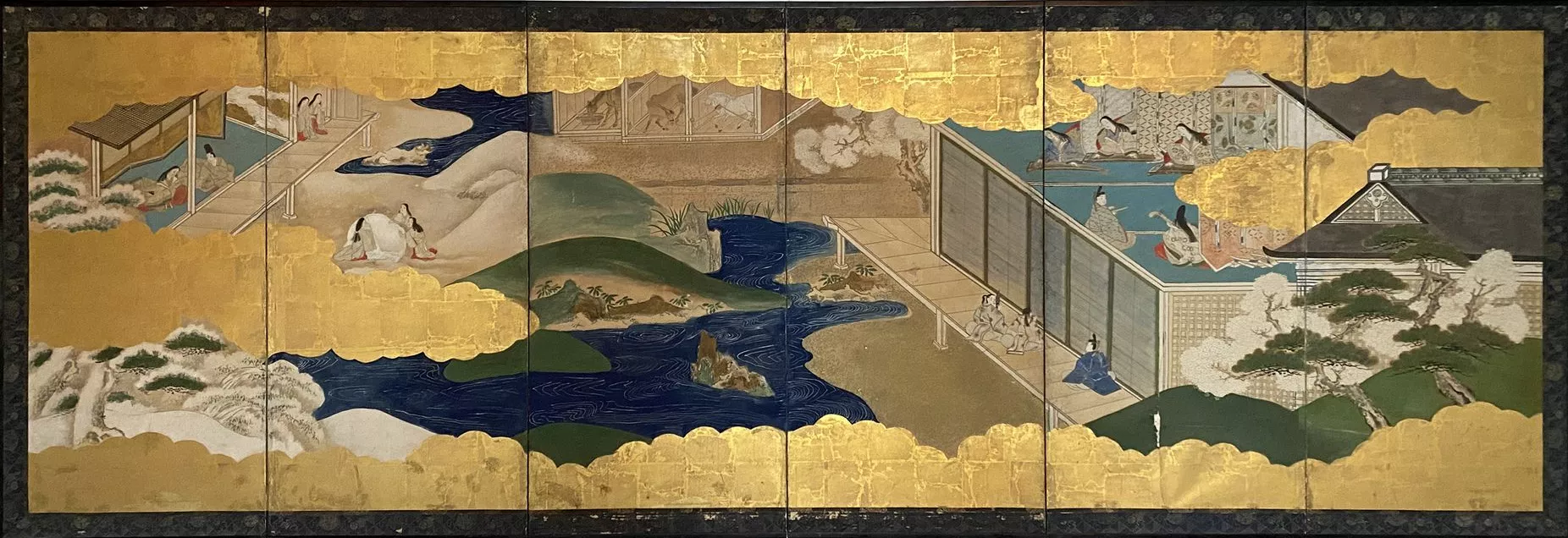
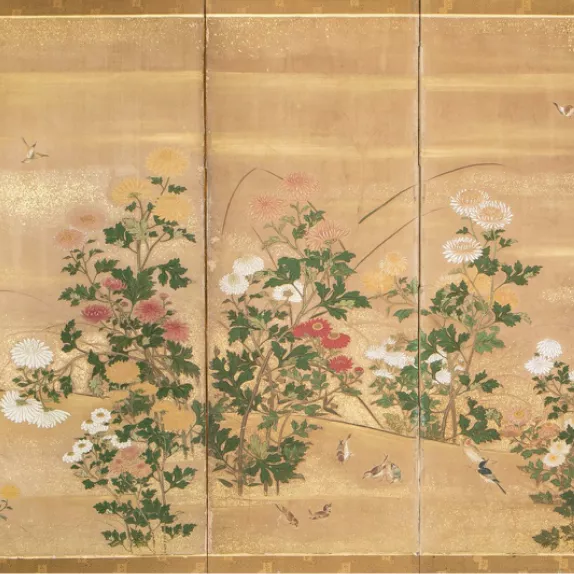
Focus on the Les Grues screen, from the Edo period
The Japanese screen, in its very essence, defies the classic conventions of the genre.
His decor, initially uncluttered, seems to play with the limits of figuration, gradually erasing contours to leave only bursts of shapes that, instead of being precisely defined, brush against each other in fluid, almost unfinished arabesques.
The birds, etched in suspended movement, melt into a space that is neither entirely real nor entirely abstract, where natural elements merge in a ballet of nuances and textures.
The absence of marked reliefs, of reinforced volumes, gives way to a light, almost intangible atmosphere.
In this universe, the golden hues of the background mingle with the almost evanescent forms of the birds, which seem to escape the boundaries of the screen, as if to insist on the idea that art cannot be contained by material limits.
The treatment of space, like a chiaroscuro etching, varies between dense and almost non-existent zones, as if the gaze were invited to navigate from one area to another, following the curves of light and shadow, without ever really settling on a fixed form.
The eye is thus lost in a series of impressions, light traces that, while remaining recognizable, escape the rigor of realistic representation.
The screen then becomes no longer a simple decorative object, but a quest for the invisible, a space where nature unfolds in a constant dialogue between visibility and absence.
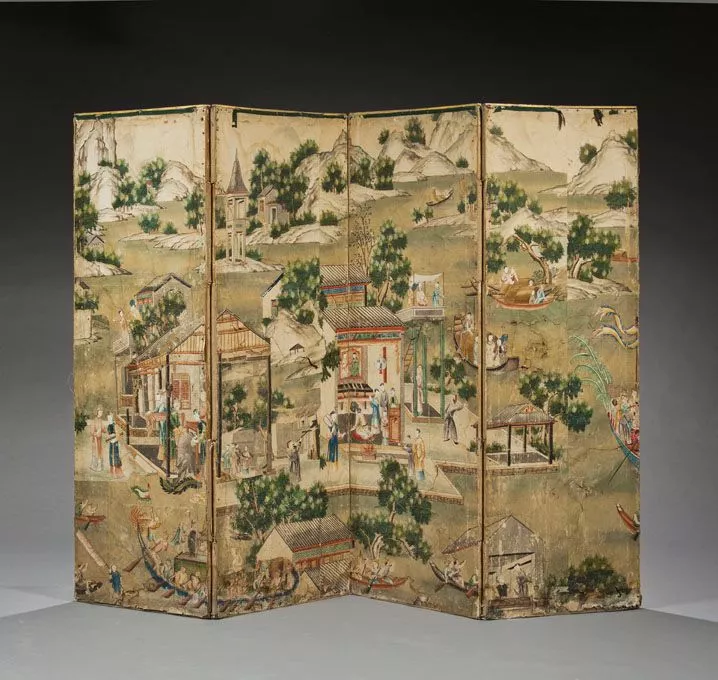
Features and Styles
Japanese folding screens are characterized by their minimalist design and artistic refinement.
They're usually made up of several panels linked together by hinges, allowing them to be folded and unfolded to adjust their position and size as required.
There are several styles of Japanese screens, each reflecting a specific era and aesthetic:
1. Yamato-e: Yamato-e-style screens depict scenes from everyday Japanese life, natural landscapes, and historical or mythological figures. Colors are often vivid and details meticulous.
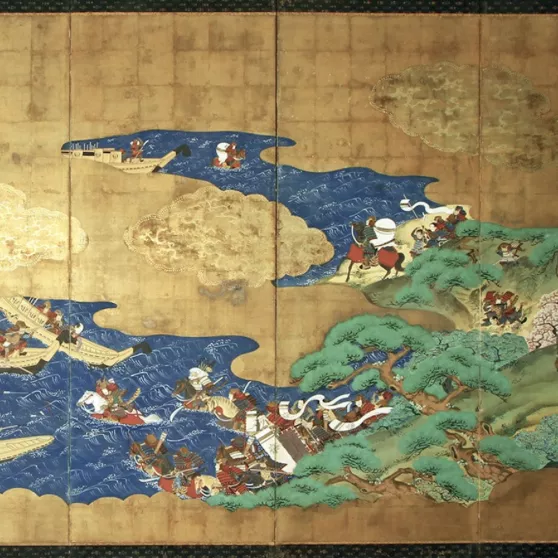
2. Kanō School: This style emerged in the 16th century and is characterized by more elaborate paintings featuring battle scenes, animals and landscapes. Kanō screens are renowned for their great realism and use of color.
3. Rimpa School: This style emerged in the 17th century and focuses on elegant compositions, with floral motifs and stylized landscapes. Rimpa screens are renowned for their visual harmony and subtle use of gold.
4. Namban: These screens, created in the 16th century, illustrate encounters between the Japanese and Europeans. They show exotic scenes of boats, strangers and unknown animals.
The success of screens on the art market
The success of Japanese screens on the art market stems, in large part, from their singularity and the atmosphere they convey, along with a certain idea of escapism and exoticism.
These pieces, in their refined design and decorative dimension, appeal not only to collectors but also to lovers of Japanese history and culture.
From the end of the 19th century and throughout the 20th century, fascination with the Orient, amplified by the Universal Exhibition of 1867 and Japan's opening to the West, fueled a quest for Japanese pieces, particularly screens, seen as emblematic of ancestral craftsmanship.
At this time, Art Nouveau, with its curves and natural motifs, resonated with the fluidity of Japanese designs, giving them a place of choice in the elegant interiors of European bourgeois and aristocrats.
The contemporary market for Japanese screens builds on this historical fascination, while responding to a search for rarity and quality.
While lacquer work, painting on silk or the use of gold leaf remain popular features, it's the sophistication of the decoration that makes these objects so interesting.
The blend of stylized motifs, natural elements and legendary animals, often treated with avant-garde abstraction, catches the eye of those looking to treat themselves to an exceptional piece.
In addition, the status of these screens as both works of art and utilitarian objects lends a special aura to each piece.
In terms of auction results, Japanese screens can fetch very high prices.
For example, a Meiji period screen decorated with landscape and animal scenes sold for over 200,000 euros at an auction in Paris in 2019.
Another screen, decorated with a sublime lotus motif in lacquer, exceeded $150,000 in New York, attracting particular attention from Western collectors keen to own a work of art paying tribute to the expertise of Japanese craftsmanship.
These results illustrate not only the quest for rare pieces, but also the role of these objects in the construction of a privileged aesthetic universe, where Orientalism, refinement and history blend to offer both a decorative and heritage investment.
As a result, the craze for these screens shows no signs of abating, driven by a growing demand for transdisciplinary objets d'art, where Orientality blends with a sophisticated Western aesthetic.
Their value today on the auction market
Although Japanese screens have ancient origins, they remain highly valued in the contemporary world for their timeless aesthetic and ability to separate different spaces.
Their ability to filter light while preserving privacy makes them particularly attractive for modern living spaces.
They are among Asia's most sought-after objets d'art, along with vases chinois, the jades de Chine and the Chinese-tabatieres.
Dating your Japanese screen
Japanese screens often have a recognizable style, which makes it possible to date them. We'll know, for example, that if gilding is present on the screen, it dates either from the 17th century or later.
Preliminary work will be carried out on the state of conservation of your object and the study of pictorial techniques to determine the most precise date possible.
.
Estimate in less than 24h
Knowing the value of a work
If you happen to own a Japanese folding screen, or think your object might be one, don't hesitate to request a free appraisal using our form on our website.
A member of our team of experts and licensed auctioneers will contact you promptly to provide you with an estimate of the market value of your work, not forgetting to send you ad hoc information about it.
If you wish to sell your work, you will also be accompanied by our specialists in order to benefit from alternatives for selling it at the best possible price, taking into account market inclinations.
Discover in the same theme

Get a free estimate for your Chinese, Asian and imperial dre...
Chinese dresses are unique and fascinating pieces of art. Having them appraised by an impartial expert is essential.
Learn more >

Rating and value of Vietnamese lacquer panels
Vietnamese lacquer panels are highly prized by collectors, and their value is rising on the auction market.
Learn more >

Rating and value of Hue porcelain from Vietnam
Vietnamese porcelain is a highly valued collectible at auction. Estimates within 24 hours.
Learn more >
More Japanese art at auction

Estimated 3.000 - 5.000 €
Japanese armor. Japan, Meiji era.

Estimated 80 - 120
CHINA or JAPAN, 19th century. Two porcelain bottle vases that can form pendants

Estimated 500 - 1.000
JAPAN, probably Arita, 19th / 20th century (?) Pair of porcelain baluster vases decorated in cobalt blue

Estimated 2.000 - 4.000
JAPAN Japanese armor: a twelve-strip iron kabuto

Estimated 3.000 - 5.000
JAPAN Japanese armor: eight-lamellar iron kabuto

Estimated 500 - 1.000
JAPAN, Edo period, 17th/18th century. Kawari-kabuto, featuring fukigaeshi, mabizashi, shikoro

Estimated 30 - 50
JAPAN, 19th century, Bronze vase with long neck resting on a flared foot

Secure site, anonymity preserved

Auctioneer approved by the State

Free and certified estimates
Frequently asked questions
-
What are the main styles of Japanese folding screens, and what are their characteristics?There are four major styles of Japanese folding screens: Yamato-e, depicting scenes of daily life in vivid colors; the Kanō School (16th century), characterized by elaborate paintings of battles and landscapes; the Rimpa School (17th century), focused on elegant compositions featuring floral motifs and a subtle use of gold; and the Namban style (16th century), depicting encounters between the Japanese and Europeans. Each style reflects a specific era and aesthetic in Japanese art.
-
What is the price range for a Japanese folding screen at auction?Japanese folding screens sell for between €110 and €15,000, depending on their style and quality. For example, a Yamato-e folding screen is valued between €320 and €2,600, while a Rimpa School folding screen can reach up to €15,000. This wide range reflects the variability in the quality, age, and provenance of these objects.
-
How can you authenticate and appraise the value of a Japanese folding screen?To authenticate and appraise your Japanese folding screen, we recommend that you submit a request for a free estimate with Auctie's. Our team of experts and state-certified auctioneers will examine the condition, the painting techniques used, and distinctive features such as the presence of gilding (dating from the 17th century or later) to determine the authenticity, period, and precise market value of your piece.
-
How does the appraisal of a Japanese folding screen work at Auctie's?Appraisals at Auctie's are free and non-binding. All you need to do is fill out a form on our website. A certified appraiser or auctioneer will contact you promptly and provide you with an accurate assessment of your folding screen’s market value, along with relevant information about it, within 48 hours.
-
Is this a good time to sell a Japanese folding screen?Yes, this is an excellent time to sell a Japanese folding screen. Demand for these items continues to grow in the art market, particularly among Japanese and Western collectors. Japanese folding screens are among the most sought-after Asian art objects, which guarantees excellent visibility and optimal results when they go up for sale.
