



Rating and value of Chinese snuffboxes, from China

If you own a Chinese snuffbox, and would like to know its value, our state-approved experts and auctioneers will offer you their appraisal services.
Our specialists will carry out a free appraisal of your work, and provide you with a precise estimate of its value on the current market.
Then, should you wish to sell your work, we will direct you to the best possible arrangement to obtain the optimum price.
Rating and value of Chinese snuffboxes
Chinese snuffboxes are currently highly sought-after collectors' items. If you own one, its value may be higher than you think.
On the art market, prices for these objects can be very high under the auctioneer's hammer.
They are particularly prized and the price at which they sell on the art market ranges from €50 to €62,400, a fairly substantial range, but one that speaks volumes about the value that can be attributed to these objects.
In 2019, an 18th-century snuffbox in gilt bronze and Chinese enamels sold for €62,400, while it was estimated at €6,000 to €8,000.
Order of value from a simple work to the most prestigious
Object type | Result |
|---|---|
Tabatière in bone | From 55 to 2,500€ |
Tabatière in glass | From 50 to 3,400€ |
Agate tabatière | From 50 to 3 500€ |
Porcelain tabatiere | From 50 to 9 000€ |
Jade chabotera | From 50 to 13 750€ |
Chinese enamel bezel | From 50 to 62 400€ |
Estimate in less than 24h
Chinese snuffboxes
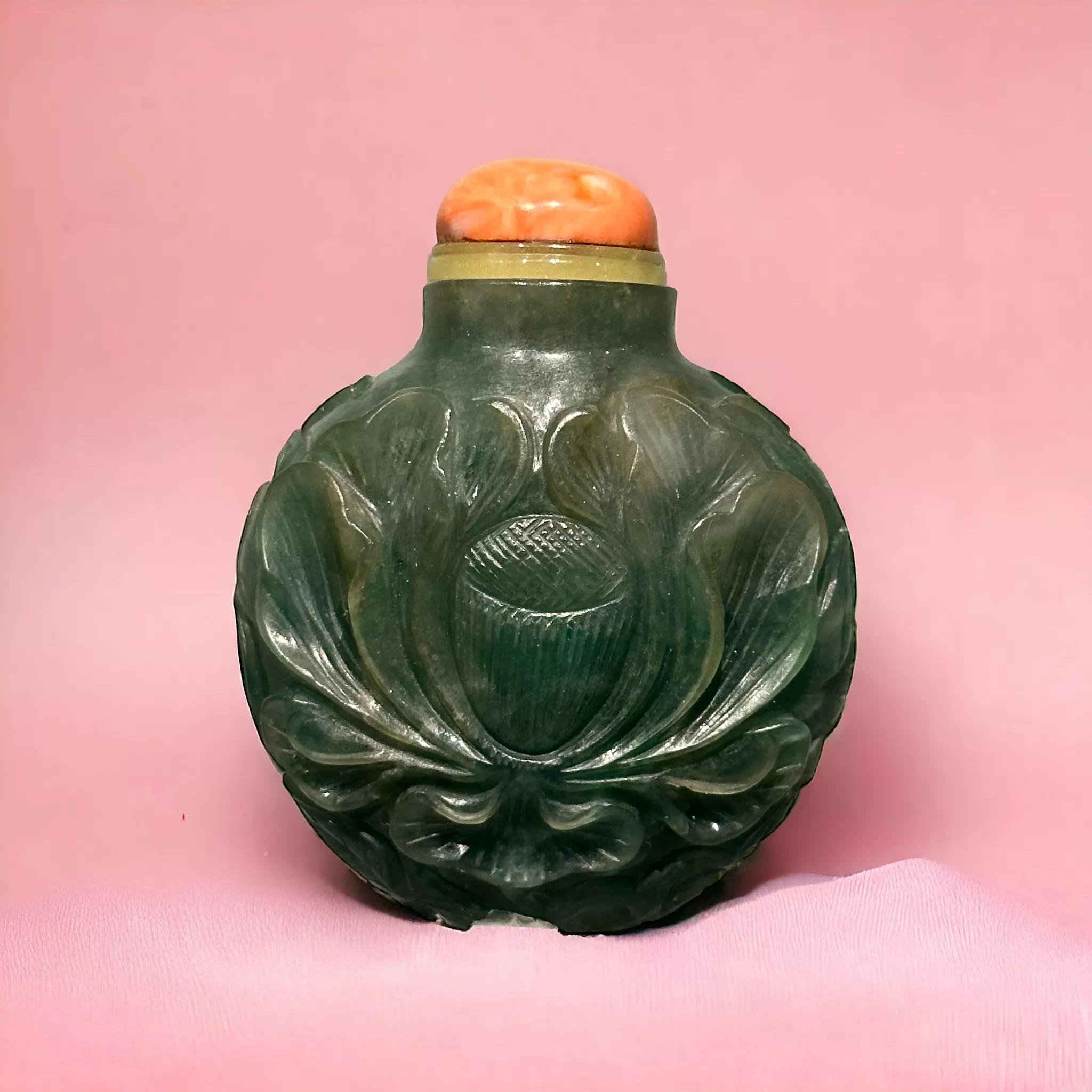
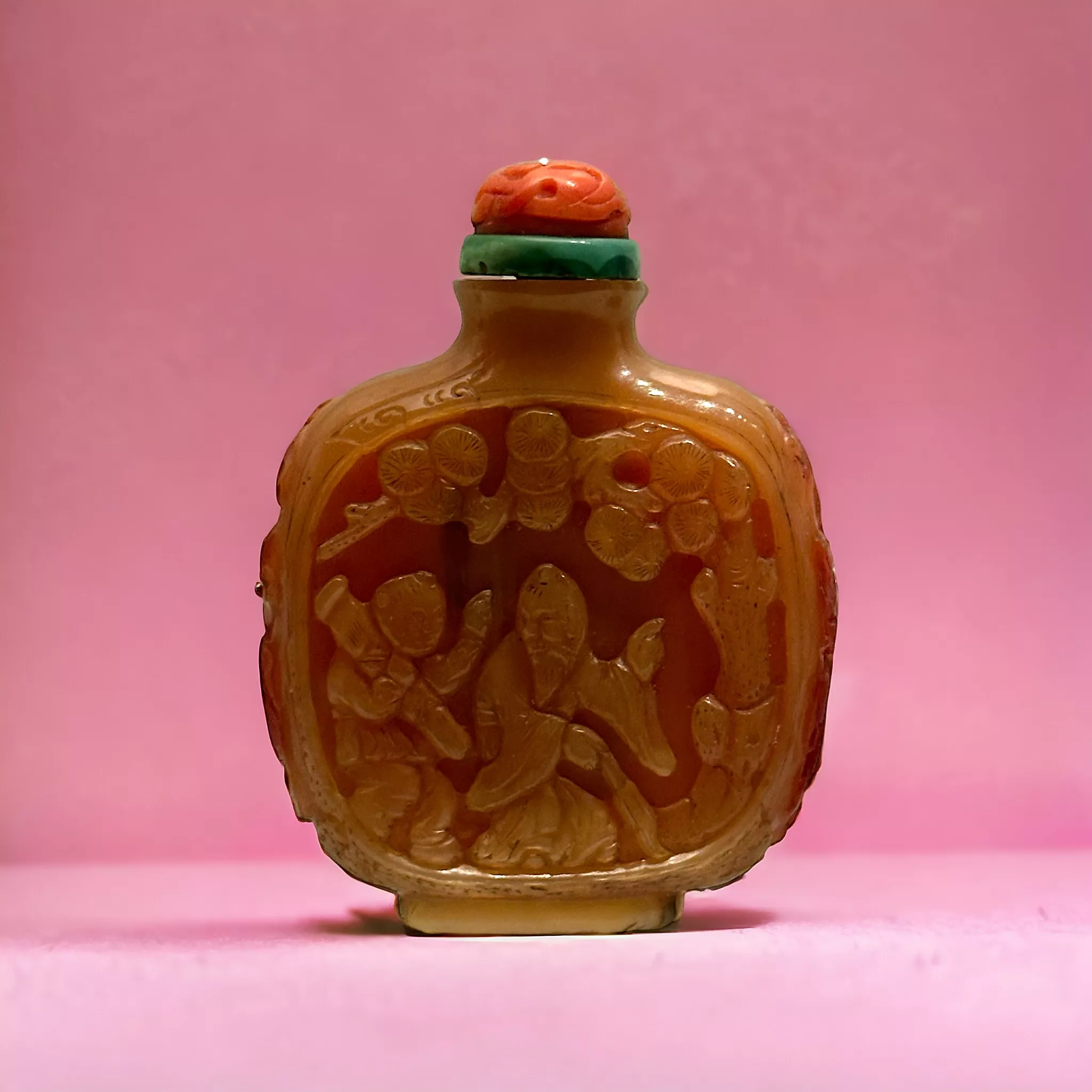
In the art of Chinese snuffboxes, the miniature becomes a theater of precision and refinement.
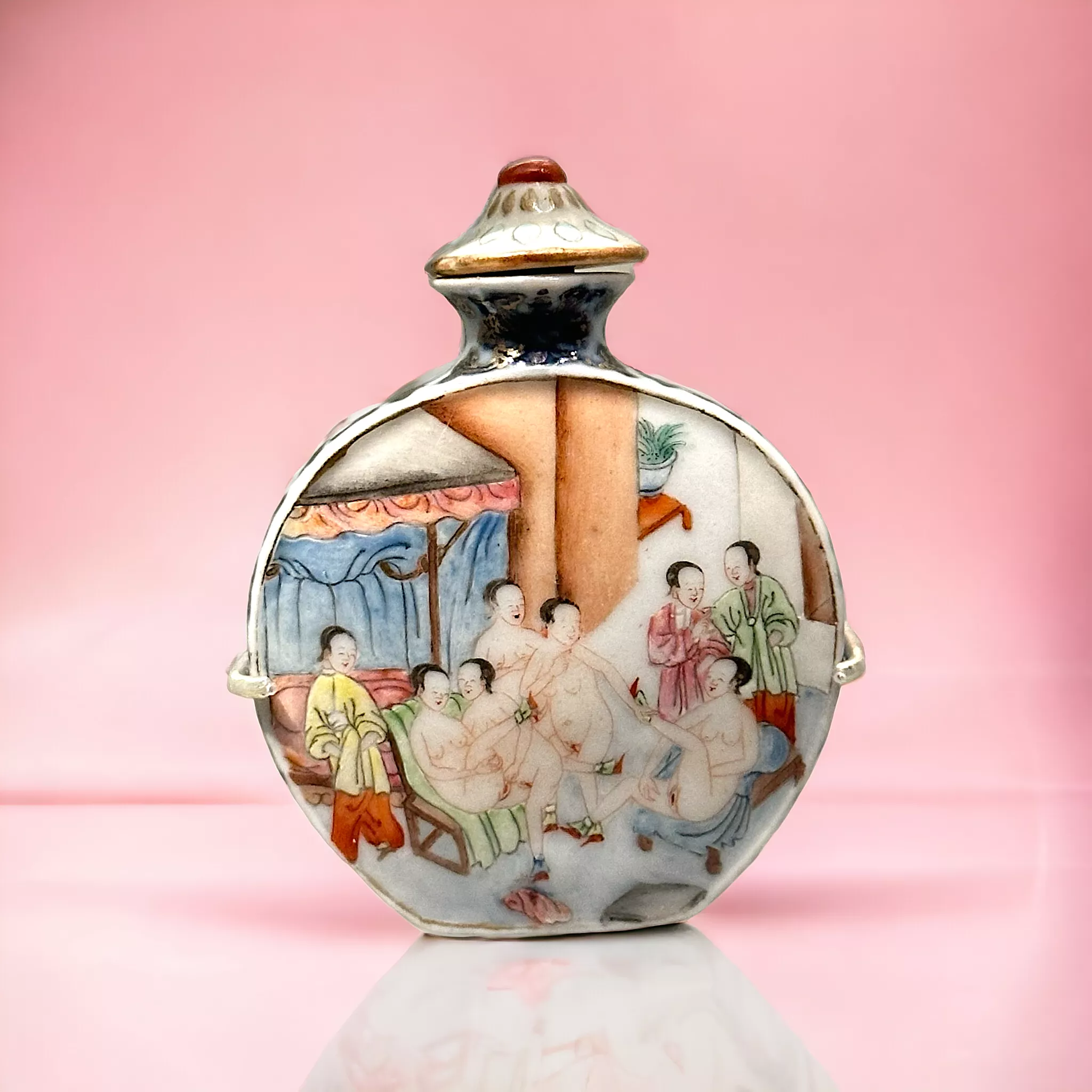
From the 18th century onwards, these precious objects, often made of jade, rock crystal or porcelain, became the medium for a dialogue between artisanal virtuosity and the aesthetic demands of their patrons.
On these tiny surfaces, artists deployed naturalistic scenes, dreamlike landscapes or symbolic motifs, while exploiting the transparency or opacity of the materials to play with light and depth.
Far from the baroque exuberance that characterizes some contemporary European works, Chinese snuffboxes favor a delicate palette of evanescent hues, where milky white and shades of blue or red dominate.
The attention to detail, almost scientific, and the rigor of the line are part of a tradition in which the object becomes both utilitarian and spiritual, serving to protect tobacco while embodying a fragment of the cosmos.
European collectors, fascinated by this balance between functionality and beauty, see in these objects an invitation to contemplate another way of thinking about art.
History and symbolism of Chinese snuffboxes
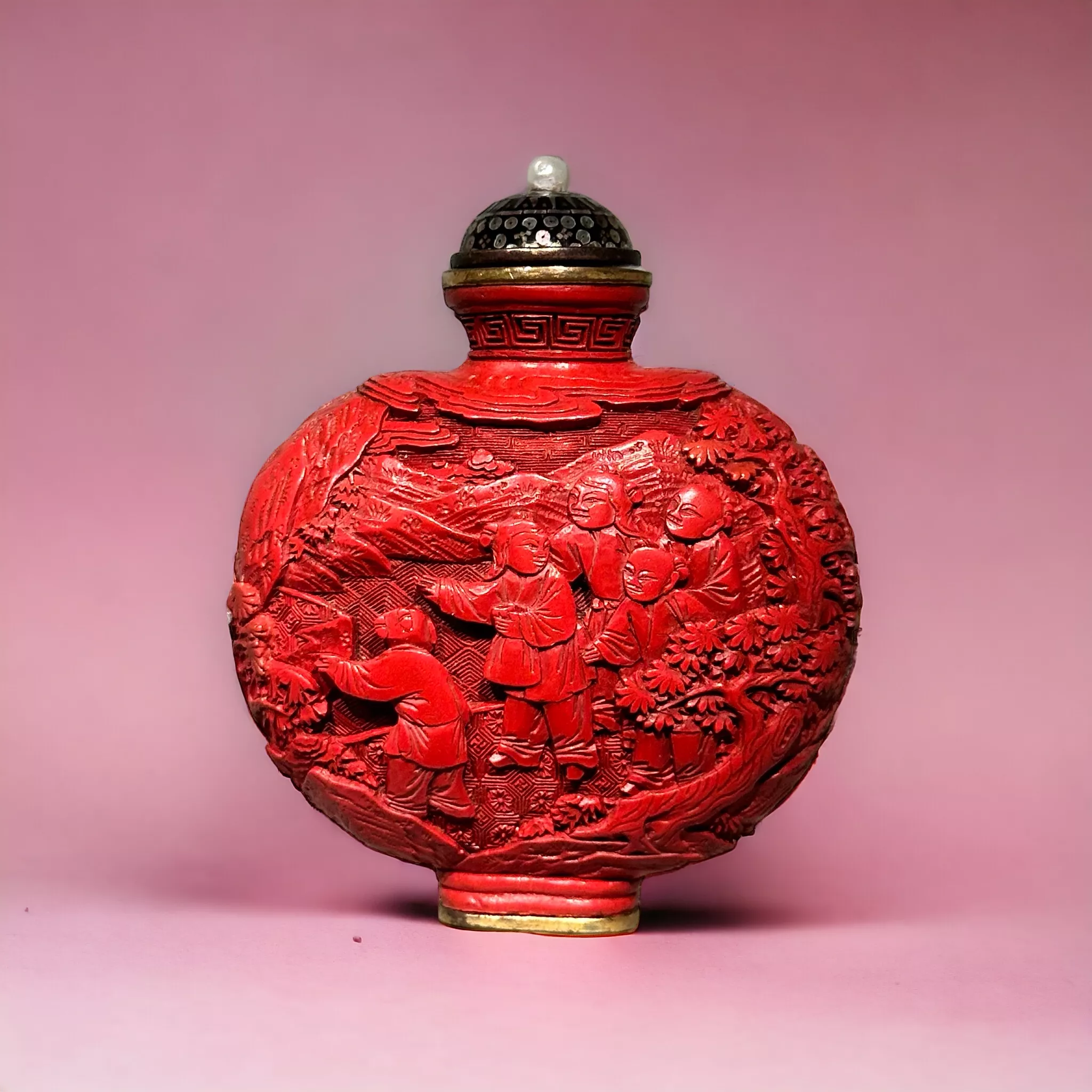
The history of Chinese snuffboxes is part of a trajectory in which the utilitarian object becomes an emblem of refinement and prestige.
Introduced in the 17th century under the Qing dynasty, they reflect both the growing influence of tobacco, a foreign product, and the ability of Chinese craftsmen to sublimate its use.
Virtual microcosms, these snuffboxes were often worn on the belt or given as gifts, manifesting the social rank or personal affinities of their owner.
But they were also invested with complex symbolism: the motifs - dragons, phoenixes, plum blossoms or mountain landscapes - referred to wishes for prosperity, longevity or cosmic harmony, while the choice of materials, imperial jade or veined agate, testified to a quest for spiritual and aesthetic balance.
In their compact, closed form, they appear as worlds in reduction, where the craftsman's hand espouses the principles of the Tao: capturing the essence of the great in the small, blending the tangible and the intangible.
Silent witnesses to an art of living steeped in philosophy, these snuffboxes are both functional objects and receptacles of a symbolic language destined to defy the ephemeral.
Focus on a snuffbox by Ma Shaoxuan
Among masterpieces of its kind, the painted inner glass snuffbox by Ma Shaoxuan, active in Beijing towards the end of the 19th century, stands out for its extreme delicacy and the subtlety of its iconography.
This object, seemingly modest in size, unfurls on its inner walls a portrait of a scholar, probably a man of renown or an ideal model of Confucian wisdom.
The painted interior technique, requiring an almost ascetic mastery of the brush to work upside down and in confined spaces, confers a diffuse luminosity to the image, amplified by the transparency of the glass.
On the back, an elegant calligraphy accompanies the work, mixing poem and dedication, thus uniting visual art and poetry in a harmonious dialogue.
The restrained tonalities - deep blacks, amber browns, and flashes of discreet red - evoke a gravity imbued with serenity, far removed from the chromatic exuberance that marks other productions of the period.
The stopper, in polished coral, adds a touch of preciousness, while establishing a symbolic continuity with the vitality and prosperity evoked by the red.
In this snuffbox, every detail becomes a metaphor: the scholar, the embodiment of the moral ideal, is reflected in the transparent walls, suggesting introspection or meditation on the human condition.
In short, this object transcends its primary function to become a microcosm of Chinese thought, combining technical gesture with philosophical depth.
Focus on the Victoria and Albert Museum's Quianlong snuffbox
A remarkable snuffbox is this carved white jade one, dating from the Qianlong period (1736-1795), housed at the Victoria and Albert Museum in London.
Compact and almost unreal in its purity, it is fashioned from milky-white translucent jade, the supreme symbol of perfection and virtue in Chinese culture.
The slightly flattened form, enhanced by subtle reliefs depicting plum blossoms and intertwined bamboo branches, conveys an aesthetic language blending geometric rigor and poetic naturalism.
These motifs, emblematic of resilience and longevity, are part of a symbolism specific to the Qing dynasty, where nature and morality were perceived as a harmonious whole.
The polished surface, almost silky to the touch, captures and diffuses light, giving the object an aura of softness and serenity. The stopper, in rose quartz, complements the whole perfectly, adding a touch of warmth to the mystical coolness of the jade.
Through this choice of materials and economy of detail, the anonymous craftsman celebrates a form of spiritual minimalism, where each element refers to a quest for balance between heaven and earth.
More than a simple container for tobacco, this snuffbox becomes a silent declaration of inner virtue, embodying the Confucian ideal in the simplicity of a mastered gesture.
Success of these objects on the auction market
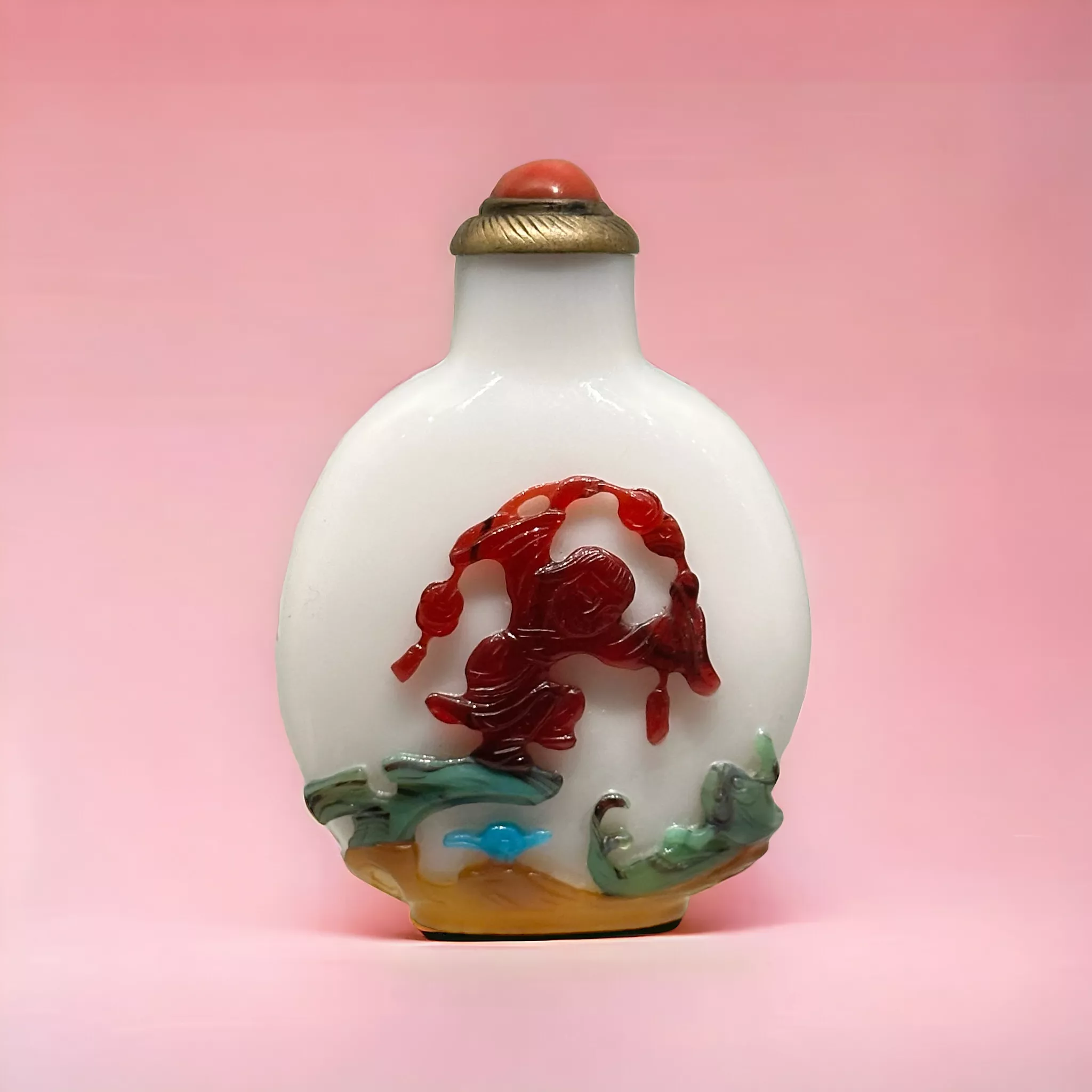
On the auction market, Chinese snuffboxes continue to generate a remarkable craze, rivaling the heights reached by other iconic pieces of Asian art, such as imperial porcelain vases or exceptional jades.
Although modest in size, these objects concentrate an artistic and historical density that fascinates collectors.
In 2011, a cloisonné enamel snuffbox, attributed to the Qianlong period, exceeded expectations by fetching over $2 million at Sotheby's, proving that their rarity and refinement can match, if not surpass, the records set by certain celadon vases or "famille rose" bowls.
By way of comparison, imperial jades - whether carved in animal forms or as ritual talismans - are often positioned in similar ranges, marking an implicit rivalry between these two types of precious miniatures.
However, snuffboxes are distinguished by their narrative and personalized dimension: their inscriptions, interior portraits or symbolic motifs tell stories that captivate an audience sensitive to the intimacy of these objects.
In contrast to the Chinese dresses woven in gold and silk, where prestige is combined with visual splendor, snuffboxes seduce with a discretion that sublimates the artisanal gesture.
This success thus rests on a unique balance: the alliance of technical mastery, symbolic significance and the fascination exerted by these portable microcosms, enshrining a fragment of the history and soul of imperial China.
Recognizing an original Chinese snuffbox
As these pieces have a certain success, they may not come from Chinese craftsmanship. That's why an appraisal, including verification of any markings and a study of the materials, is vital.
Knowing the value of a work
If you happen to own a Chinese snuffbox, don't hesitate to request a free appraisal using our form on our website.
A member of our team of experts and licensed auctioneers will contact you promptly to provide you with an estimate of the market value of your work, not forgetting to send you ad hoc information about it.
If you are considering selling your work, you will also be accompanied by our specialists in order to benefit from alternatives for selling it at the best possible price, taking into account market inclinations.
Estimate in less than 24h
Discover in the same theme

Free estimate of your antique Chinese vase
Interest in the ancient arts of China is growing all the time. Having your Asian art pieces appraised by an expert is key.
Learn more >

Get a free estimate for your Chinese, Asian and imperial dre...
Chinese dresses are unique and fascinating pieces of art. Having them appraised by an impartial expert is essential.
Learn more >

Rating and value of Japanese porcelain: Imari and Satsuma...
Japanese porcelain is known the world over and appreciated by bidders. It is stable and valuable. Estimated in 24h.
Learn more >
Asian artworks sold at auction

Estimated 500 - 1.000 €
China, Kangxi reign (1662-1722). Two porcelain covered baluster pots with cobalt blue decoration.

Estimated 400 - 600 €
Standing Buddha on a circular base, Thailand, Sukhothai style, 18th/19th century.

Estimated 300 - 500 €
China, Carved stone stele, Buddha, attendants and apsaras.

Estimated 300 - 400
Celadon jade-nephrite snuff bottle, China, 20th century

Estimated 2.000 - 4.000
CHINA, 20th century Statuette in orange-pink coral, the goddess Guanyin holding the vase of lustral water

Estimated 1.000 - 2.000
CHINA, reign of Kangxi (1662-1722). Porcelain bidong brush pot with blue underglaze decoration of an assembly of scholars

Secure site, anonymity preserved

Auctioneer approved by the State

Free and certified estimates
