



Get a free appraisal of your Chinese jades

Key takeaways
- Chinese jade sells for between €100 and €50,000, with exceptional pieces fetching several million euros at auction.
- Jade comes in two varieties: nephrite and jadeite, each with distinct mineralogical characteristics and a hardness of 6 to 7 on the Mohs scale.
- Auctie’s experts offer free appraisal and an accurate estimate to authenticate your jade pieces and help you sell them at the best price.
If you own one or more Chinese jade objects, and would like to know its value, our state-approved experts and auctioneers will offer you their appraisal services.
Our specialists will work to carry out a free appraisal of your work, and will provide you with an accurate estimate of its value on the current market.
Then, should you wish to sell your work, we will direct you to the best possible arrangement to obtain the optimum price.
Rating and value of Chinese jades
Chinese jades are currently highly sought-after collectors' items. If you own one, it may be worth more than you think. On the art market, prices for these objects can be very high under the auctioneer's hammer.
They are particularly prized, and the price at which they sell on the art market ranges from €100 to €50,000, a fairly substantial range, but one that says a lot about the value that can be attributed to these objects.
In 2013, a jade statuette from China sold for €1.56 million, while it was estimated at over 100 times less.
Order of value from a simple work to the most prestigious
Technique used | Result |
|---|---|
Earrings | 150 - 8,000 € |
Pendants and amulets | 100 - 10,000 € |
Rings | 200 - 15,000 € |
Bracelets | 200 - 20,000 € |
Necessaries | 300 - 30,000 € |
Sculptures and figurines | 500 - 50,000 € |
Estimate in less than 24h
Scientific characteristics of Chinese jades
Chinese jade, as a material, is distinguished by scientific characteristics that transcend the realm of aesthetics to become rooted in that of mineralogical precision.
We know, for example, that this stone is composed mainly of two distinct varieties: nephrite, rich in calcium and magnesium, and jadeite, a silicate of sodium and aluminum.
These two types, although similar in appearance to the untrained eye, have notable structural differences.
Nephrite, fibrous and dense, offers subtle shades from ivory white to olive green, while the rarer jadeite fascinates with its granular texture and brilliant tones, sometimes enhanced by inclusions that seem to play with the light.
What's also striking is jade's exceptional hardness, oscillating between 6 and 7 on the Mohs scale. Such solidity explains the longevity of artifacts carved in this material, crossing the centuries without significant alteration.
However, this robustness is never at the expense of delicacy: Chinese craftsmen managed to extract incredibly fine shapes from it, halfway between the organic and the geometric.
Under incident light, the surface of a jade reveals a singular translucence, a phenomenon that lends these objects an almost mystical depth.
This quality, far from trivial, has nurtured a complex symbolism associating jade with purity, wisdom and immortality.
Finally, jade also intrigues with its unique physical properties. Its high density and discreet fluorescence under ultraviolet light, studied using modern technologies, enable pieces to be authenticated with almost scientific rigor.
In this, jade goes beyond its decorative role to become an interface between ancient knowledge and contemporary advances.
This stone, at the crossroads of art and science, thus embodies a subtle dialogue between tradition and modernity, between the hand of the craftsman and the eye of the researcher.
History and creators of Chinese jades
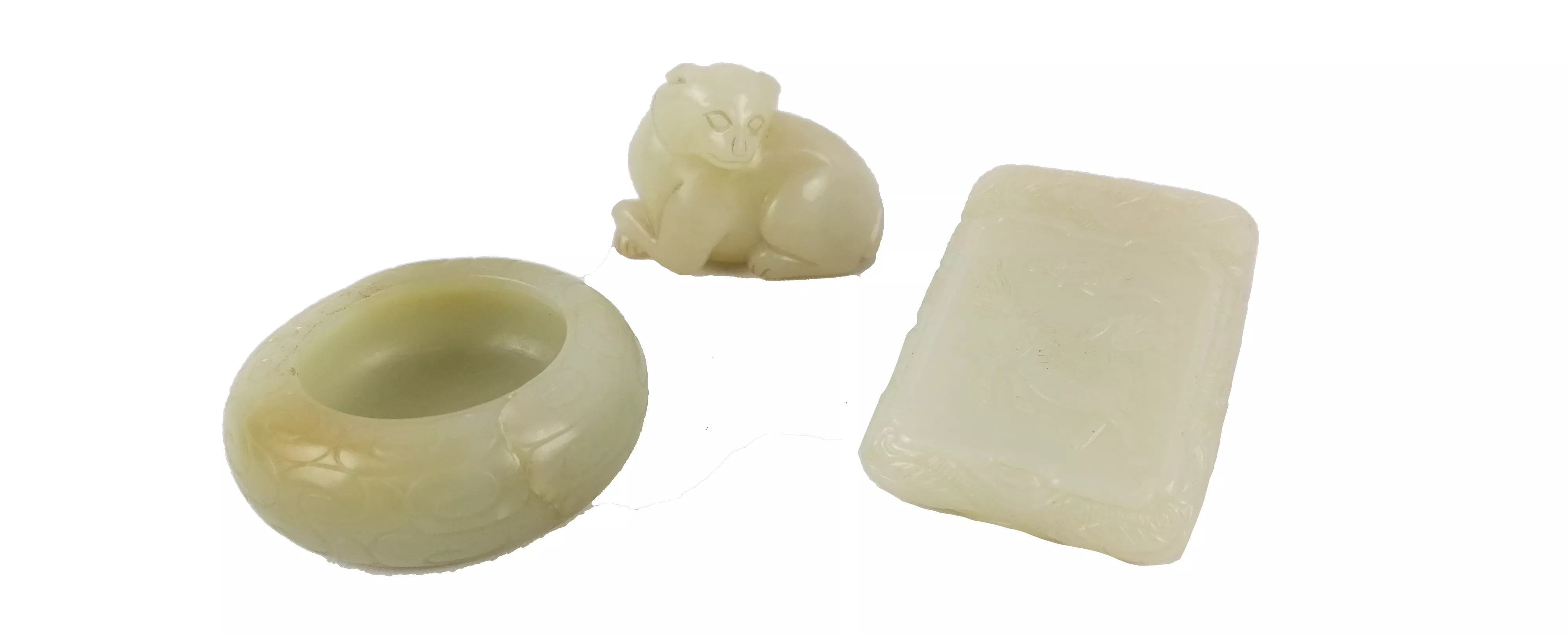
The history of Chinese jades is inseparable from the virtuosity of the sculptors and creators who, over the centuries, have elevated this stone to an eminent place in the artistic and spiritual heritage of the Middle Kingdom.
As early as the Neolithic Liangzhu dynasty (circa 3300-2200 BC), jade appeared on the market.C.), jade appears as a privileged material, sculpted into enigmatic geometric shapes such as bi, ritual discs, or cong, hollow cylinders, whose function seems to blend the sacred with the cosmological.
These objects bear witness to an early mastery of perforation and polishing techniques, astonishing at a time when metal tools remained rare.
As the dynasties progressed, from the Tang to the Qing, the art of jade evolved in complexity and refinement. Under the Song, craftsmen explored naturalistic motifs of great sensitivity: delicate flowers, birds in flight, and miniature landscapes seem to come alive in the diaphanous hues of the stone.
With the Ming and Qing, jade became an ostentatious symbol of power, prized by emperors and offered as tribute.
Sculptors of this period excelled in the creation of ceremonial objects and imperial seals, where every incision and polish reveals a profound respect for the material and its spirituality.
Their techniques, passed down from master to disciple, are based on remarkable meticulousness: bas-relief engravings, complex ajours and polishes that play with the translucence of jade. The introduction of Buddhist and Taoist motifs in the sculptures also marks the spiritual impregnation of this art.
These creations, while responding to demanding commissioners, carry within them a subtle philosophy where raw stone is transformed into an object of contemplation, testimony to a dialogue between man and nature.
Through these works, Chinese sculptors leave a timeless imprint, elevating jade to the rank of total art, at once mineral, sculptural and spiritual.
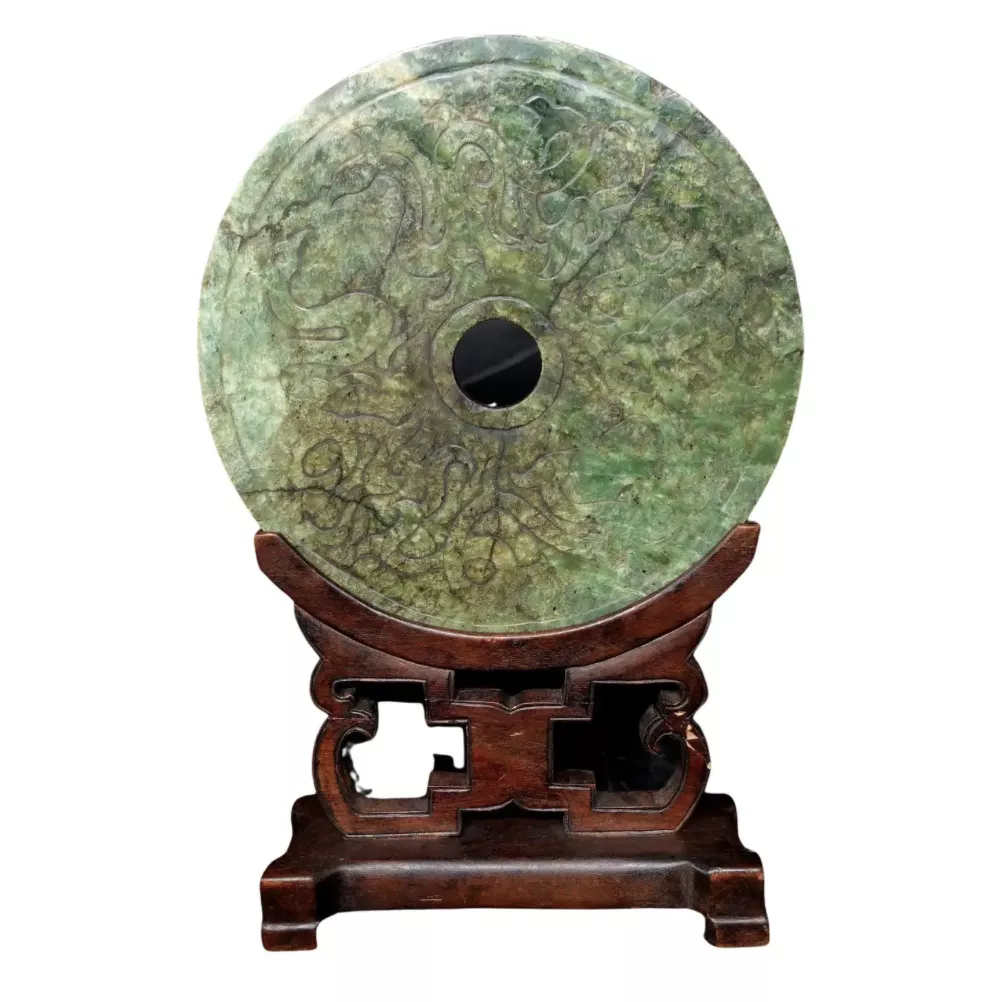
Focus on Jade with Clouds and Dragons
The Jade with Clouds and Dragons from the imperial workshops of the Ming dynasty illustrates the extent to which hardstone sculptors were able to take advantage of the specific qualities of jade.
Their work is not limited to exploiting the translucent veins of the stone: they skilfully integrate them, setting them in tension with a meticulous decorative vocabulary imbued with symbolism.
This jade thus trades simple craftsmanship for a complex narrative, where dragons, emblematic figures of Chinese cosmology, seem to move among carefully incised cloud scrolls.
The craftsmen don't simply reproduce the traditional motifs of the time: they codify and systematize them, to the point of making archetypes of them.
This treatment, as rigorous as it is elegant, inscribes the work in a long tradition, while renewing the ornamental language of ritual objects.
The precision of the chasing and the brilliant polish of the surfaces recall the standards established under the Song, but here, the dynamism of the curves lends new vigor to these mythological representations.
This refined work can only be fully understood by placing it in the context of the imperial workshops, where each piece had to meet requirements of symmetry, harmony and proportion.
Jade, as a material, imposes its own laws: its extreme hardness requires specific tools, and its texture demands patient polishing, or risk losing the unique lustre that gives these pieces their aura.
This discipline is reminiscent of that of classical European engravers: the lines incised on the surface are reminiscent of the ordered networks of Mellan's or Nanteuil's burins.
Far from being static, however, this art of cutting evolves, like the striations and facets that populate jade. These details, in turn sober or abundant, reflect an intimate relationship between the craftsman and the material.
This jade, although rooted in tradition, is also part of a formal research capable of renewing established codes, while retaining a spiritual dimension deeply rooted in Chinese culture.
The success of Chinese jades at auction
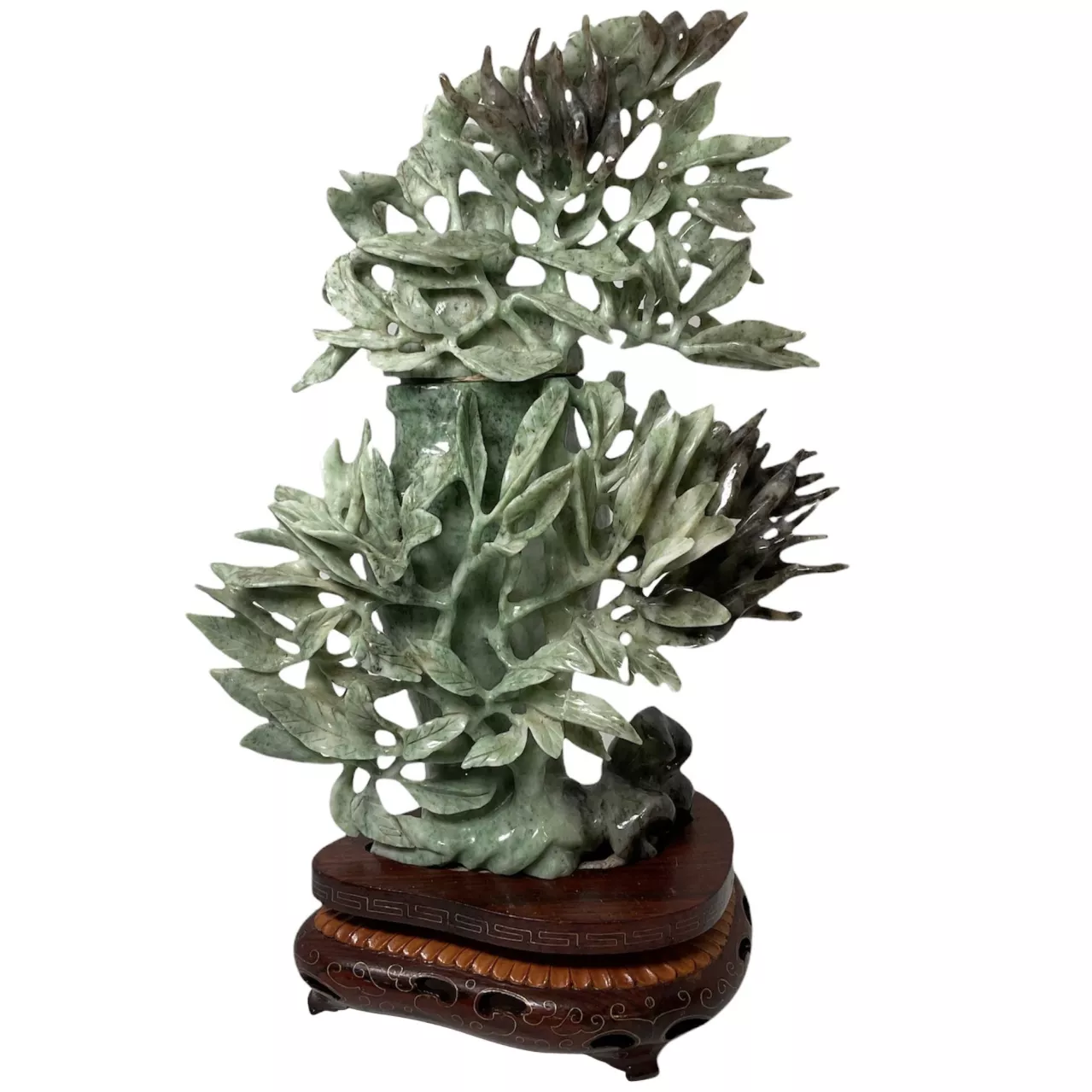
The success of Chinese jade objects at auction is striking in its consistency and spectacular rise, just like chinese porcelain vases, bronzes or traditional Chinese dresses.
These pieces, witnesses to a centuries-old tradition, manage to capture the attention of both Asian and international audiences, fascinated by both their rarity and their symbolic value, in the image of vases, Chinese bronzes or porcelain objects.
Far from being merely a passing fad, the jade market is becoming a stage where history mingles with contemporary demand, where the precious material crosses the centuries without losing its lustre.
One might ask what justifies such interest, and it seems that jade art, while drawing on deep roots, manages to embody a form of timelessness that few other art objects can claim.
The perfection of the sculptures, their technical refinement, as well as the mystical symbols they convey, make them coveted objects not only by collectors, but also by investors, who see in these pieces a value that goes beyond the merely aesthetic.
The symbolism of jade, its role in Chinese culture and its link with the spiritual, make it an art form both charged with meaning and history, transcending market trends.
In this context, each sale is a reminder of the central place these objects occupy in the world's heritage, offering collectors a unique opportunity to appropriate a share of this continuity between past and present.
Recognizing an original Chinese jade
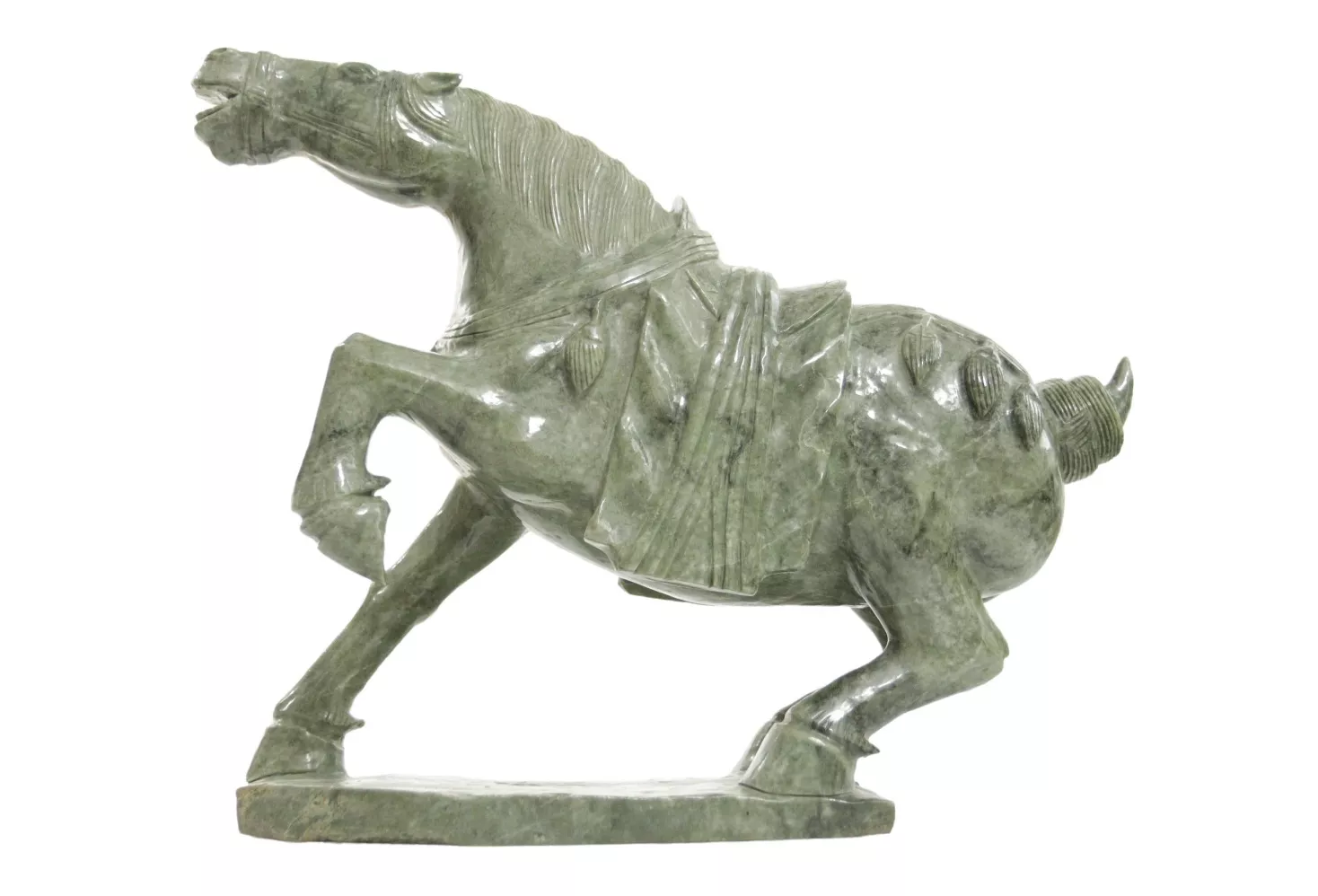
Since these pieces are so popular, it is possible that they do not originate from Chinese craftsmanship. For this reason, expertise including verification of any markings and a study of the materials is paramount.
Estimate in less than 24h
Knowing the value of a work
If you happen to own a Chinese jade object, don't hesitate to request a free appraisal using our form on our website.
A member of our team of experts and licensed auctioneers will contact you promptly to provide you with an estimate of the market value of your piece, as well as any relevant information about it.
If you're thinking of selling your work, our specialists will also help you find alternatives to sell it at the best possible price, taking into account market trends.
Discover in the same theme

Get a free estimate for your Chinese, Asian and imperial dre...
Chinese dresses are unique and fascinating pieces of art. Having them appraised by an impartial expert is essential.
Learn more >

Rating and value of Chinese bronzes
Chinese bronzes are highly sought-after works of art on the auction market, whatever the period, subject or size of the object.
Learn more >

Market Value and Pricing of Coral Jewelry and Chinese Corals
Corals are precious collectors' items that can be highly valued at auction. 100% free and certified estimate!
Learn more >
More Chinese art at auction

Estimated 500 - 600 €
China, 20th, Two porcelain baluster vases with cobalt blue decoration.

Estimated 300 - 400
Celadon jade-nephrite snuff bottle, China, 20th century

Estimated 700 - 1.000
Statuette of Guanyin in red-orange coral, the lustral water vase in the left hand, the mala in the right. China, 20th century.

Estimated 50 - 100
CHINA, Compagnie des Indes, Qing dynasty, Jiaqing period (1796-1820), Enameled porcelain dessert dish

Estimated 1.500 - 2.000
CHINA, reign of Kangxi (1662-1722). Porcelain yenyen vase with blue decoration.

Estimated 1.000 - 2.000
CHINA, reign of Kangxi (1662-1722). Porcelain bidong brush pot with blue underglaze decoration of an assembly of scholars

Estimated 300 - 600
CHINA, 19th century. Large 8-leaf folding screen in red lacquered wood

Secure site, anonymity preserved

Auctioneer approved by the State

Free and certified estimates
Frequently asked questions
-
What is Chinese jade, and what are its main characteristics?Chinese jade is a gemstone composed primarily of two mineral varieties: nephrite (rich in calcium and magnesium) and jadeite (sodium aluminum silicate). These materials are distinguished by their exceptional hardness (6 to 7 on the Mohs scale), unique translucency, and high density, which allow artisans to create sculptures of remarkable finesse. Jade has endured through the centuries without significant deterioration, which explains its longevity and prestige among collectors.
-
What is the price range for Chinese jade on the current market?Prices for Chinese jade vary considerably depending on the type of object and its quality. Earrings range from €150 to €8,000, while sculptures and figurines can cost between €500 and €50,000. Necklaces can range from 300 to 30,000 €. This wide range reflects differences in the pieces’ rarity, age, and prestige, with some exceptional works far exceeding these estimates.
-
How can you identify Chinese jade and verify its authenticity?To authenticate Chinese jade, it is essential to consult qualified experts. At Auctie's, our auctioneers and certified experts conduct a verification of the materials, an analysis of the mineralogical characteristics (including fluorescence under ultraviolet light), and an examination of the provenance. We offer a free, no-obligation appraisal, with a response within 48 hours, to confirm the authenticity and value of your item.
-
Why is now the right time to sell Chinese jade?The Chinese jade market has enjoyed steady success and spectacular growth over the past several years. These objects attract an international audience fascinated by their rarity, symbolic value, and timelessness. Demand remains strong among both collectors and investors, ensuring that your piece will fetch a good price at auction right now.
-
How does the appraisal and sale of Chinese jade work at Auctie's?Appraisals at Auctie's are free and non-binding. Contact our experts via our online form, and an auctioneer or appraiser will contact you promptly to examine your jade. After the appraisal, we’ll provide you with an estimate of its market value within 48 hours. If you decide to sell, we’ll then provide personalized support throughout the auction process to help you achieve the best possible price.
