



Estimate, price of the works, pâte de verre vases, Daum vase

Key takeaways
- Daum glass paste vases sell for between €80 and €800,800, with price variations reflecting their quality and historical provenance.
- In 2019, an Art Deco vase exceeded Sotheby’s estimates, selling for €12,000 against an initial estimate of €2,000 to €3,000.
- The pâte de verre technique, reinvented by Amalric Walter, allows for the creation of approximately 200 identical vases using the lost-wax casting method, which requires 20 days of firing.
If you own a pâte de verre work made by the Daum glassworks or after, and would like to know its value, our state-approved experts and auctioneers will offer you their appraisal services.
Our specialists will work to carry out a free appraisal of your work, and will provide you with an accurate estimate of its value on the current market.
Then, should you wish to sell your work, we'll direct you to the best possible arrangement to obtain the optimum price.
Rating and value of Daum pâte de verre pieces
Daum is a French glassmaker quite well known to fans of glass services. If you own one, it may be worth more than you think. On the art market, prices for Daum pâte de verre works can be very high at the auctioneers' gavel.
His pâte de verre works are particularly prized and the price at which they sell on the art market ranges from €60 to €800,800, a fairly substantial range, but one that says a lot about the value that can be attributed to Daum pâte de verre.
In 2019, an Art Deco-style pâte de verre vase sold for €12,000 while it was estimated at €2 000 to €3 000 by Sotheby's.
Order of value from a simple work to the most prestigious
Object type | Result |
|---|---|
Glass service (all types) in glass paste | From 60 to 5 000€ |
Glass paste sculpture | From 90 to 11 500€ |
Glass paste vases | From €80 to €800,800 |
Estimate in less than 24h
The history of the Daum glassworks
Jean Daum (1825-1885), a French glassmaker, gave his name to the world-renowned Daum company. A notary by profession in northern France, he moved to Nancy after the war with Prussia and opened a glassworks there in 1878.
The business soon became a family affair, with his son working with him from the outset. Auguste Daum took over management of the glassworks on his father's death, and was joined by his brother Antonin.
More closely involved with the artistic side of the manufacture, the latter signed several works, and pieces signed Antonin Daum are more frequently found on the auction market: he heads Daum's artistic department.
Antonin Daum played a crucial role in the development of pâte de verre, a technique that quickly became emblematic of the manufacture. His interest in new methods enabled him to explore the infinite possibilities offered by this material.
He produced his first works using the technique of acid decoration, a process that involves creating patterns by etching with a corrosive acid.
At the same time, he developed a passion for multi-layered glass, which enables different shades and textures to be superimposed, enriching the chromatic palette of his creations.
It was also under his guidance that wheel engraving, a delicate and precise technique, found its place in the creative process. To perfect his work, Antonin recruits Jacques Grüber, a talented artist in charge of creating the pieces.
Grüber, with his artistic vision, broadens the horizons of Daum glassworks, contributing to the rise of pâte de verre as a true art form in its own right. Together, they took part in the Chicago World's Fair in 1893, where their skills were showcased.
The factory then exhibited throughout France, receiving several awards for its work. At the 1900 Universal Exhibition, both the Daum glassworks and the Gallé glassworks receive a prize for their work, the beginning of international recognition.
The success is reinforced by the arrival of artists such as Henri Bergé, Émile Writz and Amalric Walter, who successively joined the manufacture at close intervals.
Their presence contributed to the artistic development of the house, enabling Daum pâte de verre to establish itself as an essential reference in the field of artistic glass, combining innovative techniques and aesthetic sensibility.
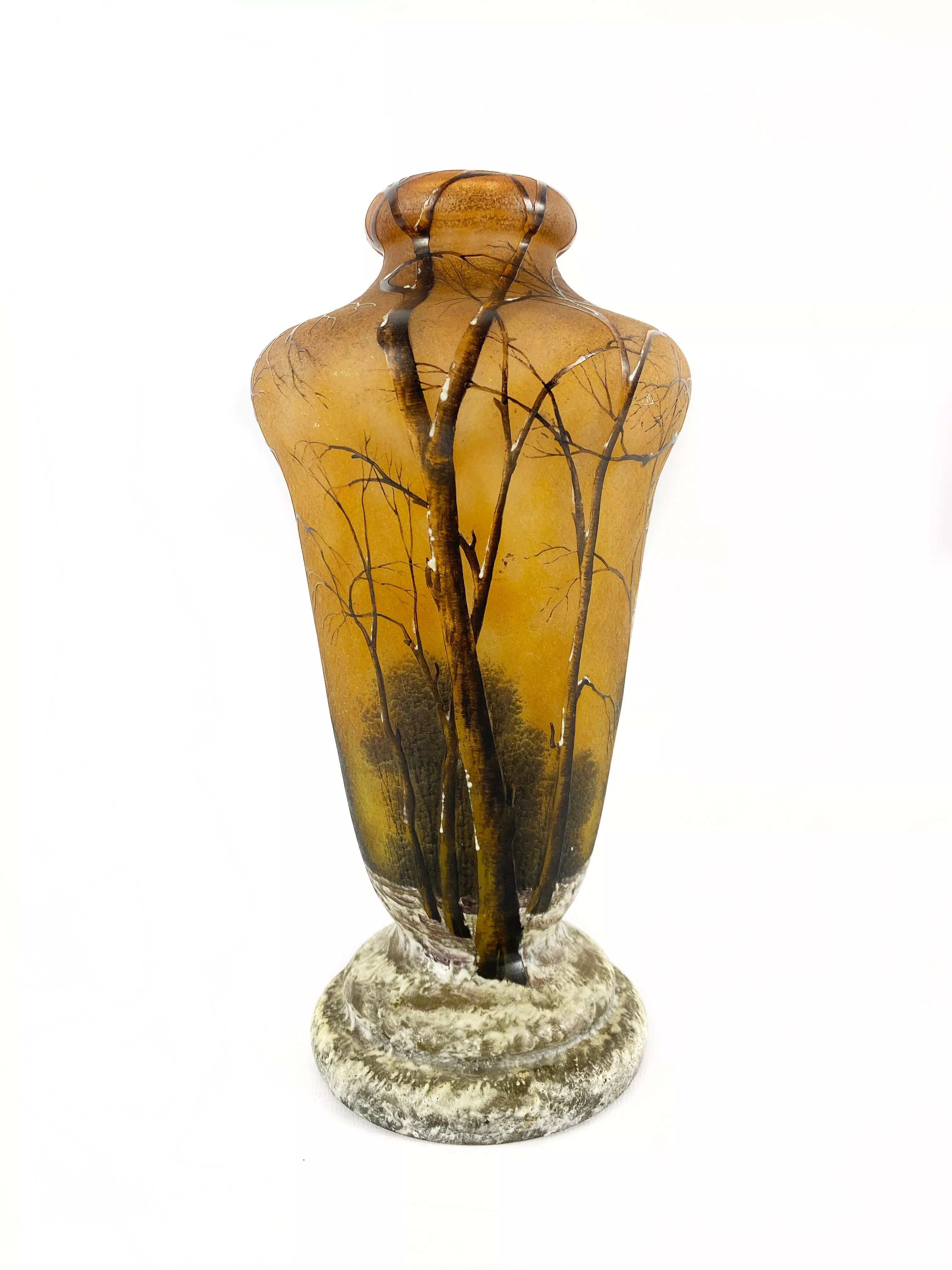
Focus on the cloisonné vase by Daum and Majorelle
Glass paste, an innovation from the Daum glassworks
Glass paste was reinvented by the maison Daum, it was Almaric Walter who initiated it. The technique has been around since the time of the Egyptians, around 500,000 BC, but it's thanks to Walter's innovation that pâte de verre is enjoying a new lease of life.
This revived technique is based on a lost-wax casting process, enabling extremely precise mass production.
This process offers results identical to the original model, which is impossible to achieve with blown crystal, often subject to the imperfection of handwork.
Glass paste is composed of a mixture of crystal and lead, giving it remarkable luminosity and depth of color.
The creative process begins with the creation of an initial model in terracotta, which is then covered with a flexible elastomer mold. This is a crucial step, as it enables us to faithfully reproduce every detail of the original work. Wax is then applied to the mold, then covered with plaster, forming a negative mold.
A 20-day firing is required in an oven, a time that may seem long but is essential to bring the groisil out of the plaster and guarantee the piece's solidity.
This meticulous process makes it possible to create around 200 identical vases of the same quality, illustrating the expertise and craftsmanship of the Daum house.
Thanks to this technique, pâte de verre has become not only a symbol of innovation, but also a true art in its own right, celebrated for its beauty and originality.
.
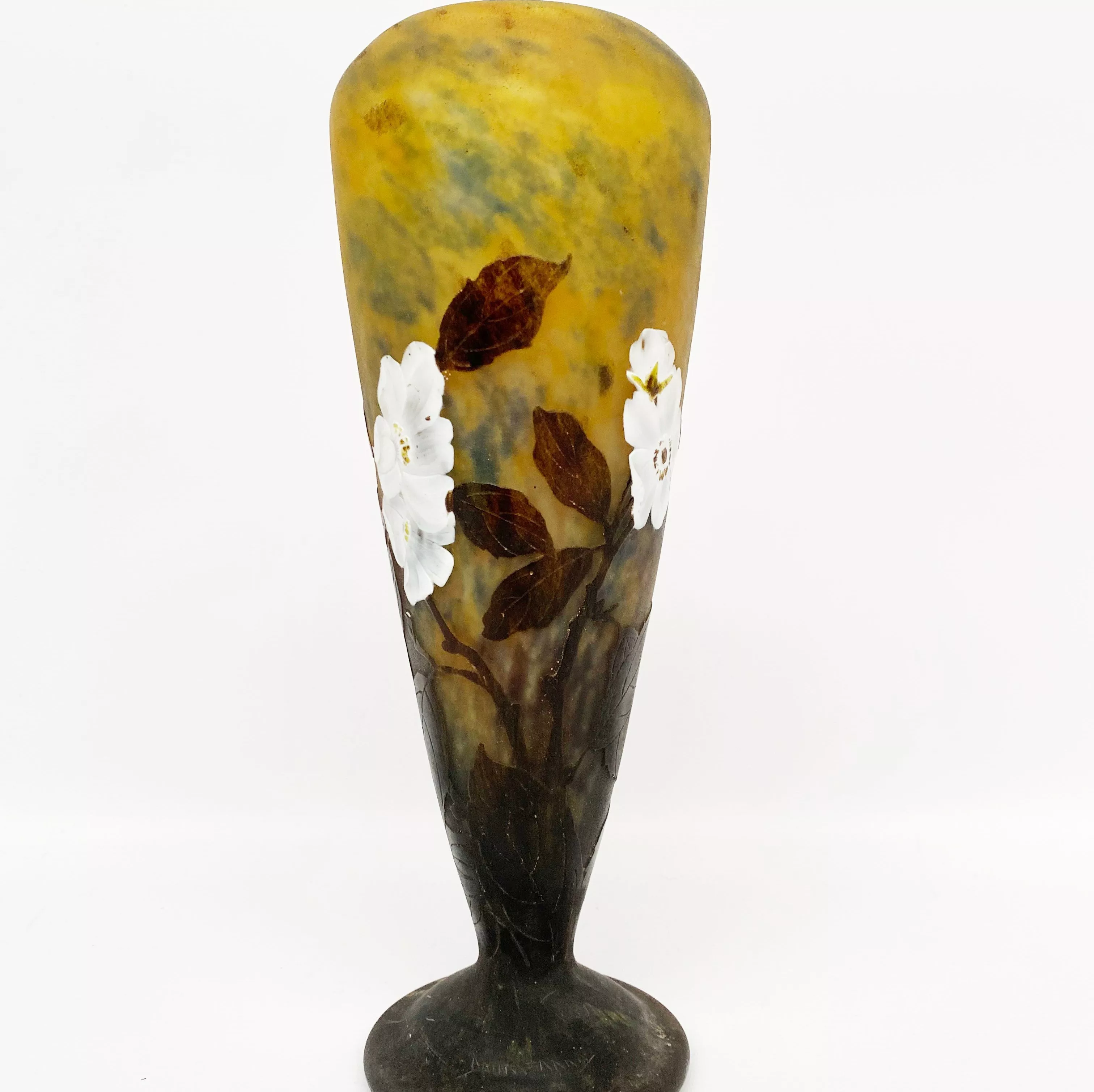
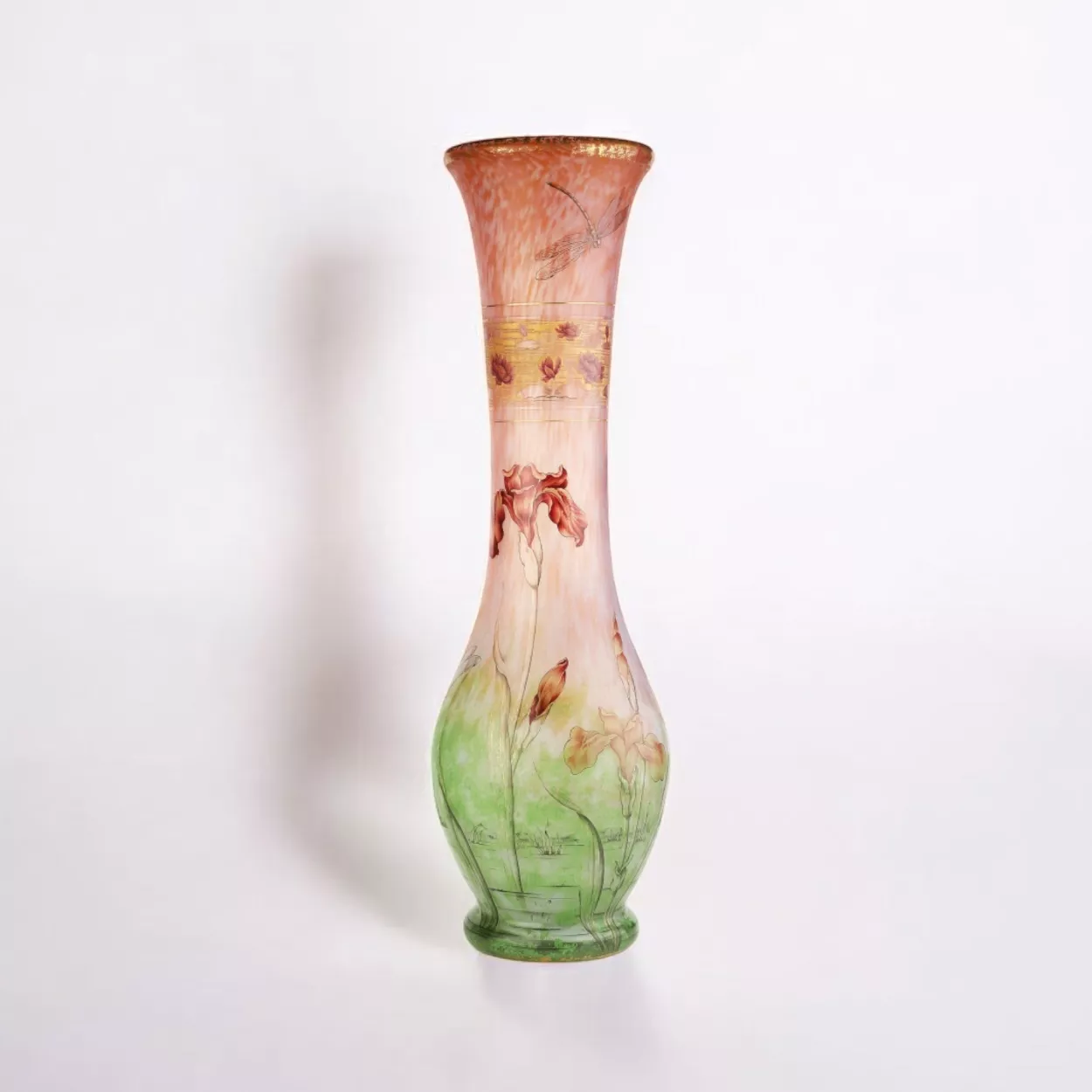
Focus on a Daum vase with iris decoration
This vase by Daum embodies the finesse and elegance characteristic of Art Nouveau, with a touch of plant poetry. The choice of a delicate floral motif, in this case irises, is typical of the naturalistic inspiration that inhabits Daum creations.
This motif gently extends along the slender silhouette of the vase, subtly shifting from a soft green background to salmon pink, creating a gradient effect reminiscent of daybreak over a garden in bloom.
The color transition testifies to exceptional technical mastery, where each layer of glass seems to melt into the next, giving the whole a dreamlike appearance.
Fine etching and acid staining bring out the delicate details of the petals and stems, while the slender shape of the slightly flared neck gives the piece a refined, slender allure.
A delicately engraved dragonfly on the top of the vase completes this bucolic atmosphere, adding an element of life within this plant scene.
This type of piece demonstrates the Daum brothers' talent for marrying technique and artistic inspiration, transforming natural elements into decorative objects of rare beauty.
Through this vase, the Daum house offers a true tribute to nature, sublimating the materials and infusing their glass with an almost living breath, which captures the light and diffuses it into a soft glow.
Recognizing the signature on a Daum product
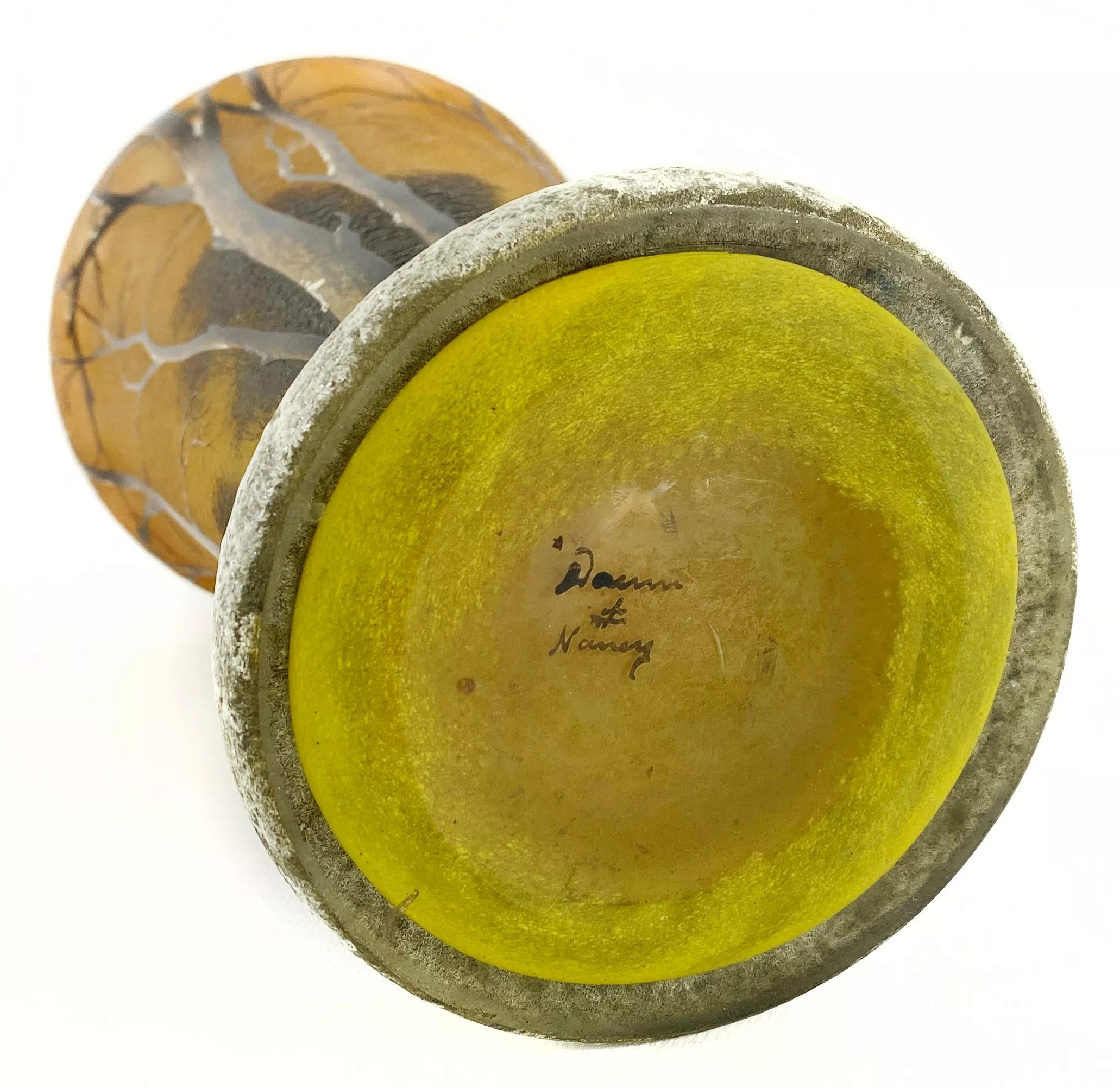
Not all pieces produced by the Daum glassworks are signed. Moreover, as several artists have worked and sometimes collaborated for the manufactory, the vase may be signed with another name even though it was produced by the Daum glassworks. That's why it's important to have your pieces appraised.
Knowing the value of a work
If you happen to own a work by Daum or after the artist, don't hesitate to request a free appraisal using our form on our website.
A member of our team of experts and licensed auctioneers will contact you promptly to provide you with an estimate of the market value of your work, not forgetting to send you ad hoc information about it.
If you are considering selling your work, you will also be accompanied by our specialists in order to benefit from alternatives to sell it at the best possible price, taking into account market inclinations.
Estimate in less than 24h
Discover in the same theme

Rating and value of works, paintings and drawings by Henri E...
Henri Epstein is a major painter of the École de Paris. His works are highly prized at auction. Estimated in 24h.
Learn more >

Rating and value of paintings by Pierre de Clausade
Pierre de Clausade is a twentieth-century French landscape painter who produced paintings of fairly high value.
Learn more >

Rating and value of paintings by Tibor Csernus
Tibor Csernus is a Hungarian painter and pioneer of the over-naturalist style. His works are listed and have a high value at auction. 24h estimate
Learn more >
Works by Daum sold at auction

Estimated 1.500 - 3.000
DAUM - NANCY "Marronnier" vase with curved ovoid body and hooked-cut neck

Estimated 1.500 - 3.000
DAUM - NANCY "Marronnier" vase with curved ovoid body and hooked-cut neck

Estimated 800 - 1.200
DAUM - NANCY Vase with slightly swollen baluster body on circular pedestal

Estimated 1.500 - 3.000
DAUM - NANCY, Vase with shouldered ovoid body and small tubular neck

Estimated 1.000 - 2.000
DAUM - NANCY, Tubular vase with three-lobed hot-modelled neck

Estimated 10.000 - 15.000
DAUM - NANCY, "Water iris and dragonflies". Ovoid vase with conical neck on hemmed base

Secure site, anonymity preserved

Auctioneer approved by the State

Free and certified estimates
Frequently asked questions
-
Who was Daum, and what is the history of this glassworks?Daum is a French glass manufacturer founded in 1878 in Nancy by Jean Daum, a French glassmaker. His sons Auguste and Antonin carried on the family business, with Antonin playing a crucial role in the development of pâte de verre and artistic innovation. Through collaborations with talented artists such as Jacques Grüber and Amalric Walter, Daum has become a leading name in Art Nouveau glass art, recognized internationally since the 1900 World’s Fair.
-
What is the average price of a Daum glass paste vase?Daum glass paste vases have a wide price range, generally ranging from €80 to €800,800. This significant variation depends on factors such as the quality of craftsmanship, rarity, condition, and the artist’s signature. For example, an Art Deco vase can fetch over €12,000 at auction, far exceeding initial estimates.
-
How do you authenticate a Daum pâte de verre piece?To authenticate a Daum piece, we recommend that you request a free appraisal from Auctie's. Our team of experts and state-certified auctioneers will examine your piece and provide you with a reliable assessment within 48 hours, with no obligation on your part. This evaluation is particularly important because not all Daum pieces are signed, and several artists have collaborated with the manufactory.
-
Why is now the right time to sell a Daum pâte de verre piece?The art market for Daum glass paste pieces remains vibrant and well-regarded, with strong demand from collectors for these iconic Art Nouveau pieces. Daum enjoys an established reputation and stable market value, making now a particularly opportune time to sell if you wish to achieve the best possible price. Auctie’s will guide you in maximizing the value of your piece based on current market trends.
-
How does the appraisal and sale process work at Auctie's?The process is simple and non-binding: you request a free estimate using our online form, an expert will contact you shortly, and you’ll receive an accurate appraisal within 48 hours. If you decide to sell, our team of specialists will guide you from the appraisal to the auction, offering you the best options for selling your artwork at the highest possible price based on current market trends.
