



Rating and value of paintings by Gabriele Münter

Key takeaways
- Gabriele Münter's oil paintings sell for between €3,730 and €1,737,350, with her market value rising sharply since 2020.
- A German artist (1877–1962) associated with Expressionism and Die Blaue Reiter, she used vivid colors, thick black outlines, and simplified forms inspired by Bavarian folk art.
- Her 1910 work “Yellow House with Apple Tree” fetched €1,737,350 in 2020, exceeding the initial estimate of €1,437,800 to €2,135,142.
If you own a work by or based on the artist Gabriele Münter and would like to know its value, our state-approved experts and auctioneers will guide you.
Our specialists will carry out a free appraisal of your work, and provide you with an accurate estimate of its value on the current market.
Then, if you wish to sell your work, we'll direct you to the best possible device for obtaining an optimal price.
Rating and value of the artist Gabriele Münter
Gabriele Münter is a German artist known to modern art enthusiasts. Now, the prices of her works are rising at the auctioneers' gavel.
Her oils on canvas are particularly prized, especially by German buyers, and the price at which they sell on the art market ranges from €20 to €1,737,350, a significant delta but one that speaks volumes about the value that can be attributed to the artist's works.
In 2020, his oil on canvas Yellow house with apple tree/landscape, dating from 1910 sold for €1,737,350, while it was estimated at between €1,437,800 and €2,135,142. Its price has risen sharply.
Order of value from the most basic to the most prestigious
Technique used | Result |
|---|---|
Estamp - multiple | From €20 to €35,000 |
Drawing - watercolor | From €530 to €73,000 |
Painting | From €3,730 to €1,737,350 |
Estimate in less than 24h
The artist's works and style
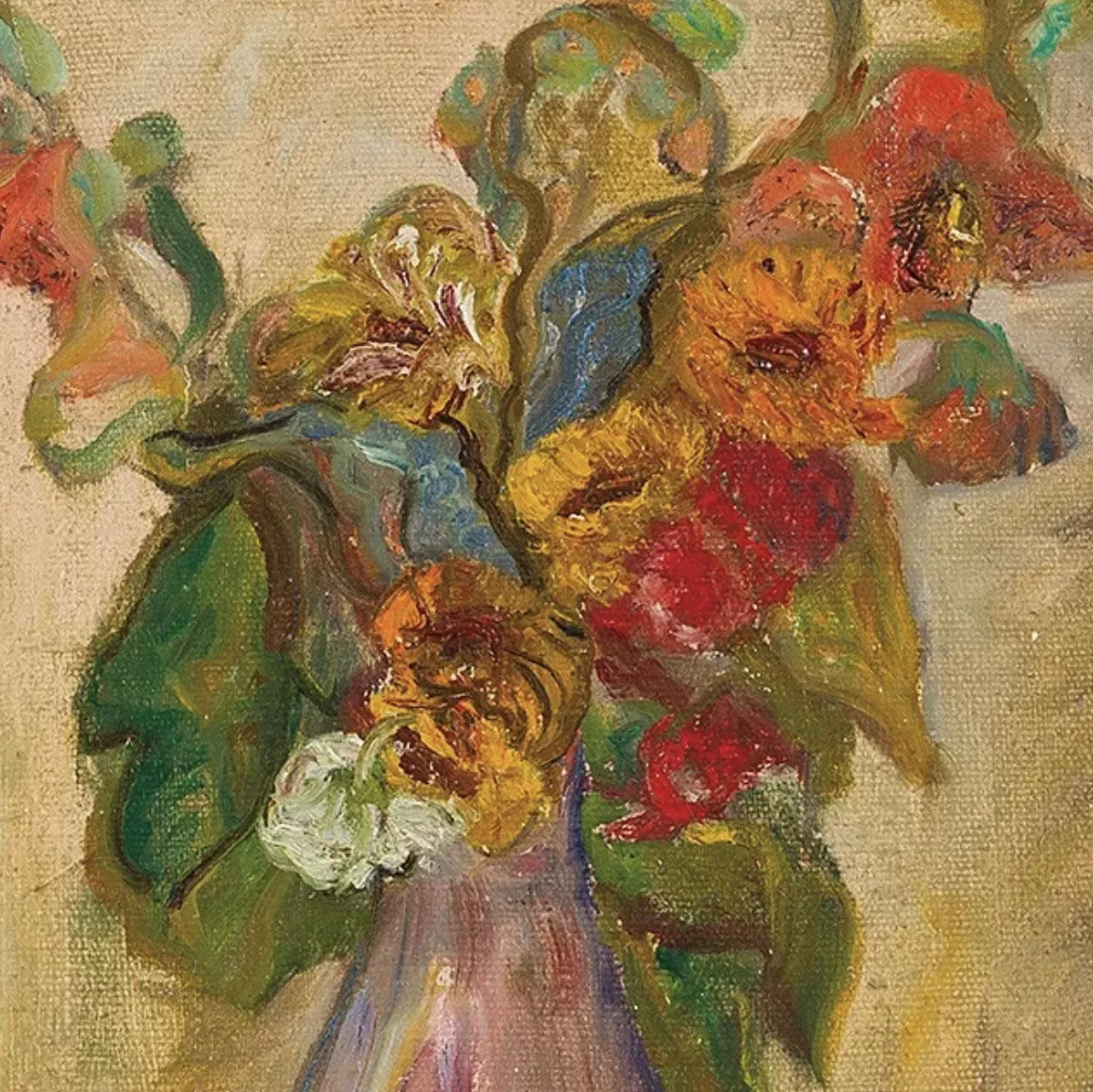
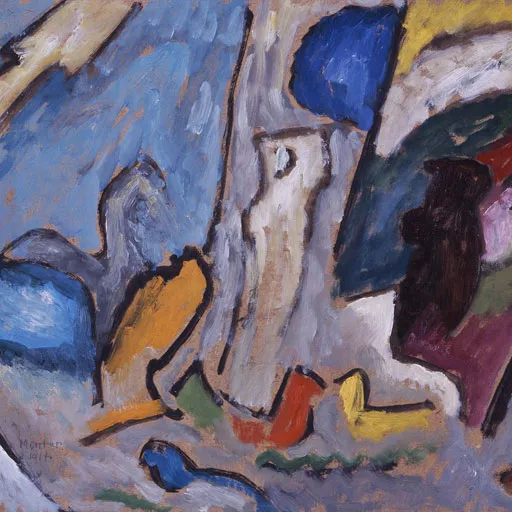
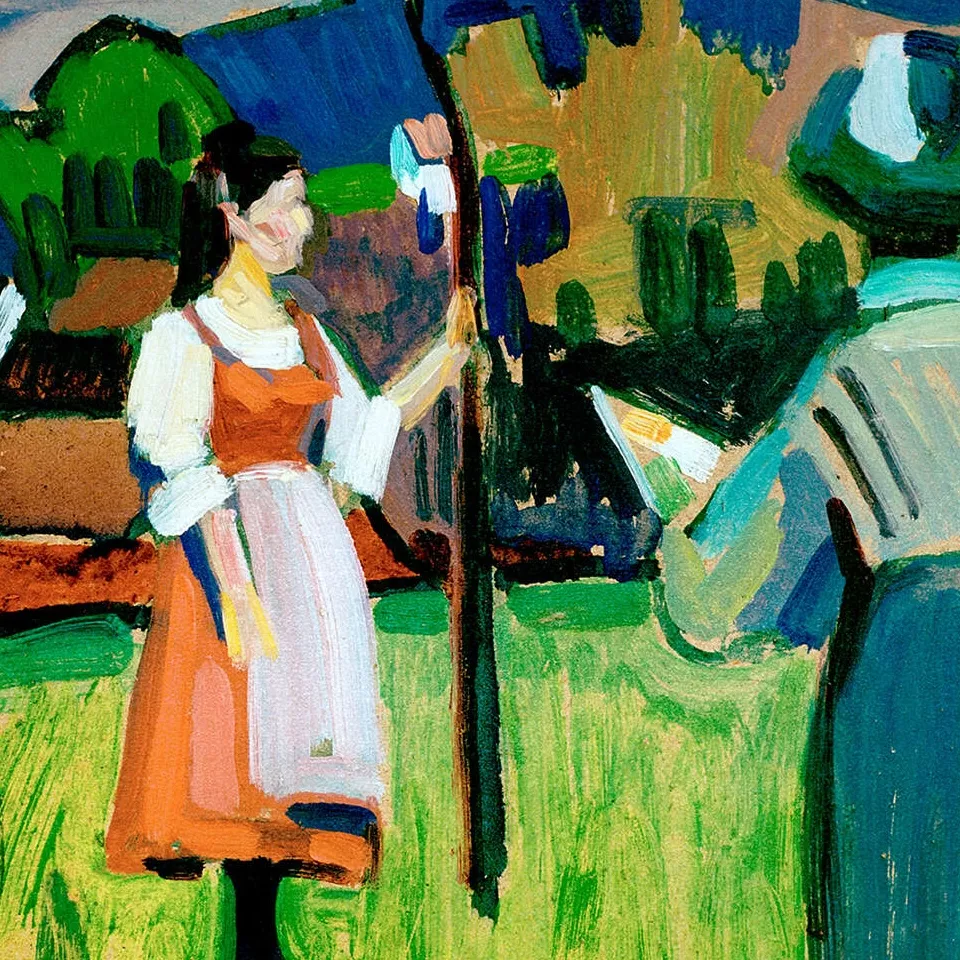
Gabriele Münter (1877 - 1962) was a German artist associated with Expressionism and the Die Blaue Reiter group. She developed a deeply Expressionist style, influenced by the German avant-gardes of the early 20th century, with a highly personal style that combines formal simplification, vivid colors and clear mass structuring.
She uses thick black outlines to define shapes, in the manner of stained glass or Bavarian folk art. The palette is dominated by pure, often non-realistic tones (intense blue, lemon yellow, acid green and vermilion red).
She uses color as a vehicle for emotion rather than description, rejecting realistic shading in favor of flat tints. Chromatic associations create visual tensions that give energy and life to the composition.
She mostly paints in oil on board or canvas, often in small to medium format. Her brushstrokes are flat and fluid, with little substance but a confident, almost naive application in her economy of means. She eliminates anecdotal details to get to the essence of the motif: stylized houses, schematic mountains and portraits with fixed expression.
She received academic training, then was influenced by the Fauvists, Matisse, Japanese and primitive art, as well as by Kandinsky, her companion. She adopted the principles of Bavarian folk art: frontality, stylization and folk motifs.
Münter was also influenced by medieval stained glass, icons and prints. Alpine landscapes, Bavarian villages, scenes of domestic life and self-portraits dominate her output.
Her vision is often intimate, even in landscapes, where nature is a mental projection rather than a topographical survey. She likes to paint everyday objects or isolated figures, in a climate of silent contemplation.
She produces numerous ink drawings, watercolors and prints, and cultivates a graphic approach close to the sketchbook, with clean lines, often without perspective. Her woodcuts reveal an extreme simplification, akin to art brut or children's work.
She doesn't seek to rival Kandisnsky or Jewlensky on the terrain of pure abstraction. Her style remains figurative but condensed, with a strong emotional intensity, through a stylized representation of the visible world.
She occupies a place apart, balancing between lyrical expression, introspection and popular memory.
The life of Gabriele Münter
Born in Berlin in 1877, Gabriele Münter came from a cultivated bourgeois family. She lost both her parents in her teens, reinforcing her early independence. She took drawing lessons in Düsseldorf, then at the women's school of the Munich Artists' Association, since fine art was forbidden to women.
In 1901, she entered the Phalanx art school in Munich, where she met Wassily Kandinsky, who became her mentor and companion. She took part in study trips with him to Europe and North Africa, experimenting with plein-air painting, printmaking and drawing, and was influenced by the French avant-garde and German folk art.
She helped found the Die Blaue Reiter group in 1911, along with Kandinsky, Franz Marc, Auguste Macke and others. In 1909, she bought a house in Murnau am Staffelsee, Bavaria. This became a place of artistic creation and experimentation.
She painted numerous landscapes of the region, with simplified forms and saturated colors. The house is now a museum dedicated to her work. In 1914, Kandinsky left Germany at the outbreak of war, and their relationship ended without explanation.
Münter went through a period of artistic withdrawal, marked by loneliness and disinterest in the art world. She continued to paint, but distanced herself from official circles, until she was rediscovered in the 1930s.
During the interwar period, she treasured works by Kandinsky, Marc, Klee and others. During the Nazi regime, it hid works described as " degenerate art ". At the end of the war, she donated an exceptional collection of major Blaue Reiter pieces to Munich's Lenbachhaus.
Gabriele Münter was not officially recognized until the 1950s. She received several tributes and exhibitions during her lifetime, including a retrospective in Munich in 1957, and died in 1962 in Murnau, leaving a body of work rich in several hundred paintings, drawings and prints.
Today, the artist is considered a pioneer of modernism and one of the few women recognized in German Expressionism, alongside Marie Louise von Motesiczky or Marianne von Wereflin.
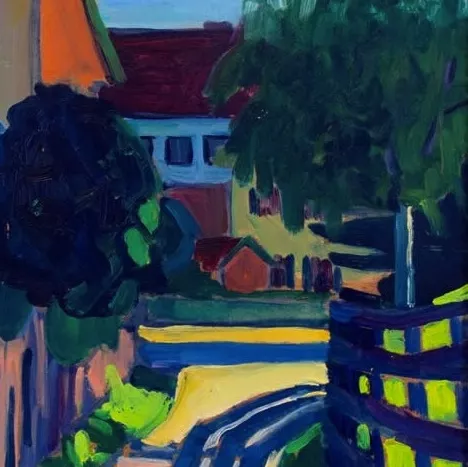
Focus on House in Murnau with garden, circa 1909
This oil-on-canvas work was produced during the pivotal period of Münter's stylistic turnaround, measures 33 x 44 cm and is housed at Munich's Lenbachhaus Museum in the permanent collection.
It depicts Münter's house in Murnau, seen from the outside with its flower-filled garden, in a slightly elevated perspective. The bright yellow facade, green shutters and garden in the foreground create a structured yet lively composition.
The frontal framing gives an impression of stability, almost symbolic, like a personal anchor. The palette used is very vivid (lemon yellow, royal blue, meadow green and vermilion red). The colors are applied in flat tones, without modeling or gradation, giving the whole a luminous, almost naïve appearance.
The whole is bathed in an even, non-naturalistic yet highly expressive light. In this work, she works with thick black outlines, characteristic of Münter's style at the time, inspired by Bavarian folk art.
The forms are simplified and almost geometric, the house is treated as a box and the trees as compact masses. There is an absence of linear depth, but a balance in the organization of planes (garden, facade, sky).
The work illustrates Münter's desire to reinterpret reality through subjectivity, without abandoning it altogether. Here, the garden becomes the expression of an inner world, between serenity and vigor. The Murnau house is a refuge and creative center, and this painting is a form of personal pictorial manifesto.
This painting synthesizes the group's aesthetic (stylized forms, pure colors and a direct relationship with the landscape). It embodies the idea of an emotional and spiritual art, capable of conveying states of mind through formal simplification.
The influence of Kandinsky is perceptible, but Münter retains a solid figuration and a grounding in the visible.
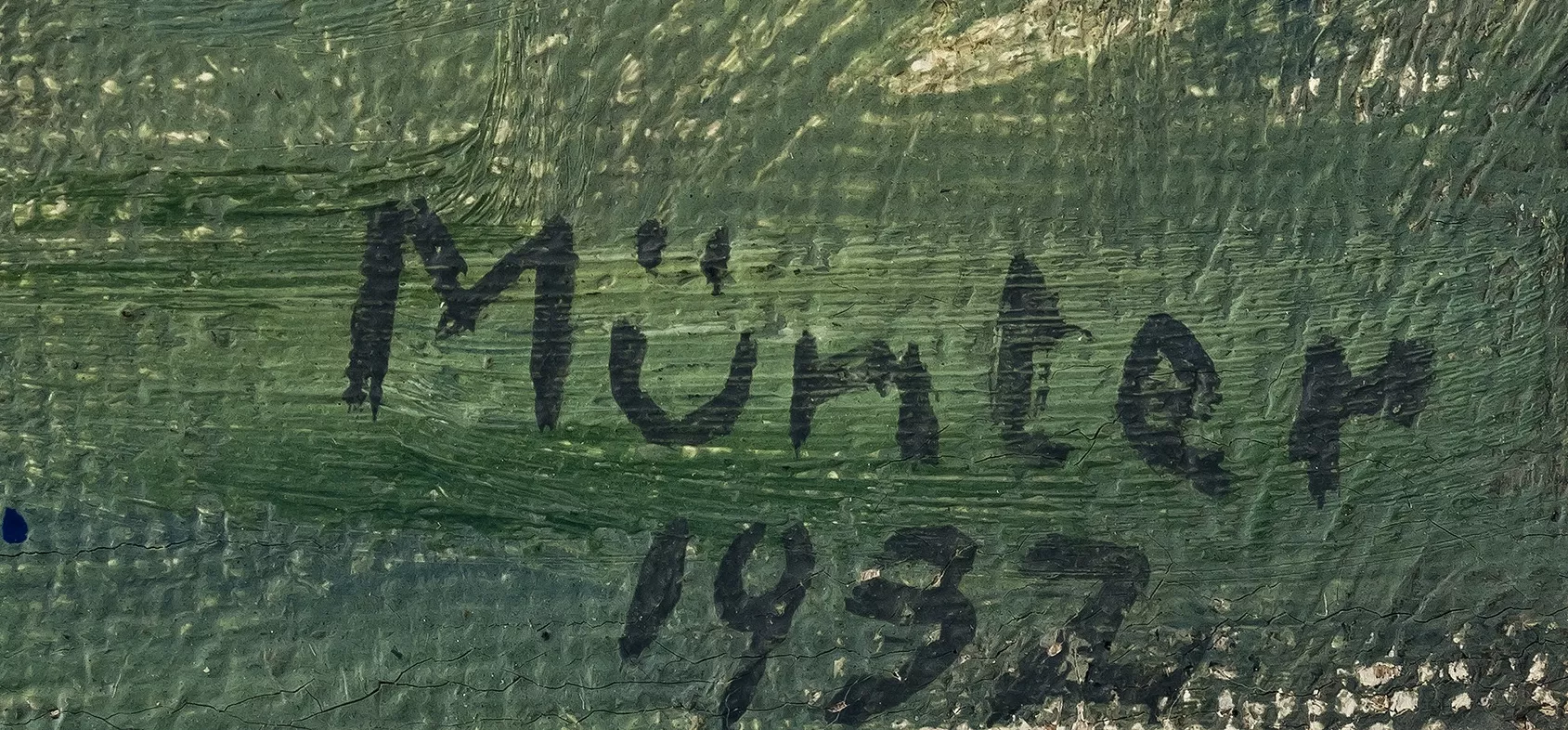
His signature
Not all of Gabriele Münter's works are signed.
Although there are variations, here's a first example of his signature:
Expertise your property
If you own a work by Gabriele Münter, don't hesitate to request a free appraisal by filling in our online form.
A member of our team of experts and certified auctioneers will contact you to provide an estimate of the market value of your work.
If you are considering selling your work, our specialists will also guide you through the various alternatives available to obtain the best possible price, taking into account market trends and the specific features of each work.
Estimate in less than 24h
Discover in the same theme

Value and quotation of works, ceramics by Roger Capron
Post-war designer Roger Capron leaves behind a singular body of work that is still very valuable. Estimate in less than 24h.
Learn more >

Rating and value of sculptures, paintings and drawings by Ar...
Aristide Maillol is a 20th-century sculptor and painter. He produced many works that are highly valued at auction.
Learn more >

Ratings and values of paintings by Luong Xuan Nhi
Luong Xuân Nhi is a Vietnamese painter trained in Hanoi, who has produced numerous works of high value. Estimated 24h.
Learn more >
D'autres tableaux expressionnistes vendus aux enchères


Secure site, anonymity preserved

Auctioneer approved by the State

Free and certified estimates
Frequently asked questions
-
Who is Gabriele Münter, and what is her artistic background?Gabriele Münter (1877–1962) was a pioneering German Expressionist artist and co-founder of the group *Die Blaue Reiter* alongside Kandinsky, her mentor and partner. Her distinctive style combines vivid, non-realistic colors, thick black outlines inspired by Bavarian folk art, and a formal simplification of forms. She is now recognized as one of the few major female figures in German Expressionist modernism.
-
What is the price range for works by Gabriele Münter?Prices for works by Gabriele Münter vary considerably depending on the medium. Prints range from €20 to €35,000, watercolors and drawings between €530 and €73,000, and paintings (oil-on-canvas works being particularly sought after) between €3,730 and €1,737,350. Her market value is rising sharply, particularly among German collectors.
-
How can you authenticate a work by Gabriele Münter?To authenticate a work by Gabriele Münter, we recommend that you request a free, no-obligation appraisal from Auctie's. A certified expert or auctioneer will examine your work and provide you with an accurate estimate of its market value within 48 hours.
-
Is this the right time to sell a work by Gabriele Münter?Yes, now is an excellent time to sell a work by Gabriele Münter. Her market value is currently rising sharply in the art market, particularly for oil-on-canvas works. Demand remains strong, especially among German collectors and international institutions, which ensures a good return on your investment.
-
How does the sales process work at Auctie's?The process begins with a free, no-obligation appraisal conducted by our experts and certified auctioneers. If you decide to sell, our specialists will guide you toward the best option to maximize the price of your artwork, taking into account market trends and the specific characteristics of your piece. We support you every step of the way, from the appraisal to the auction.
