



Rating and value of paintings by Alexej von Jawlensky

Key takeaways
- A pioneering Russian artist of 20th-century abstraction, Jawlensky enjoys stable market value, with works fetching several million euros at auction.
- Prices vary considerably depending on the medium: prints range from €30 to €52,000, watercolor drawings from €270 to €200,000, and paintings from €20 to €11,117,880.
- His work is characterized by the use of color as a vehicle for pure spiritual expression, particularly in his “Mystical Heads” and “Abstract Heads,” which are reduced to clean lines and vibrant blocks of color.
If you own a work by or based on the work of artist Alexej von Jawlensky and would like to know its value, our state-approved experts and auctioneers will guide you.
Our specialists will carry out a free appraisal of your work, and provide you with an accurate estimate of its value on the current market.
Then, should you wish to sell your work, we will direct you to the best possible arrangement to obtain the optimum price.
Artist's rating and value
A Russian artist and pioneer of abstraction, Alexej von Jawlensky established himself as a major artist of his time. He produced works inspired by several twentieth-century currents and his native country, mixing media.
On the art market, his works sell for very good prices and keep a stable quotation.
As such, a work signed by the artist's hand can fetch millions of euros at auction, as evidenced by his oil on canvas Spanish Dancer, fetched €7,000,000 in 2024, testifying to the growing interest of collectors in Jawlensky's works.
Order of value from the most basic to the most prestigious
Technique used | Result |
|---|---|
Estamp - multiple | From €30 to €52,000 |
Drawing - watercolor | From €270 to €200,000 |
Painting | From €20 to €11,117,880 |
Estimate in less than 24h
The artist's works and style
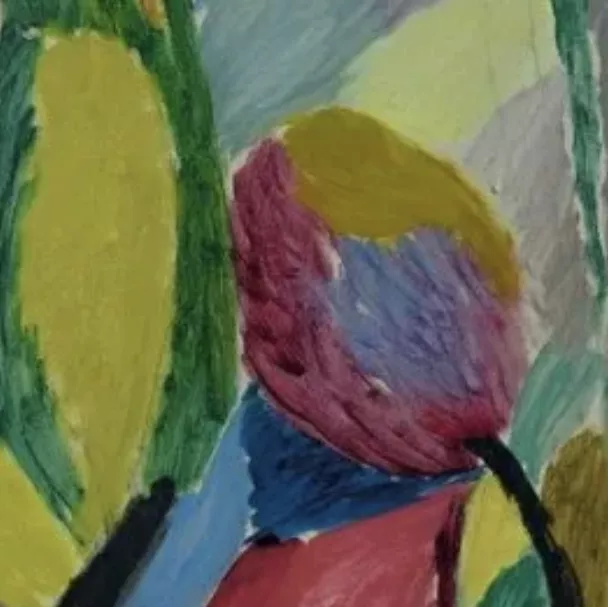
In Alexej von Jawlensky, color asserts itself as a vector of pure expression, freed from the constraints of naturalism. From his earliest works, influenced by Impressionism and Fauvism, he favors a broad, energetic brushstroke, where pictorial matter, laid down in vibrant flat tints, tends towards increasing stylization.
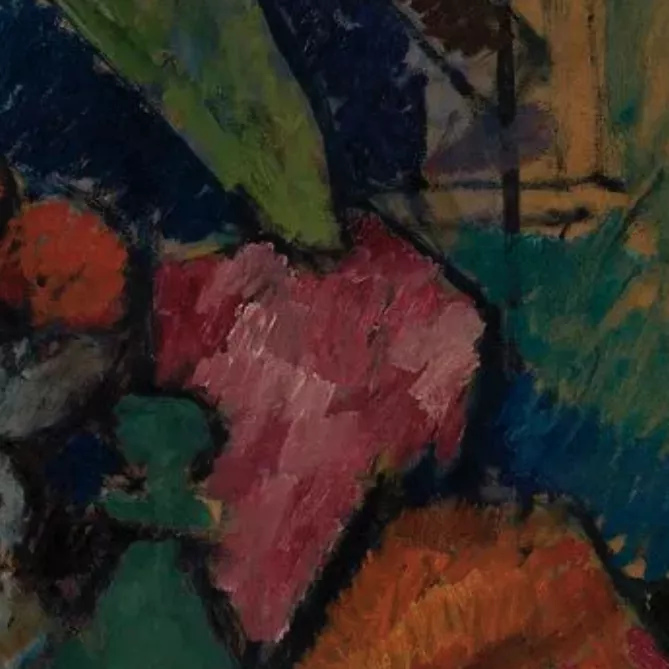
His relationship to form, first inherited from Cézanne and Van Gogh, evolves towards a synthesis where the structure of the face, particularly in his mystical heads and abstract heads, is reduced to a network of rhythmic, almost calligraphic lines.
The artist substitutes traditional modeling with a play of chromatic oppositions, where incandescent red rubs shoulders with deep blue, where yellow illuminates green shadows, in a construction where color becomes the true motor of expression.
From the 1910s onwards, Jawlensky moved away from the external motif towards an exacerbated interiority: in his Variations, the brushstroke becomes more fluid, the painting surface is stripped to achieve an abstraction where light and chromatic vibration take the place of subject.
He no longer seeks to describe but to transcribe a spiritual reality, where the repetition of forms and the intensity of colors establish an autonomous pictorial language, purified to the essential.
The life of Alexej von Jawlensky
Born in 1864 in Torjok into a family of Russian nobility, Alexej von Jawlensky initially embarked on a military career, following family tradition, before a visit to the Academy of Fine Arts in St. Petersburg awakened in him an irrepressible vocation for painting.
Encouraged by Ilia Répine, he trained with Anton Ažbe in Munich, where he frequented Kandinsky, Marianne von Werefkin and other avant-garde figures.
There, he discovered the expressive power of color through the lessons of Cézanne, Van Gogh and above all Matisse, whose influence shines through in his early compositions, where the line is liberated and the palette is set ablaze.
A founding member of the Neue Künstlervereinigung München, he broke with Kandinsky in 1911 to exhibit with the Blaue Reiter, finding in this movement a resonance with his quest for an inner painting, freed from naturalism. The war forced him into exile in Switzerland, where he began his Variations, series in which the landscape is stripped down to nothing more than a vibrant arrangement of colors and rhythms.
Returning to Wiesbaden, Germany, he began his Mystical Heads and Abstract Heads, in which the human figure is reduced to an architecture of colored lines and planes, in a quest for pictorial absoluteness that takes on a spiritual dimension.
Affected by arthritis from the 1920s onwards, he persisted despite the pain, pursuing his work in an asceticism where the reduction of forms reaches an almost liturgical intensity.
His painting, more than a simple stylistic evolution, becomes an autonomous language, where color, transcended, imposes itself as the ultimate expression of the soul and inner meditation.
Focus on Tête de femme, Alexej von Jawlensky, circa 1912
In Tête de femme, circa 1912 (Musée national d'Art moderne, Paris), Alexej von Jawlensky replaces naturalistic description with a synthetic construction in which pure, incandescent color becomes the driving force of figuration.
The face, reduced to a network of simplified lines, is inscribed in a rigorous frontality, where the black outline accentuates the structure of the planes and imposes an almost hieratic geometry.
The green and blue shadows, set in broad flat tints, contrast with the bursts of red and yellow, giving the whole a chromatic vibrancy that evokes the research of Matisse and the Fauvists, while taking on a more interiorized register.
The dense application of pure colors, juxtaposed without gradation, intensifies the visual impact, while the gaze, emptied of all anecdotal detail, reinforces the impression of an immutable mask, on the edge of Byzantine icon and abstraction.
Far from a psychological portrait, Jawlensky here imposes a modern effigy, where expressiveness is born of the tension between extreme stylization and colorful intensity.
This approach, which foreshadows his Mystical Heads and Abstract Heads, inscribes his work in a spiritual quest, where formal simplification tends towards an almost sacred dimension.
In this painting, color no longer describes: it embodies an essence, an inner radiance, a visual epiphany where the human face becomes the medium for a meditation on light and the divine.
Alexej von Jawlensky's imprint on his period
Alexej von Jawlensky's imprint on his period lies in this transfiguration of the face into an archetype, where color is no longer a matter of naturalism but of spiritual necessity.
His work, on the bangs of the most radical avant-gardes, nevertheless asserts itself as one of the essential milestones of nascent abstraction, in that it extracts from the motif an inner truth, detached from any narrative contingency.
From his Mystical Heads and Abstract Heads, in the 1910s-1920s, Jawlensky deploys a pictorial language that profoundly influences Expressionist generations, from Kandinsky to Klee, through this ability to turn the portrait into a space for plastic and chromatic meditation.
His use of line, pared down to the most elementary schematization, and his approach to flat tints of color, worked in vibrant juxtapositions, herald both the research of Orphism and Abstract Expressionism.
Far from a simple formal renewal, Jawlensky thus inscribed painting in an inner quest where the human face becomes, through its repetition and stylization, a universal sign, a profane icon on the edge of the sacred.
The stylistic influences of Alexej von Jawlensky
In Alexej von Jawlensky, stylistic influences intertwine in a dense network where Russian iconographic tradition meets European avant-gardes.
Trained at the St. Petersburg Academy of Fine Arts, he assimilated the codes of academic painting before opening up, through contact with Marianne von Werefkin, to the boldness of the French Post-Impressionists.
His move to Munich in 1896 marked a turning point: the discovery of Van Gogh, Cézanne and Gauguin inflected his approach to color and form, while friendship with Kandinsky and membership of the Blaue Reiter in 1911 steered him towards a more intense expressivity, where figuration took on an almost mystical dimension.
Alongside this hybridization came the decisive influence of folk art and Orthodox icons, from which Jawlensky retained the hieratic frontality, extreme simplification of volumes and power of the gaze.
In his series of Mystical Heads and Abstract Heads, this Byzantine imprint melts into a pictorial style in which the line partitions the colored planes in the manner of the Nabis, while the brushstroke, laid down in vibrant flat tints, recalls the Fauvism of Matisse and Derain.
The gradual deconstruction of the model, reducing the face to an essential structure of shapes and colors, evokes the research of Cézanne, but also the work of the German Expressionists, in whom Jawlensky finds a similar quest for interiority.
His palette, initially marked by violent contrasts, gradually moves towards more meditative harmonies, where deep tonalities and complementary oppositions create a spiritual resonance.
Far from simply borrowing from the currents of his time, this synthesis enables him to inscribe painting in a timeless dimension, between iconic tradition and visionary abstraction.
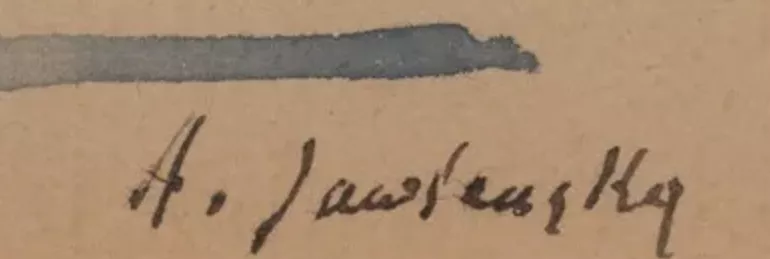
His signature
Not all Alexej von Jawlensky's works are signed.
Although there are variations, here's a first example of his signature:
Expertise your property
If you own a work by Alexej von Jawlensky, don't hesitate to request a free appraisal by filling in our online form.
A member of our team of experts and certified auctioneers will contact you to provide an estimate of the market value of your work.
If you are considering selling your work, our specialists will also guide you through the various alternatives available to obtain the best possible price, taking into account market trends and the specific features of each work.
Estimate in less than 24h
Discover in the same theme

Rating and value of works, drawings, paintings by Gustave Ca...
Gustave Cariot was a twentieth-century pointillist painter who produced drawings and oil paintings that were appreciated and quoted at auction.
Learn more >

Rating and value of furniture, desks, lamps, armchairs by Pa...
Paul Dupré-Lafon was a 20th-century architect and decorator who produced much sought-after furniture that is valued at auction.
Learn more >

Rating and value of paintings by Louis Mathieu Verdilhan
Louis Mathieu Verdilhan is a twentieth-century figurative painter who produced
Learn more >

Secure site, anonymity preserved

Auctioneer approved by the State

Free and certified estimates
Frequently asked questions
-
Who was Alexej von Jawlensky, and what role did he play in the history of modern art?Alexej von Jawlensky (1864–1943) was a Russian artist who pioneered abstraction and was a leading figure in German Expressionism. Trained in Saint Petersburg and later in Munich, he founded the Neue Künstlervereinigung München before joining the Blaue Reiter in 1911. His work, characterized by the expressive use of pure color and the gradual simplification of form—particularly in his famous series *Mystical Heads* and *Abstract Heads*—profoundly influenced generations of Expressionist and Abstract artists in the 20th century.
-
What are the price ranges for Jawlensky's works based on the medium used?Prices for Jawlensky’s works vary considerably depending on the medium: prints range from €30 to €52,000, drawings and watercolors from €270 to €200,000, while paintings range from €20 to €11,117,880. His major works, such as the oil on canvas “Spanish Dancer,” which sold for €7,000,000 in 2024, reflect the art market’s growing interest in his work and the stability of his market value.
-
How do I have a Jawlensky artwork authenticated and appraised?Auctie's offers a free, no-obligation appraisal of your artwork. Simply fill out an online form, and a certified expert or auctioneer will contact you to conduct the appraisal and provide you with the exact market value of your item. This process also helps you identify the best options for selling your artwork at the best price.
-
Is this the right time to sell a work by Jawlensky?Yes, the current market is favorable for selling works by Jawlensky. His market value remains stable, and collectors are showing growing interest in his paintings, as evidenced by the record prices achieved at auction in recent years. Our experts will advise you on the best time and the optimal approach to achieve the highest possible price.
-
How does the sales process work at Auctie's?Auctie's supports you every step of the way: after a free appraisal by our certified auctioneers, we’ll help you determine the best sales strategy for your artwork. We take into account market trends and the unique characteristics of each piece to maximize your return, from the initial appraisal through to the final sale.
