



Rating and value of sculptures and bronzes by Séraphin Soubdinine

Key takeaways
- A student of Auguste Rodin, Séraphin Soudbinine (1867–1944) is highly sought after by collectors, with works fetching up to €284,500 at auction in 2018.
- Terracotta and marble sculptures dominate the market for his work, with price ranges of €700–812,790 and €800–284,500, respectively, depending on the piece.
- His refined style emphasizes formal simplicity, balanced volumes, and restrained emotional expression, influenced by Byzantine art and Russian Orthodox iconography.
If you own a work by or based on the artist Séraphin Soudbinine and would like to know its value, our state-approved experts and auctioneers will guide you.
Our specialists will carry out a free appraisal of your work, and provide you with a precise estimate of its value on the current market.
Then, if you wish to sell your work, we will direct you to the best possible arrangement to obtain the optimum price.
Artist's rating and value
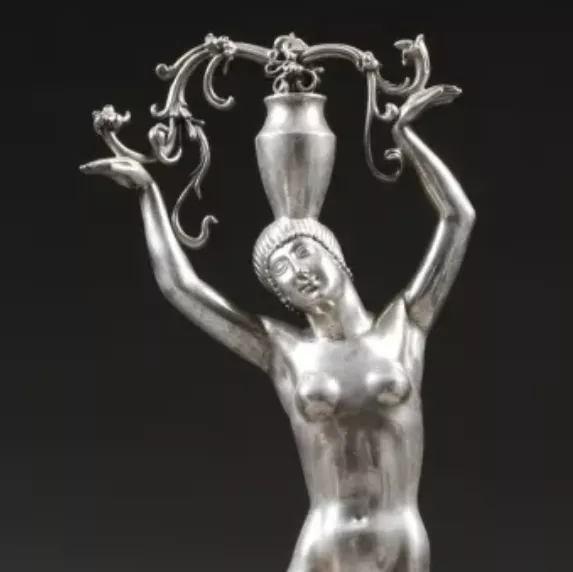
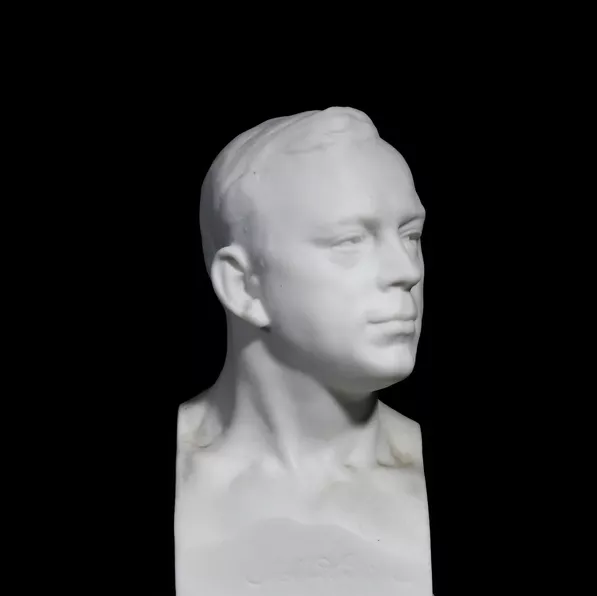
Considered one of Auguste Rodin's most promising pupils, Séraphin Soudbinine sculpted numerous bronzes. Also a draughtsman, Soudbinine enjoyed a certain reputation during his lifetime, establishing himself as a major figure on the art market.
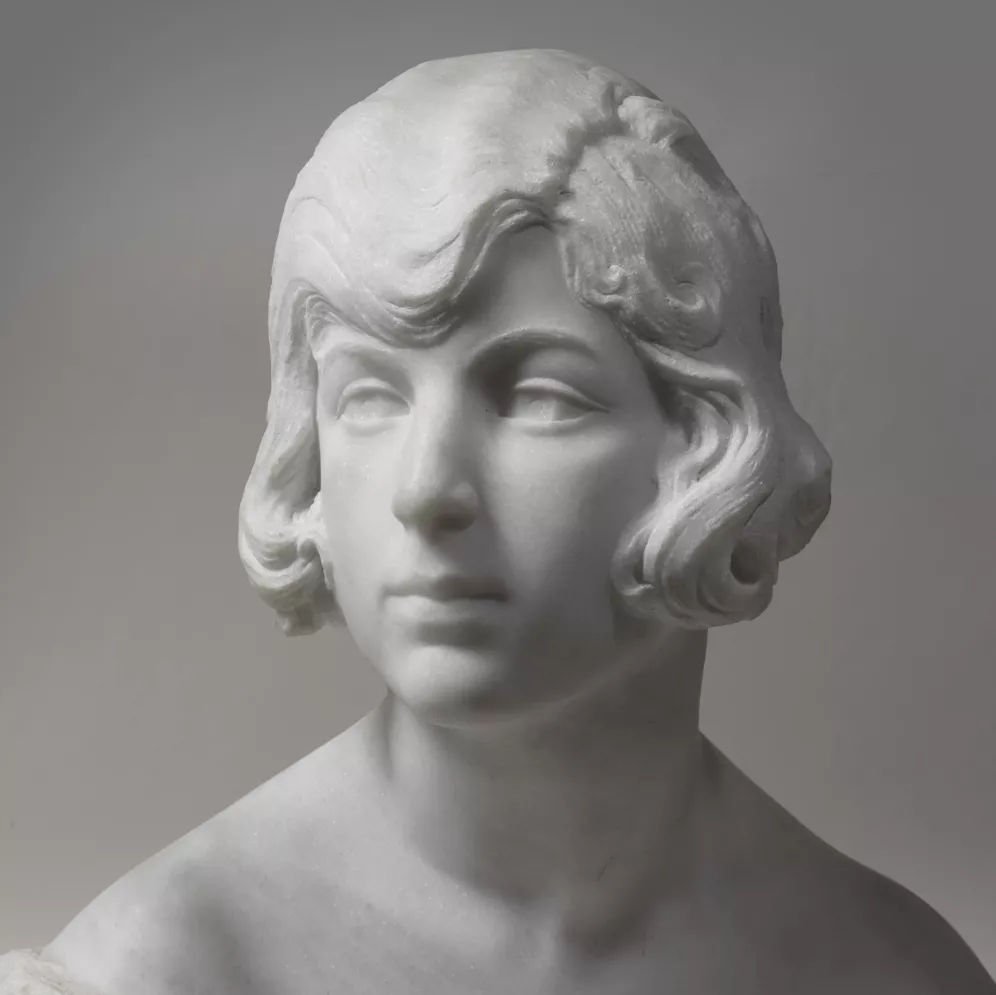
Today highly-rated and sought-after by collectors, the price of works by Séraphin Soudbinine soars at auction and can reach hundreds of thousands of euros, as evidenced by his marble bust of a young woman, 42.9 cm high, sold for €284,500 in 2018 whereas it was estimated at between €45,500 and €68,300.
Order of value from the most basic to the most prestigious
Technique used | Result |
|---|---|
Drawing - watercolor | From €1,100 to €30,700 |
Wood | From 370 to €37,000 |
Bronze | From €500 to €39,000 |
Silver | From €33,000 to €56,000 |
Marble | From 800 to €284,500 |
Terracotta | From €700 to €812,790 |
Estimate in less than 24h
Style and technique of artist Séraphin Soudbinine
Séraphin Soudbinine's style and technique testify to rigorous craftsmanship inherited from his apprenticeship with Auguste Rodin, while asserting a singular, uncluttered vision.
His work is distinguished by a constant search for balance between form and expressivity, where soft lines and simple volumes seem to carry a restrained emotional charge. Far from dramatic effects, he favors a sobriety that reinforces the silent presence of his figures, whether human or animal.
Soudbinine mainly uses stone and bronze, materials he masters with remarkable technical precision. In his stone sculptures, he exploits the intrinsic qualities of the material, playing on texture and polished surfaces to catch the light and accentuate the fluidity of the forms.
Through this economy of means, he manages to make palpable a certain interiority, a discreet but deeply rooted spirituality.
Compared with his contemporaries, such as Maillol or Bourdelle, Soudbinine stands out for a measured abstraction that is more akin to a synthesis than a rupture.
Where Maillol celebrates the fullness of the female body and Bourdelle exalts heroic movement, Soudbinine focuses on a more meditative, almost ascetic expression, inscribed in compact, balanced forms.
This quest for timeless purity makes his work a modern echo of the classical canons, while paving the way for a new sculptural sensibility.
.
The life of Séraphin Soudbinine
Born in 1867 in Nizhny Novgorod, Russia, Séraphin Soudbinine embodies a fascinating trajectory, straddling two worlds: that of his Russian heritage and that of an artistically effervescent France.
Initially trained as an actor in Moscow, he joined the Stanislavsky Art Theatre, but his destiny changed when he turned to sculpture in the late 1890s.
Attracted by Europe, he settled in Paris and became a pupil of Auguste Rodin in 1904, whose studio would profoundly shape his artistic sensibility.
Soudbinine quickly distinguished himself with a pared-down approach, contrasting with the exuberance of his master, and began exhibiting from 1909.
His works met with a favorable response, particularly from a circle of enlightened amateurs who recognized in him a singular voice, blending classical influences and nascent modernity.
The Russian Revolution of 1917 cut him off from his roots, forcing him to make France his permanent home, where he pursued a discreet but steady career.
Throughout his life, Soudbinine refused commercial compromises, preferring a limited, meticulous output. He died in 1944 in Paris, leaving behind a body of work imbued with a profound serenity.
While his name remains relatively unknown to the general public, his influence is evident in the way he reconciled heritage and modernity, inscribing his sculptures in a universal, meditative temporality.
The imprint of Séraphin Soudbinine
Séraphin Soudbinine's imprint on his era, though discreet, is part of a quest for timelessness that stands in stark contrast to the stylistic upheavals of the early 20th century.
Heir to Rodin's teachings, he adopts a resolutely uncluttered approach, eschewing naturalistic excess in favor of effusive, almost spiritual forms.
In the midst of modernist effervescence, as art ventured towards abstraction and radical experimentation, Soudbinine chose to focus on the essentials: line, volume, and the expression of restrained emotion.
His influence can be measured in the way he blended classical traditions, stemming from Russian symbolism and the teaching of Rodin, with a contemporary sensibility, marked by simplicity and contemplation.
At a time when art was fragmenting into multiple movements, his work recalled the power of a sculptural discourse centered on humanity and serenity.
His works, though few in number, found their way to a circle of aesthetes sensitive to this quest for universality, illustrating a valuable counterpoint to the frenzy of the avant-garde.
While his name often remains overshadowed by the giants of his period, Soudbinine's legacy lies in this singularity: a timeless art, where form and meaning meet to express a soothed beauty, far removed from the tumult and stylistic ruptures of his time.
Focus on La Tristesse, Séraphin Soudbinine
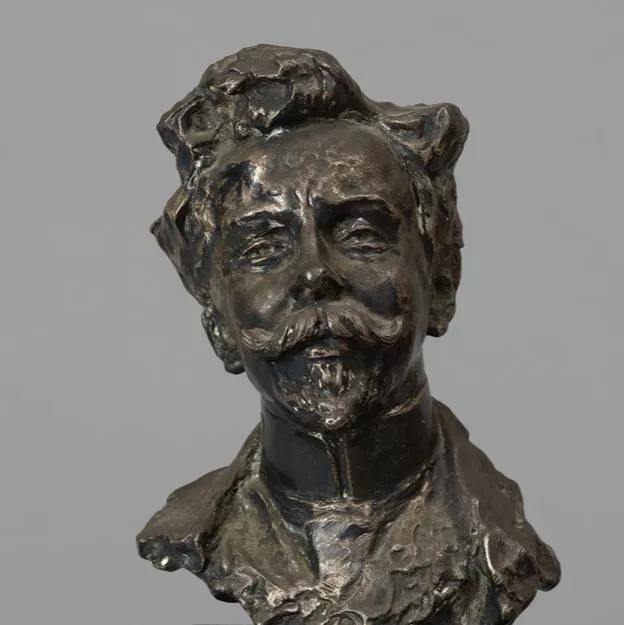
The La Tristesse bust by Séraphin Soudbinine is part of an approach in which formal sobriety is placed at the service of universal expression. Created in finely polished marble, it bears witness to the search for a balance between simplicity and emotional depth.
The slightly idealized facial features convey a silent melancholy. The closed eyelids, delicate lip line and softened contours exude a restraint where any dramatic effect seems deliberately excluded.
In this work, Soudbinine inherits Rodin's lessons, particularly in the treatment of matter as a vehicle of interiority. However, he detaches himself from them through an almost spiritual quest for harmony, probably influenced by his attachment to his Russian roots and Orthodox iconography.
This sculptural simplicity, which plays on light and reduced volumes, also recalls the aesthetics of the primitives, where every element is at the service of an essential, timeless emotion.
The choice of marble, a demanding but noble material, is not insignificant: it lends permanence and solemnity to this figure of restrained sadness. The work, in its expressive restraint, calls for silent, profound contemplation.
This bust, far from narrative demonstrations or grandiloquent effects, perfectly illustrates the way Soudbinine conceived sculpture: not as an imitation of the living, but as a reflection on the essence of the human soul, translated into the purity of the artistic gesture.
Seraphim Soudbinin's stylistic influences
Seraphim Soudbinin is part of an artistic landscape where classical traditions and modernist aspirations converge, while asserting a deeply personal stylistic identity.
A student of Rodin, he assimilates the master's sensitivity to movement and material, but favors a more austere interpretation, guided by a quest for formal purity.
Influences of Greek archaic art, perceptible in his sculptures with their simplified volumes, are interwoven with a fascination for Byzantine iconography, where frontality and rigor compose a timeless solemnity.
This convergence of heritages is not unlike the approach of sculptors such as Antoine Bourdelle, who revisits antiquity with monumental vigor, or Aristide Maillol, whose full, smooth forms respond to an aesthetic of the essential.
However, Soudbinine integrates into this tradition a specific spiritual breath, marked by his Russian origins and his attraction to Orthodoxy, which lend his works a meditative gravity.
In addition, his ceramic work, inspired by the mastery of the arts of fire in Asia, testifies to an attention to detail and a sensitivity to material that bring him closer to Japanese craft practices.
In this way, Soudbinine achieves a synthesis between various artistic universes, transforming plural influences into a unified, singular vision that is deeply rooted in the aesthetic questionings of his time, and his work finds echoes in the works of Antoine Bourdelle or Aristide Maillol.
His sculptures stand out as objects for reflection, transcending contingencies to achieve a timelessness that is both subtle and universal.
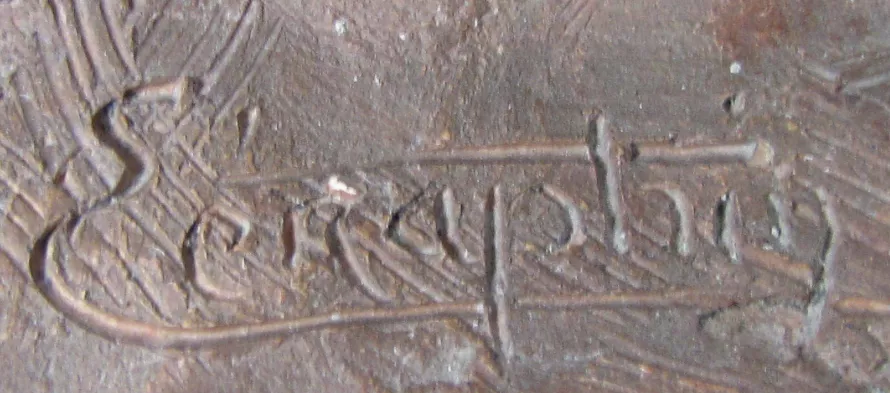
His signature
Not all of Séraphin Soudbinine's works are signed.
Although there are variations, here is a first example of his signature:
Expertise your property
If you own a work by Séraphin Soudbinine, don't hesitate to request a free appraisal by filling in our online form.
A member of our team of experts and certified auctioneers will contact you to provide an estimate of the market value of your work.
If you are considering selling your work, our specialists will also guide you through the various alternatives available to obtain the best possible price, taking into account market trends and the specific features of each work.
Estimate in less than 24h
Discover in the same theme

Rating and value of furniture, tables and chairs by Shiro Ku...
Shiro Kuramata is a twentieth-century Japanese designer who produced design furniture that is highly rated and has a high auction value.
Learn more >

Rating and value of works, drawings, paintings by Emile Bogg...
Emile Boggio is a Franco-Argentinian Impressionist painter who produced drawings and paintings that are listed at auction. Estimated in 24h.
Learn more >

Appraisal and Value of Henri Hélis's Paintings, Drawings, an...
Henri Hélis is a twentieth-century Impressionist painter who produced works that are listed and appreciate in value at auction. Estimate in 24h
Learn more >
D'autres bronzes modernes vendus aux enchères

Estimated Between €2,000 and €4,000
Edouard Marcel SANDOZ (1881-1971) curly stingray, bronze print

Estimated Between €1,500 and €3,000
Renato CARVILLANI (1896-1986), seated woman, gilded bronze print

Estimated Between €1,500 and €3,000
César BALDACCINI dit CESAR (1921-1998), Poule Cartier, bronze print

Estimated Between €10,000 and €20,000
Baltasar LOBO (1910-1993), female nude in bronze

Estimated 5.000 - 8.000
Igor MITORAJ (1944-2014), Bust of Asclepius, Green patina bronze sculpture

Secure site, anonymity preserved

Auctioneer approved by the State

Free and certified estimates
Frequently asked questions
-
Who was Séraphin Soudbinine, and what is his significance in the history of sculpture?Séraphin Soudbinine (1867–1944) was a Russian-French sculptor considered one of Auguste Rodin’s most promising students. Initially trained as an actor in Moscow, he turned to sculpture in the late 1890s and moved to Paris in 1904 to study under Rodin. His work is distinguished by a refined and meditative approach that blends classical heritage with modernity, and he is highly sought after by collectors today.
-
What are the prices and price ranges for works by Séraphin Soudbinine?The prices of Soudbinine’s works vary considerably depending on the medium and the prestige of the piece. Drawings and watercolors range from €1,100 to €30,700, bronzes from €500 to €39,000, and marble sculptures from €800 to €284,500. His most prestigious works can fetch hundreds of thousands of euros at auction, such as this marble bust that sold for €284,500 in 2018.
-
How do I have a sculpture or bronze by Séraphin Soudbinine appraised?To have a work by Séraphin Soudbinine appraised, please fill out our free online appraisal form. A certified expert or auctioneer from our team will contact you to appraise your item. This appraisal is non-binding, and you will receive an accurate estimate of your artwork’s market value within 48 hours.
-
Is this the right time to sell a work by Séraphin Soudbinine?Yes, now is an excellent time to sell a work by Séraphin Soudbinine. The artist is currently highly regarded and sought after by collectors, and his prices continue to rise at auction. Demand remains strong for high-quality sculptures and bronzes, which ensures the best possible selling conditions.
-
How does the sale of a work of art work at Auctie's?Auctie's supports you from the appraisal to the auction. After a free appraisal conducted by our experts and certified auctioneers, we will recommend the best sales approach based on your artwork and current market trends. Our team will guide you through every step to help you achieve the best possible price.
