



Rating and value of paintings, sculptures and collages by Raymond Hains

Key takeaways
- Raymond Hains, a leading figure in lyrical abstraction, has seen his market value rise steadily, with prices ranging from 20 to 270,000 euros.
- His most prestigious works are his paintings (up to 270,000 euros), while his photographs start at a minimum of 600 euros.
- The artist is known for inventing the hypnagogoscope and repurposing torn urban posters, placing his work at the intersection of New Realism and conceptual art.
If you own a work by artist Raymond Hains or based on his work and would like to know its value, our state-approved experts and auctioneers will guide you.
Our specialists will carry out a free appraisal of your work, and provide you with an accurate estimate of its value on the current market.
Then, should you wish to sell your work, we will direct you to the best possible arrangement to obtain the optimum price.
Artist's rating and value
Considered a major artist of lyrical abstraction, Raymond Hains exhibited widely during his lifetime. As a result, he already enjoys a certain notoriety and presence on the art market.
Today, his stock continues to rise, the artist establishing himself as a sure bet on the art market, with prices at which they sell ranging from €20 to €270,000 on the art market.
A work by Hains can fetch hundreds of thousands of euros at auction, as evidenced by his lacerated and torn poster Sans titre, dating from 1967 sold for €200,70 in 2007, while it was estimated at between €80,000 and €100,000.
Order of value from the most basic to the most prestigious
Technique used | Result |
|---|---|
Photography | From €600 to €11,500 |
Drawing | From €280 to €71,200 |
Estamp | From €20 to €73,000 |
Sculpture - volume | From €400 to €140,000 |
Painting | From €120 to €270,000 |
Estimate in less than 24h
Artist's style and technique
Raymond Hains began his career with photography, but soon invented new processes, notably with fluted glass, giving his works a rather hybrid character.
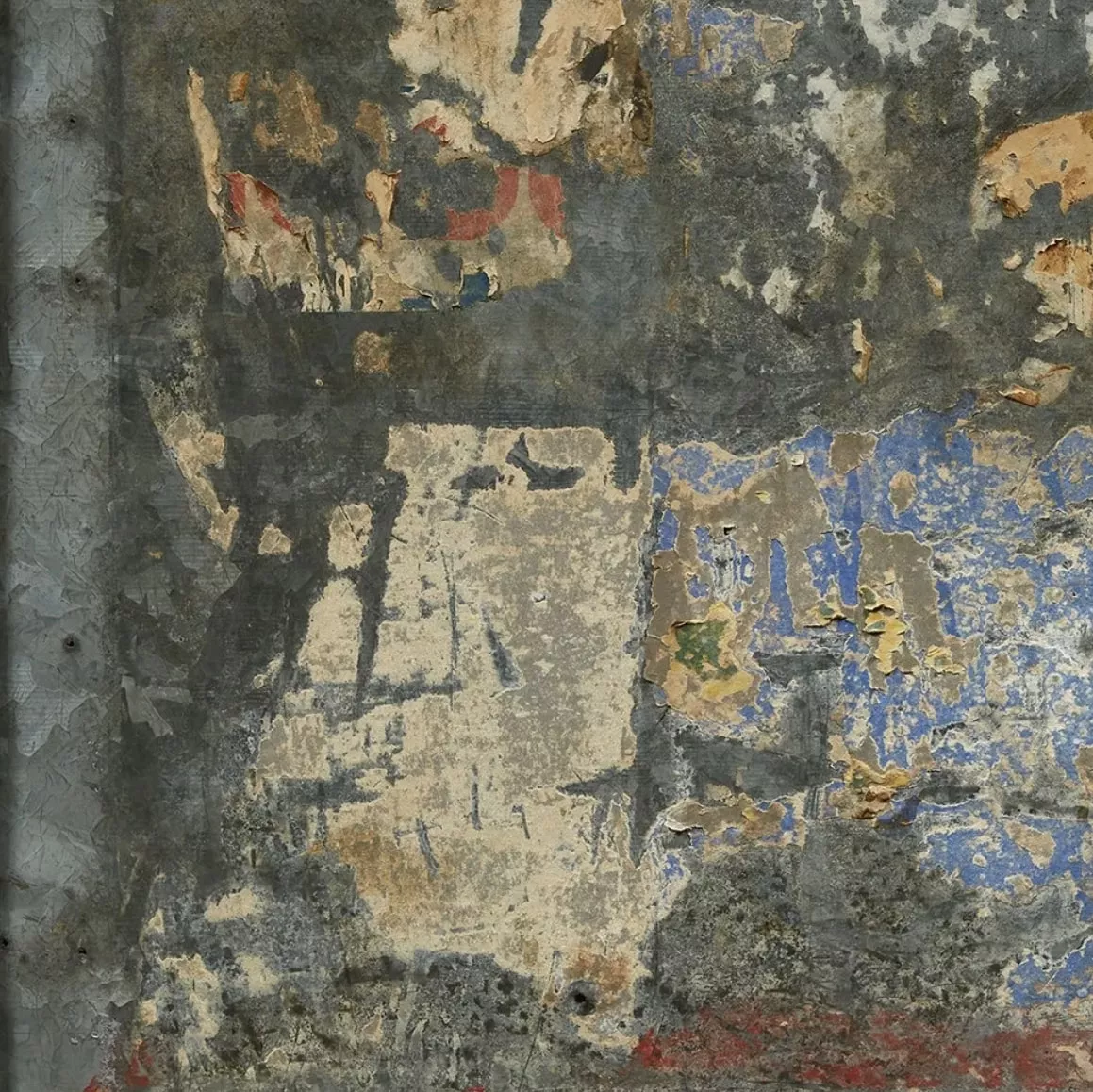
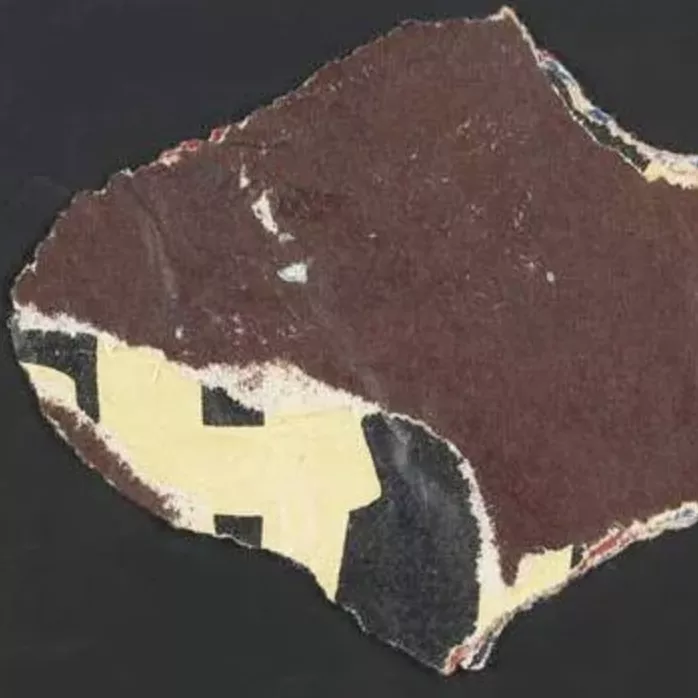
His aesthetic is founded on détournement : he develops a visual language that is based on the recovery of urban elements, especially where torn posters are concerned. He extracts them from their context to make them works in their own right, which are inscribed in reality.
From the late 1940s onwards, he collected fragments of posters torn down from the street, which he chose to assemble without direct pictorial intervention, claiming in this way an artistic gesture rooted in randomness, quite close to New Realism.
Throughout his career, he has worked with photography and experimental optics, initially taking an interest in distorted photography, using a grooved lens he calls " hypnagogoscope ", which modifies the image and thus inscribes it in a formal research around perception.
As a result, he plays with language, integrating a linguistic dimension into his work that multiplies puns, neologisms and phonetic shifts - especially in his " poster-poems ", and more broadly in the titles of his works.
He leads a reflection between art and everyday life, his approach aiming to blur the boundary between art and urban reality, he values the traces of modern life as artistic materials and criticizes, in filigree, consumer society.
His conceptual influence is undeniable, his work often being seen as a reflection on the act of creation itself, where the artist becomes more revelator than producer of form.
Through his style and technique, the artist builds a singular body of work that lies at the crossroads of New Realism, conceptual art and visual poetry - appropriating everyday signs in order to reveal their aesthetic and critical force.
Today, his works hold a very high value on the art market and are sought after by many collectors and enthusiasts. 52.8% of the artist's sales take place in France.
The life of Raymond Hains
Raymond Hains (1926 - 2005), is a French abstract painter born in Saint-Brieuc, in the Côtes d'Armor. He trained at the École des Beaux-Arts in Saint Brieuc, before moving to Paris. He soon held his first photography exhibition.
In 1960, he was one of the signatories of the Nouveau Réalisme manifesto, which included Arman, Yves Klein and Jacques Villeglé.
Villeglé's early work was characterized by a substantial photographic output, inspired in particular by Emmanuel Sougez, whose work he discovered in Laval two days after D-Day. During this period, he photographed the consequences and damage of the war with a Kodak.
A year later, in 1945, he continued his artistic and intellectual training at the Beaux-Arts in Rennes, where he met Jacques Villeglé. However, he preferred to study philosophy and take up photography with Emmanuel Sougez, director of photography at France-illustrations.
In 1946, he finished developing his first photographs and solarizations, which he submitted to André Breton. He chooses to give his photographs greater scope by purchasing a circular reflector that works with mirrors, allowing the subject to be multiplied and fragmented.
Innovations in photography
Born into a family of glaziers, he discovers paint-stained fluted glass in his parents' workshop, which he decides to use as materials for his own photographs. He developed a fluted lens that he called " the hypnagogoscope " -
Thanks to this invention, he completely abandoned the mimetic tendency of photography, moving closer to abstraction. The works he produced during this period were exhibited in 1948 at the Colette Allendy gallery.
He also established himself in the world of art and photography as a theorist, publishing as early as 1952 his article " Graphismes en photographie. When photography becomes an object". The article goes on to explain that all the manipulations he imposes on the image enable him to achieve abstraction.
In 1949, the artist made his first short films in black and white, and directed several films including Pénélope and Défense d'afficher, based on a phenomenon of visual distortion.
Lettrist period
He then turns his attention to a plastic implementation of Lettrist practices. Still using his fluted glasses, he sets up a photographic process of deforming letters - which is in line with questions raised by Mallarmé and Apollinaire.
He explodes Camille Bryen's poem, a founding text of lyrical abstraction, into " ultra-lettres " thus creating a poem to be " dé-lire ".
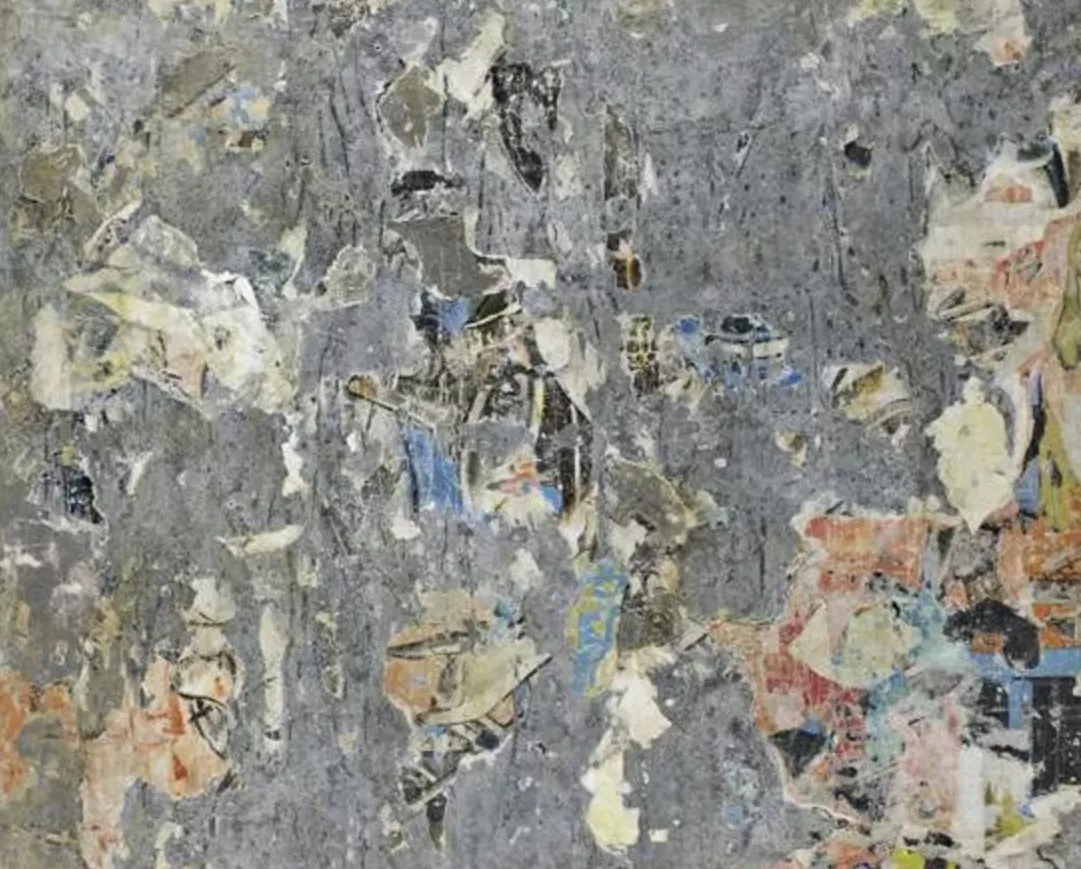
He then leads a work on Paris posters - which he tears down in the street and pastes back together. He superimposes and successively lacerates them, creating a transformation of typogrpahic signs that resembles hypnagogic bursting.
In the newspaper Combat in 1955, the " Flagrant-Dali " affair is published, attributing a work by Raymond Hains to the artist. After the publication of the Nouveau Réalisme manifesto, a name popularized by art critic Pierre Restany, Raymond Hains exhibited his galvanized metal sheets. He then exhibited a series entitled " La France galvanisée " featuring political posters referencing the Algerian conflict, but refused to sell them because of the subject matter.
New cycles and Iris Clert
The artist also tries his hand at sculpture, making a horse out of palisade boards supposedly reminiscent of the Trojan horse, and also evokes Iris Clert's nickname for him of " colt ". This work would later be packaged by Christo.
He believes that the Nouveaux Réalistes group is moving from " a world of painting to a world of truth. " He adds that " Artists stop making art to become Abstractions personified ".
Then begins the cycle of artists SEITA and SAFFA, two acronyms coined by the artist. At the Venice Biennale, he exhibited Biennale déchirée and Biennale éclatée four years apart. During this period, he works more in Italy and presents a giant matchbox illustrated with the Fables de la Fontaine at the Galleria del Leone.
He reused this process in the exhibition Seita et Saffa : copyright by Raymond Hains " where he signed the matchboxes with acronyms, artists " fictitious and incendiary ", posing as the artists' agent, and commandeered two Paris pompies in front of the exhibition.
In the 1970s, he began a new cycle entitled photos-constats, which he elaborated through a process of deformation of meaning, relying on visual analogies, puns or semantic connivance.
In 1976, his first retrospective took place thanks to Daniel Abadie at the Centre national d'art et de culture (CNAC). From 1997 onwards, he created his " Machintoshages " ; devices for bringing together and manipulating texts and images, which are linked to several themes.
His signature
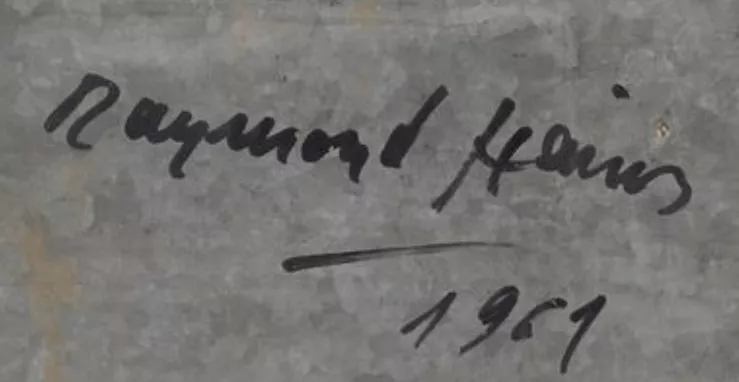
Although there are variations, here's a first example of his signature :
Expertise your property
If you own a work by Raymond Hains, don't hesitate to request a free appraisal by filling in our online form.
A member of our team of experts and certified auctioneers will contact you to provide an estimate of the market value of your work.
If you are considering selling your work, our specialists will also guide you through the various alternatives available to obtain the best possible price, taking into account market trends and the specific features of each work.
Estimate in less than 24h
Discover in the same theme

Rating and value of sculptures and bronzes by François-Xavie...
François-Xavier Lalanne is an acclaimed and talented 20th-century sculptor whose works have skyrocketed in value at auction.
Learn more >

Rating and value of Isabelle Waldberg's sculptures
Isabelle Waldberg is a twentieth-century abstract sculptor who has produced works that are highly rated and valued at auction.
Learn more >

Cote and value of paintings by Adrien Demont
Adrien Demont is an impressionist painter who has produced paintings that are highly valued at auction. Estimation in 24h.
Learn more >
D'autres tableaux abstraits vendus aux enchères

Estimated 2.000 - 4.000
Serge POLIAKOFF (1900-1969), Composition en rouge et bleu. 1965, Lithograph

Estimated Between €5,000 and €8,000
Jean MIOTTE (1926-2016), acrylic on canvas

Estimated 3.000 - 5.000
Roberto MATTA (1911-2002), Composition, Gouache on canvas

Secure site, anonymity preserved

Auctioneer approved by the State

Free and certified estimates
Frequently asked questions
-
Who is Raymond Hains, and what is his artistic movement?Raymond Hains (1926–2005) was a leading French artist in the field of lyrical abstraction and a signatory of the New Realism manifesto in 1960. His unique body of work lies at the intersection of New Realism, conceptual art, and visual poetry: he appropriates urban elements—particularly torn posters—to reveal their aesthetic and critical power, deliberately blurring the line between art and everyday reality.
-
What is the price range for works by Raymond Hains?Prices for works by Raymond Hains range from €20 to €270,000, depending on the type of work and the technique used. A painting can fetch between €120 and €270,000, a sculpture between €400 and €140,000, while a drawing ranges from €280 to €71,200. His market value continues to rise, and the artist is establishing himself as a safe bet on the art market.
-
How can you authenticate a work by Raymond Hains?To authenticate a work by Raymond Hains and determine its value, we recommend that you submit your item for a free appraisal at Auctie's. Our experts and state-certified auctioneers will examine your work and provide you with an accurate estimate of its current market value, with no obligation.
-
Is this the right time to sell a work by Raymond Hains?Yes, now is an excellent time to sell a work by Raymond Hains. The artist has established himself as a safe bet in the art market, and his value continues to rise, as his works are highly sought after by collectors and art lovers. Our specialists will help you identify the best terms for selling your piece.
-
How does the appraisal process work at Auctie's?The appraisal is completely free and non-binding. Simply fill out our online form or contact us directly. A member of our team of experts and auctioneers will contact you to appraise your artwork and provide you with an accurate estimate of its market value within 48 hours.
