



Rating and value of paintings - landscapes and seascapes by Maurice de Vlaminck

Key takeaways
- Vlaminck’s landscapes and seascapes, particularly those from his Fauvist period, command high prices ranging from €990 to €13,488,000, depending on the technique and period.
- A major painting, "Landscape with Dead Wood" (1906), sold for €12,896,590 in 2018, exceeding its initial estimate of €10,673,040 to €16,009,560.
- Vlaminck stands out as a pioneer of Fauvism by liberating color from its descriptive functions to make it a pure vehicle for emotion and personal artistic expression.
If you own a work by or after the artist Maurice de Vlaminck and would like to know its value, our state-approved experts and auctioneers will offer you their appraisal services.
In fact, Maurice de Vlaminck is an artist well known to Auctie's auction house and its experts.
Lastly, several paintings by the Fauvist painter were presented for sale and achieved significant success - with the hammer price exceeding our high estimate.
These include marine and landscape paintings from the Fauvist period, which are currently very highly rated.
This is why we particularly encourage you to submit your Vlaminck painting to us for appraisal, and if you so wish, for sale.
Our specialists will carry out a free appraisal of your work, and provide you with a precise estimate of its value on the current market. Then, if you'd like to sell your painting, we'll guide you towards the best possible arrangement to obtain the optimum price.
Rating and value of the artist Maurice de Vlaminck
Considered one of the pioneers of Fauvism, Maurice de Vlaminck quickly made his mark on twentieth-century art. This legacy is made up of various creations : mainly oils on canvas among which are landscapes and seascapes.
At present, prices for his works are rising enormously under the auctioneers' hammer.
His landscapes are particularly prized, and the price at which they sell on the art market ranges from €5 to €13,488,000, a considerable gap but one that speaks volumes about the value that can be attributed to Vlaminck's paintings.
In 2018, a painting dating from the heart of the Fauvist period, 1906, entitled Paysage au bois mort, was sold for €12,896,590while it was estimated at between €10,673,040 and €16,009,560.
Order of value from a simple work to the most prestigious
Technique used | Result |
|---|---|
Marine | From 13,380 to 9,451,800€ |
Country landscape | From 990 to 12 896 590€ |
City landscape | From 8,070 to 13,488,000€ |
Estimate in less than 24h
Aesthetic revolt in Vlaminck's landscapes
Maurice de Vlaminck established himself as one of the most fervent representatives of fauvism, a revolutionary movement that exploded at the very beginning of the 20th century under the impetus of critic Louis Vauxcelles and the famous scandal of Room VII at the 1905 Salon d'Automne.
Vlaminck, with his unwavering vigor, embraced this aesthetic revolt, redefining painting's relationship to color and form.
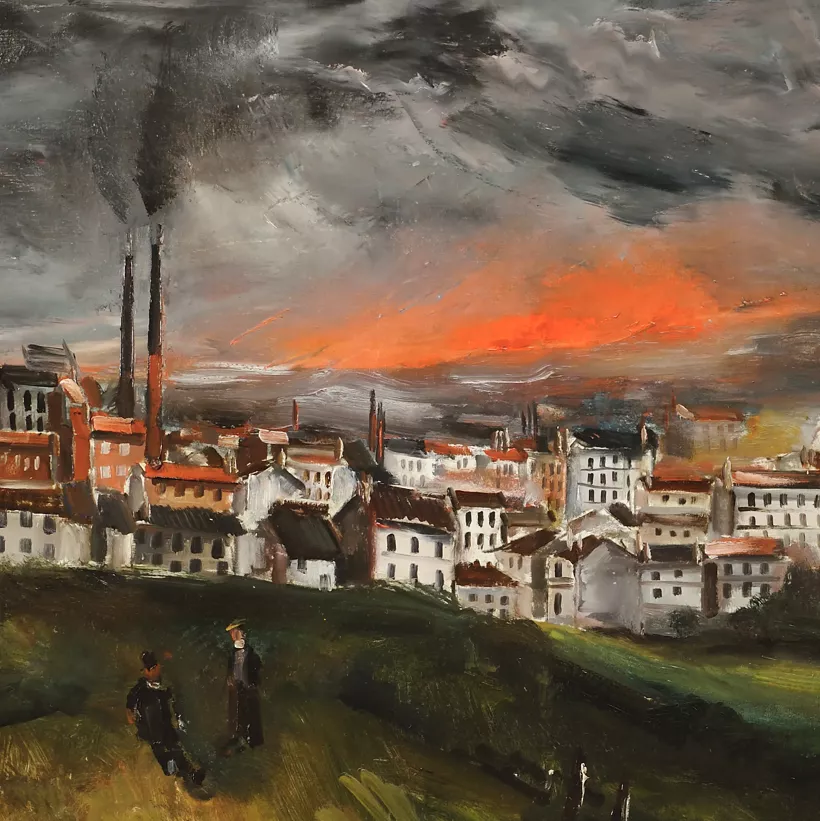
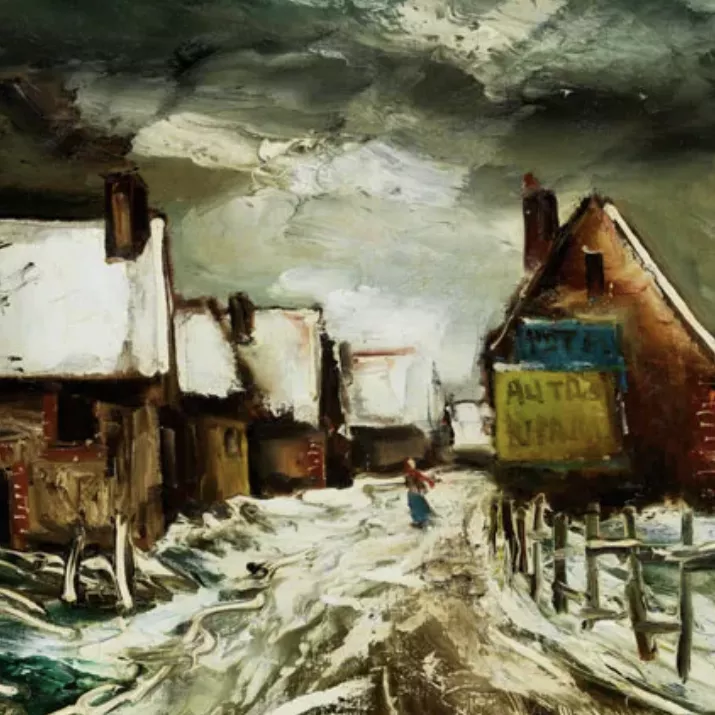
He is best known for his landscapes and seascapes, where he gives free rein to his artistic instincts, oscillating between a dark palette and explosions of vivid tones, characteristic of Fauvism.
Vlaminck's landscapes are distinguished by a great variety of styles, offering a range of sensations and emotions, sometimes deeply rooted in the observation of nature, sometimes freed from the constraints of realism.
Some of his works mark a more classical stage, where the representation of natural elements, such as trees and waves, is executed with remarkable precision and sobriety.
In these canvases, the movement of branches in the wind, or waves crashing against rocks, are rendered with an almost naturalistic attention to detail. The light is soft, the hues subdued, and the atmospheres, though often dramatic, reflect a restraint in the use of color.
However, most of the works that made Vlaminck famous within Fauvism take an entirely different approach. In these paintings, forms are simplified, strokes become broader, almost savage, and colors explode.
Brilliant shades of blue, red and yellow collide, invading the canvas with a rare emotional intensity. Here, the artist no longer seeks to faithfully represent nature, but rather to translate its raw essence through bold, vivid color juxtapositions.
Realism fades away in favor of an expressive interpretation, where each brushstroke seems to capture an almost primitive energy.
This contrast between the two approaches-one sober and measured, the other effervescent and unleashed-demonstrates Vlaminck's mastery and versatility. Although he was a fervent advocate of expression through color, he never abandoned a certain rigor in the composition of his landscapes.
The background of the scene often remains the same, a country lane, a river or a village under a heavy sky, but it's in the treatment of color and form that the artist completely frees himself from convention.
This stylistic evolution is perfectly in line with the Fauvist philosophy, which advocates freeing color from its descriptive functions, turning it into a pure vector of emotion.
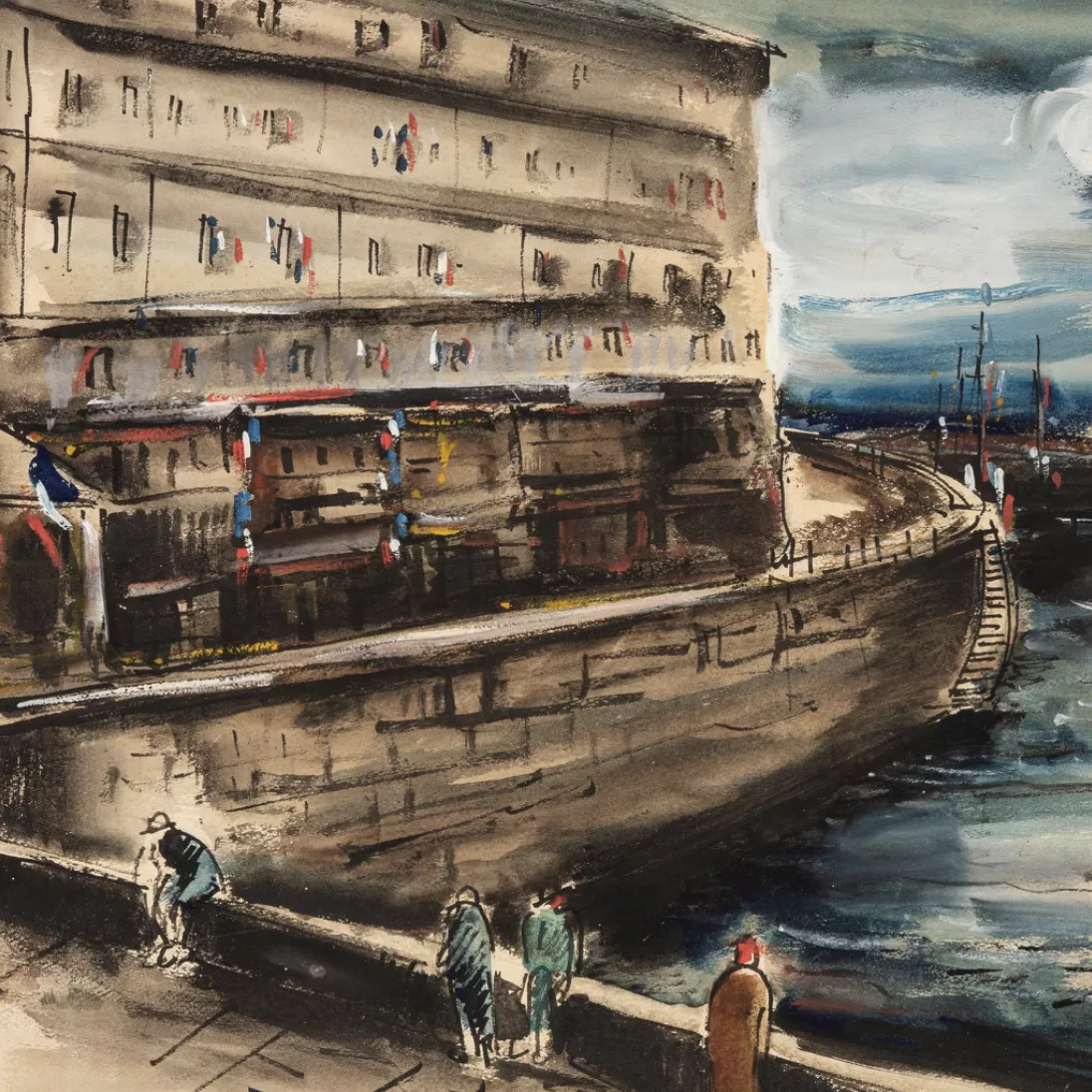
Vlaminck thus manages to transcend the boundaries of the traditional landscape. In his marine paintings, for example, waves are no longer simply masses of moving water, but become textured surfaces where color creates an almost abstract play of light and shadow.
The skies, often tormented, are rendered with broad strokes of deep blues and violent grays, giving these scenes a dramatic intensity that rivals the greatest masters of the genre.
It is in his most colorful works, however, that Vlaminck finds the most success on the art market. These Fauvist paintings, in which color seems to burst from the canvas, are particularly prized by collectors and enthusiasts.
Their brilliance, their chromatic boldness, capture the very essence of the avant-garde of the early 20th century, a time when art was throwing off the shackles of realism to become a terrain of pure expression.
In short, Maurice de Vlaminck embodies this permanent tension between tradition and modernity. Through his landscapes and seascapes, he offers us a renewed vision of nature, where artistic instinct and passion for color prevail over faithful representation of the world.
Maurice de Vlaminck and the Reinvention of Landscape: Color and Emotion
Maurice de Vlaminck, pseudonym of Maurice Edmond Devlaeminck (1876-1958), left his mark on the twentieth-century art world, particularly in the field of landscape painting.
Born in Paris, where he would reside for the rest of his life, Vlaminck was distinguished by a protean artistic practice.
Although his nudes and ceramic experiments are lesser-known facets of his work, it is in landscape painting that he truly excelled, imposing a style in which color and emotion take precedence over fidelity to reality.
Through his landscapes and marines, he succeeds in translating an intensely personal vision of nature, halfway between tradition and stylistic revolution.
Introduced to painting as a child by an artist neighbor, Vlaminck quickly developed a passion for art, but was slow to make it his main profession. Before devoting himself fully to painting, he led a multi-faceted life, juggling music, cycling and painting.
It was thanks to his brother-in-law, an influential journalist, that he managed to bring his work to the attention of the general public. His marriage to Suzanne de Verly, who accompanied him at the start of his career, also marked a period when he explored nature intensively, transcribing it with a vivacity and energy that would soon become his signature.
Vlaminck's friendship with André Derain was crucial to the development of his art. Together, they explored new ways of representing the world, breaking with naturalism to plunge into a universe where color becomes autonomous.
Vlaminck's landscapes, in particular, break free from established conventions. Far from academic representations of nature, he allows himself an approach where emotion dominates.
The sky, earth and trees are no longer decorative elements but vectors of pure energy, which the artist translates with broad, brutal brushstrokes.
It was at the beginning of the 20th century, with the scandal of the 1914 Salon des Indépendants, that Vlaminck achieved international recognition. His Fauvist landscapes, often described as an "orgy of pure tones", pushed back the boundaries of pictorial representation.
Alongside Henri Matisse, Albert Marquet, Raoul Dufy and André Derain, he revolutionized painting with works in which colors burst forth, saturating pictorial space and lending natural scenes an emotional intensity never seen before.
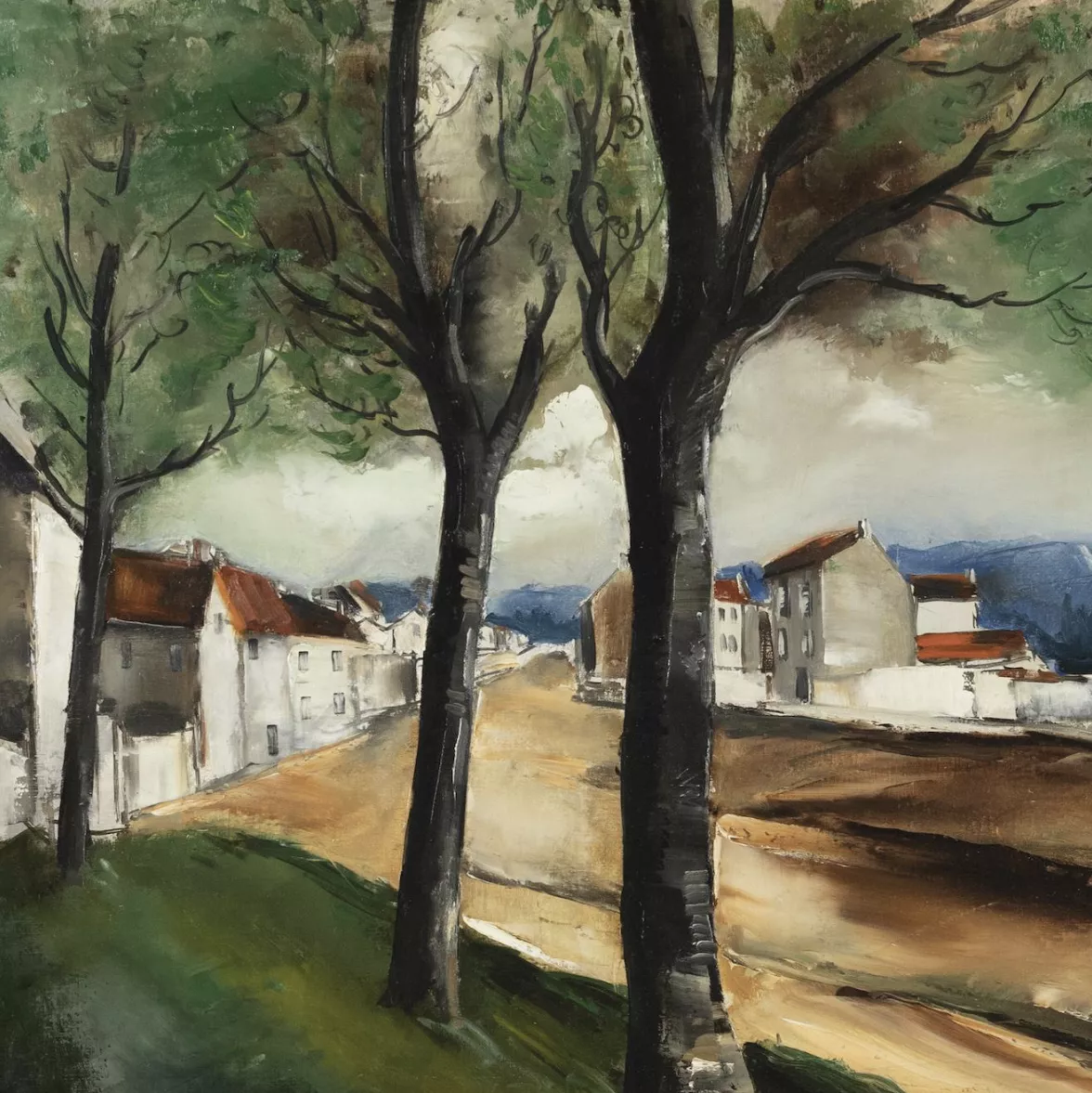
The landscapes he painted at this time, particularly those inspired by the villages and countryside around Paris, unfold bright skies, stylized trees and winding roads, all in an unbridled chromatic palette characteristic of fauvism.
Vlaminck stands out in his ability to capture the landscape not as a faithful representation of nature, but as a pretext for expressing powerful emotions.
Trees are nothing more than vibrant masses, skies are tumultuous flat tints of blue and gray, and country lanes become vast expanses where the brush runs free.
Each canvas is an open window into the artist's mind, where the outer landscape becomes a projection of his inner world.
One of Vlaminck's strengths lies in his ability to modulate his style according to the emotion he seeks to capture. While some of his works are almost dramatic in their sobriety, playing with dark hues and precisely sculpted forms, others are explosions of vivid, saturated color.
It's this duality, this tension between calm and restlessness, that makes his landscape work so fascinating. Each painting is an invitation to explore nature not with the eyes, but with the emotions.
The First World War, however, marked a halt in Vlaminck's career. Posted to a factory because of his family situation - father of three daughters - he was cut off from his usual landscapes.
But this interruption only strengthened his determination to take up his brush again after the war, with new intensity. His post-war landscapes are darker, more introspective, marked by the horrors of the conflict.
However, they retain that same vitality, that same boldness in the way he manipulates color to convey the depth of his feelings.
In short, Maurice de Vlaminck was able, through his landscapes, to reinvent the way nature is perceived and represented in painting. His canvases don't simply describe a place; they capture the very essence of what nature inspires, making him one of the great masters of landscape in modern art.
Introduction to colorimetry - blue (2)
L'Héritage pictural de Maurice de Vlaminck
Maurice de Vlaminck, a key figure of Fauvism, is an artist whose career has spanned the upheavals of the 20th century, testifying to its constant evolution.
At the forefront of the artistic revolution initiated by the early Fauvists, Vlaminck pushed back the boundaries of painting, breaking academic codes to explore new ways of representing the world, particularly through color and emotion.
This process, which he shared with contemporaries such as Henri Matisse and André Derain, reflected a moment when art became a terrain for experimentation freed from the constraints of realism.
Vlaminck's work is rich and varied, testifying to an artistic sensibility in perpetual motion. Over the decades, his style evolves, moving from a Fauvist period characterized by the "orgy of pure tones" to a more introspective phase, marked by a growing influence of Expressionism.
Towards the end of his career, his paintings become darker, the brushstrokes heavier, conveying a sense of anguish in the face of the events of the century.
This obsession with color also led him to write theoretical essays on art, in which he sought to explore the infinite potential of the chromatic palette and pass on his vision to future generations of artists.
Vlaminck's influence was not limited to his works on canvas, but also extended to his thinking on artistic practice. In his writings, he expresses radical thinking, advocating a liberation of art from aesthetic and moral conventions.
These essays, which exerted a lasting influence on the painters of his day, also helped spread his legacy. Like Kandinsky, Vlaminck was convinced that art must free itself from the limits of figurative representation to reach a higher level of spirituality and individual expression.
However, it is his early works, those produced at the beginning of the 20th century, that are now attracting the most attention from collectors and art historians.
These paintings, which epitomize Fauvism at its height, are characterized by a bold use of vivid colors, applied in broad flat tints, as well as a certain magnification of line, giving his landscapes and still lifes an unprecedented visual power.
In these works, Vlaminck frees himself completely from visible reality to plunge into an instinctive representation, where emotion dominates composition.
Summing up, Maurice de Vlaminck's legacy is that of a pioneering artist, who helped transform twentieth-century art through an intense exploration of color and form.
His revolutionary approach continues to inspire contemporary painters, while his canvases, bursting with vitality, are as popular as ever on the art market.
Through his work and writings, he has left an indelible imprint, bearing witness to a relentless quest for artistic truth, in which color is both the means and the end.
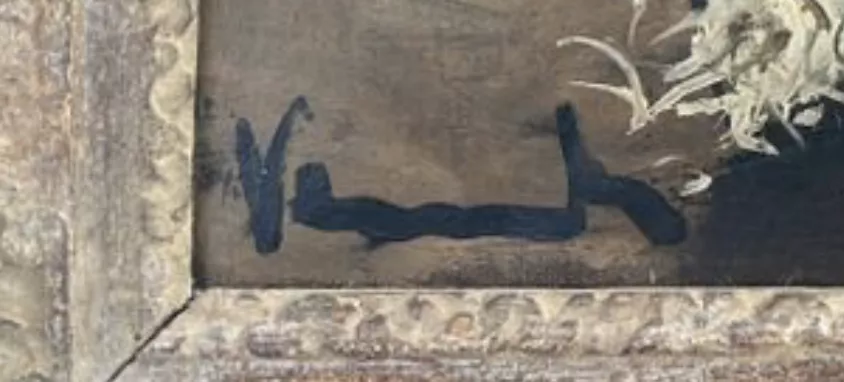
Recognizing the artist's signature
Vlaminck's works are often signed, and his signature can vary from year to year. It can also be found on manuscripts. However, he was and is much copied, which is why it's important to have your work appraised.
Knowing the value of a work
If you happen to own a work by or after Maurice de Vlaminck, don't hesitate to request a free appraisal using our form on our website.
A member of our team of experts and certified auctioneers will contact you promptly to provide you with an estimate of the market value of your work, as well as any relevant information about it.
If you're thinking of selling your work, our specialists will also help you find alternatives to sell it at the best possible price, taking into account market trends.
Estimate in less than 24h
Discover in the same theme

Rating and value of Sonia Delaunay's works, drawings and pai...
Sonia Delaunay, a renowned painter and artist, has produced a wide range of works that are sought after and appreciated at auction. Their value is hig...
Learn more >

Rating and value of works, drawings, paintings by Léonard Fo...
Léonard Foujita is a twentieth-century Japanese artist who produced a huge number of works, much appreciated and sought-after at auction.
Learn more >

Rating and value of paintings by Roger Marcel Limouse
Roger Marcel Limouse is a Post-Impressionist and Post-Fauvist painter who has produced canvases that are highly valued at auction.
Learn more >
Works from the same period sold at auction

Estimated 1000 - 2000€
Alfred Stevens (1817 - 1875), marine painting, oil on canvas

Estimated 20.000 - 30.000
Alexandre ROUBTZOFF (1884-1949), Portrait of Marie-Madeleine Leroy, oil on canvas

Estimated 8.000 - 15.000
Maurice de VLAMINCK (1876-1958), Still life with jugs and leeks, oil on canvas

Estimated 5.000 - 10.000
Jean Roger SOURGEN (1883-1978), Lake and pine forest, oil on canvas

Estimated 2.000 - 3.000
Raymond THIBÉSART (1874-1968) Apple trees in blossom, oil on canvas

Estimated 5.000 - 8.000
Robert PINCHON (1886-1943) View of a port on the banks of the Seine, Oil on canvas

Secure site, anonymity preserved

Auctioneer approved by the State

Free and certified estimates
Frequently asked questions
-
Who is Maurice de Vlaminck, and what is his role in art history?Maurice de Vlaminck (1876–1958) was one of the pioneers of Fauvism, a revolutionary movement of the early 20th century. A leading Parisian artist, he established himself as a key figure in modern art by revolutionizing the depiction of landscapes and seascapes, prioritizing emotional expression and color over realistic accuracy. Alongside Henri Matisse and André Derain, he helped liberate painting from academic conventions.
-
What is the price range for Vlaminck's paintings?Prices for works by Maurice de Vlaminck vary considerably depending on the subject and period. His rural landscapes range from a few hundred to several million euros, while his seascapes and cityscapes fall within similar price ranges. His paintings from his Fauvist period (early 20th century), which are particularly sought after, currently command the highest prices on the art market.
-
How do you authenticate a painting by Vlaminck?To authenticate a work by Maurice de Vlaminck, we recommend submitting your painting for a free appraisal at Auctie's. Our state-certified auctioneers and experts will conduct a detailed examination of the work and provide you with an accurate estimate of its current market value, with no obligation on your part.
-
Is this the right time to sell a Vlaminck painting?Yes, this is an excellent time to sell a work by Vlaminck. The value of his paintings—particularly those depicting landscapes and seascapes from his Fauvist period—is rising significantly. Several works recently offered at auction have exceeded their high estimates, demonstrating growing interest among collectors in this major artist.
-
How does the appraisal and sale of a work of art take place at Auctie's?The appraisal is free and non-binding: simply submit your painting, and our experts will provide you with an accurate valuation within 48 hours. If you’d like to sell, Auctie’s will guide you through the entire process—from appraisal to auction—by identifying the best approach to secure the highest possible price for your Vlaminck artwork.
