



Rating and value of paintings by Yan Wang Cheng

Key takeaways
- Yan Wang Cheng is a highly sought-after artist on the art market; his abstract oil paintings have fetched up to 2.8 million euros at auction.
- His mixed-media works are valued between €4,000 and €800,000, while his oil-on-canvas works range from €5,000 to €2,802,300.
- Born in 1976, this Chinese artist, a graduate of the Beijing Academy, fuses traditional calligraphy with contemporary Western geometric abstraction.
If you own a painting by or based on the work of artist Yang Cheng Wang and would like to know its value, our state-approved experts and auctioneers will guide you.
Our specialists will carry out a free appraisal of your work, and provide you with an accurate estimate of its value on the current market.
Then, should you wish to sell your work, we will direct you to the best possible arrangement to obtain the optimum price.
Artist's rating and value
Yang Wang CHENG's work is a mainstream artist and highly rated on the auction market. His works arouse keen interest among collectors and art lovers, particularly those who appreciate 20th-century Chinese painting.
The most sought-after pieces are his abstract paintings, produced using the oil-on-canvas technique.
As such, a painting by Cheng can fetch millions of euros at auction, as evidenced by his Untitled, adjudicated for €2,802,300 in 2020 by Poly International Auction.
Ranging in value from the most basic to the most prestigious
Technique used | Result |
|---|---|
Mixed technique | From €4,000 to €800,000 |
Oil on canvas | From €5,000 to €2,802,300 |
Estimate in less than 24h
The artist's style and technique
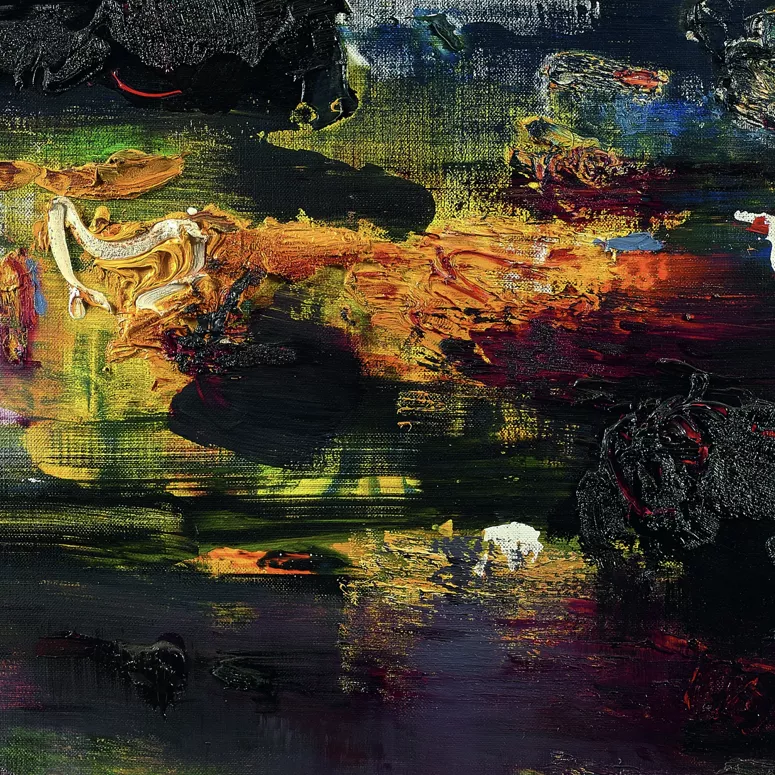
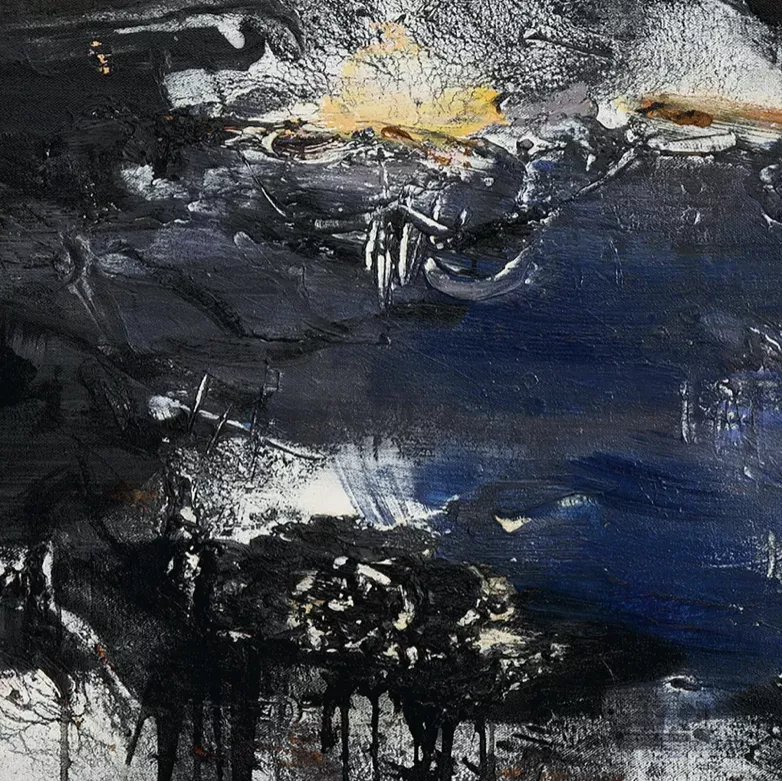
Yan Cheng Wang makes his mark with a plastic style that boldly blends Eastern tradition with contemporary abstraction.
His fluid, incisive strokes evoke the great masters of calligraphy, while breaking away from them to explore a more geometric, formalized language.
Far from sticking to traditional mimicry, he systematizes a gestural style in which the tension between control and spontaneity becomes the key to reading. Every stroke, every surface, seems calibrated to serve a search for rigor and balance, while flirting with the raw energy of gesture.
The organization of his compositions sometimes recalls the rigorous architecture of classical prints, where lines intersect in a meticulously structured network.
However, Wang doesn't stop at a simple reworking of ancient codes: he modifies their contours, incorporating breaks, bursts of pigment that defy uniformity.
These superimpositions of layers and textures result in works of remarkable density, where each element participates in an overall unity while preserving its singularity.
We perceive in his approach a form of mechanization of the stroke, an almost mathematical concern for repetition and variation, but one that avoids any coldness through a sensitivity to light and matter. Wang skilfully plays with variations in thickness, subtle gradations and visual ruptures, giving his works an internal vibration.
This process, close to etching in its meticulousness and respect for rigorous laws, extends to a more universal vision, where the past is in constant dialogue with modern aspirations.
Yan Wang Cheng's career
Yan Wang Cheng is a figure who questions heritages as much as he transforms them. Born in 1976 in a rapidly changing China, he grew up at the crossroads of age-old traditions and the upheavals of the contemporary era.
From an early age, calligraphy constituted an essential visual grammar for him, imbued with a rigor and fluidity that would mark his entire practice.
A graduate of the Central Academy of Fine Arts in Beijing, he crossed the borders of his country at the turn of the 2000s to settle in Europe, where he discovered the Western avant-garde.
This geographical shift also became a conceptual shift: his first European works reflect a hybridization of calligraphic motifs and geometric abstractions borrowed from Minimalism.
His career was built at the crossroads of these influences: in Paris, he exhibited compositions in which the gesture of ink dialogues with the rigor of flat forms, at times recalling the work of a Ellsworth Kelly or a Soulages while remaining rooted in a distinctly Asian aesthetic.
Cheng thus establishes himself as one of the rare artists to weave such a direct link between these two visual traditions.
Today, his works, present in international collections, testify to a commitment to a poetics of line, where the individual gesture responds to the great historical movements.
Chinese contemporary abstraction
Chinese contemporary abstraction is surprising in the way it combines heritage and modernity, while defying the Western conventions of the genre.
When observing the works of its major figures, one notes a recurrence of the masterful, almost calligraphic gesture, which revives an age-old tradition while being part of an eminently contemporary approach.
Here, emptiness is never absence: it is a space for dialogue, a place where matter seems to breathe. We might compare this approach to that of classical Chinese painters, for whom every stroke, every reserve of white, carried a spiritual as well as a formal charge.
But Chinese abstraction doesn't stop at a reinterpretation of traditional canons. It explores new textures, new supports, venturing into zones where the pictorial gesture becomes a writing, an imprint of the moment.
These artists move away from the direct influences of cubism or abstract expressionism to propose their own aesthetic, where ink and oil rub shoulders, where the relationship to the material remains visceral.
This quest can be found in the work of Zao Wou-Ki or Chu Teh-Chun, whose canvases seem to vibrate between the tangible and the infinite.
These works, though abstract, retain a tenuous link with nature and the cosmos, recalling the misty, evanescent landscapes of the Old Masters. But they are distinguished from them by a more diffuse energy, a tension between fluidity and geometric rigor.
Contemporary Chinese abstraction, far from being a simple technical evolution, imposes a redefinition of pictorial space, a poetic exploration of modernity anchored in the timeless.
Focus on Echo of Emptiness, Yan Wang Cheng
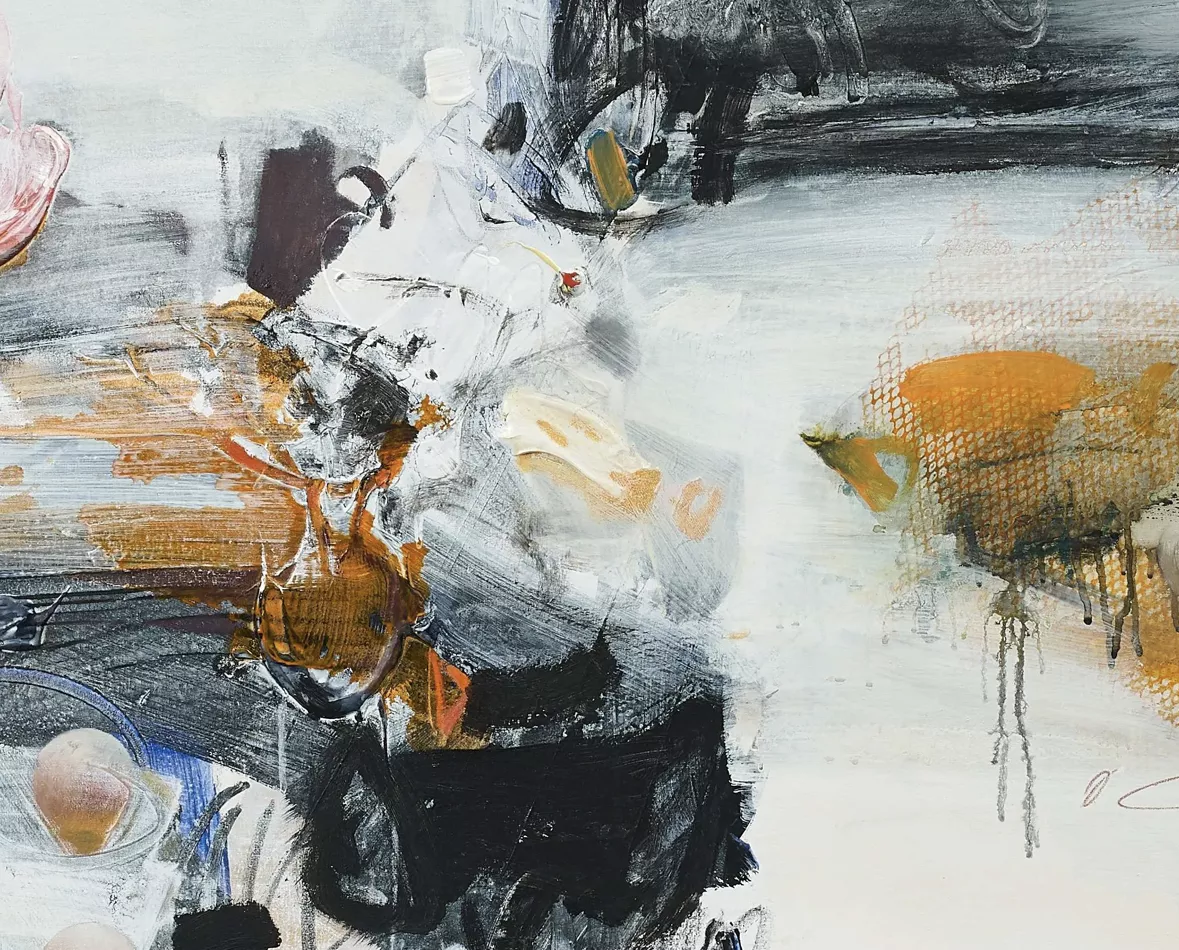
Yan Wang Cheng's Untitled (Echo of Emptiness) offers fascinating ground for reflection on contemporary Chinese abstraction, bringing into play the relationships between the visible and the invisible, the full and the empty.
The canvas deploys a restricted, almost reductive palette, dominated by deep blacks and ethereal greys, mingled with bursts of white.
These nuances, at first sight simple, are revealed in the light, where each layer of material is carefully applied to play with depth and contrast. The space, far from being simply empty, seems to breathe through this juxtaposition of textures.
The background, almost monochrome, is strewn with minimalist touches that nevertheless act like indelible marks, inscribed in time. In this way, the artist seems to summon a silent memory, an echo, an imprint that runs through the paper.
The void at the heart of the composition is not merely aesthetic.
This is a subtle reinterpretation of Taoist concepts, according to which the void is neither a negation nor an end, but a space of transformation.
As both a vector of tension and liberation, the void inscribes a presence that is both strong and fragile. It testifies to the artist's relationship with her medium: each line is an attempt to capture the invisible, to freeze the infinite.
The brushstrokes, fine and assured, overlap to create a particular density, not through the accumulation of matter but through the way each trace seems to melt and disappear into the next.
This process recalls that of the painters of the Song period, but also a certain contemporary writing where the very action of the gesture is as important as the resulting form.
The material itself becomes a metaphor for instability and movement.
In this sense, Echo of the Void transcends the boundaries of calligraphy or traditional Chinese painting. If tradition is present in this work, it manifests itself in a desire to erase, to go beyond, not to reproduce but to reinvent a language.
The forms fade away in a compositional game where meaning gradually dissipates, to make way for the viewer's introspection.
In the manner of the great old masters, Yan Wang Cheng opens up space for silent contemplation, in which each element - matter, void, light - becomes an actor in an infinite dance.
By its subtlety, its apparent calm, the work invites deep reflection, at once timeless and resolutely anchored in the present.
His signature
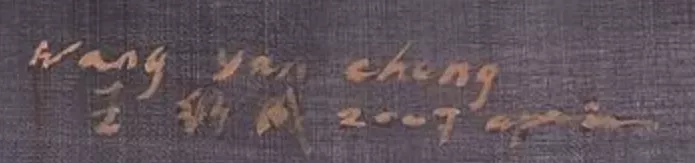
Not all Yan Wang Cheng's works are signed. It's also possible that they're copies or that the inscription has faded over time, which is why expertise is essential.
Expertise your property
If you own a work by Yan Wang Cheng, don't hesitate to request a free appraisal by filling in our online form.
A member of our team of experts and certified auctioneers will contact you to provide an estimate of the market value of your work.
If you are considering selling your work, our specialists will also guide you through the various alternatives available to obtain the best possible price, taking into account market trends and the specific features of each work.
Estimate in less than 24h
Discover in the same theme

Appraising and valuing Charlotte Perriand furniture
How to value and sell furniture by designer Charlotte Perriand at auction. What is its value on the art market?
Learn more >

Rating and value of Charlotte Perriand's furniture
Charlotte Perriand designed a great deal of furniture during the 20th century. She was a great success during her lifetime, and her furniture still is...
Learn more >

Rating and value of Jean Dunand's works of art, furniture an...
Jean Dunand is a 20th-century goldsmith, coppersmith and sculptor who produced highly-regarded and valuable furniture and coppersmithing.
Learn more >
D'autres tableaux abstraits vendus aux enchères

Estimated 2.000 - 4.000
Serge POLIAKOFF (1900-1969), Composition en rouge et bleu. 1965, Lithograph

Estimated Between €5,000 and €8,000
Jean MIOTTE (1926-2016), acrylic on canvas

Estimated 3.000 - 5.000
Roberto MATTA (1911-2002), Composition, Gouache on canvas

Secure site, anonymity preserved

Auctioneer approved by the State

Free and certified estimates
Frequently asked questions
-
Who is Yan Wang Cheng, and what is his artistic background?Yan Wang Cheng, born in 1976, is a Chinese artist who graduated from the Central Academy of Fine Arts in Beijing. He settled in Europe in the early 2000s and has established himself as a major figure in contemporary Chinese abstraction, skillfully blending Eastern calligraphic tradition with Western geometric abstraction. His works, which are part of international collections, reflect a commitment to a poetics of the line in which the artist’s gesture engages with major historical movements.
-
What is the price range for Yan Wang Cheng's paintings?Yan Wang Cheng's works vary considerably depending on the technique and the prestige of the piece. Mixed-media works range from €4,000 to €800,000, while oil-on-canvas paintings—his most sought-after works—can fetch from €5,000 to over €2.8 million, as illustrated by the 2020 auction of his painting “Untitled” in 2020.
-
How can you authenticate a work by Yan Wang Cheng?To authenticate a work by Yan Wang Cheng, we recommend that you request a free appraisal from Auctie's. A certified expert or auctioneer will examine your painting and provide you with a detailed estimate of its market value. This step is particularly important because some works are unsigned or may have signatures that have faded over time.
-
How does the appraisal process work at Auctie's?Appraisals at Auctie's are completely free and require no obligation. Simply fill out our online form with information and photos of your piece. A member of our team of experts and licensed auctioneers will contact you to examine your item and provide you with an accurate estimate of its current market value, usually within 48 hours.
-
Is this a good time to sell a work by Yan Wang Cheng?Yes, now is a good time to sell a work by Yan Wang Cheng. The artist is highly regarded in the auction market, and his works are generating significant interest among collectors and art lovers, particularly those who appreciate contemporary Chinese abstract painting. If you are considering selling, our specialists will guide you in obtaining the best possible price, taking current market trends into account.
