



Rating and value of paintings by Remedios Varo

Key takeaways
- Prices for Remedios Varo’s works vary considerably, ranging from €10 for prints to €4,630,000 for major paintings in 2020.
- A Spanish surrealist artist (1908–1963) known for her esoteric style, which blends alchemy, science fiction, and mystical symbolism into precise narrative compositions.
- Her oil paintings command the highest prices (€9,500 to €4,630,000), while her drawings and watercolors range from €350 to €1,600,000.
If you own a work by or after Remedios Varo, and would like to know its value, our state-approved experts and auctioneers will offer you their appraisal services.
Our specialists will carry out a free appraisal of your work, and provide you with an accurate estimate of its value on the current market.
Then, if you'd like to sell your work, we'll direct you to the best possible arrangement to get the best price for it.
Remedios Varo artist rating and value
The artist Remedios Varo leaves behind a rather colorful and surreal work, she is famous for her paintings and drawings. Now, prices for her works are rising under the auctioneers' gavel.
Her paintings are particularly prized, especially by American buyers. The price at which they sell on the art market ranges from €10 to €4,630,000, a substantial range but one that says a lot about the value that can be attributed to Remedios Varo's works.
In 2020, Armonia, a 1956 oil on masonite depicting a fantastic landscape was sold for €4,630,000, against an estimate of €1,780,000 to €2,670,000.
Order of value from a simple work to the most prestigious
Technique used | Result |
|---|---|
Estamp - multiple | From €10 to €3,300 |
Drawing - watercolor | From €350 to €1,600,000 |
Painting | From €9,500 to €4,630,000 |
Estimate in less than 24h
The style and technique of Remedios Varo
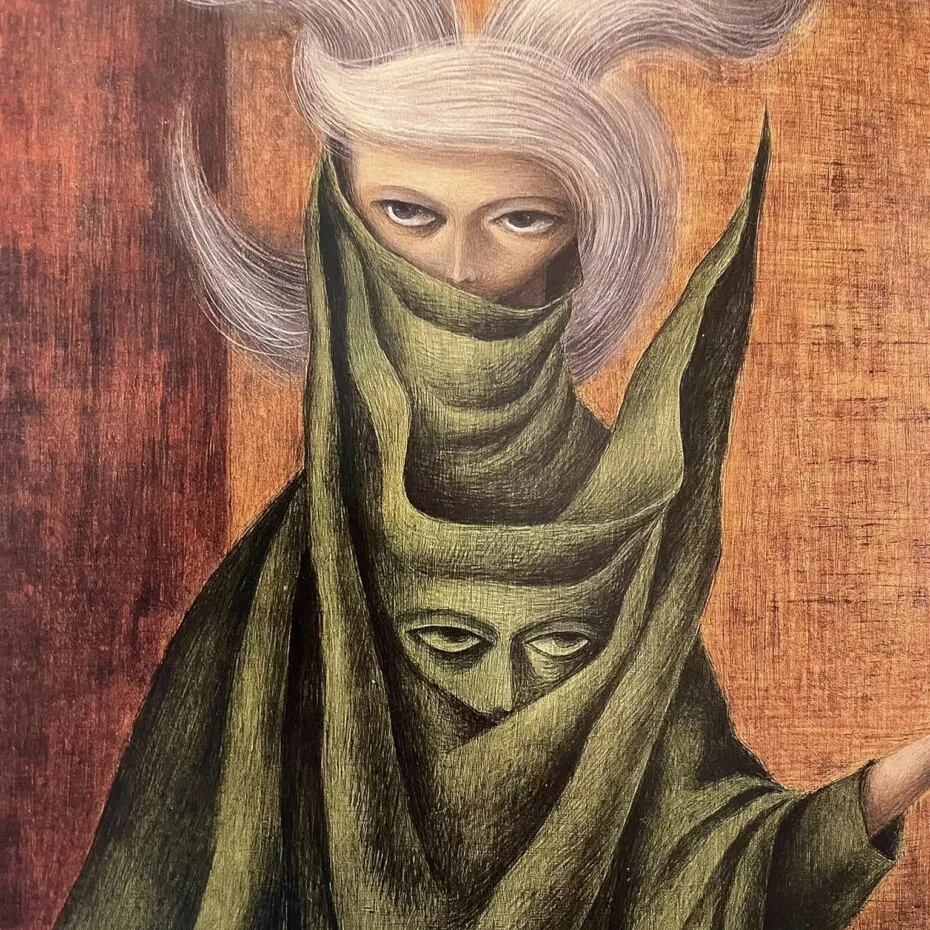
Remedios Varo (1908 - 1963) was a major figure in 20th-century surrealism and esoteric art. She developed a highly personal surrealist style with a singular pictorial language, blending surrealism, mystical symbolism, esotericism and science fiction.
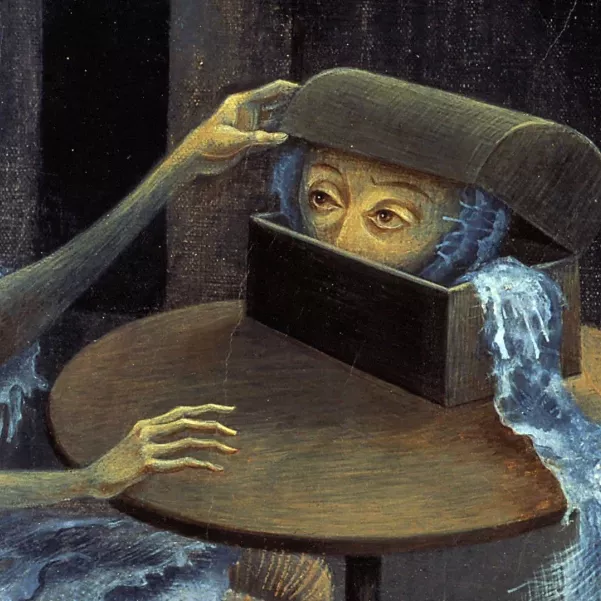
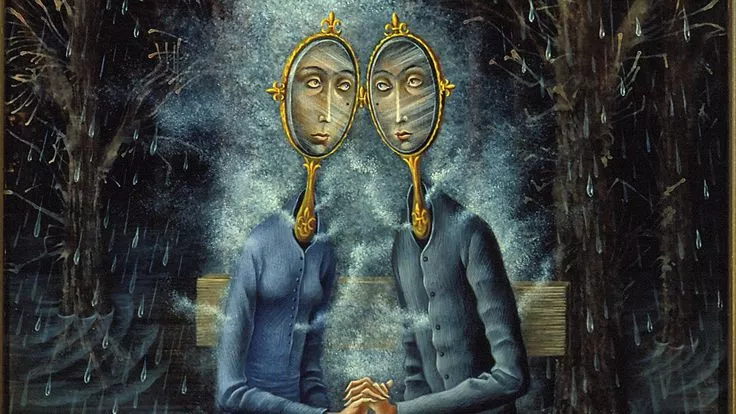
Her works are narrative, populated by androgynous characters, strange instruments and unreal architectures, in a rigorous dreamlike logic. She moves away from automatic or Freudian surrealism to build a structured, intellectual imagination, close to alchemical or Gnostic thought.
Her technique is influenced by the Flemish masters : she uses precise preparatory drawing, a layer of imprimatura, and superimposed glazes to create effects of transparency and light. Her brushstrokes are fine, detailed, almost miniaturistic, in the service of a world that is hyper-organized despite its strangeness.
She applies oil paint in subtle layers, with extreme attention to the rendering of materials (stone, wood, fabric and metal).
Highly influenced by engineering, mechanics, Gothic architecture and scientific tools, she populates her paintings with impossible machines, alchemical instruments, cogs and labyrinths. She uses forced or symbolic perspective, with narrow, vertical interiors that evoke asceticism or meditation.
These elements give her works a rigorous structure that contrasts with their visual strangeness. Her figures, often female or asexual, are depicted in rituals, experiments or transfigurations (readings, ascensions, magical operations and fusions with matter).
She often represents women as researchers, magicians, experimenters, inversting the codes of traditional surrealism. Her palette is often composed of soft, pearly tones (light ochre, verdigris, celadon blue, golden brown), punctuated by reds or golds. She masters an internal light, often unrealistic but coherent, that gives scenes a quality of vision or gentle hallucination.
This light serves to guide the eye through space and hierarchize symbolic forms. Her painting summons science, religion, magic, alchemy and Jungian psychology with a very high level of symbolization.
She conceives painting as a space for inner research, where every element carries meaning. Her style is a masterful blend of formal rationality and structured dreaming, which sets her apart from many other Surrealist artists.
The life of Remedios Varo
Remedios Varo was born in 1908 in Anglès, Catalonia. Her father, who was a hydraulic engineer, introduced her from childhood to technical drawing, mathematics and applied sciences, which were to become lasting influences in her work.
She trained at the Real Academia de Bellas Artes de San Fernando in Madrir (the same school as Dali), where she studied the Old Masters as well as classical techniques.
Varo participated in the Spanish artistic avant-garde from the 1930s, joining the Catalan surrealist group Logicofobista. She lived in Paris at the end of the 1930s and frequented the Surrealist circle around André Breton, but broke away because of her attraction to mysticism, science and feminine symbolism.
During the Spanish Civil War and then the Second World War, she fled facism and crossed several European countries. She took refuge in Mexico in 1941 after passing through Casablanca and Vichy France, accompanied by the poet Benjamin Péret.
Remedios Varo quickly became part of the Mexican intellectual scene, alongside Leonora Carrington, Kati Horna, Octavio Paz and Frida Kahlo. She worked in a variety of fields before making a living from her personal production (medical illustration, advertising, textile design).
Her work matured in Mexico, where she began to paint with intensity and continuity from the 1950s, in a rather studious solitude. Varos was inspired by Hermetic philosophy, alchemy, the natural sciences, Christian mysticism, the tarot and the writings of Jung.
Remedios Varo thus created an autonomous, deeply symbolic universe, reflecting her quest for meaning and her vision of art as a path to inner transformation. Although she was briefly married, the artist lived with great independence, often alone or in the company of other artists.
She had an intense artistic and friendly relationship with Leonora Carrington, with whom she shared similar spiritual and artistic visions. For a long time, she refused to sell her work, as she considered her painting above all an inner necessity and not a market product.
She died suddenly of a heart attack in 1963 in Mexico City, at the age of 54, leaving behind her a concentrated but very dense body of work, quickly recognized as a major in the history of Surrealism and 20th-century women's art.
Her influence is now being rediscovered in the fields of visionary art, esoteric feminism and contemporary alchemical iconography.
Focus on The Creation of Birds, Remedios Varo, 1957
The Creation of Birds is a 1957 work in oil on masonite, measuring 60 x 48 cm. It is held in a private Mexican collection and is regularly reproduced in major retrospectives.
It depicts a hybrid figure, half-human half-bird, painting live birds that escape from his pallet violin. The work features a solitary creator in a laboratory-studio, making birds with a brush, an alchemical inkwell and rays of light.
The artist is shown with owl wings, which are symbols of wisdom and night vision, and suggest an identification of Varo herself with the character. The birds come to life through light and music : the image becomes an allegory of artistic inspiration.
The laboratory evokes the cabinets of alchemists or hermetists : vials, containers, magnifying glasses, projected constellation... and the magic ink is linked to a celestial constellation via a lens, evoking the idea of cosmic knowledge or higher knowledge.
The scene condenses several disciplines (music, science, painting) into an act of total creation, where the artist is an initiate rather than a mere performer. The composition is symmetrical, almost architectural, with a slightly crushed perspective reminiscent of the Flemish masters.
The details are meticulous and the textures (feathers, curtains, scientific tools) are rendered with extreme precision. Successive glazes produce a diffuse, unearthly light, reinforcing the visionary character of the scene.
The palette is reduced but refined (sepia tones ; dark greens, pale gold, with touches of celestial blue). The light comes not from a natural source, but from the figure itself, as if inspiration were intended to illuminate the painting.
The work is intended to subvert the cliché of male genius, since here it is a woman, alone and concentrated, who masters the creative act. The image thus becomes a metaphor for the condition of the artist in exile, working in solitude but connected to cosmic and inner forces.
This painting is often read as an affirmation of the feminine power of transformation, far from all its passivity. This work is a mature masterpiece, synthesizing all the artist's preoccupations : creation, solitude, magic, knowledge and otherness.
It is among the most reproduced, analyzed and commented on, often considered an icon of esoteric surrealism, and embodies all Remedios Varo's originality.
His signature
Not all Remedios Varo's works are signed.
In any case, it remains essential to have your works appraised and authenticated.
Expertise your property
If you own a work by Remedios Varo, don't hesitate to request a free appraisal by filling in our online form.
A member of our team of experts and certified auctioneers will contact you to provide an estimate of the market value of your work.
If you are considering selling your work, our specialists will also guide you through the various alternatives available to obtain the best possible price, taking into account market trends and the specific features of each work.
Estimate in less than 24h
Discover in the same theme

Rating and value of chairs, tables and desks by Jean Prouvé
Jean Prouvé is a 20th-century designer best known for his chairs, an essential piece of furniture that he reinvented. They are highly prized.
Learn more >

Rating and value of paintings, drawings and lithographs by P...
Paul Delvaux is a Belgian surrealist artist whose works are highly valued on the auction market.
Learn more >

Rating and value of paintings by Émile Deckers
Émile Deckers was a Belgian Orientalist painter whose drawings and oil paintings are highly valued at auction.
Learn more >
D'autres tableaux modernes figuratifs vendus aux enchères

Estimated 800 - 1.500
Jean Roger SOURGEN (1883-1978) Trees and dunes Oil on panel

Estimated 3.000 - 5.000
Georges LAPCHINE (1885-1951) The port of St Tropez Oil on canvas

Estimated 18.000 - 30.000
Charles CAMOIN (1879-1965) "Le Port de Marseille, 1928" Oil on canvas.

Estimated 1.500 - 3.000
Jean VANDEN EECKHOUDT (1875-1946), Basket of persimmons, Oil on canvas

Estimated 2.000 - 4.000
Charles LACOSTE (1870-1959) Starry night, Oil on paper mounted on canvas

Secure site, anonymity preserved

Auctioneer approved by the State

Free and certified estimates
Frequently asked questions
-
Who is Remedios Varo, and what is her artistic style?Remedios Varo (1908–1963) was a major figure in 20th-century surrealism and esoteric art. She developed a highly personal surrealist style that blended surrealism, mystical symbolism, esotericism, and science fiction. Her narrative works, populated by androgynous figures, strange instruments, and surreal architecture, are distinguished by a structured and intellectual approach—influenced by alchemy and Gnostic thought—that diverges from traditional automatic Surrealism.
-
What is the price range for works by Remedios Varo?Prices for works by Remedios Varo vary considerably depending on the medium and the artist’s reputation: prints range from €10 to €3,300, drawings and watercolors from €350 to €1,600,000, and paintings from €9,500 to €4,630,000. This wide range reflects the importance of factors such as size, provenance, condition, and the rarity of each work.
-
How can you authenticate a work by Remedios Varo?It is essential to have any work attributed to Remedios Varo appraised and authenticated. Auctie's offers a free, no-obligation appraisal conducted by its state-certified experts and auctioneers. Simply fill out the online appraisal form to receive an accurate estimate of your artwork’s market value within 48 hours.
-
Is this a good time to sell a work by Remedios Varo?Yes, now is a good time to sell a work by Remedios Varo. Prices for her works are rising steadily on the art market, particularly among American buyers. Her esoteric surrealist style is currently experiencing a resurgence in the fields of visionary art, esoteric feminism, and alchemical iconography, driving up demand.
-
How does the appraisal and sale process work at Auctie's?The process is simple and free: fill out the online appraisal form, and a certified expert or auctioneer will contact you to examine your artwork and provide you with an accurate appraisal within 48 hours. If you decide to sell, our specialists will guide you toward the best sales approach, taking into account market trends and the unique characteristics of your artwork to help you achieve the best price.
