



Rating and value of paintings by Marie Laurencin

Key takeaways
- Works by Marie Laurencin (1883–1956) sell for between €10 and €1,006,660, with oil-on-canvas paintings fetching prices ranging from €80 to €808,950.
- Her illustrations for *La Dame aux Camélias* (1936) sold for €1,006,660, exceeding the initial estimate of €228,670 to €320,140, as her market value continues to rise.
- His distinctive style combines pastel colors (faded pinks, blue-grays, and watery greens), stylized female figures, and Surrealist, Cubist, and Japanese influences in a highly personal approach.
If you own a work by or based on the artist Marie Laurencin and would like to know its value, our state-approved experts and auctioneers will guide you.
Our specialists will carry out a free appraisal of your work, and send you a precise estimate of its value on the current market.
Then, if you wish to sell your work, we will direct you to the best possible arrangement to obtain the optimum price.
Rating and value of the artist Marie Laurencin
Marie Laurencin is a well-known artist among contemporary art lovers. Now, prices for her works are rising under auctioneers' hammers.
Her oils on canvas are particularly prized, especially by French buyers, and the price at which they sell on the art market ranges from €10 to €1,006,660, a significant delta but one that speaks volumes about the value that can be attributed to the artist's works.
His illustrations for La dame aux camélias, dating from 1936, sold for €1,006,660, while they were estimated at between €228,670 and €320,140. Its value is on the rise.
Order of value from the most basic to the most prestigious
Technique used | Result |
|---|---|
Estamp - multiple | From €10 to €14,020 |
Oil on canvas | From €80 to €808,950 |
Drawing - watercolor | From €40 to €1,006,660 |
Estimate in less than 24h
Artist's style and technique
Marie Laurencin's works are distinguished by their unique, personal style and bold use of color.
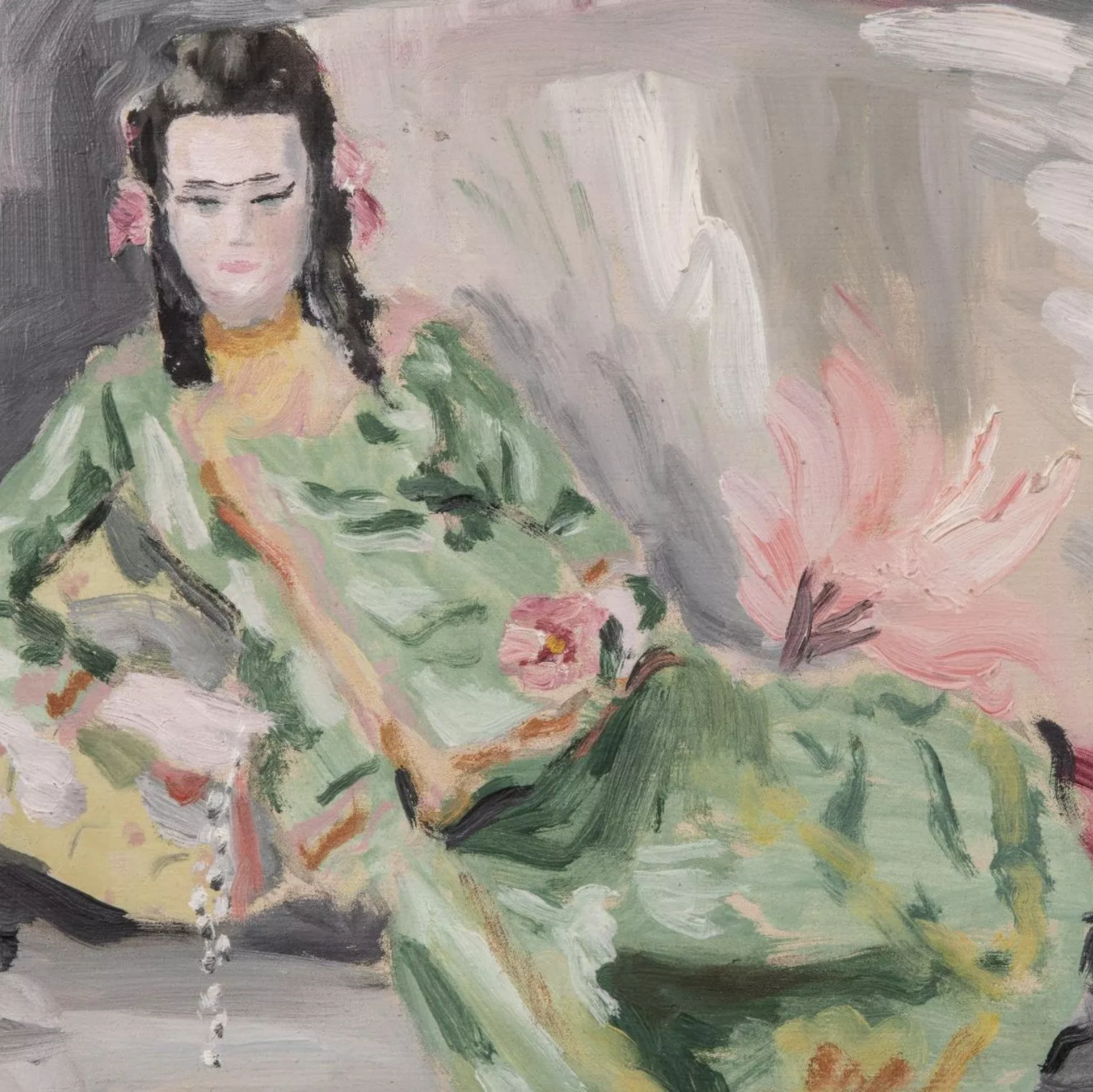
The artist developed her own pictorial language, combining surrealist and abstract elements with organic and geometric forms while retaining a certain suggestion of reality. Initially close to the Fauvist movement, she later acquired a stylistic proximity to Cubism.
A student at the Académie Humbert in Paris, her early work was influenced by Cubism (notably by Picasso and Braque), but without fully embracing it. She quickly detached herself from Cubist austerity to develop a feminine, poetic, dreamlike language, close to the world of softened Fauves.
She was also influenced by Symbolism, 18th-century France (Watteau, Fragonard) and Japonism. Her palette is immediately recognizable: muted pastel tones (faded pinks, blue-greys, water greens, lilacs, mother-of-pearl), almost devoid of violent contrasts.
Colors are not used to model, but to envelop forms in a diffuse harmony. The paint is often matte, fluid, sometimes watercolor-like in its lightness. She makes frequent use of bluish or pinkish gray as an atmospheric dominant.
The drawing is deliberately simplified, at times almost naïve (curves are soft, contours blurred, and the absence of depth is marked). The figures are framed by light outlines, then softened by the use of color.
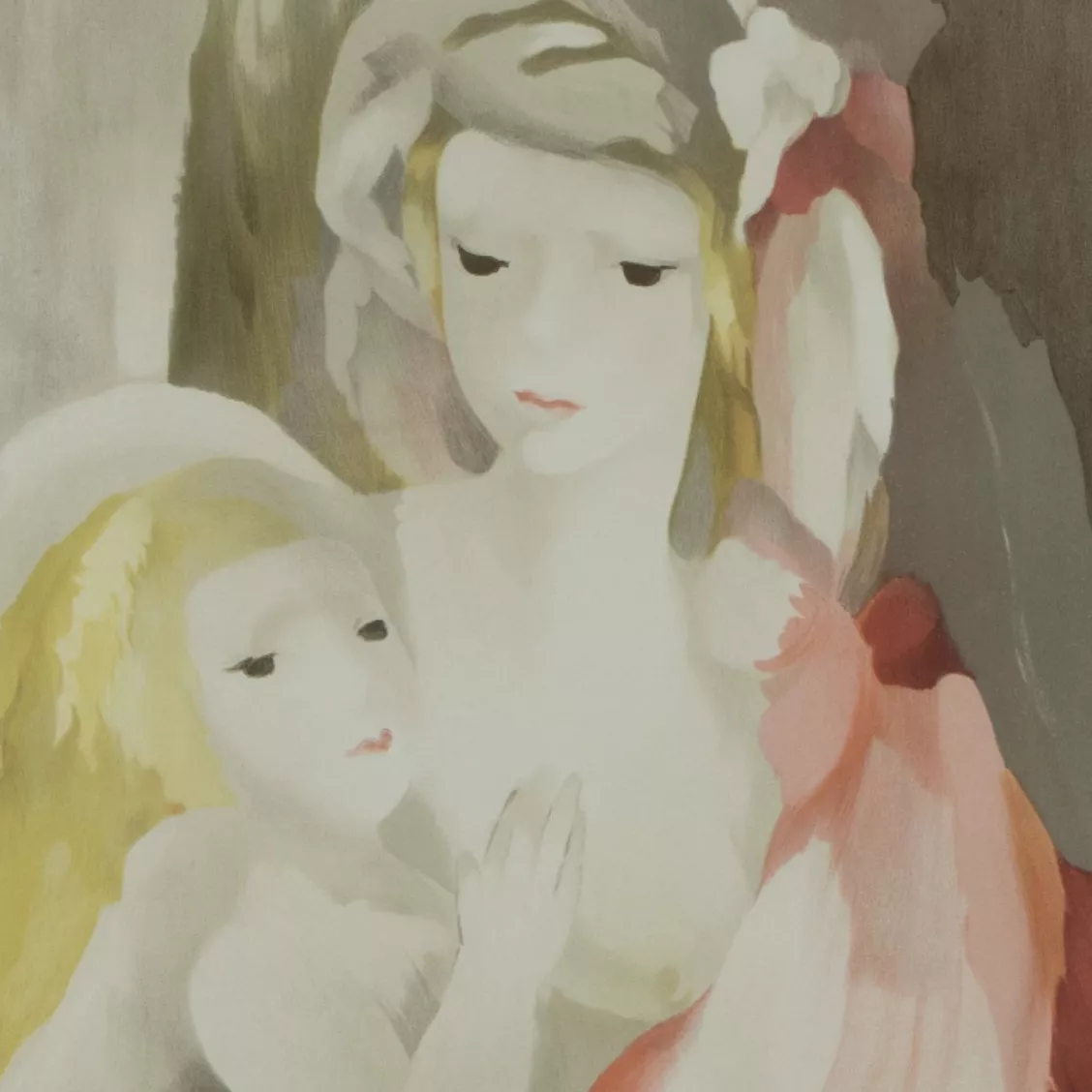
She uses numerous repetitive effects (poses, faces, looks), creating a form of visual music, and depicts almost exclusively female figures, graceful, melancholy and often in half-profile or with downcast eyes.
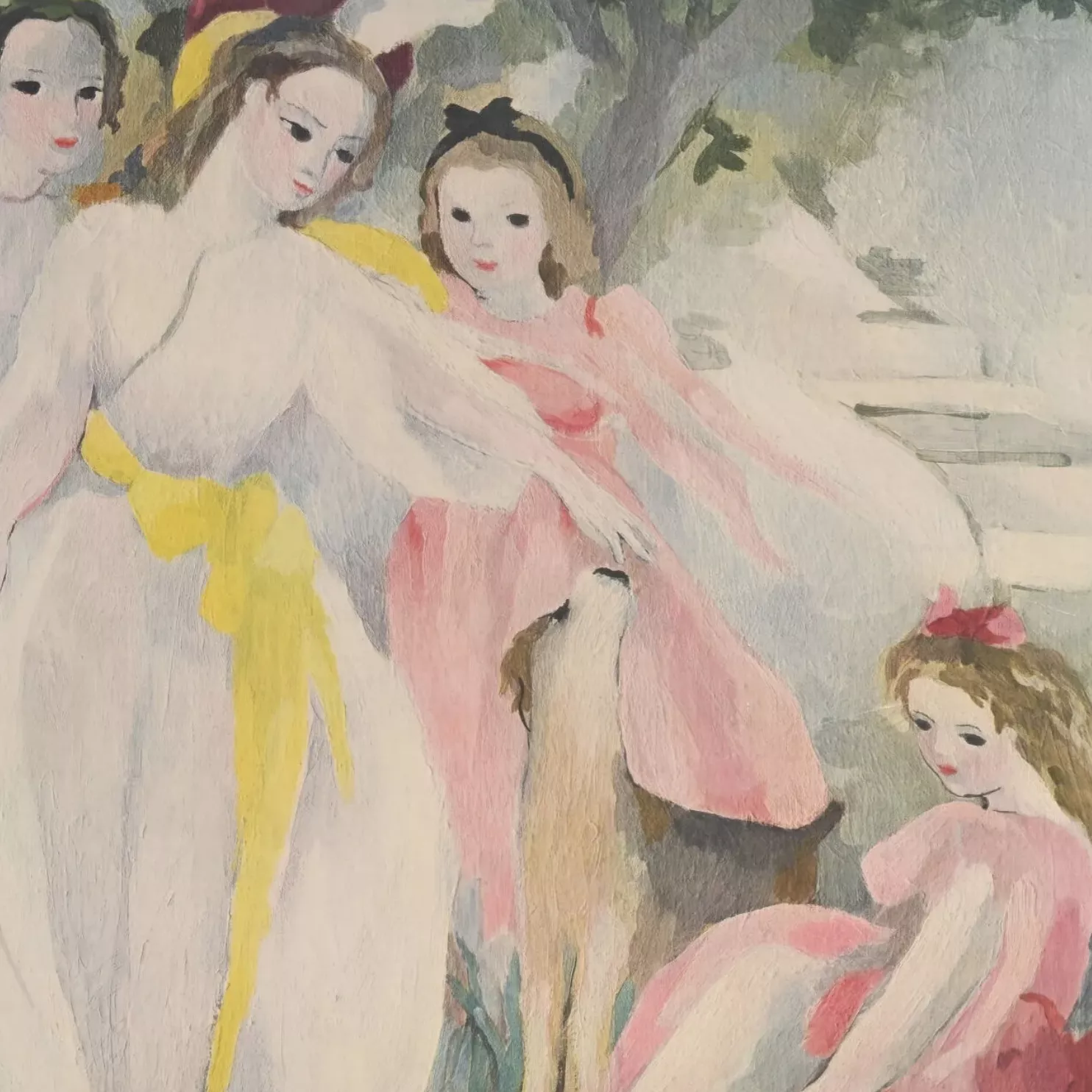
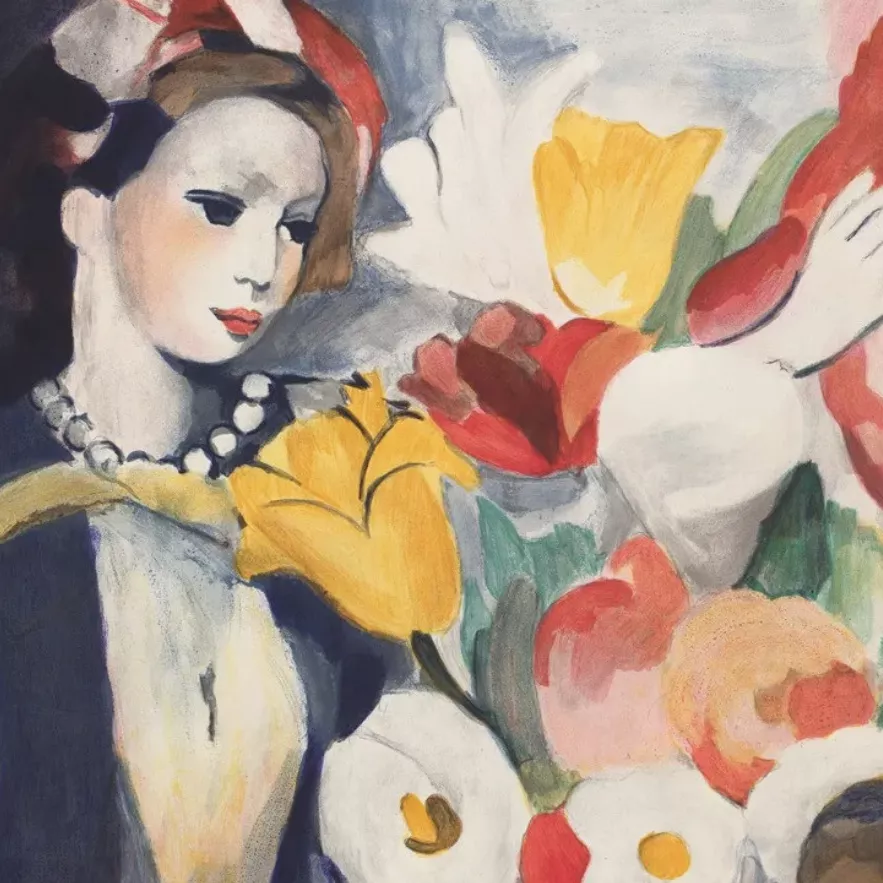
His recurring themes are young girls, horsewomen, animals (deer, hinds, greyhounds), bouquets and musicians. The female model thus becomes an icon of reverie, far removed from realism or narrative.
Marie Laurencin's relationship to modern art lies on the bangs of the formal avant-gardes, but is totally modern in its subjectivity and autonomous visual language.
Marie Laurencin, cubist among the fauvists
Marie Laurencin (1883-1956), a French artist, began her artistic career by learning the art of painting on porcelain. She later enriched her knowledge by attending drawing classes in Paris and at the Académie Humbert. In 1907, she made her debut with her first solo exhibition, marking the start of a promising career.
It was during this period that she crossed paths with Pablo Picasso and the Bateau-Lavoir artists' group in Montmartre, as well as that of the famous poet and art critic Guillaume Apollinaire. A passionate affair was born between Marie Laurencin and Apollinaire, fueled by intellectual and artistic exchanges, which lasted until 1912.
Influenced initially by Fauvism, Marie Laurencin evolved towards a simplification and idealization of forms under the influence of Cubist painters. From 1910 onwards, her palette took on softer hues, oscillating between gray, pink and pastel tones.
However, the First World War turned her life upside down. Her new merchants, being German nationals, disappeared, and she herself was linked by marriage to a German baron in the summer of 1914.
Constrained to remain in Germany, she was unable to return to France permanently until 1921, a period when her palette darkened, perhaps reflecting the torments of this tumultuous period.
Around 1912, Marie Laurencin crossed paths with Paul Guillaume, probably thanks to Apollinaire. In the 1920s, he even became her dealer. Returning to Paris at this time, she devoted herself to painting slender, evocative female figures, bathed in pale tones, creating an enchanting world through her canvases.
She also distinguished herself in portraits of Parisian celebrities and in the creation of sets for the Ballets Russes. In her works, she expresses a pronounced taste for metamorphosis, fusing her favorite themes of young women and animals.
Marie Laurencin remains one of the women-of-the-20th-century who is known to the general public today and whose cote is on the rise.
Focus on Les jeunes filles, Marie Laurencin
Les jeunes filles is a medium-format oil on canvas by Marie Laurencin, held at the Musée de l'Orangerie in Paris. It was produced after the artist's return from exile, at a time when her style was fully established.
The composition centers around three young women with dreamy attitudes, stylized bodies and almost identical faces. The setting is reduced to a few stylized plant forms and a vaporous background, with no real spatial depth.
She chose to depict a greyhound, an animal whose presence is recurrent in Laurencin's work, embodying both gentleness and fidelity. The pastel palette she uses is dominated by bluish greys, faded pinks and water greens, as well as lavenders.
No shadows are deliberately marked to create a translucent effect, like a veil laid over the scene. The figures seem suspended and detached from the ground. Contours are delicately traced, then blurred with liquid, tapering strokes.
Marie Laurencin represents an exclusively feminine world, outside time and narrative, both intimate and impersonal. The faces are similar in that they are archetypes of femininity, melancholic and introspective. The atmosphere is hushed, almost silent.
This work is an accomplished example of pure Laurencinian style, with a codified formal language, a refusal of anecdotal narrative and plastic homogeneity. The work illustrates his desire to free himself from realism without lapsing into abstraction, establishing an autonomous poetic universe.
It offers a subtle alternative to masculine modernism, creating an aesthetic based on repetition, softness and suggestion. This painting helped establish her reputation in the 1920s, particularly in literary and social circles.
Marie Laurencin's imprint on her time
Marie Laurencin made a lasting mark on the art world. However, unlike her fellow artists, she was not widely known by the general public. Her works are relatively rarely exhibited, and over time have acquired a certain notoriety on the art market.
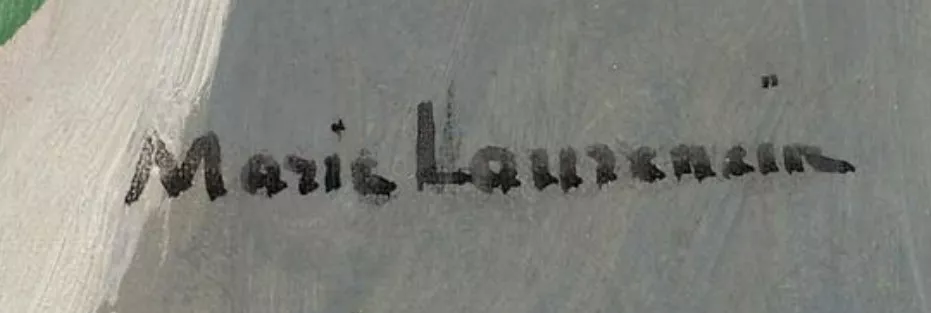
Her signature
Not all of Marie Laurencin's works are signed.
Although there are variations, here is a first example of her signature:
Expertise your property
If you own a Marie Laurencin work, don't hesitate to request a free appraisal by filling in our online form.
A member of our team of experts and certified auctioneers will contact you to provide an estimate of the market value of your work.
If you are considering selling your work, our specialists will also guide you through the various alternatives available to obtain the best possible price, taking into account market trends and the specific features of each work.
Estimate in less than 24h
Discover in the same theme

Estimate and auction your Camille Fauré vases and other Limo...
Pieces by Camille Fauré often fetch high prices at auction. The work of Emaux de Limoges justifies it!
Learn more >

Value and quotation of works, paintings by Eugène Leroy
Eugène Leroy, a 20th-century painter, produced a singular body of work appreciated and quoted on the auction market. Estimated in less than 24h.
Learn more >

Market Value and Price of the Sculptures and Bronzes by Loui...
Louis de Monard is a twentieth-century animal sculptor whose sculptures are highly prized at auction.
Learn more >
Works from the same period sold at auction


Secure site, anonymity preserved

Auctioneer approved by the State

Free and certified estimates
Frequently asked questions
-
Who is Marie Laurencin, and what is her artistic background?Marie Laurencin (1883–1956) was a major French artist of the 20th century, initially influenced by Fauvism and later by Cubism. Close to Pablo Picasso and the Bateau-Lavoir group, she developed a unique pictorial language combining surrealist and abstract elements with a characteristic palette of pastel tones (faded pinks, blue-grays, and watery greens). She is particularly noted for her depictions of slender, melancholic female figures, as well as for her set designs for the Ballets Russes.
-
What are the price ranges for Marie Laurencin's works based on the medium used?The prices of Marie Laurencin’s works vary considerably depending on the medium: prints range from €10 to €14,020, watercolor drawings from €40 to €1,006,660, and oil paintings on canvas from €80 to €808,950. Her most prestigious illustrations, such as those for *La Dame aux Camélias* (1936), can fetch over one million euros. Her market value is currently on the rise, particularly among French buyers.
-
How do I have a work by Marie Laurencin authenticated and appraised?To authenticate and appraise a work by Marie Laurencin, we recommend that you request a free appraisal from Auctie's by filling out our online form. A state-certified expert or auctioneer will contact you to examine your artwork and provide you with an accurate estimate of its market value, with no obligation on your part.
-
Is this the right time to sell a work by Marie Laurencin?Yes, now is a good time to sell a work by Marie Laurencin. Her market value has been rising steadily in the art market, her oil-on-canvas paintings are particularly sought after, and the artist’s reputation continues to grow among international collectors. Our specialists will advise you on the best sales strategy based on current market trends.
-
How does the process of selling a work of art at Auctie's work?At Auctie's, we support sellers from the appraisal stage through to the auction. Following a free, no-obligation appraisal, our auctioneers will present you with the best options to maximize the sale price of your artwork. We handle all administrative and sales-related procedures, taking into account the unique characteristics of each artwork and current market opportunities.
