



Rating and value of paintings by Hippolyte Petitjean

Key takeaways
- Petitjean’s Pointillist paintings from the 1900s are the most sought-after, with prices ranging from €220 to €125,000 depending on technique and quality.
- The artist’s market value surged in 2019 before stabilizing, with 78% of his sold works classified as paintings.
- Hippolyte Petitjean (1854–1929) was a master of Divisionism influenced by Seurat, who employed a rigorous method of juxtaposing colored brushstrokes to build light.
If you own a work by or after the artist Hippolyte Petitjean, and would like to know its value, our state-approved experts and auctioneers will offer you their appraisal services.
Our specialists will carry out a free appraisal of your work, and provide you with an accurate estimate of its value on the current market.
Then, if you wish to sell your work, we will guide you towards the best possible arrangement to obtain the optimum price.
Artist's rating and value
An important artistic figure of his time, Hippolyte Petitjean has established himself as a sure bet on the art market. Constantly evolving, his value remains high and his works are sold internationally.
In the auction room, the pointillist canvases, painted in the early 1900s, are the most sought-after and therefore prized. Drawings are also very popular with collectors.
A work by Petitjean, for example, can sell for a hundred million euros at auction, as evidenced by his 1903 oil on canvas, Baigneuse se laver les cheveux, which fetched €125,000.
Order of value from the most basic to the most prestigious
Technique used | Result |
|---|---|
Estamp - multiple | From €10 to €500 |
Drawing - watercolor | From €30 to €36,700 |
Painting | From €220 to €125,000 |
Estimate in less than 24h
Style and technique of Hippolyte Petitjean
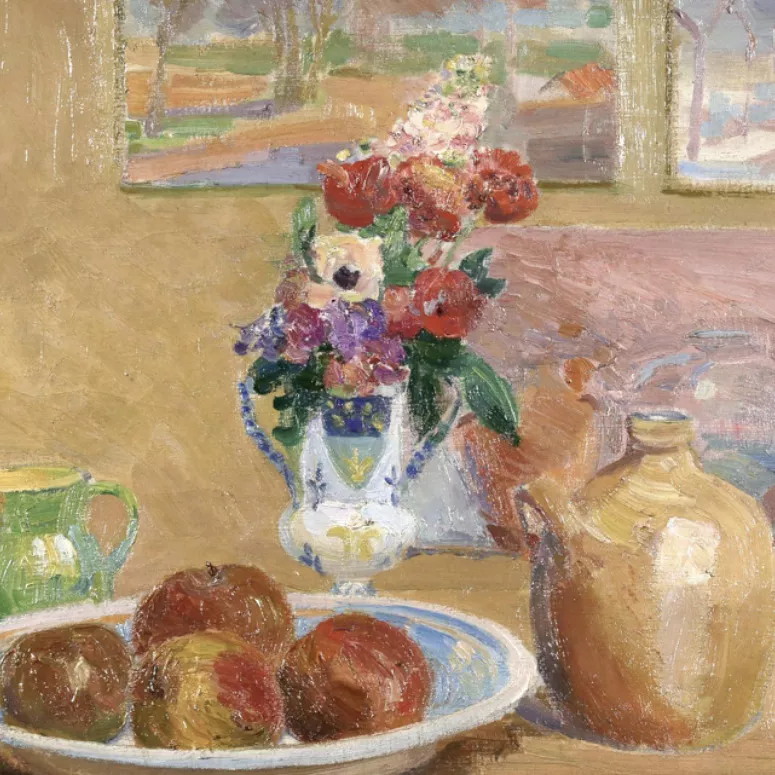
In Hippolyte Petitjean's painting, the surface retains this function of clarity, balance, orderly distribution of forms.
But it is no longer organized according to the principles of academic modeling: it is based on the division of the brushstroke, the methodical juxtaposition of tones, the vibrant unity of the visual field. The brush doesn't accompany volume: it breaks it down.
Light doesn't model, it emerges from within the color, built point by point, nuance by nuance. The composition, often centered, without excessive depth, favors stability, continuity and immediate readability.
The motif - a tree, a river, an elongated figure - is not imposed by the narrative, but by its place in space, its relationship to the colored masses, its anchoring in a rhythm. The brushstroke, regular and even, follows a rigorous logic, with no expression of gesture, no variation in thickness.
As a result, removed from virtuosity as well as spontaneity, Petitjean's painting asserts a measured gaze, a held figuration, a technique without effect - a slow, silent construction, where light does not illuminate, but structures.
Hippolyte Petitjean, his life, his work
Hippolyte Petitjean (1854 - 1929) was a French painter born in Mâcon. He trained as a painter first in Mâcon, which enabled him to obtain a scholarship to study in Paris, under the supervision of Pierre Puvis de Chavannes and Alexandre Cabanel.
He exhibited at the Salon as early as 1880, and presented paintings there for over ten years. His meeting with Georges Seurat in 1884 was to have a decisive and lasting influence on his style. Starting out in academism, he then tried his hand at symbolism for a while before adopting a more impressionist, and finally pointillist, style.
He took part in the Indépendants exhibitions from 1891 and became an active member of the neo-impressionist group.
Attached to the division of tones, the luminous vibration of the brushstroke and the balance of compositions, he developed a structured style of painting, often constructed in the studio from sketches made on the spot.
His favorite subjects landscapes, bathers, intimate scenes, are treated in a clear, poised range, where the rigor of the method never gives way to virtuosity. Settled in Paris, then in Lagny-sur-Marne, he pursued his work steadfastly, on the bangs of the great breakaway movements.
Thus, far from scandalous effects or stylistic renunciations, Hippolyte Petitjean's career is part of a discreet, yet rigorous continuity, where fidelity to the principle of point and light becomes a way of holding form, without noise.
Focus on Bathers in a Landscape
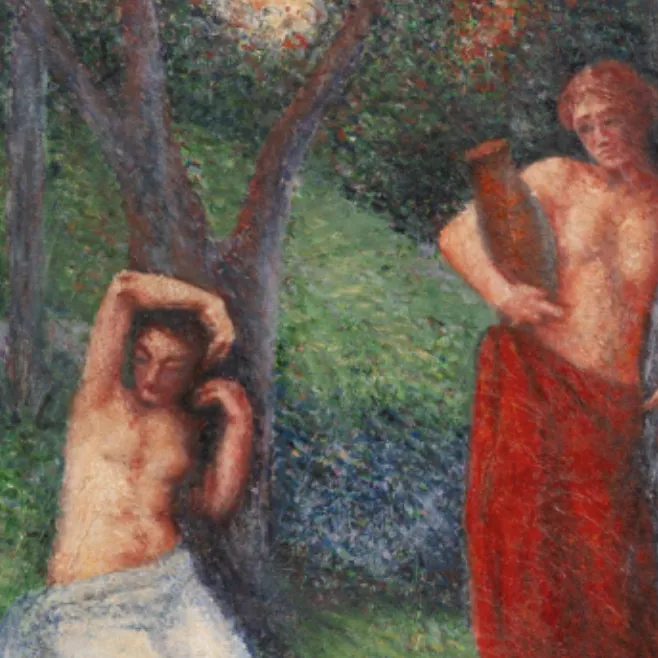
In Baigneuses dans un paysage (fig. 1), light is not applied, it is constructed. It doesn't come from a specific point in the sky, it emanates from the entire surface.
It doesn't cut, it evens. The motif, simple - a few figures lying on the edge of a body of water, trees, hills, a smooth sky - tells nothing.
It doesn't suggest a moment, it organizes a field. The bodies, treated without shadow, without line, don't stand out: they pose. They are there, without movement, without gaze, without drama. The landscape doesn't surround them, it contains them.
The brushstrokes, laid out regularly, follow a horizontal logic. It varies neither in intensity nor direction. Each zone vibrates without jarring the other. Sky, water, earth, foliage are constructed with the same rigor, the same patience.
No contrast, no forced depth. The eye doesn't fall on anything, it circulates. The figure is not central, but on an equal footing with the forms around it. The body becomes surface, the décor becomes rhythm. The painting doesn't seek out the scene, it proposes a distribution.
Then the image doesn't give itself immediately. It reveals itself slowly, without accent, without appeal. It imposes a silence, an equality, a diffuse light, where everything is posed - in the same time, in the same tone.
Hippolyte Petitjean's imprint on his period
In Hippolyte Petitjean's work, color retains this function of modulation, vibration, distribution in space. But it doesn't seek effect, it doesn't aim for brilliance. It follows a method. It builds a balance.
At a time marked by formal ruptures, pictorial experimentation and theoretical discourse, Petitjean maintains a continuous line. He makes no claims. He doesn't break. He consistently applied the principles of Neo-Impressionism in prolonged silence. No manifesto. No break in style.
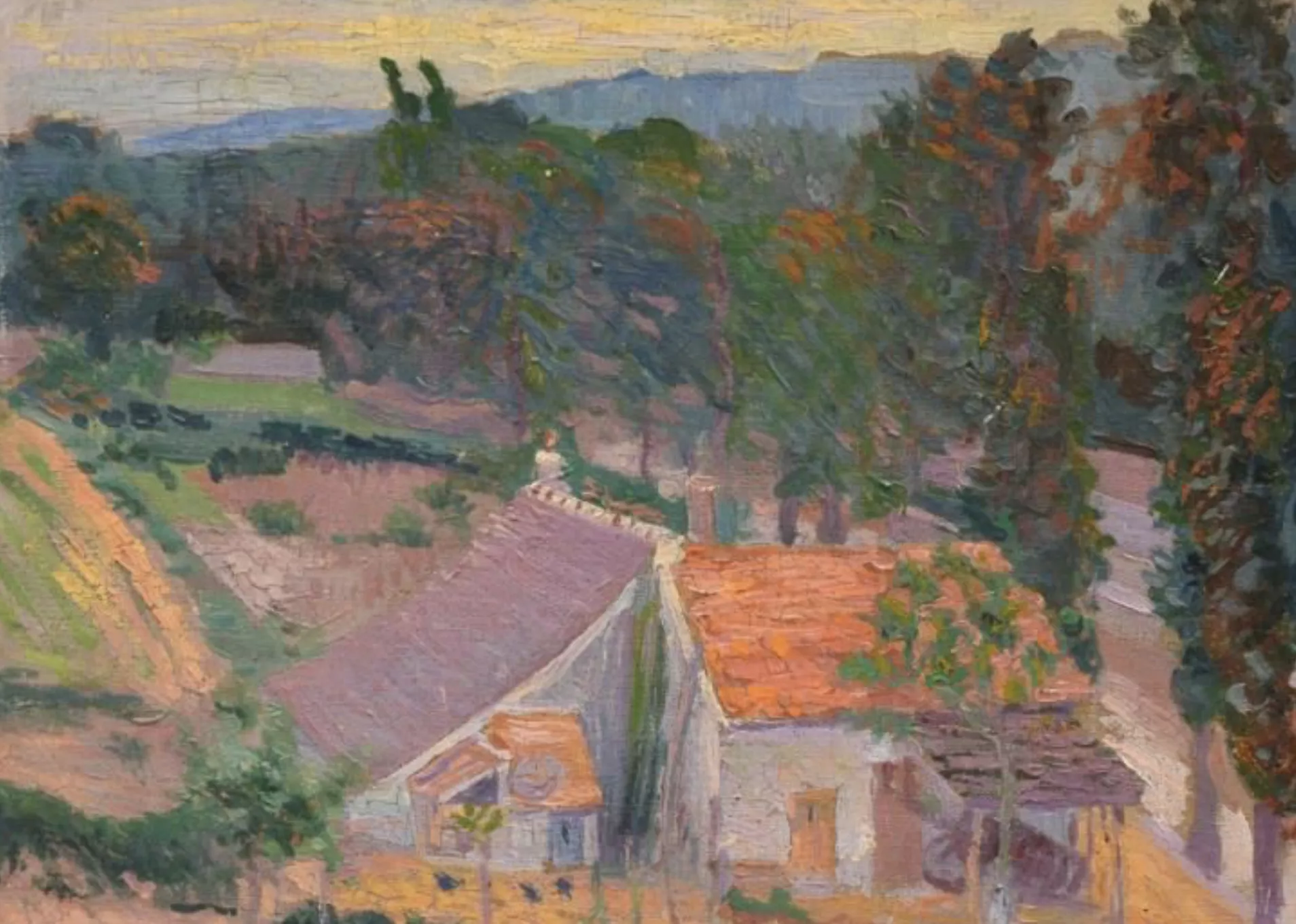
His discreet imprint is not that of the avant-garde. It's that of an eye that holds. A painter who builds slowly, without effect. Baigneuses dans un paysage, Lac au crépuscule, Femme couchée dans les feuillages - so many works that seek neither the scene, nor the accident, nor the exception.
They pose a figure, a tree, a reflection. They distribute them. They fit them into a field. Each touch is a unity, each plane a calm surface. Light is divided, but without tension. Rhythm builds, but without rupture.
It's not a question of innovating, but of continuing. To adjust. To maintain. Where others paint upheaval, he installs duration. A painting on the sidelines. Neither on the fringe, nor at the center.
Far from generational effects, Hippolyte Petitjean's imprint is part of a low, regular, smooth time. A fidelity to a method, to a light, to a figure - always posed, always held, always in balance.
The artist's quotation experienced a sudden jump in 2019, due to a strong presence of his works on the market that year. Since then, it has been lower, but with few fluctuations. 78% of the artist's works are auctioned in the painting category.
Seurat et le divisionnisme
Divisionism, a technique based on the systematic separation of colors into small, juxtaposed strokes, is founded on scientific principles borrowed from optics and color theory, notably Chevreul's work on simultaneous contrasts and Rood's on light perception.
Georges Seurat was the pioneer, transforming the canvas into a vibrant surface where each colored point participates in a chromatic recomposition by the viewer's eye.
This process, visible in Un dimanche après-midi à l'Île de la Grande Jatte (Art Institute of Chicago), achieves a mathematical precision where the arrangement of primary and secondary colors maximizes the luminous effect.
Paul Signac, Seurat's faithful companion, perfected this technique with a freer touch, as witnessed by Le port de Saint-Tropez (Musée d'Orsay). More distant Seurat influences can also be found in Serge Mendjisky.
Camille Pissarro, initially an Impressionist, also incorporates elements of Divisionism, although his approach remains more intuitive. In Italy, Giovanni Segantini and Gaetano Previati adapt these principles to Symbolist compositions, giving the movement international scope.
Divisionism is not just about technical prowess: it illustrates a methodical, quasi-scientific vision of painting, transforming the creative act into an experiment with light and space.
Recognizing the artist's signature
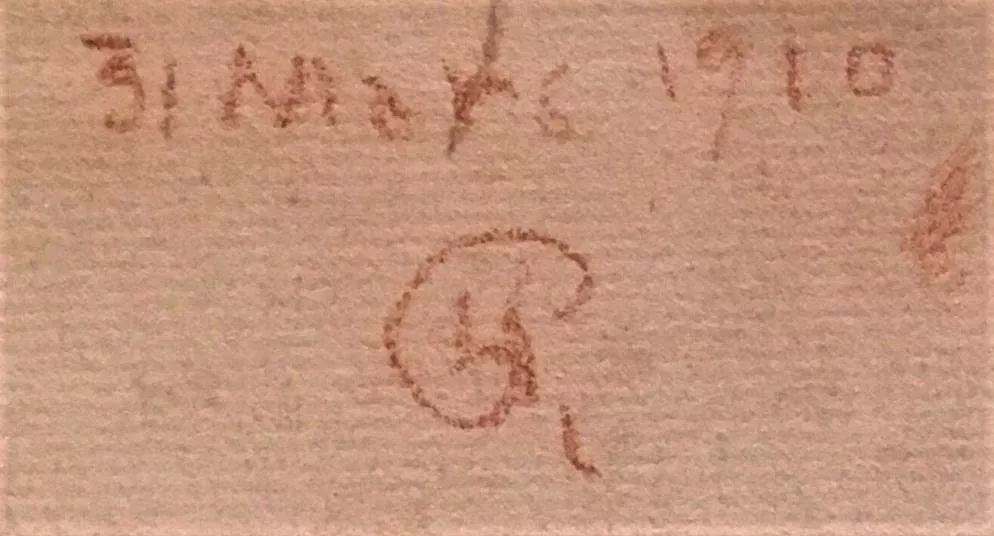
Not all of Hyppolite Petitjean's works are signed, and copies may exist. The production of fake paintings is very important for this artist. Here's an example of his signature.
Expertise your property
If you happen to own a work by Hippolyte Petitjean, request a free appraisal without further delay via our form on our website.
A member of our team will contact you promptly to provide you with an estimate of the value of your work, as well as ad hoc information about it.
If you are considering selling your work, you will also be accompanied by our specialists in order to benefit from alternatives for selling it at the best possible price.
.Estimate in less than 24h
D'autres tableaux modernes figuratifs vendus aux enchères

Estimated 800 - 1.500
Jean Roger SOURGEN (1883-1978) Trees and dunes Oil on panel

Estimated 3.000 - 5.000
Georges LAPCHINE (1885-1951) The port of St Tropez Oil on canvas

Estimated 18.000 - 30.000
Charles CAMOIN (1879-1965) "Le Port de Marseille, 1928" Oil on canvas.

Estimated 1.500 - 3.000
Jean VANDEN EECKHOUDT (1875-1946), Basket of persimmons, Oil on canvas

Estimated 2.000 - 4.000
Charles LACOSTE (1870-1959) Starry night, Oil on paper mounted on canvas
Discover in the same theme

Rating and value of works, paintings, drawings by Sam Szafra...
Sam Szafran is a 20th-century painter and draughtsman. His figurative works are highly valued and quoted at auction.
Learn more >

Rating and value of paintings by Othon Coubine
Othon Coubine is a twentieth-century Fauvist painter who produced paintings that are highly valued at auction. 24-hour estimate!
Learn more >

Rating and value of paintings by Toshio Bando
Toshio Bando is a painter from the École de Paris who has produced many works that are highly valued at auction.
Learn more >

Secure site, anonymity preserved

Auctioneer approved by the State

Free and certified estimates
Frequently asked questions
-
Who was Hippolyte Petitjean, and what was his contribution to art history?Hippolyte Petitjean (1854–1929) was a leading French painter of the Neo-Impressionist movement. Trained under Pierre Puvis de Chavannes and Alexandre Cabanel, his encounter with Georges Seurat in 1884 transformed his style. He became one of the active members of the Divisionist group, consistently and rigorously applying the technique of Pointillism to landscapes and compositions of bathers, in contrast to the formal innovations of his time.
-
What are the prices and price ranges for Hippolyte Petitjean's works?Prices vary depending on the medium: prints sell for between €10 and €500, drawings and watercolors between €30 and €36,700, and paintings between €220 and €125,000. Pointillist paintings from the early 1900s are the most sought-after and therefore the most expensive. For example, the oil on canvas *Baigneuse se lavant les cheveux* (1903) fetched €125,000 at auction.
-
How can you authenticate a work by Hippolyte Petitjean and verify its authenticity?Although not all of Petitjean’s works are signed, a significant number of forgeries have been produced in this artist’s name. To authenticate a work and determine its exact value, we recommend requesting a free, no-obligation appraisal from Auctie’s. Our team of experts and state-certified auctioneers will examine your item and provide you with a detailed appraisal within 48 hours.
-
Is this the right time to sell a work by Hippolyte Petitjean?Yes, this is a good time. Hippolyte Petitjean remains a safe bet in the art market, with high valuations and sales taking place internationally. Although the market peaked in 2019, fluctuations have remained limited since then. His works—particularly his Pointillist paintings—continue to be in steady demand among collectors.
-
How does the appraisal and sale of a work of art take place at Auctie's?At Auctie's, appraisals are free and come with no obligation. Simply fill out our online form: an expert will contact you shortly to appraise your item and provide you with an accurate estimate within 48 hours. If you decide to sell, our specialists will guide you through the entire process, offering you the best options to achieve the highest possible price at auction.
