



Rating and value of paintings by Henri Robert Brazil

Key takeaways
- Henri Robert Brésil (1952–1999), a self-taught Haitian painter, established himself as a major figure in naïve art with his highly recognizable tropical landscapes.
- His paintings sell for between €150 and €15,800 at auction, such as the oil painting “Untitled,” which sold for €15,800 in 2023 against an estimate of €2,000–3,000.
- His works, characterized by the repetition of plant motifs, a lack of depth, and a vibrant color palette, are sought after internationally for their meditative and decorative qualities.
If you own a work by or after the artist Henri Robert Brésil and would like to know its value, our state-approved experts and auctioneers will offer you their appraisal services.
Our specialists will carry out a free appraisal of your work, and provide you with an accurate estimate of its value on the current market.
Then, should you wish to sell your work, we will direct you to the best possible arrangement to obtain the optimum price.
Artist's rating and value
An important artistic figure of his time, Henri Robert Brésil has established himself as a sure bet on the art market. Constantly evolving, his quotation remains high and his works are sold internationally.
In the auction room, his landscapes inspired by Hawaii, where he is originally from, are the most sought-after and therefore prized. He produced paintings almost exclusively, the only medium present on the market today.
As such, a work signed Henri Robert Brésil can sell for thousands of euros at auction, as evidenced by his oil on canvas, Sans titre,adjudged €15,800 in 2023, whereas it was estimated at between €2,000 and €3,000.
Order of value from the most basic to the most prestigious
Technique used | Result |
|---|---|
Painting | From €150 to €15,800 |
Estimate in less than 24h
Artist's style and technique
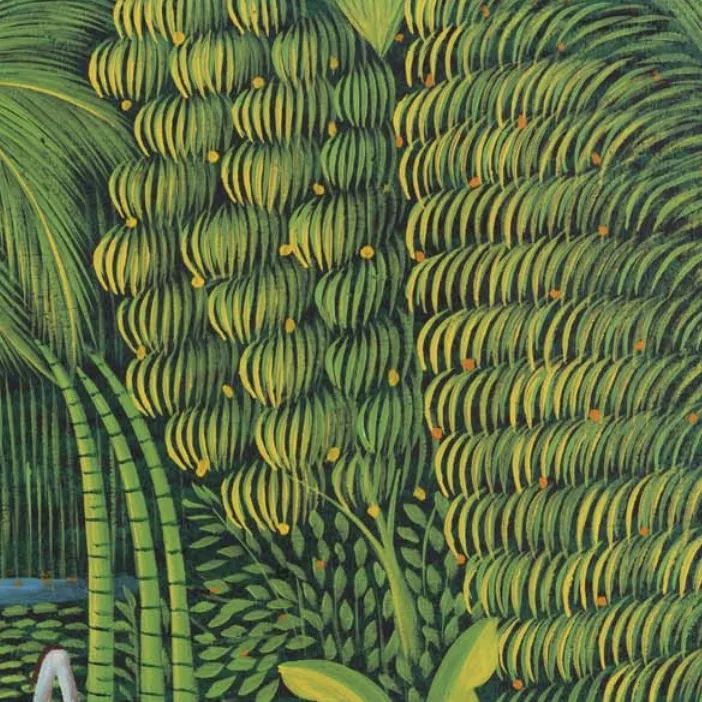
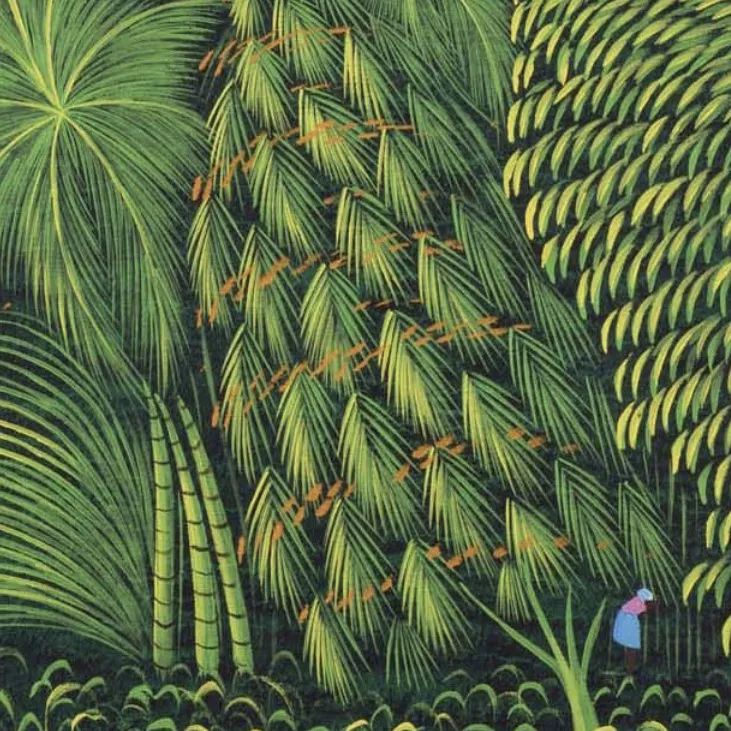
Henri Robert Brésil (1952 - 1999), is a Haitian painter who is best known for his lush landscapes, in which tropical vegetation occupies most of the pictorial surface. Trees, palms, lianas and abundant foliage are represented with almost obsessive attention, reflecting a rather enchanted vision of nature.
The technique he uses is intuitive and repetitive : he works without sketches, directly on the canvas, using successive flat tints and recurring motifs (which explains the absence of drawings on the market). The forms are stylized, simplified, stylized and almost decorative, in a logic of ornamentation where the plant motif becomes structure.
The palette he uses is vibrant and contrasting, his works distinguished by the use of bold colors (intense greens, deep blues, saturated ochres and reds, juxtaposed in gradations, creating contrasting effects and a luminous, unreal atmosphere.
The chosen perspective is suspended and frontal, the point of view is often aerial or frontal, with no horizon line or marked depth. This gives his landscapes a deliberate flatness, akin to prints or plant carpets.
The elements float or organize themselves according to an internal rather than naturalistic logic. His aesthetic is close to Haitian naive art. Although he was not trained in an academic school, Brésil is nevertheless part of the Haitian naïve painting movement, and favors immersion in the landscape over the depiction of genre scenes.
The work is intended as meditative or silent, and despite their chromatic exuberance, his canvases have nothing agitated about them. They establish a climate of calm and withdrawal, where nature becomes a mental and spiritual space, disconnected from the tumult of the world.
Henri Robert Brésil's style and technique are thus based on a poetic, almost mystical vision of landscape. Through the repetition of forms, the intensity of colors and the absence of anecdote, he proposes a deeply personal painting, which imposes itself as both decorative and meditative, where nature becomes an infinite motif.
Henri Robert Brésil's career
Henri Robert Brésil was born in 1952 in Gonaïves, Haiti. He began painting at a very early age, on the fringe of any academic training, following a self-taught logic based on direct observation of the landscape, the patient accumulation of motifs and the rigorous arrangement of forms.
In 1973, he moved to Port-au-Prince. There, he developed a personal vocabulary that was immediately recognizable: dense vegetation, winding rivers, open skies, flamingos arranged in a repeated, almost decorative pattern. The composition does not seek the illusion of reality, but organizes a constructed, coded space, saturated with detail.
From the 1980s onwards, his works were exhibited in Haiti, the United States, France, Italy and Japan. In 1981, he received an ISPAN-UNESCO award, confirming the singularity of his approach to landscape. The international press took an interest in his work, and collectors lingered.
His success was not anecdotal: it was based on a way of ordering nature according to internal logics, without perspective, without shadow, without rupture. Henri Robert Brésil died in 1999, leaving behind a coherent body of work, repetitive in its economy but dense in its execution.
A sustained painting, entirely structured by color, repetition, and the will to make landscape not a place, but a world.
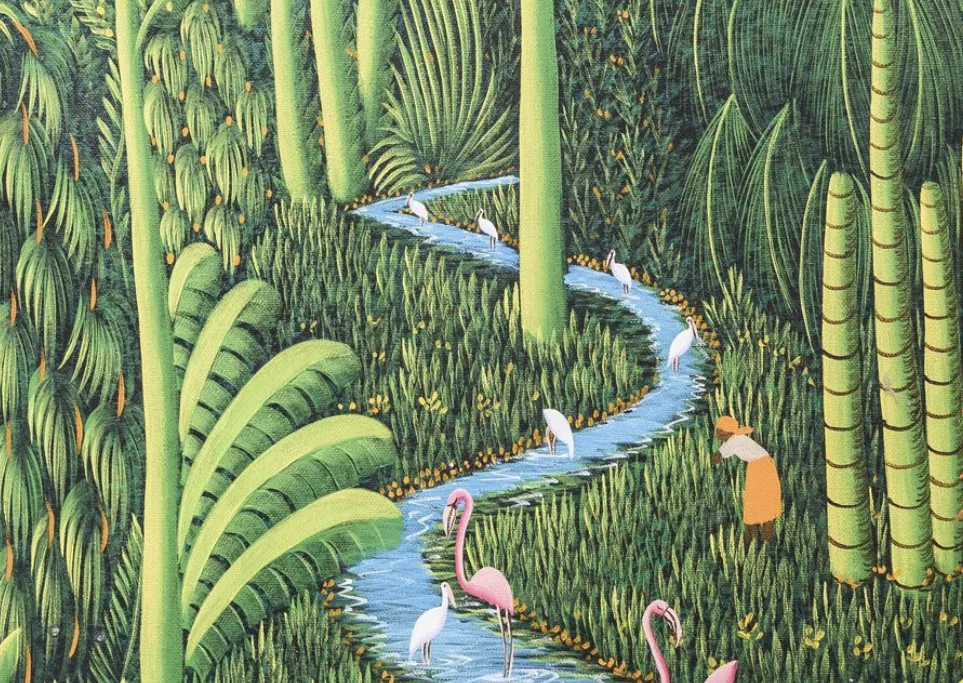
Focus on Rivière aux oiseaux, Henri Robert Brésil
In Rivière aux oiseaux, composition is not based on constructed depth, it is elaborated in the repetition of forms, the distribution of elements, the density of surfaces.
The watercourse, traced in a curve, does not structure a perspectival space: it crosses the canvas like a motif, laid on the surface, guided by a decorative logic. The vegetation, arranged in superimposed strata, doesn't reproduce nature, it orders it.
Each leaf, each branch, each tuft is isolated, reproduced, aligned. The trees settle into a vertical cadence, stable, without deviation.
The birds, placed in groups of two or three, punctuate the scene according to a logic of balance. They don't fly, they punctuate. The sky, uniform, without gradation, without effect, closes the composition. Light doesn't modify color, it reveals it.
No shadow contrast, no break in tone. The image is not an observed landscape, it's a reconstructed space, organized according to an internal syntax.
From Henri Robert Brésil, Rivière aux oiseaux doesn't show a nature to be seen, it proposes a world to be traversed. A space without drama, without a central figure, structured by repetition, frontality, clarity of motif. A full, closed, continuous image.
Henri Robert Brésil's imprint on his period
In Henri Robert Brésil's work, his imprint is not one of rupture or assertion, but of formal constancy, a rigorous mode of construction, a way of turning landscape into language. He doesn't seek to upset frameworks, he stabilizes them.
At a time marked in Haiti by the tension between narrative figuration and naive painting, he proposes a space without story, without character, without action. The eye is not fixed on an event, but circulates in a closed, saturated composition, entirely devoted to the ordering of vegetation.
His influence does not lie in technical innovation, but in controlled repetition, precision of form and the immediate legibility of the image. He imposes a style without overload, based on regulated accumulation, on the frontality of the field, on the constancy of the motif.
His success, local and then international, is part of this logic of strong visual identification: each work becomes a contained variation of an immobile world.
Henri Robert Brésil thus marks his period not by diversity, but by the intensity of a single, structured, invariable gaze, which transforms the landscape into a full, available, silent surface.
The stylistic influences of Henri Robert Brésil
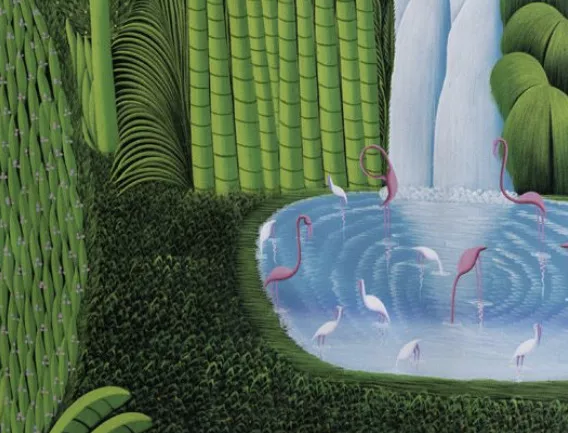
In Henri Robert Brésil's painting, the influences are not stated as quotations, they are observed in the construction of the field, in the arrangement of the vegetation, in the repetition of the motif.
He doesn't take up an academic tradition, he extends a logic specific to Haitian painting, structured around a radical frontality, an absence of depth, a bursting of forms over the entire surface. Naïve art can be found in France, however, with artists such as Rémi Blanchard, Henri Rousseau or Chagall, in a few works.
He shares with Préfète Duffaut this way of organizing the composition by strata, but where Duffaut introduces figures, temples, narratives, Brésil erases all narrative. The landscape becomes the only subject, the only measure, the only rhythm.
There's a closeness in his paintings to the work of André Pierre, in the saturated use of color, in the importance given to the plant motif, but without the symbolic charge, without the spiritual dimension.
In Brésil, the visible world refers to no cosmogony: it is stated as it is, structured, full, motionless. The repetition of trees, flamingos and rivers acts not as a constraint, but as a grammar. It's not a question of representing nature, but of recomposing it.
The influence can be read in this discreet but firm shift away from naive narrative art towards a painting of organization, surface, calm. A painting without story, without scene, without hierarchy, which imposes another logic on the gaze.
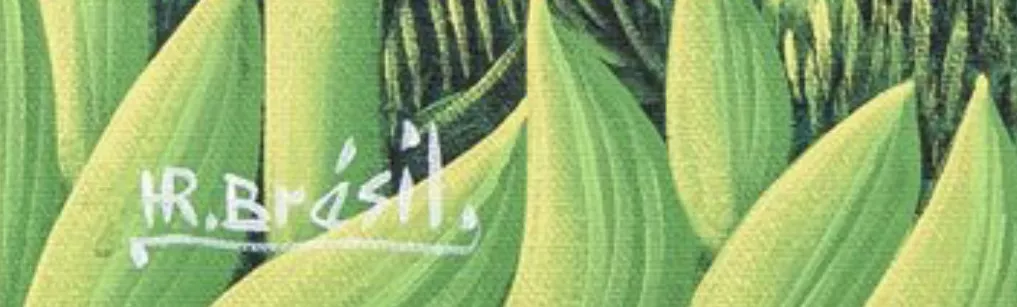
Recognizing the artist's signature
Not all of Henri Robert Brésil's works are signed. Here is an example of his signature.
Expertise your property
If you happen to own a work by Henri Robert Brésil, request a free appraisal without further delay via our form on our website.
A member of our team will contact you promptly to provide you with an estimate of the value of your work, as well as ad hoc information about it.
If you are considering selling your work, you will also be accompanied by our specialists in order to benefit from alternatives for selling it at the best possible price.
Estimate in less than 24h
Discover in the same theme

Rating and value of paintings by Nicolas Roerich
Nicolas Roerich is a Russian symbolist painter of the 20th century. The value of his works continues to rise on the auction market.
Learn more >

Rating and value of paintings by Michel Larionov
Michel Larionov is a Russian painter of the Rayon period who has produced works that are quoted and valued at auction. Estimated in 24h.
Learn more >

Ratings and values of paintings by Luong Xuan Nhi
Luong Xuân Nhi is a Vietnamese painter trained in Hanoi, who has produced numerous works of high value. Estimated 24h.
Learn more >
D'autres tableaux modernes figuratifs vendus aux enchères

Estimated 800 - 1.500
Jean Roger SOURGEN (1883-1978) Trees and dunes Oil on panel

Estimated 3.000 - 5.000
Georges LAPCHINE (1885-1951) The port of St Tropez Oil on canvas

Estimated 18.000 - 30.000
Charles CAMOIN (1879-1965) "Le Port de Marseille, 1928" Oil on canvas.

Estimated 1.500 - 3.000
Jean VANDEN EECKHOUDT (1875-1946), Basket of persimmons, Oil on canvas

Estimated 2.000 - 4.000
Charles LACOSTE (1870-1959) Starry night, Oil on paper mounted on canvas

Secure site, anonymity preserved

Auctioneer approved by the State

Free and certified estimates
Frequently asked questions
-
Who is Henri Robert Brésil, and what is his artistic style?Henri Robert Brésil (1952–1999) was a self-taught Haitian painter known for his lush landscapes featuring tropical vegetation. His style belongs to the Haitian naïve art movement, characterized by a meditative approach that employs vibrant colors, a frontal perspective, and an obsessive repetition of plant motifs (trees, palm trees, rivers) arranged according to an internal logic rather than a naturalistic one.
-
What is the price range for works by Henri Robert Brésil?Henri Robert Brésil’s paintings generally sell for between €150 and €15,800. His Hawaii-inspired landscapes are the most sought-after. A notable example: his oil on canvas titled “Untitled,” estimated at between €2,000 and €3,000, sold for €15,800 at auction in 2023, demonstrating the strong appreciation for high-quality works on the market.
-
How can I have a work by Henri Robert Brésil authenticated and appraised?Request a free, no-obligation estimate using our online form. A certified expert or auctioneer will contact you promptly to appraise your artwork and provide you with an accurate estimate of its current market value, along with detailed information about the item.
-
Why is now the right time to sell a work by Henri Robert Brésil?Henri Robert Brésil has established himself as a sure bet in the art market, with a steadily rising market value and international sales. His tropical landscapes remain highly sought after by collectors, which keeps prices high and creates a favorable environment for sales.
-
How does the sale of a work of art work at Auctie's?Once your artwork has been appraised free of charge, our specialists will guide you every step of the way to ensure you benefit from the best sales options. Auctie's, a licensed auction house, guides sellers from the appraisal process through to the auction to secure the best possible price for your item.
