



Rating and value of paintings by Gaston Balande

Key takeaways
- Works by Gaston Balande (1880–1971), a 20th-century naturalist painter, sell for between 160 and 96,610 euros at auction.
- Oil-on-canvas paintings fetch the highest prices (50 to 30,000 euros), while drawings and watercolors range from 40 to 2,400 euros.
- His style synthesizes the Post-Impressionist legacy with a rigorous compositional approach, emphasizing light as an organizing principle and the clarity of the subject.
If you own a work by or after the artist Gaston Balande, and would like to know its value, our state-approved experts and auctioneers will offer you their appraisal services.
Our specialists will carry out a free appraisal of your work, and provide you with a precise estimate of its value on the current market.
Then, if you wish to sell your work, we will direct you to the best possible arrangement to obtain the optimum price.
Rating and value of the artist Gaston Balande
Gaston Balande is a naturalist painter who leaves a considerable legacy in the history of the 20th century.
His works sell at auction for between 160 and 96,610 euros, a substantial delta but one that speaks volumes about the value that can be attributed to the artist's works.
In 2019, an oil on canvas entitled La joie de vivre sold for €25,000, while it was estimated at €1,500 to €2,000.
Order of value from a simple work to the most prestigious
Technique used | Result |
|---|---|
Drawing - watercolor | From €40 to €2,400 |
Estamp | From 50 to 2 400€ |
Oil on canvas | From €50 to €30,000 |
Estimate in less than 24h
The artist's style and technique
Gaston Balande builds his pictorial language on a synthesis where vigorous drawing is matched by a full, vibrant brushstroke, inherited from the great post-impressionist currents.
Trained in the demands of naturalism, he retains its precision of line and taste for detail, but inscribes it in a more fluid material, where light shapes forms and energizes composition.
His landscapes and urban scenes, often bathed in a diffuse clarity, reflect a search where the perception of the moment is combined with rigorous construction.
His technique relies on subtle work with values, favoring juxtapositions of frank tones that give his canvases an immediate presence.
The use of color, laid down in vigorous strokes, reflects an Impressionist heritage, but without dissolving the motif: each element remains legible, structured by a clear organization of planes and a masterful modulation of shadows and reflections.
The result is a painting in which light is not a mere effect, but an organizing principle, guiding the eye and accentuating the depth of space.
Balande also excels in the art of perspective, notably in his harbor views and market scenes, where the rigor of framing accompanies a freer facture, anxious to capture movement and life.
His moderate impastos give the pictorial surface a particular density, avoiding scattering while retaining spontaneity in execution.
This technical mastery, combined with a sensitivity attentive to variations in reality, makes his work a balance between classicism and modernity, where solidity of construction never sacrifices the freshness of visual impression.
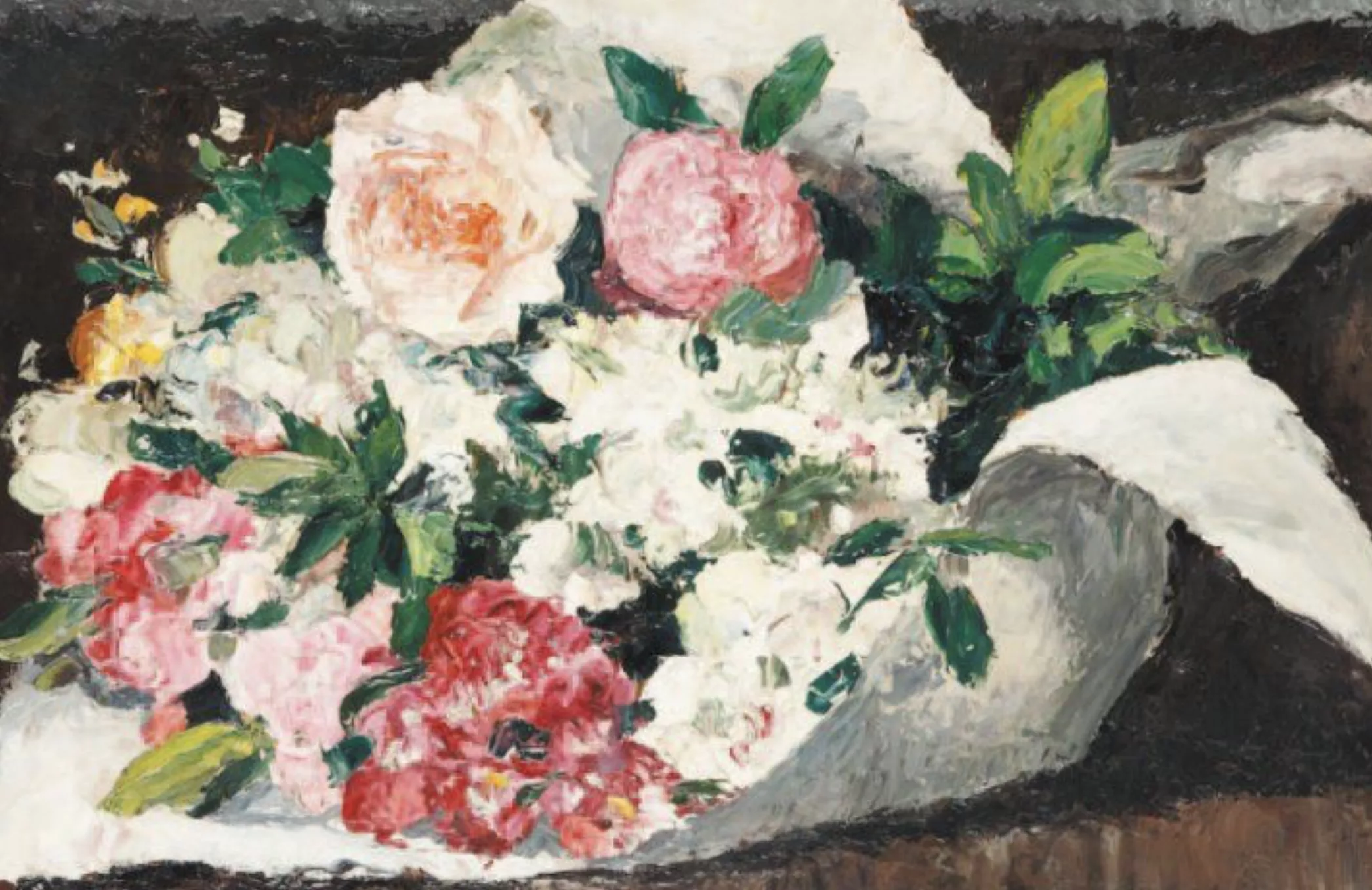
The life of Gaston Balande
Gaston Balande (1880-1971) showed a marked interest in art from an early age, practicing with a determination that made up for his initial lack of academic training.
He developed his line and sense of composition on his own, capturing rural and urban landscapes with remarkable acuity. To support himself, he took on a variety of jobs while devoting most of his time to drawing and painting.
His first failure at the Arts Décoratifs competition did not deter him from his vocation: he eventually joined the institution, although his apprenticeship was interrupted by his military service.
Returning to Paris after the war, he frequented the studios of Ruppert Bunny and Jean-Paul Laurens, where he honed his sense of light and movement.
His talent did not go unnoticed: Fernand Cormon, an influential figure in the art world, invited him to join his studio, offering him recognition that marked a turning point in his career.
In 1914, witnessing first-hand the ravages of the conflict, he volunteered at a hospital, where he witnessed the daily life of the war-wounded.
This experience nourished his work, which he devoted in part to poignant depictions of convalescent soldiers and scenes of war. His gaze, far from any dramatic emphasis, conveys a sincere humanity and meticulous attention to the details of reality.
Thanks to a grant, he embarked on a journey across Europe alongside his wife, enriching his palette and experimenting with new techniques.
His work then opened up to other influences, while retaining that rigor in the construction of space that characterizes him. Invited to exhibit in the United States, he rubbed shoulders with the works of Vlaminck, Picasso and Braque, confirming his foothold on the international art scene.
His career spanned several decades, punctuated by exhibitions and official commissions.
He died in Paris in 1971, leaving behind him a body of work in which light, composition and the accuracy of the gaze emerged as the founding elements of his aesthetic.
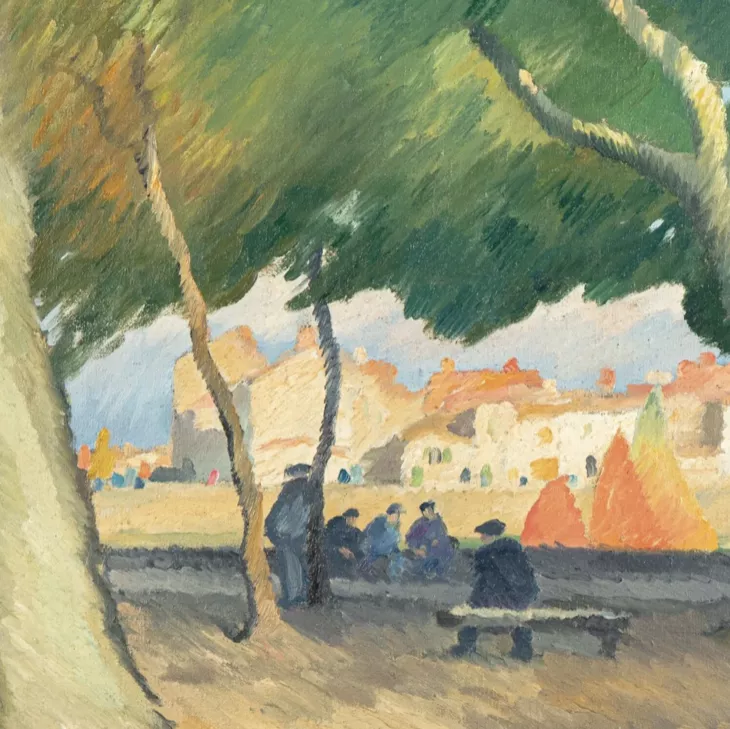
Focus on Le marché à La Rochelle, Gaston Balande
In Le Marché de La Rochelle, Gaston Balande orders the composition through a play of colored masses where the human figure, treated in broad strokes, blends into the liveliness of the place.
The scene, captured on the spot, favors an immediate reading: the sketched silhouettes fit into a construction punctuated by light and tonal contrasts.
The chromatic chords, dominated by a palette of bluish grays and ochres, structure the space in broad successive planes, accentuating the depth and vibrancy of the atmosphere.
The organization of the painting is based on alternating dense zones and more open passages, where the eye circulates unimpeded.
Balande modulates here a vigorous facture, both synthetic and expressive, where economy of detail gives way to a moving transcription of forms.
Far from anecdotal narration, he favors an approach in which painting asserts itself as an autonomous language, summoning both memories of Impressionism and a more rigorous construction, close to Cézanne research.
The scene, in its apparent spontaneity, is nonetheless constructed with a mastery of rhythm and light that lends the whole a plastic coherence.
The free yet measured brushstrokes embrace the materiality of the subject while inscribing the figure in a dynamic of volumes and colors.
Between the immediate transcription and the rigorous structuring of the motif, Balande establishes a tension that makes all the singularity of his look.
Gaston Balande's imprint on his period
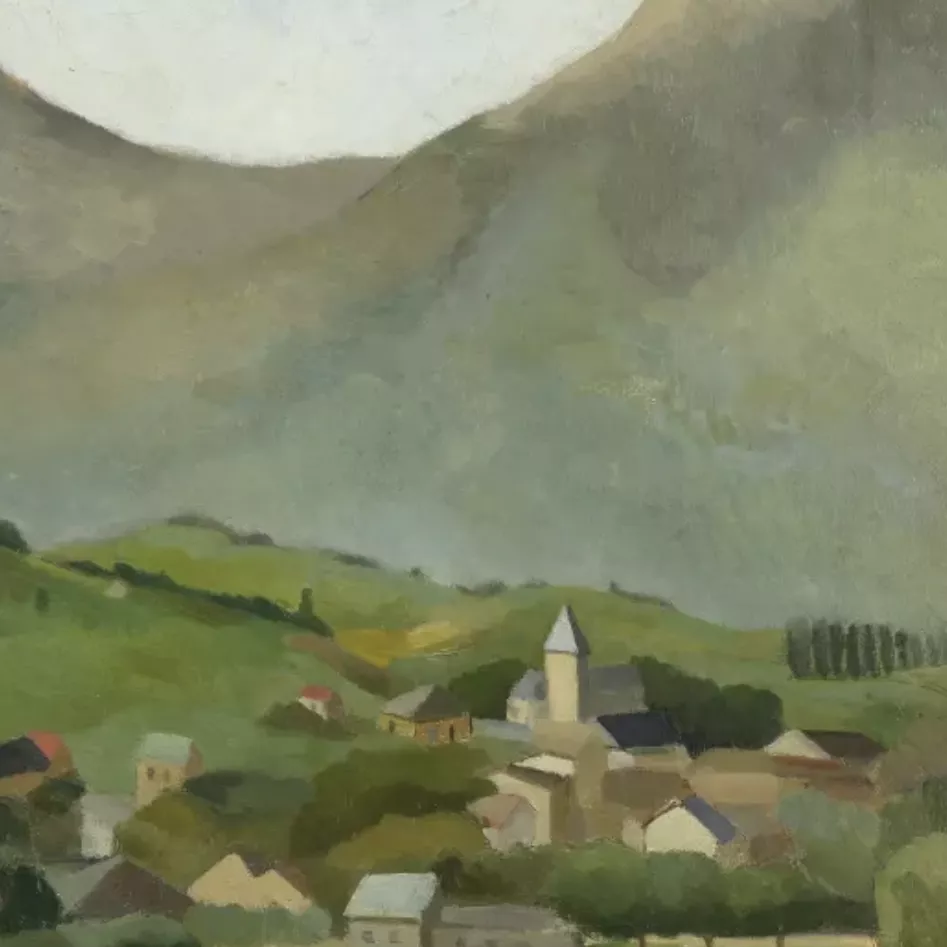
In the artistic panorama of the 20th century, Gaston Balande occupies a singular place, at the crossroads of a tradition inherited from naturalism and a modernity concerned with renewing the perception of the motif.
While his work is rooted in the great lineage of plein-air painters, he goes beyond its heritage with an approach in which the structuring of space and the density of the brushstroke redefine the relationship to reality.
With a style that is both free and orderly, he imposes a vision that combines the acuity of detail with a pictorial synthesis close to post-impressionist concerns.
At a time when the avant-gardes were overturning the canons, Balande went against the grain of radical ruptures without becoming frozen in a bygone academicism.
His work, marked by a constant search for light and vibrancy of form, reflects a sensibility that yields neither to abstraction nor to the temptation of the picturesque.
His influence is thus exerted in an intermediate space, where genre scenes and urban landscapes assert themselves through the force of a pictorial writing that retains its autonomy from the dominant movements of his time.
If his name sometimes remains in the background of the great figures of modernism, his work nevertheless testifies to an ability to synthesize the contributions of the past and the demands of a renewed vision of the visible.
Through a painting in which structure and atmosphere are balanced with subtle mastery, Balande participates in the evolution of a modern figuration that, far from renouncing the emotion of the motif, explores new plastic potentialities.
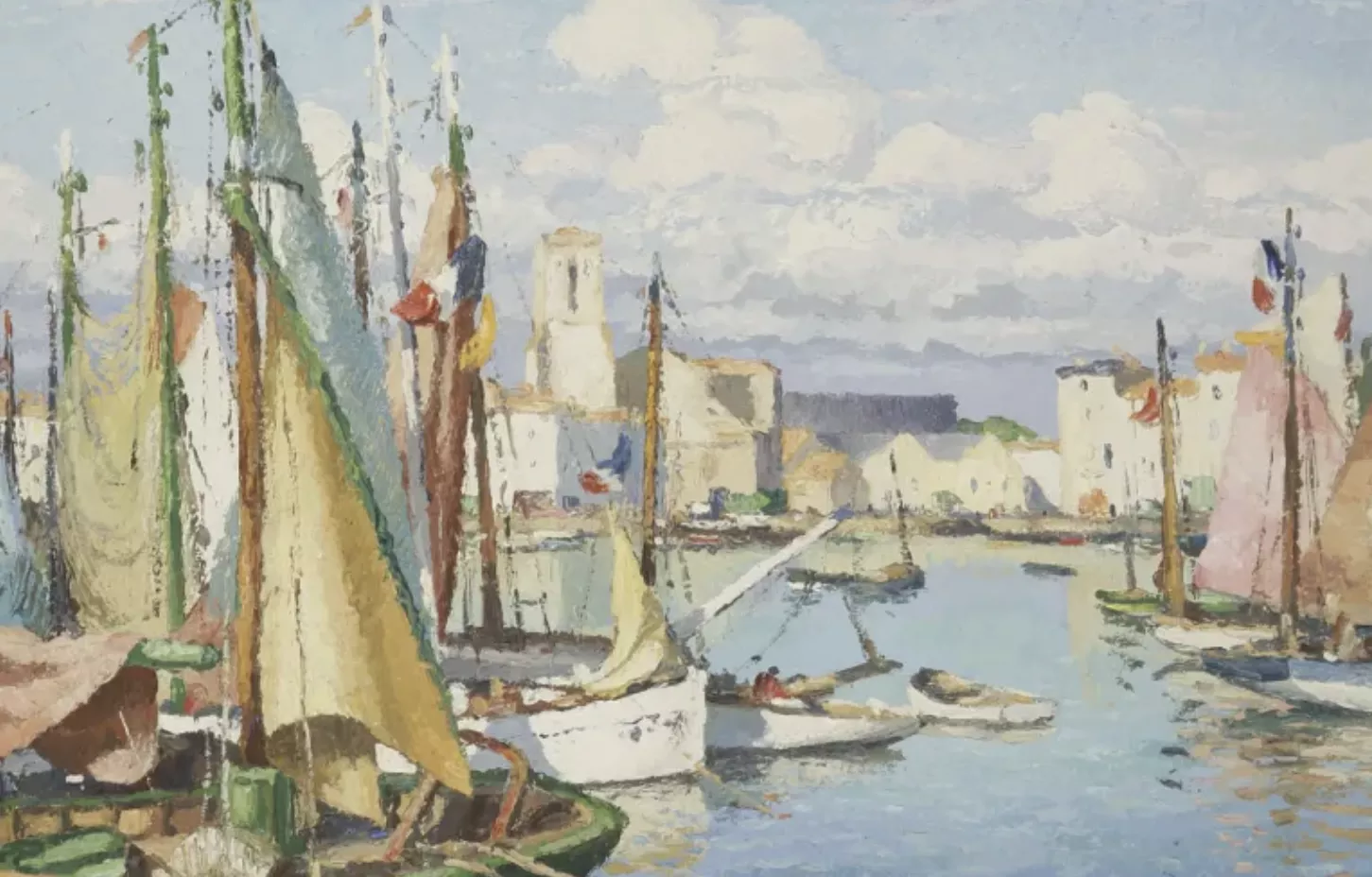
Gaston Balande's artistic influences
In Gaston Balande, the influence of the 19th-century masters is combined with his own sensibility, where observation of reality is a pictorial imperative.
From his earliest works, the shadow of Courbet can be discerned in the solidity of his compositions and the thickness of a brushstroke that refuses all idealization.
The lesson of the Impressionists, and more particularly that of Monet and Sisley, shines through in his way of animating the surface with changing light, fragmented into subtle chromatic modulations.
However, Balande does not limit himself to these immediate filiations: his time in the studios of Jean-Paul Laurens and Fernand Cormon introduces him to structured drawing, where rigorous construction balances the élan of a free touch.
In contact with Ruppert Bunny, he discovered a more vibrant palette and an assertive taste for the staging of space, while his stay in Italy and his travels throughout Europe enabled him to assimilate post-impressionist research, notably that of Vuillard and Bonnard, from whom he retains the relationship between color and the organization of the pictorial plane.
But it is in his very anchorage, between a realist tradition and a tempered modernity, that his singularity is played out: neither totally anchored in classicism, nor yielding to radical experimentation, Balande constructs a pictorial language in which the heritage of the 19th century dialogues with the formal demands of a new century.
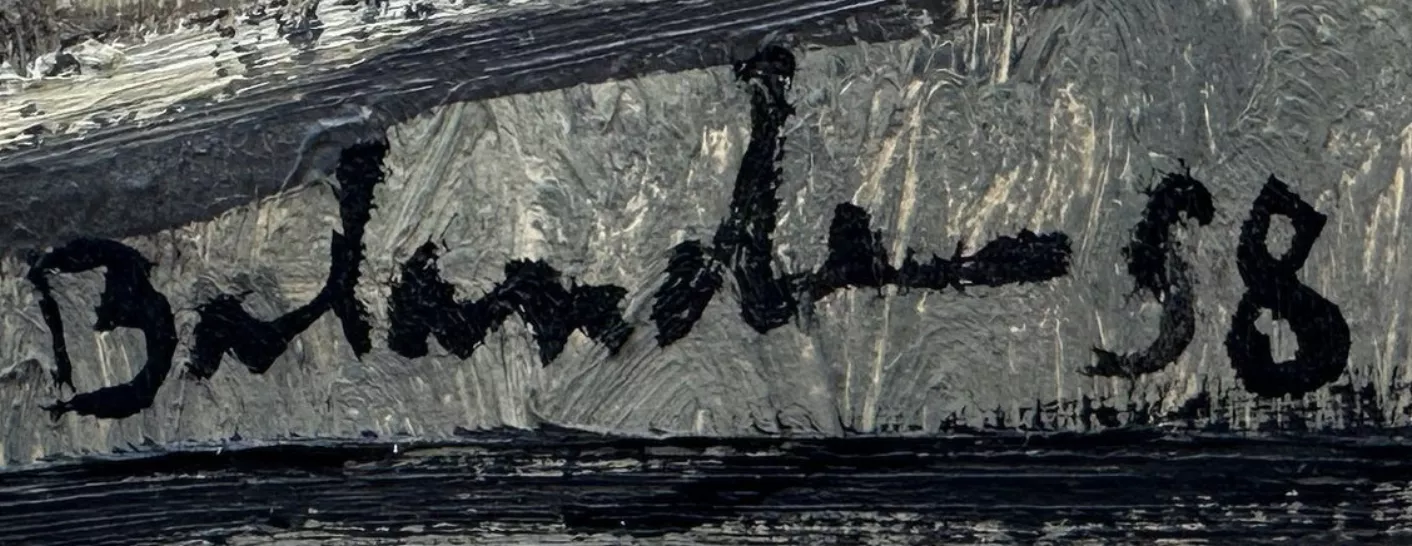
Recognizing the artist's signature
Gaston Balande signs most of his works with his name "Balande" on the bottom right, in cursive script.
Knowing the value of a work
If you happen to own a work by Gaston Balande, request a free appraisal without further delay via our form on our website.
A member of our team will contact you promptly with an estimate of the value of your work, as well as providing you with ad hoc information about it.
If you're considering selling your work, our specialists will also help you find alternatives to sell it at the best possible price.
Estimate in less than 24h
Discover in the same theme

Rating and value of François Raty vases
François Raty's history, the price of his works and their current market value. Ranging from 200 to 50,000 euros, only an expert can authenticate them...
Learn more >

Cote and value of paintings by Edgar Brandt
Edgar Brandt is a twentieth-century Art Deco and Art Nouveau metalworker who produced works that are highly prized and valued.
Learn more >

Rating and value of drawings and painting by Sadamasa Motona...
Sadamasa Motonaga is a Japanese artist who has created numerous works that command high prices at auction. 24-hour estimate.
Learn more >
Works from the same period sold at auction

Estimated Gaston BALANDE (1880-1971), Boats at low tide, oil on canvas
Gaston BALANDE (1880-1971), Boats at low tide, oil on canvas

Estimated 1.500 - 3.000
Henri MEGE (1904-1984), oil on canvas

Estimated 8.000 - 12.000
Guillaume FOUACE (1837 - 1895), Still life with lobster, oil on canvas

Estimated 3.000 - 5.000
Georges LAPCHINE (1885-1951) The port of St Tropez Oil on canvas

Secure site, anonymity preserved

Auctioneer approved by the State

Free and certified estimates
Frequently asked questions
-
Who is Gaston Balande, and what is his artistic style?Gaston Balande (1880–1971) was a 20th-century naturalist painter who combined the Impressionist and Post-Impressionist traditions with a rigorous approach to composition. His style is characterized by a synthesis of precise drawing and a broad, vibrant brushstroke, in which light becomes an organizing principle of form. He particularly excelled at landscapes, urban scenes, and harbor views, prioritizing clarity of the subject while capturing the movement and freshness of the moment.
-
What is the price range for Gaston Balande's works?Gaston Balande's works sell at auction for between 160 and 96,610 euros, depending on the medium and size. Drawings and watercolors range from 40 to 2,400 euros, prints from 50 to 2,400 euros, and oil paintings on canvas from 50 to 30,000 euros. However, some exceptional pieces may exceed these ranges, as was the case in 2019 when an oil painting sold for 25,000 euros despite being estimated at between 1,500 and 2,000 euros.
-
How do I have a work by Gaston Balande authenticated and appraised?To authenticate and appraise a work by Gaston Balande, we recommend that you consult the state-certified experts and auctioneers at Auctie's. The appraisal is free and non-binding: simply fill out a form on our website with a description and photos of the artwork. An expert will contact you within 48 hours to provide you with an accurate estimate of your item’s current market value.
-
How can you tell if a work is a genuine, signed piece by Gaston Balande?Gaston Balande signs most of his works in the lower right corner with his name, “Balande,” written in cursive. However, to confirm the authenticity of a painting attributed to the artist, an appraisal by a certified professional remains essential, particularly to verify the technique, provenance, and condition of the work.
-
Is this a good time to sell a work by Gaston Balande?Yes, this is a good time to sell a work by Gaston Balande. Collectors’ interest in this painter remains steady, and the market for 20th-century figurative painting is experiencing consistent demand. Auctie's, a specialized auction house, supports sellers from the initial appraisal through to the final sale to ensure you get the best possible price for your piece.
