



Rating and value of paintings by Édouard Cortès

Key takeaways
- Édouard Cortès's works sell for between €50 and €100,800 at auction, with oil-on-canvas paintings fetching the highest prices.
- The artist, born in 1882, is known for his Parisian urban scenes characterized by a palette of pearl grays and warm browns, influenced by Post-Impressionism.
- His painting “Paris Evening” (1905) exceeded its estimate, selling for €100,800 against a projected range of €70,000 to €90,000.
If you own a work by artist Édouard Cortes or based on his work and would like to know its value, our state-approved experts and auctioneers will guide you.
Our specialists will carry out a free appraisal of your work, and provide you with a precise estimate of its value on the current market.
Then, should you wish to sell your work, we will direct you to the best possible arrangement to obtain the optimum price.
Artist's rating and value
Thanks to their serene, luminous atmosphere, Édouard Cortes's works are popular with collectors.
On the market, his various realistic compositions are successful at auction. His works sell for between €50 and €100,800, a significant delta but one that speaks volumes about the value that can be attributed to these canvases.
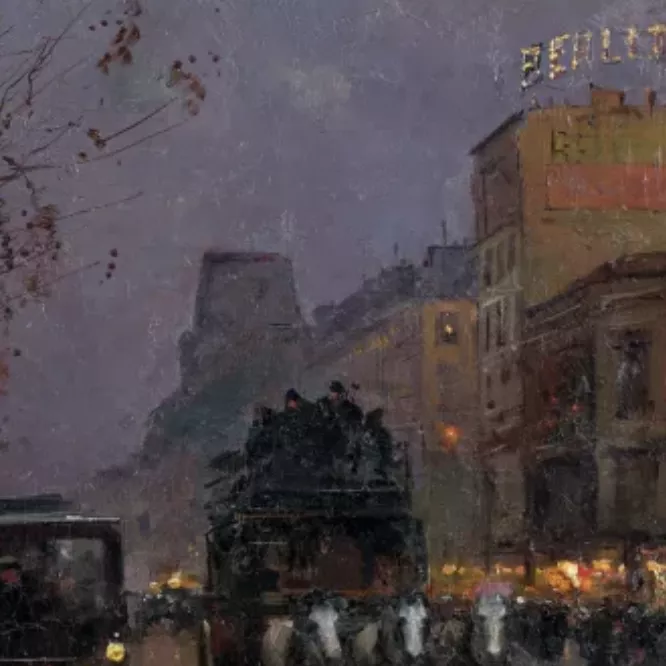
Some of the artist's works, for example, have reached unprecedented sums, as witness his painting Paris Evening,dating from 1905, which sold for €100,800 while it was estimated at between €70,000 and €90,000.
Order of value from the most basic to the most prestigious
Technique used | Result |
|---|---|
Estamp - multiple | From €50 to €810 |
Drawing - watercolor | From €300 to €27,000 |
Oil on canvas | From €130 to €100,800 |
Estimate in less than 24h
The artist's works and style
In Édouard Cortès's canvases, such as Le Boulevard des Capucines sous la pluie, the fragmentation of the brushstroke achieves an almost systematic precision, which seems less concerned with a faithful transcription of contours than with the elaboration of a luminous texture capable of transcending urban reality.
Wet cobblestones, glittering shop windows and the parasols of passers-by are not described, but constructed, through a skilful play of facets and chromatic contrasts.
This process recalls, in many ways, post-impressionist research, where the unity of a worked surface takes precedence over the optical illusion of volumes.
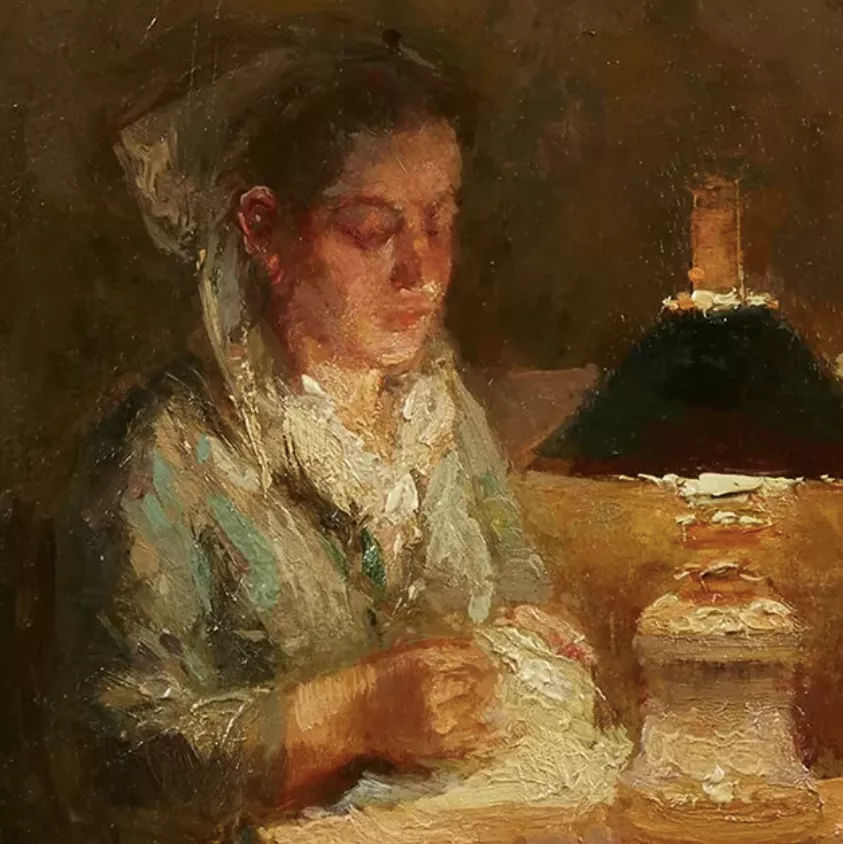
At Cortès, this approach is accompanied by a methodical treatment of light and reflections, where the palette, dominated by pearl grays and warm browns, plays on muted nuances to better accentuate the intensity of points of light.
Lamp posts and puddles become structuring elements, not so much for their narrative function as for their role in the construction of a continuous pictorial space.
This standardization of surfaces, coupled with a sensitivity to the very matter of paint, gives his work an almost tactile dimension, where each brushstroke seems animated by a concern to make the changing substance of the city recognized.
Artistic influences of Édouard Cortes
Artistic influences of Édouard Cortès are part of the Post-Impressionist tradition, where the innovations of masters such as Monet and Pissarro find a particular resonance in his painting.
Like the latter, he strives to translate the effects of light and atmosphere, but turns away from them in favor of a structural rigor inherited from French academicism.
The precision of his drawing, the careful organization of his compositions and his frequent use of linear perspective recall the teachings of 19th-century masters such as Alfred Stevens or Jean-Baptiste Camille Corot, whose taste for an ordered observation of landscape he takes up.
In his urban views, particularly those of Parisian boulevards, Cortès dialogues with modernity, evoking through his choice of subjects the approach of Caillebotte, while incorporating a sensibility close to that of the Venetian painters in his treatment of reflections and wet surfaces.
His chromatic ranges, oscillating between brown, gray and ochre tones, evoke the soothing harmonies of Whistler, while the vibrant atmosphere of his night scenes reflects an Impressionist heritage reworked with poetic intent.
In his case, each influence interweaves to create a vision where descriptive realism is combined with a visual reverie that is properly unique.
The life and career of Édouard Cortes
Édouard Cortès, born in 1882 in Lagny-sur-Marne, grew up in a family of artists. His father, a painter himself, guided his first steps in art. At an early age, he turned to the École des Beaux-Arts in Paris, where he developed a particular sensitivity to urban scenes.
From his earliest entries at the Salon des Artistes Français, he attracted attention, particularly with his depictions of Paris, its streets lit with the changing moods of different times of day. His work is distinguished by a unique ability to capture the play of light and urban atmospheres.
Cortès is often described as a "painter of Paris" for his deep love of the city, which he transcribes in his scenes of streets, squares and quays, sublimated by light.
Traffic lights, lampposts, lively terraces, boat-lined quays, everything seems to melt under his brush in a silent choreography, like a luminous ballet frozen in time.
While his work is in the Impressionist tradition, he departs from it with his attention to detail and a more accomplished technique, particularly in the precision of perspective and the subtleties of reflections.
His street scenes in the rain, for example, deploy effects of reflected light on the cobblestones, capturing fleeting moments when everyday life seems suspended.
Cortès, while capturing the modernity of the capital, manages to preserve its timeless aspect, in a subtle balance between movement and silence. The city he paints, vibrant with life, is nevertheless always imbued with a fragile serenity, as if each scene could dissipate in a breath.
Focus on La rue de Rivoli, 1920, Édouard Cortès
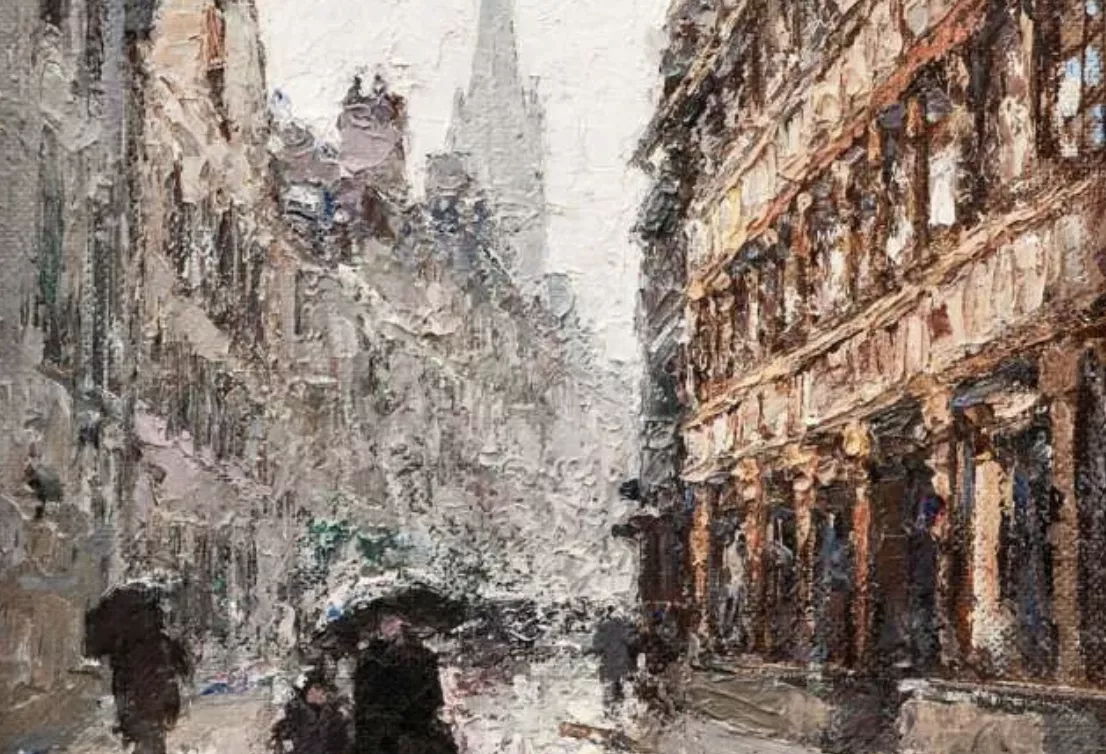
In the 1920s, Cortès, in his Paris street scenes such as La Rue de Rivoli (Musée Marmottan, Paris), chose to capture moments when the light of Paris, light and mysterious, seems to bathe the entire environment.
He uses the restricted, nuanced palette of gray and beige, which, through their simplicity and sobriety, make the light softer, almost ethereal.
The facades of the buildings, as if grazed by a ray of sunlight filtered through an overcast sky, take on almost silvery tones, which give the landscape a gentle depth, but also a distance, as if Paris itself were set apart, observed through a light veil.
Like his contemporaries, such as Gustave Caillebotte, who, through photography and the particular framing of his canvases, had succeeded in translating the modernity of the city, Cortès too seems to be witnessing this modernity.
But he chooses to freeze this world in a softer, more subdued light, where passers-by are only furtive shadows, where architecture becomes a living, but almost silent mass.
It's a Paris that, under his brush, seems to stretch in time, like a nostalgic, intimate black-and-white photograph. He is far removed from the frenzy of his predecessors' canvases, capturing instead the poetry that emerges from everyday life, that suspended moment that just begs to be admired.
Post-Impressionism and twentieth-century art criticism
At the beginning of the twentieth century, Post-Impressionism, initially viewed with suspicion, saw its importance reassessed by a changing art criticism. This movement, the successor to Impressionism, took new directions that intrigued and divided observers.
Although controversial for their subjective approach, artists such as Cézanne, Van Gogh and Gauguin gradually began to be recognized for their boldness and ability to go beyond Impressionist research into light and movement.
The first, often unflattering judgments gave way to a more nuanced reading of their work. Influential critic Roger Fry saw in Cézanne's work a redefinition of form and structure, opening up new perspectives on composition and inspiring a whole generation of modern artists.
For Fry, these Post-Impressionist artists no longer seek merely to capture the moment, but to reveal a deeper reality, where color and form express a personal feeling.
Post-Impressionism, far from being limited to an extension of Impressionism, is now seen as a key stage in modernity. Twentieth-century critics saw the movement as a landmark break with convention, heralding the avant-gardes of Cubism and Fauvism.
What was once considered puzzling art became a benchmark for subsequent generations, propelling Post-Impressionism as a pillar of the century's artistic evolution.
Edouard Cortès's imprint on his period
In the 1920s, Cortès, in his Parisian street scenes such as La Rue de Rivoli (Musée Marmottan, Paris), chose to capture moments when the light of Paris, light and mysterious, seems to bathe the entire environment.
He uses the restricted, nuanced palette of gray and beige, which, through their simplicity and sobriety, make the light softer, almost ethereal.
The facades of the buildings, as if grazed by a ray of sunlight filtered through an overcast sky, take on almost silvery tones, which give the landscape a gentle depth, but also a distance, as if Paris itself were set apart, observed through a light veil.
Like his contemporaries, such as Gustave Caillebotte, who, through photography and the particular framing of his canvases, had succeeded in translating the modernity of the city, Cortès too seems to be witnessing this modernity.
But he chooses to freeze this world in a softer, more subdued light, where passers-by are but furtive shadows, where architecture becomes a living, but almost silent, mass. It's a Paris that, under his brush, seems to stretch in time, like a nostalgic, intimate black-and-white photo.
His signature
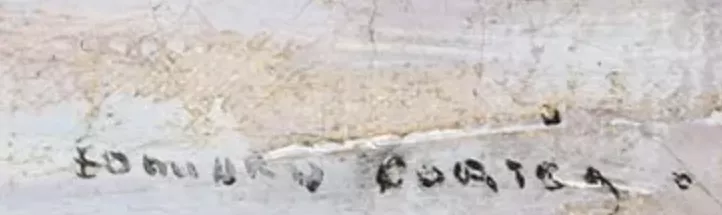
Not all Édouard Cortès's works are signed.
Although there are variations, here's a first example of his signature:
Expertise your property
If you own a work by Édouard Cortès, don't hesitate to request a free appraisal by filling in our online form.
A member of our team of experts and licensed auctioneers will contact you to provide an estimate of the market value of your work.
If you are considering selling your work, our specialists will also guide you through the various alternatives available to obtain the best possible price, taking into account market trends and the specific features of each work.
Estimate in less than 24h
Discover in the same theme

Rating and value of works, drawings, paintings by Marino Mar...
Marino Marini is a twentieth-century Italian painter and sculptor who produced a wide range of works that are sought-after and quoted at auction.
Learn more >

Rating and value of paintings by Vartan Makhokhian
Vartan Makhokhian is an Armenian marine painter who has produced works that are highly rated and valued at auction. Estimate in 24h.
Learn more >

Rating and value of paintings by Amédée Ozenfant
Amédée Ozenfant is a cubist and purist artist of the 20th century, who produced works in a variety of media that are highly rated and valued.
Learn more >
D'autres tableaux impressionnistes vendus aux enchères

Estimated 6.000 - 8.000
Mikhail Markianovich GUERMACHEFF (1867 - 1930) House under the snow, oil on canvas

Estimated 2.000 - 4.000
Jean DUFY (1888-1964) Vase of anemones, Watercolor

Estimated 600 € - 800 €
Henri ZUBER (1844-1909), Bridge at Artemare. Oil on canvas.

Secure site, anonymity preserved

Auctioneer approved by the State

Free and certified estimates
Frequently asked questions
-
Who is Édouard Cortès, and what is his artistic style?Édouard Cortès (1882–1954) was a French painter born in Lagny-sur-Marne, famous for his scenes of Parisian streets. His style falls within the Post-Impressionist tradition, characterized by a meticulous treatment of light and urban reflections, particularly in the rain. He is distinguished by his limited palette of pearl gray and warm browns, which creates a serene and poetic atmosphere of the city, while maintaining the precision of drawing inherited from French academic art.
-
What are the estimated values of Édouard Cortès's works based on the medium used?Édouard Cortès’s works vary significantly in price depending on the medium: prints range from €50 to €810, watercolors and drawings from €300 to €27,000, and oil paintings on canvas from €130 to €100,800. For example, his painting *Paris Evening* (1905) sold for €100,800 at auction, exceeding its initial estimate of €70,000 to €90,000.
-
How do I have a work by Édouard Cortès appraised?To have a work by Édouard Cortès appraised, you can request a free, no-obligation appraisal from Auctie's by filling out an online form. A state-certified expert or auctioneer will examine your artwork and provide you with an accurate estimate of its market value within 48 hours, at no cost.
-
Is this the right time to sell a work by Édouard Cortès?Yes, now is a good time to sell a work by Édouard Cortès. His realistic compositions are very popular with collectors thanks to their serene and luminous atmosphere, and the auction market remains active, with works regularly meeting or exceeding their estimates.
-
How does the sale of a work of art work at Auctie's?At Auctie's, the process begins with a free appraisal of your artwork by our experts and licensed auctioneers. If you decide to sell, we’ll guide you toward the best possible approach, taking into account market trends and the unique characteristics of your artwork, to help you achieve the best possible price at auction.
