



Rating and value of paintings by Bernard Boutet de Monvel

Key takeaways
- Bernard Boutet de Monvel’s works sell for between €10 and €6,600 at auction, with oil-on-canvas paintings fetching up to €2,100,000 in 2016.
- A 20th-century artist (1881–1949) who mastered painting, printmaking, and fashion illustration, he exhibited as early as 1912 at the Art Institute of Chicago and collaborated with *Vogue* and *Harper’s Bazaar*.
- His style combines French classicism with restrained Cubism, characterized by rigorous geometry, a subdued palette of grays and ochres, and an almost photographic perfection devoid of embellishment.
If you own a work created by artist Bernard Boutet de Monvel or based on his work and would like to know its value, our state-approved experts and auctioneers will guide you.
Our specialists will carry out a free appraisal of your work, and provide you with an accurate estimate of its value on the current market.
Then, should you wish to sell your work, we will direct you to the best possible arrangement to obtain the optimum price.
Rating of the artist Bernard Boutet de Monvel
Bernard Boutet de Monvel enjoyed great success during his lifetime thanks to his participation in some of the major events of his time. He quickly established himself as a major player on the art market. Today, his works are successful in auction houses and attract a large number of collectors.
His pieces are traded mainly in France and the United States. The price at which his works sell on the auction market ranges from €10 to €6,600, a consequent delta but one that speaks volumes about the value that can be attributed to the artist's works.
As witness his oil on canvas entitled S.A.R. Le Marharadjah d'Indore à dominante blanche, sold for €2,100,000 in 2016, whereas it was estimated at between €300,000 and €500,000.
Order of value from the most basic to the most prestigious
Technique used | Result |
|---|---|
Estamp - multiple | From €8 to €6,000 |
Sculpture - volume | From €80 to €8,000 |
Drawing - watercolor | From €40 to €480,000 |
Oil on canvas | From €200 to €2,100,000 |
Estimate in less than 24h
The style and technique of Bernard Boutet de Monvel
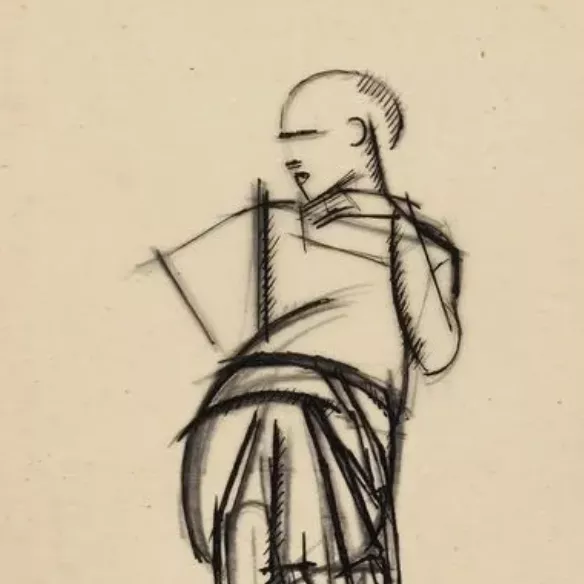
Mastering drawing and composition with absolute rigor, Bernard Boutet de Monvel imposes a style where geometric precision marries austere elegance. Heir to French classicism, he purifies line to the essential, rejecting all embellishment in favor of absolute clarity.
The contribution of Cubism, assimilated with restraint, is perceived in the subtle fractioning of volumes and the rigorous construction of space, without ever lapsing into abstraction.
His palette, with its almost metallic sobriety, plays on ranges of gray, ochre and steel blue, reinforcing the impression of sharpness and icy refinement.
This quest for balance is complemented by a relentless technique of execution: his smooth touch, with no visible repentance, lends his portraits and landscapes an almost photographic perfection, where every surface seems polished like lacquer.
This obsession with detail extends to his fashion studies and illustrations, where he transposes his acute sense of proportion and volume. With him, everything is constructed, weighed and measured with an exactitude that borders on the decorative arts, evoking goldsmithing at times.
But beneath this apparent coldness lies an absolute mastery of framing and rhythm, where structure becomes a language and drawing a sovereign discipline.
.
The life of Bernard Boutet de Monvel
Bernard Boutet de Monvel, son of Louis Maurice Boutet de Monvel, is a twentieth-century painter. Born in Paris in 1881 and originally from Lorraine, he came from a family of artists.
In 1897, he decided to turn to painting - initially alongside Luc Olivier Merson. He also worked for some time on sculpture alongside Jean Dampt. Sculpture is not an important part of his output.
In his training, he also learns engraving from artists such as Eugène Delâtre, who is also a publisher. He quickly developed a talent for engraving and made it one of his favorite mediums. He always worked after oils on canvas, and an article was devoted to him in the British newspaper The Studio.
As early as 1912, the Institute art of Chicago devoted an exhibition to him - mainly focused on his etchings. At the same time, he continued to work in oil on canvas, and was exhibited at the Société Nationale des Beaux-Arts, the Salon d'Automne and the Salon des Artistes Indépendants.
From the 1910s onwards, his touch became more pointillist - having traveled to Florence and been influenced by the great Italian masters.
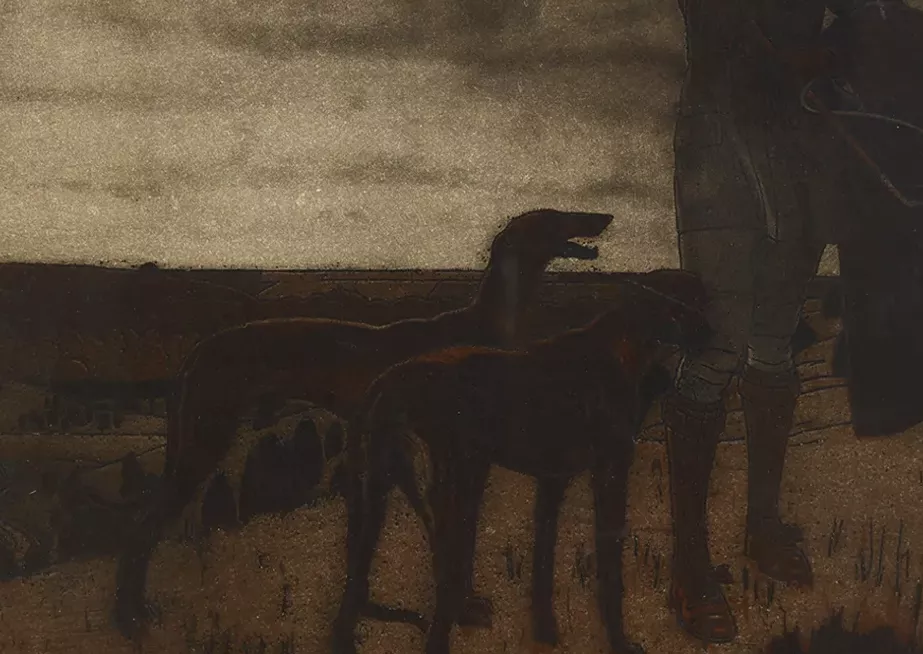
As far as the critics were concerned, his talent and renown were no longer in doubt from 1908, when he exhibited a self-portrait in the Nemours countryside, embellished with two greyhounds. His use of light changed, and he chose darker hues. For the first time in his work, perspective disappeared.
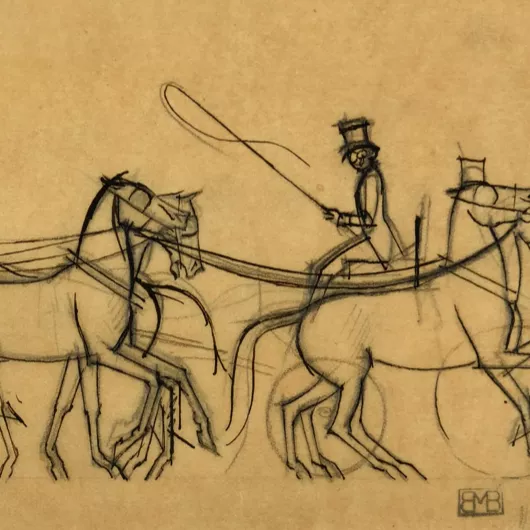
It was to return shortly afterwards, as he experimented with compass and ruler work in his drawings, adopting a more geometric approach to composition.
He also worked for several fashion magazines such as Femina, producing cartoons and fashion drawings.
Paul Poiret was seduced by his talent and quickly propelled his career as a fashion illustrator. He met Lucien Vogel and collaborated on the Gazette du bon ton, with other artists such as Georges Lepape and George Barbier.
His career was interrupted during the First World War, when he was wounded during the Battle of the Marne. He became an aviator and was awarded the Légion d'Honneur. Posted to Morocco, he returned to painting on the advice of General Lyautey.
From this period, he left notably compositions depicting the city of Fez, which revive his 1908 period with the dark tents and geometric approach to composition.
In 1919, after exerting a major influence on Jacques Majorelle, he returned to France and collaborated with Vogue and Harper's Bazaar.
He then lived for some time in the United States and chose not to leave France during the Occupation, continuing to work during this period.
On his way to the United States for work, he died in a plane crash in 1949.
.
Focus on a the portrait of the Countess de Noailles, Bernard Boutet de Monvel
In his portrait of the Countess de Noailles, Bernard Boutet de Monvel pushes his quest for formal perfection to the extreme.
The composition, of absolute rigor, is ordered around an implacable geometry where each line responds to another, where each surface, polished to excess, seems captive to an icy light.
The face, of an almost mineral precision, is inscribed in a network of sharp planes, underlined by a restricted palette, dominated by metallic grays and refined browns.
Nothing overflows, nothing slackens: fabrics fall with the crispness of an architect's fold, shadows stretch in sharp flats, and the whole exudes an aloof, almost hieratic elegance.
To this graphic mastery is added a stylization that verges on abstraction without ever yielding to it, reaffirming Boutet de Monvel's own desire to suspend time, to purify reality to the point of icon.
Behind this chiselled refinement, we nevertheless perceive a restrained tension, an unsettling fixity, as if the artist, in striving for perfect balance, were freezing his model in a world where flesh fades away in favor of the pure arrangement of forms.
The legacy of Bernard Boutet de Monvel
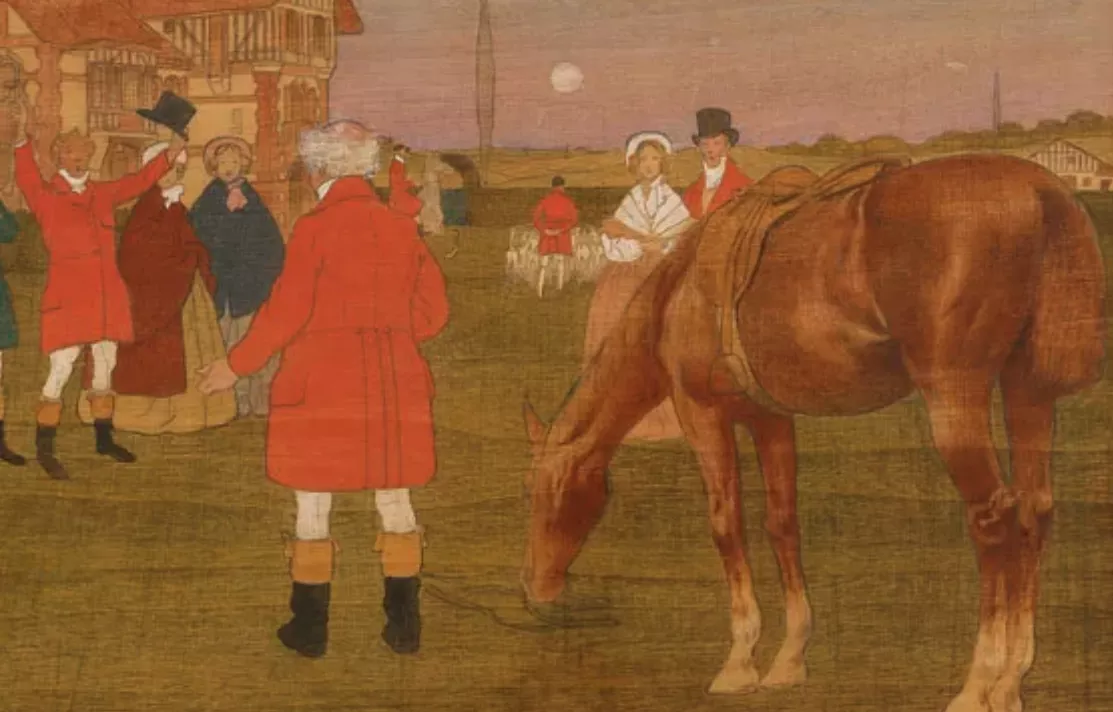
Bernard Boutet de Monvel imposed, in the first decades of the twentieth century, an aesthetic in which classicism was combined with controlled modernity.
Painter, engraver and illustrator, he embodied the rigid, geometric elegance echoed in the lanky silhouettes of Art Deco and the clean lines of incipient rationalism.
His brushwork, clean to the point of dryness, reflects an absolute demand for structure, where light cuts through shapes with implacable precision.
Through this almost mathematical rigor, he influences a certain ideal of worldly portraiture, where aristocratic sophistication is clothed in calculated coldness.
In fashion, in graphic design, his imprint can be seen in this stylization of reality that favors order and balance, abolishing any hint of raw emotion.
His gaze, at once distant and analytical, defines a vision of the elite where elegance becomes a graphic principle, an exercise in controlled abstraction, heralding, through its hieratic fixity, an era that seeks to freeze its icons in flawless perfection.
The stylistic influences of Bernard Boutet de Monvel
Bernard Boutet de Monvel inherits an academic tradition that he subjects to a quasi-architectural discipline, where the legacy of Ingres and the masters of linear drawing shines through in the implacable precision of his line.
Neoclassical rigor, in its taste for anatomical exactitude and purity of outline, is combined with the influence of Cubism, which he assimilates seamlessly, ordering space into clean, flat surfaces.
His work dialogues with Art Deco, not in its decorative exuberance, but in this graphic simplification that favors constructed elegance.
His reduced, controlled palette evokes the restrained harmonies of a Whistler, while his taste for stylized portraiture and angular silhouettes finds echoes in the fashion and illustration of the 1920s-1930s.
Between classicism and abstraction, he imposes an aesthetic where elegance becomes a play of lines, an architecture of form, a vision where modernity is thought of from the angle of absolute mastery.
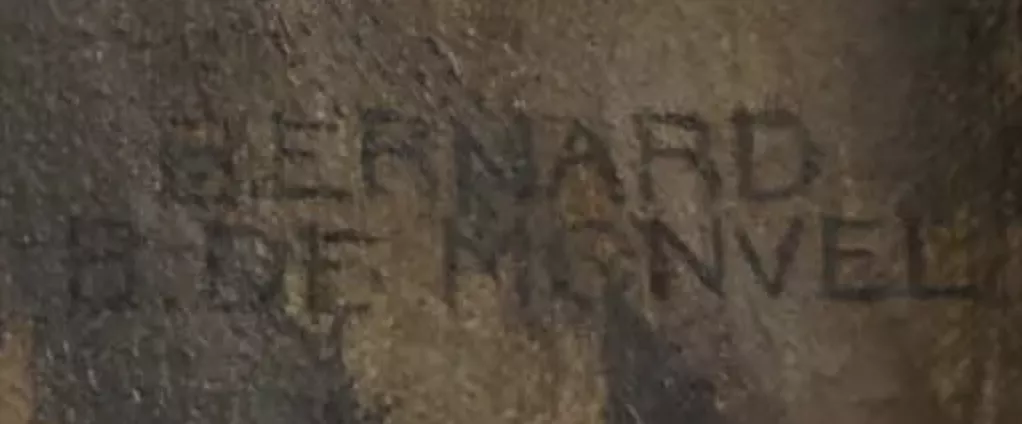
His signature
Not all of Bernard Boutet de Monvel's works are signed.
Although there are variations, here's a first example of his signature:
Expertise your property
If you own a work by Bernard Boutet de Monvel, don't hesitate to request a free appraisal by filling in our online form.
A member of our team of experts and certified auctioneers will contact you to provide an estimate of the market value of your work.
If you are considering selling your work, our specialists will also guide you through the various alternatives available to obtain the best possible price, taking into account market trends and the specific features of each work.
Estimate in less than 24h
Discover in the same theme

Rating and value of works, paintings, drawings by Maximilien...
Maximilien Luce is a 20th-century post-impressionist artist who produced many paintings and drawings that are quoted on the art market.
Learn more >

Rating and value of works, drawings and paintings by Elisabe...
Lilla Cabot Perry is an American Impressionist artist of the 20th century, who produced drawings and oil paintings listed at auction.
Learn more >

Rating and value of paintings by Michel Larionov
Michel Larionov is a Russian painter of the Rayon period who has produced works that are quoted and valued at auction. Estimated in 24h.
Learn more >
Other paintings from the same period sold at auction

Estimated 2.000 - 4.000
Maximilien LUCE (1858-1941), Moulineux, l'entrée du village, circa 1903, Oil on canvas

Estimated 5.000 - 8.000
Auguste CHABAUD (1882-1955) The washerwomen, Oil on canvas.

Estimated 1.000 - 2.000
Virginie Demont-Breton (1859-1935): Carrying donkey in an alley. Oil on panel.

Estimated 1.000 - 2.000
Jules René HERVÉ (1887-1981) Le receuillement, Oil on canvas

Estimated 1.500 - 3.000
Macario VITALIS (1898-1989) Portrait of Marie Thérèse, Oil on canvas

Estimated 2.000 - 4.000
Macario VITALIS (1898-1989) Still life with a bouquet of flowers. Oil on canvas.

Secure site, anonymity preserved

Auctioneer approved by the State

Free and certified estimates
Frequently asked questions
-
Who is Bernard Boutet de Monvel, and what is his artistic background?Bernard Boutet de Monvel (1881–1949) was a 20th-century French painter, printmaker, and illustrator who came from a family of artists. Trained under masters such as Luc Olivier Merson and Eugène Delâtre, he quickly established himself as a major figure of the interwar period, influencing Art Deco and fashion illustration with his rigorous geometric style and modernized classical approach.
-
What is the price range for Bernard Boutet de Monvel's works at auction?Prices vary considerably depending on the medium: prints sell for between €8 and €6,000, sculptures between €80 and €8,000, drawings and watercolors between €40 and €480,000, and oil paintings on canvas between €200 and €2,100,000. His works are particularly sought after in France and the United States, with exceptional record prices far exceeding initial estimates.
-
How can you authenticate and appraise a work by Bernard Boutet de Monvel?To authenticate and appraise a work by Bernard Boutet de Monvel, we recommend that you request a free appraisal from Auctie's by filling out our online form. A state-certified expert or auctioneer will contact you to provide an accurate estimate of your work’s market value, with no obligation.
-
Is this the right time to sell a work by Bernard Boutet de Monvel?Yes, now is a good time to sell a work by this artist. His paintings, drawings, and prints are very popular at auction and attract many collectors. Demand remains strong, particularly for oil-on-canvas works and fashion illustrations, which offers good opportunities for appreciation in value.
-
How does the sale of a work of art work at Auctie's?Auctie's guides you from the free appraisal all the way through to the auction. After receiving your online request, our experts will contact you within 48 hours to appraise your artwork. If you wish to sell, we’ll guide you toward the best sales strategy, taking into account market trends and the unique characteristics of your item to maximize its price.
