



Rating and value of paintings by Albert Gleizes

Key takeaways
- The prices of Albert Gleizes’s works vary considerably, ranging from €25 to €1,924,300, depending on the technique and the period in which they were created, particularly between 1910 and 1930.
- A pioneer of Cubism at the Puteaux School, Gleizes co-authored *Du Cubisme* in 1912 with Jean Metzinger, formalizing the theoretical foundations of the artistic movement.
- His paintings sell for between €300 and €1,924,300 at auction, while his drawings and watercolors range from €45 to €105,200, and his prints from €25 to €20,800.
If you own a work by or after the artist Albert Gleizes and would like to know its value, our state-approved experts and auctioneers will guide you.
Our specialists will carry out a free appraisal of your work, and provide you with an accurate estimate of its value on the current market.
Then, should you wish to sell your work, we will direct you to the best possible arrangement to obtain the optimum price.
Artist's rating and value
Since his meteoric rise in the 2000s, André Lhote's rating on the art market has been in constant evolution. His most prized paintings were produced between 1910 and 1930, the high point of his approach to cubism.
Today, the prices at which his works sell on the auction market range from €25 to €1,924,300, a considerable range but one that speaks volumes about the value that can be attributed to Gleizes' works.
A safe bet on the world market, a work signed by Albert Gleizes can sell for up to a million euros at auction, as evidenced by his oil on canvas Le chemin (Meudon), dating from 1911 sold for over a million euros in 2010.
Order of value from the most basic to the most prestigious
Technique used | Result |
|---|---|
Estamp - multiple | From €25 to €20,800 |
Drawing - watercolor | From €45 to €105,200 |
Painting | From €300 to €1,924,300 |
Estimate in less than 24h
The artist's style and technique
Albert Gleizes built his style within the Puteaux school, which in the 1910s faced the much better-known Montmartre school, including Picasso and Braque. He nevertheless established himself as a pioneer of Cubism.
A key figure of this movement, he developed a style based on the fragmentation of forms and the simultaneity of points of view. Gleizes rejected naturalism in opposition to traditional perspective, he succeeded in deconstructing objects and figures into geometric volumes, seeking a representation that was more intellectual than visual.
Both his painting and his drawings are based on dynamism and movement. His compositions don't simply juxtapose forms, but translate an internal movement - this process is partly drawn from Bergson's theories.
Optical and pictorial theories play an important role in the cubist movement, regardless of the school: whether it's Leonardo da Vinci, Choiseul or the Fibonacci sequence, cubist painters work a lot on the retinal aspect of their work, and on the viewer's optical reception.
He works with structured colors, unlike some of the more analytical cubists. Gleizes uses vivid, juxtaposed shades, enabling the sensation of rhythm and depth to be reinforced.
Instead of excessively fragmenting the surface, he organizes his compositions into superimposed planes, and curves, enabling a monumental, fluid appearance to be imparted to his works.
He was also influenced by spiritualism and abstraction indeed, from the 1920s, his approach evolved towards a more symbolic and theoretical abstraction, enabling him to integrate research into universal harmony and the mathematical laws of the Golden Number.
This mathematical reference gives its name to the Section d'Or group, to which Gleizes belongs alongside Metzinger and Villon. He also contributed to the art world as a theorist. He formalized his ideas in several writings, notably Du cubisme, which he wrote with Jean Metzinger in 1912.
His contribution was therefore not limited to painting; as a theorist, he defended an art detached from the simple imitation of reality.
Through Cubism, Gleizes' work heralds the developments of geometric abstraction, and remains a benchmark for many artistic movements seeking to structure pictorial space in a rational, dynamic way.
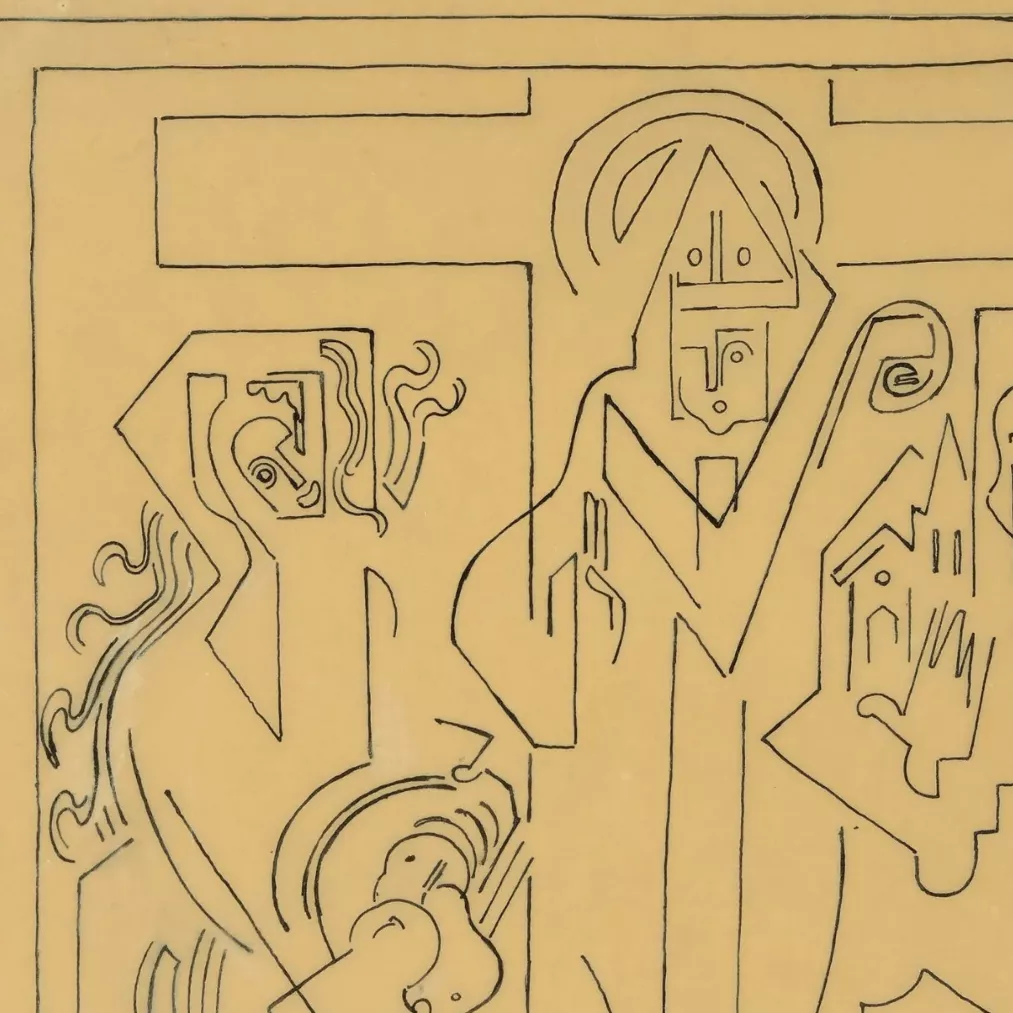
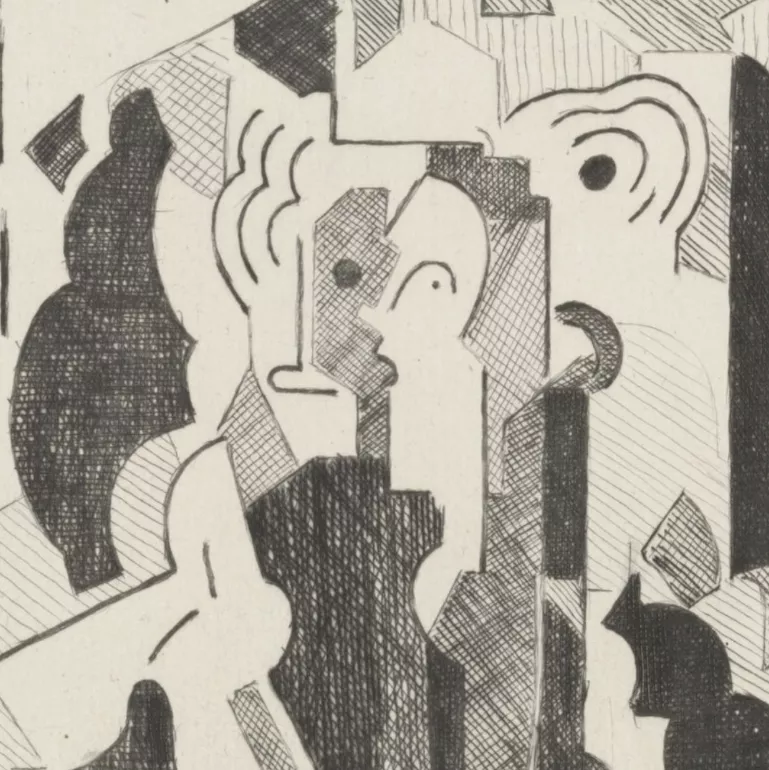
Albert Gleizes: a life turned towards cubism
Albert Gleizes was born in Paris in 1881. He grew up in an environment where art and industry rubbed shoulders. His father, a fabric designer, introduced him to shapes and colors at an early age. But Gleizes was not immediately destined for painting. He began with engraving, observing and experimenting.
He soon moved away from naturalism and sought something else. He wants to simplify, to go to the essential. He discovers Cézanne, whom he considers a turning point. He is interested in volume and structure. He no longer wanted to represent, he wanted to construct.
In 1911, he took part in the Cubist exhibition at the Salon des Indépendants alongside Metzinger, Léger and Delaunay. It's no longer a question of imitating reality, but of rethinking it.
Shapes break up, perspectives explode. With Metzinger, he writes Du "Cubisme", a theoretical text that lays the foundations of the movement.
The war takes him away from Paris for a while. He moved to the United States, then to Spain. On his return, he did not seek to return to classical Cubism. He wanted to go further. He explores rhythm and movement, and works on the idea of a painting that goes beyond simple representation.
Gleizes doesn't paint the world, he recreates it. He doesn't want a frozen image, he wants a space in motion. He seeks a painting that vibrates, that imposes itself through its structure, through its balance.
Nothing is decorative, everything is thought out, constructed. He paints as one builds architecture, leaving the viewer free to enter the work and wander through it.
Focus on Les Baigneuses (1912): a construction in motion
In Les Baigneuses, Albert Gleizes doesn't try to capture a scene, he reconstructs it. The figures are not posed, they interweave, fragment. All is movement.
The bodies, treated as facets, seem to advance and unfold in space. Far from naturalism, Gleizes composes a scene where dynamics take precedence over anecdote. He doesn't narrate, he organizes.
The lines are clean, the volumes solid. Shapes are superimposed, creating an almost architectural rhythm. Here, cubism doesn't dissect, it orchestrates.
Each element responds to another, in a balance where nothing is left to chance. Color, in bold flat tones, reinforces this rigorous construction. Ochre, brown and blue tones interact and clash, anchoring the composition in a controlled tension.
The background is not detached from the subject, but part of it. It hugs the forms, accompanying them. Space doesn't open up, it condenses. Far from classical perspective, Gleizes interweaves planes, making them coexist without hierarchy. The eye doesn't follow a vanishing line, it circulates, absorbed by the painting's internal rhythms.
Here, cubism is not limited to an aesthetic, it becomes a language. Gleizes doesn't paint bathers, he builds them. He constructs an image where every element is essential, where form and color are no longer details, but structures. Nothing is fixed, everything is arrangement, everything is thought.
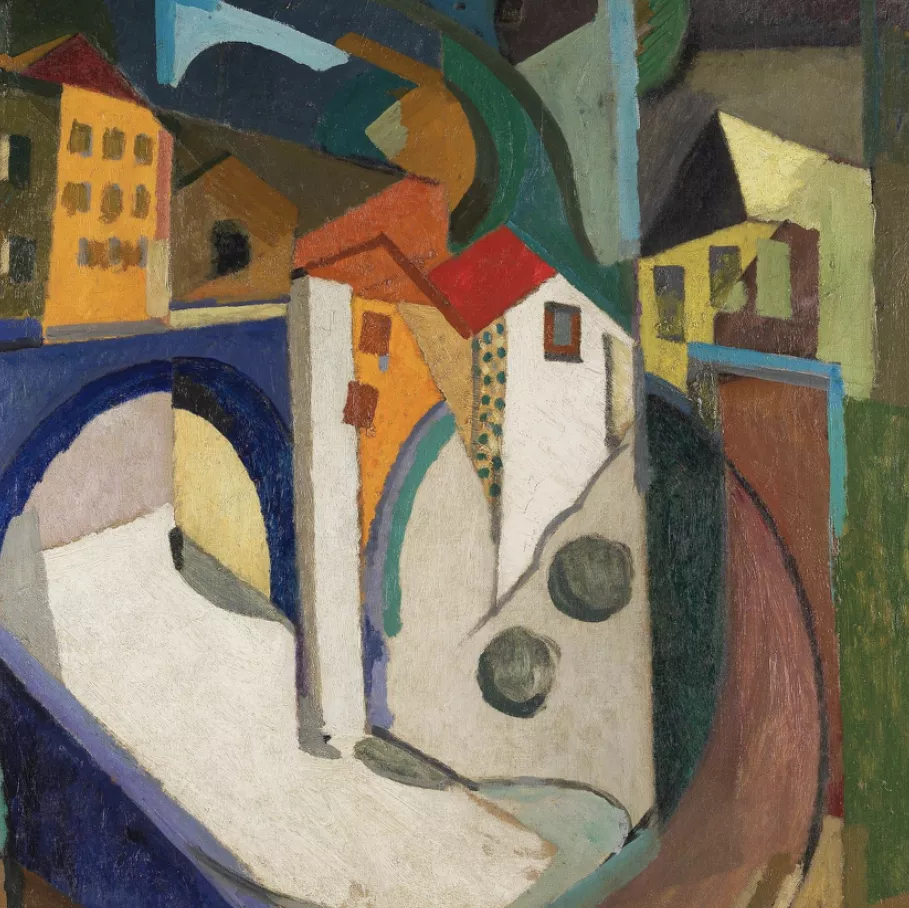
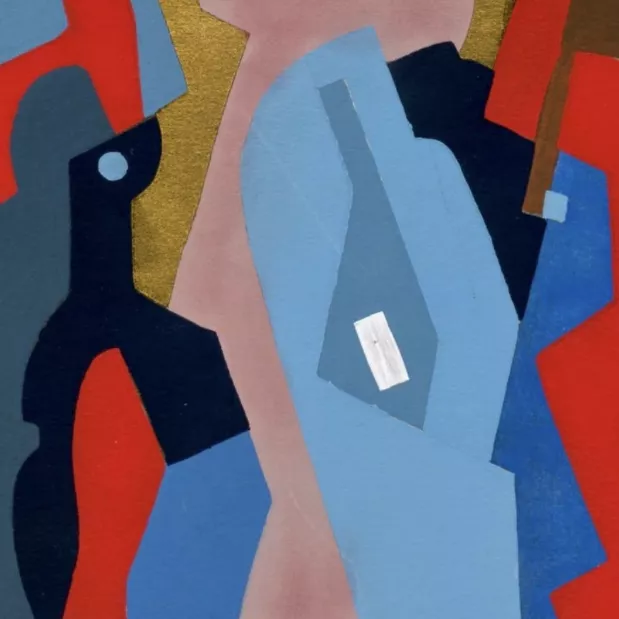
Albert Gleizes' imprint on his period
Albert Gleizes didn't just follow cubism, he structured it. As much a theorist as a painter, he laid the foundations, thinking of it as a system rather than a simple way of seeing. At a time when the movement was still seeking its direction, he gave it a foundation.
With Du "Cubisme", co-written with Jean Metzinger in 1912, he didn't just describe an aesthetic, he laid out its foundations. Cubism is not a deconstruction, but a construction.
His influence extends beyond the studio. He didn't compartmentalize, he disseminated. He introduced Cubism to the United States, boosting its influence in intellectual circles and striving to make it coherent and legible.
His role did not end with painting; he shaped thought. By rejecting illusionism, he claims a painting that does not copy, but edifies.
Gleizes leaves a mark that can be measured not just in works, but in ideas. Where others experiment, he articulates. His cubism is not limited to formal exploration, but becomes a method, a grammar. An approach that would influence the next generation as much as those who sought to go beyond Cubism itself.
Today, his works hold a very high value on the auction market and are sought after by many amateurs and collectors, who play the greatest role in the preservation of his work, even if some of his works are kept by museums, such as the Centre Pompidou.
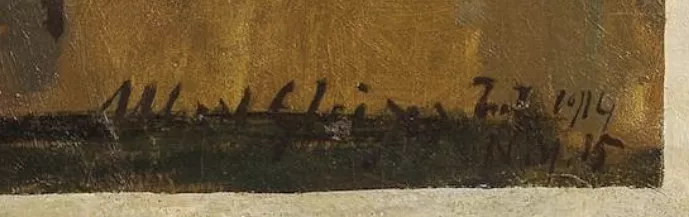
His signature
Not all of Albert Gleizes' works are signed.
Although there are variations, here's a first example of his signature:
Expertise your property
If you happen to own a work by Albert Gleizes, request a free appraisal without further delay via our form on our website.
A member of our team will contact you promptly to provide you with an estimate of the value of your work, not forgetting to send you ad hoc information about it.
If you are considering selling your work, you will also be accompanied by our specialists in order to benefit from alternatives for selling it at the best possible price.
Estimate in less than 24h
Discover in the same theme

Rating and value of Jean Cocteau's works, paintings and draw...
Jean Cocteau is a twentieth-century artist whose drawings, ceramics and paintings are sought-after at auction.
Learn more >

Rating and value of Amalric Walter paperweights, vides-poche...
Amalric Walter is a twentieth-century glassmaker who collaborated with Daum, producing works that are highly regarded and valued.
Learn more >

Rating and value of paintings by Huguette Caland
Huguette Caland is a Lebanese artist who has produced abstract works in various media, working with the body and eroticism.
Learn more >
D'autres tableaux abstraits vendus aux enchères

Estimated 2.000 - 4.000
Serge POLIAKOFF (1900-1969), Composition en rouge et bleu. 1965, Lithograph

Estimated Between €5,000 and €8,000
Jean MIOTTE (1926-2016), acrylic on canvas

Estimated 3.000 - 5.000
Roberto MATTA (1911-2002), Composition, Gouache on canvas

Secure site, anonymity preserved

Auctioneer approved by the State

Free and certified estimates
Frequently asked questions
-
Who was Albert Gleizes, and what is his role in art history?Albert Gleizes (1881–1973) was a major French painter and theorist of Cubism. A key figure in the movement, he co-founded the Section d’Or with Metzinger and Villon, and formalized the principles of Cubism by writing “On Cubism” in 1912. He distinguished himself through a structured approach to Cubism, using vivid colors and compositions with overlapping planes, and had a lasting influence on the development of geometric abstraction.
-
What is the price range for Albert Gleizes' works at auction?Prices for Gleizes’ works range from €25 to €1,924,300, depending on the medium and rarity. Prints range from €25 to €20,800, drawings and watercolors from €45 to €105,200, and paintings can fetch up to €1.9 million. In particular, his 1911 oil on canvas, “Le chemin (Meudon),” sold for over one million euros in 2010.
-
How do I have a work by Albert Gleizes appraised?Request a free, no-obligation estimate using our online form on the Auctie's website. A member of our team of experts and state-licensed auctioneers will contact you to appraise your artwork. We will provide you with an accurate estimate of its current market value within 48 hours.
-
What are the characteristics of Albert Gleizes' Cubist style?Gleizes developed a distinctive form of Cubism based on the fragmentation of forms and the simultaneity of viewpoints, rejecting naturalism. He organized his compositions into overlapping and curved planes, used juxtaposed vivid colors to enhance rhythm and depth, and, beginning in the 1920s, gradually incorporated a more abstract dimension linked to the Golden Ratio and universal harmony.
-
How do I sell a work by Albert Gleizes at Auctie's?After a free appraisal by our experts, Auctie's supports you every step of the way: we offer the best sales strategies to help you achieve the best possible price and guide you through the auction process. As an auction house, we showcase your artwork to a wide audience of collectors and fans of Cubist art.
