



Rating and value of paintings and drawings by Léon Bazile Perrault

Key takeaways
- Paintings by Léon Bazile Perrault fetch between €70 and €127,400, with "Out in the Cold" selling for €127,400 in 2010.
- A 19th-century academic painter trained by Bouguereau, specializing in idealized depictions of children and women executed with impeccable technique.
- An artist currently rarely seen on the market but appreciated by collectors for his refined compositions that blend grace and formal perfection.
If you own a work by or based on the work of artist Léon Bazile Perrault and would like to know its value, our state-approved experts and auctioneers will guide you.
Our specialists will carry out a free appraisal of your work, and provide you with a precise estimate of its value on the current market.
Then, if you wish to sell your work, we will direct you to the best possible arrangement to obtain the optimum price.
Artist's rating and value
An important member of the art pompier, or academic art, Léon Bazile Perrault quickly established himself on the art market.
Today, the artist has a limited presence on the market, but his works sell for relatively high prices, between €70 and €127,400, a substantial delta but one that speaks volumes about the value that can be attributed to these works.
A painting by Perrault can fetch tens of thousands of euros at auction, such as his composition Out in the cold, which fetched €127,400 in 2010, whereas it was estimated at between €75,000 and €112,500.
Order of value from the most basic to the most prestigious
Technique used | Result |
|---|---|
Drawing - watercolor | From €70 to €9,150 |
Painting | From €200 to €127,400 |
Estimate in less than 24h
The artist's work and style
Léon Bazile Perrault follows in the footsteps of 19th-century academic painters, favoring meticulous execution and rigorous drawing inherited from his apprenticeship with William Bouguereau at the École des Beaux-Arts in Paris.
The smooth, barely perceptible brushstrokes testify to this desire to erase gesture in favor of a perfect illusion of matter and volume - approaching in a certain sense Jules Adler.
He borrows from the Renaissance masters the precision of his modeling and the softness of his passages, playing on delicate lighting effects that give his figures an almost unreal radiance.
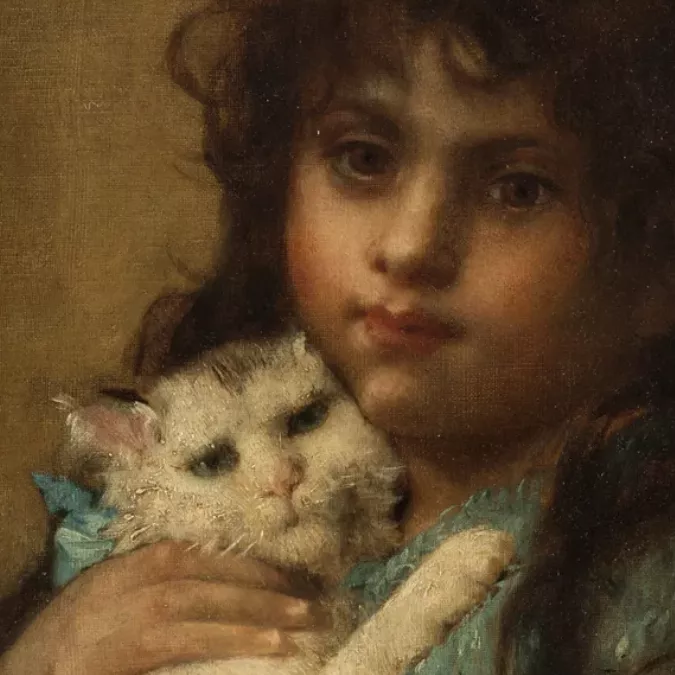
Perrault's art is distinguished by a particular attention to faces and expressions, where a sensibility close to that of troubadour painting is expressed.
His childlike figures, often idealized, convey a refinement reminiscent of Greuze's compositions, blending grace and restrained emotion.
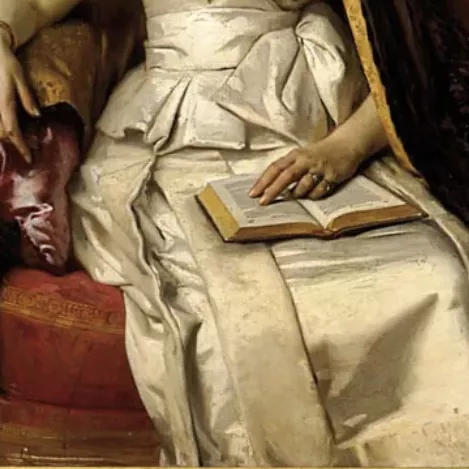
In his treatment of fabrics, he achieved a virtuosity that testifies to a perfect mastery of chiaroscuro, enhancing the brilliance of satins or the transparency of veils with a diffuse light.
This polished aesthetic, served by a palette of subtle harmonies, ensured his success with a bourgeois clientele eager for images imbued with softness and tenderness.
But this formal perfection, in its quest for idealization, clashed with the pictorial upheavals of the end of the century, where the emergence of new artistic sensibilities gradually relegated his work to the sidelines of the avant-gardes.
The life of Léon Bazile Perrault
Léon Bazile Perrault was born in Poitiers in 1832. His talent for drawing was revealed early on, enough to open the doors to the École des Beaux-Arts in Paris. There, he received rigorous instruction from William Bouguereau, who shaped his taste for meticulous, idealized painting.
From 1861, he exhibited at the Salon and quickly made a name for himself with compositions in which childhood appears in a tenderized light, bathed in delicate light and precisely modeled.
Far from the modernist impulses of his time, Perrault remained faithful to his academic heritage. His art, centered on grace and innocence, resonated with a bourgeois clientele and won him over as far afield as the United States.
He enjoyed lasting success there, buoyed by an impeccable technique and an attachment to classical aesthetic canons. Even when academicism lost its influence to the avant-garde, he continued in this vein, constantly perfecting his style.
Until his death in 1908, he remained a painter of gentleness and the ideal, offering a vision of the world where beauty takes precedence over all other considerations.
Focus on La fillette aux roses, Léon Perrault
In La fillette aux roses, Léon Bazile Perrault delivers an image imbued with ideal sweetness. The child, seated in a sliver of subdued light, holds a bouquet in delicate hues, her gaze slightly downcast, her expression both candid and melancholy.
The treatment of the face, smooth and with an almost enamel-like precision, bears witness to the direct influence of Bouguereau, master of refined academicism.
The imperceptible brushstrokes dissolve into exquisitely fine modeling, where every shade of pink and white responds to the velvety skin tone. The supple drapery falls with studied naturalness, evoking the great tradition of 18th-century portraitists.
Here, pictorial matter gives way to illusion, in a quest for formal perfection that sacrifices gesture for an impeccable finish.
At a time when Impressionism was overturning codes and making color vibrate, Perrault chose an art where precision dominates, where emotion is inscribed in a mastered harmony.
His idealized realism, far from the spontaneity of outdoor scenes, places this little girl in a suspended time, outside the tumult of the modern world.
Leon Perrault's role in pompier art
Pompier art, triumphant in the 19th century, embodies the apogee of academic savoir-faire, driven by technical virtuosity and an assertive taste for the spectacular. A direct descendant of neo-classicism and romanticism, it imposed a polished ideal of beauty, where line and modelling prevailed over boldness of touch.
Painters and sculptors trained in the bosom of the École des Beaux-Arts distinguished themselves here, drawing on mythology, history and religion for subjects where grandeur is combined with meticulous detail.
Color, subjugated to drawing, echoes flawless perfection, constructing compositions of immediate legibility, destined for official salons and prestigious commissions.
In this universe dominated by figures such as Cabanel, Dagnan Bouveret, Gérôme or Bouguereau, Léon Bazile Perrault stands out as one of the last defenders of this refined aesthetic.
His work, oriented towards ideal figuration, is distinguished by a particular attention to childhood and female figures, approached with a gentleness that reveals his attachment to academic canons.
He follows this tradition of impeccable rendering, where luminous skin tones and the precision of fabrics reflect an art of detail pushed to the extreme.
At a time when the avant-gardes are overturning conventions, he remains faithful to a vision where beauty is celebrated in its purest form, escaping the preoccupations of reality to exalt a sublimated humanity.
While pompier art was eventually swept aside by Impressionist and Modernist daring, Perrault illustrates this transition between a 19th century attached to academic excellence and an age in search of new expressions.
His success with American collectors attests to the enduring infatuation with this masterful painting, where each figure seems captured in a suspended moment, between grace and formal perfection.
Today, while art history has long relegated this academicism to the background, the view of these painters is changing.
Behind the smooth brilliance and technical precision, Perrault's work bears witness to an era fascinated by the ideal, where the artist's hand competes with nature in a relentless quest for absolute beauty.
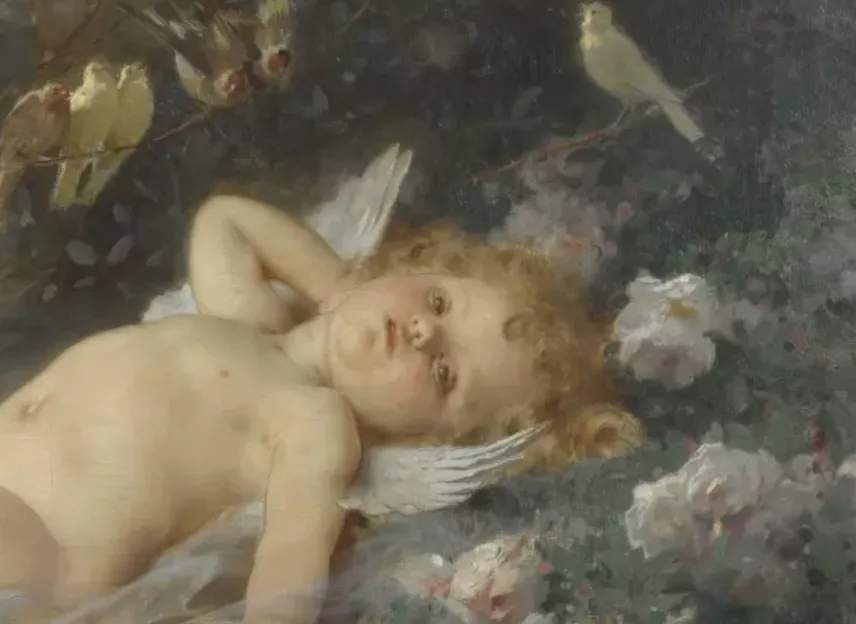
Léon Perrault's imprint on his period
Léon Bazile Perrault belongs to the line of academic painters who, at a time of aesthetic upheaval in the 19th century, maintained an ideal of timeless beauty.
Heir to the classical rigor and polished finish of Bouguereau, he embodies this loyalty to meticulous art, where drawing takes precedence over the raw brilliance of the brushstroke.
At a time when Impressionism and the avant-garde were redefining codes, his work stood out as a refuge, an idealized vision of the world, where childhood and innocence held a central place.
While art history has often relegated him to the margins, his influence on sentimental and academic painting remains undeniable. He perpetuated an aesthetic prized by the bourgeoisie of his time, concerned with art that was legible, accessible and technically impeccable.
His success with American and European collectors testifies to the enduring attachment to this delicate imagery, halfway between classicism and a form of refined romanticism.
In a fin de siècle torn between tradition and modernity, Perrault embodies a fidelity to the unchangingly beautiful, a painting that, far from new audacities, continues to enchant with its serene elegance.
The stylistic influences of Léon Perrault
Léon Bazile Perrault follows in the footsteps of the great masters of 19th-century academic painting, nourishing his art with the combined influences of neo-classicism and romanticism.
Trained under William Bouguereau, he inherited this rigorous mastery of drawing and meticulous attention to modeling, where light caresses flesh with an almost unreal softness.
His admiration for Raphael shines through in the harmony of his compositions, where balance and clarity dominate, while his taste for emotionally charged scenes brings him closer to the romantic sensibilities of Ingres or Anne-Louis Girodet.
He also draws on the heritage of the 17th-century Flemish and Dutch masters, in whom he finds an exaggerated sense of detail and an almost tactile approach to textures.
But it's above all in pompier art that he fully anchors himself, adopting this idealized aesthetic where formal perfection takes precedence over any stylistic daring.
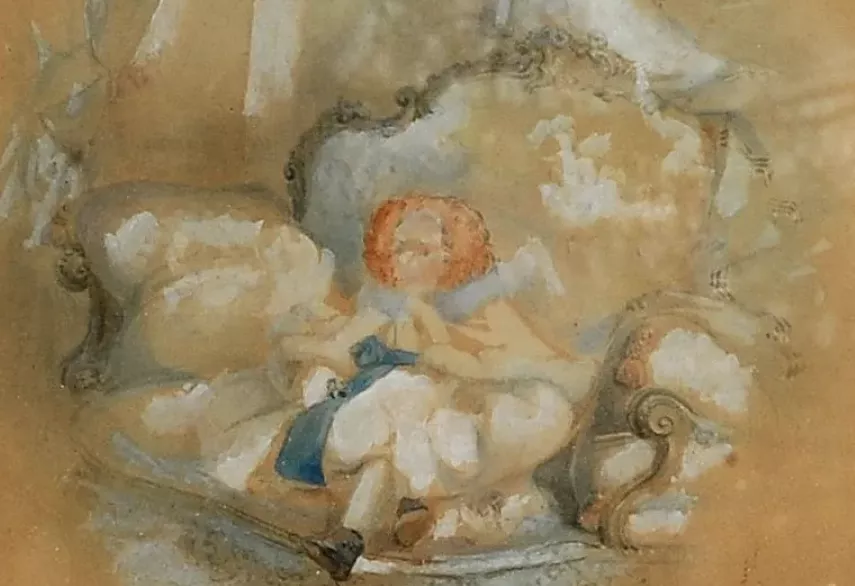
His work on childhood, expressed in compositions of controlled tenderness, sometimes evokes the sensitive portraits of Greuze, while at the same time adhering to an academic tradition where every stroke, every fold of fabric, every flash of light is sublimated in a quest for excellence.
Through this synthesis of influences, Perrault constructs a painting in which virtuosity combines with poetic vision, making his work a precious testimony to late academicism, at a time when the avant-gardes were preparing to overturn its codes.
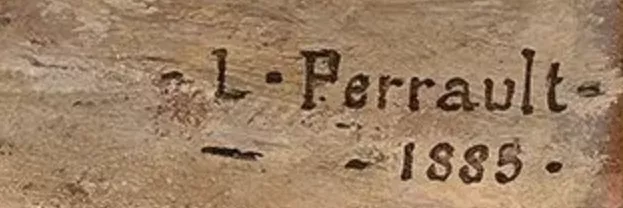
His signature
Not all of Léon Bazile Perrault's works are signed.
It is naturally best to appraise your work to ensure its authenticity.
Expertise your property
If you own a work by Léon Bazile Perrault, don't hesitate to request a free appraisal by filling out our online form.
A member of our team of experts and certified auctioneers will contact you to provide an estimate of the market value of your work.
If you are considering selling your work, our specialists will also guide you through the various alternatives available to obtain the best possible price, taking into account market trends and the specific features of each object.
Estimate in less than 24h
Discover in the same theme

Rating and value of paintings by Amrita Sher-Gil
Amrita Sher-Gil is a Hungarian-Indian artist of the 20th century who has produced works that are highly prized at auction. Estimated in 24 hours.
Learn more >

Rating and value of Luc Lanel's services, dishes and silverw...
Luc Lanel is a twentieth-century artist and designer who has produced numerous pieces of silverware that are highly prized and valued.
Learn more >

Rating and value of drawings and paintings by Dang Quy Khoa
Dang Quy Khoa is a secondary artist of Vietnamese modernity whose stock could well rise, driven by growing demand in the industry.
Learn more >
Works from the same period sold at auction

Estimated 3.000 - 5.000
Alphonse OSBERT (1857-1939) "Le soir" Oil on canvas

Estimated 4.000 - 6.000
Ary Scheffer (Dordrecht 1795-1858 Argenteuil) One of the three holy women (meditating on Christ's resurrection after the vision in the tomb?) Oil on canvas

Estimated 3.000 - 4.000
Entourage by Jean-Léon Gérôme (Vesoul 1824-1904Paris) Young androgynous Moorish smoker, dressed in Polish style, wearing a Baroque pearl (Angelo Soliman?) Oil on canvas

Estimated 1.000 - 2.000
Jules René HERVÉ (1887-1981) Le receuillement, Oil on canvas

Estimated 1.500 - 3.000
Macario VITALIS (1898-1989) Portrait of Marie Thérèse, Oil on canvas

Estimated 2.000 - 4.000
Macario VITALIS (1898-1989) Still life with a bouquet of flowers. Oil on canvas.

Secure site, anonymity preserved

Auctioneer approved by the State

Free and certified estimates
Frequently asked questions
-
Who is Léon Bazile Perrault, and what artistic movement does he represent?Léon Bazile Perrault (1832–1908) was a leading French painter of 19th-century academic and Pompier art. Trained at the École des Beaux-Arts in Paris under William Bouguereau, he distinguished himself through his impeccable technique, rigorous draftsmanship, and particular attention to the idealized depiction of childhood and female figures. His work embodies a commitment to academic excellence and the pursuit of formal beauty, even in the face of the emergence of the modernist avant-garde movements.
-
What are the price ranges for works by Léon Bazile Perrault?Léon Bazile Perrault’s works sell for prices that vary widely depending on the technique and composition. A drawing or watercolor can fetch between €70 and €9,150, while a painting ranges from €200 to €127,400. For example, the painting “Out in the Cold” sold for €127,400 in 2010, exceeding its initial estimate of €75,000 to €112,500. This range reflects the importance of the quality, subject matter, and provenance of each work.
-
How can you authenticate a work by Léon Bazile Perrault and determine its value?To authenticate a work of art and obtain an accurate estimate, we recommend requesting a free appraisal from our state-certified auctioneers and experts. Simply fill out our online form: a member of our team will contact you to examine your item and provide an estimate of its current market value. This service is non-binding and allows you to determine the likely price of your artwork before making any decisions.
-
Is this the right time to sell a work by Léon Bazile Perrault?Yes, now is a good time to sell. Although Léon Bazile Perrault is not widely represented on the current market, his works are selling for relatively high and stable prices. Collectors’ interest in academic art and “art pompier” is experiencing a resurgence: art history is now taking a fresh look at these painters, recognizing the technical virtuosity and historical value of their compositions.
-
How does the sales process work with Auctie's?Auctie's guides you from the appraisal to the auction. After requesting a free appraisal and receiving an estimate within 48 hours, if you wish to sell your artwork, our specialists will help you develop the best strategy to achieve the highest possible price. We take into account market trends, the item’s provenance, and its unique characteristics to maximize your auction proceeds.
