



Rating and value of drawings and lithographs by Kasimir Malevich

Key takeaways
- Kasimir Malevich, a Russian pioneer of abstract art, sees his works sell for between €600 and €63,992,000 depending on the technique, with stable market values.
- His *Suprematist Composition* fetched €63,992,000 in 2018, reflecting collectors’ growing interest in his work.
- As the founder of Suprematism in 1915 with *Black Square on a White Background*, he revolutionized art by favoring clean geometric forms over figurative representation.
If you own a work by or based on the artist Kasimir Malevich and would like to know its value, our state-approved experts and auctioneers will guide you.
Our specialists will carry out a free appraisal of your work, and provide you with an accurate estimate of its value on the current market.
Then, should you wish to sell your work, we will direct you to the best possible arrangement to obtain the optimum price.
Artist's rating and value
A Russian artist and pioneer of abstraction, Kasimir Malevich established himself as a major artist of his time. He produced works inspired by several twentieth-century currents and his native country, mixing media.
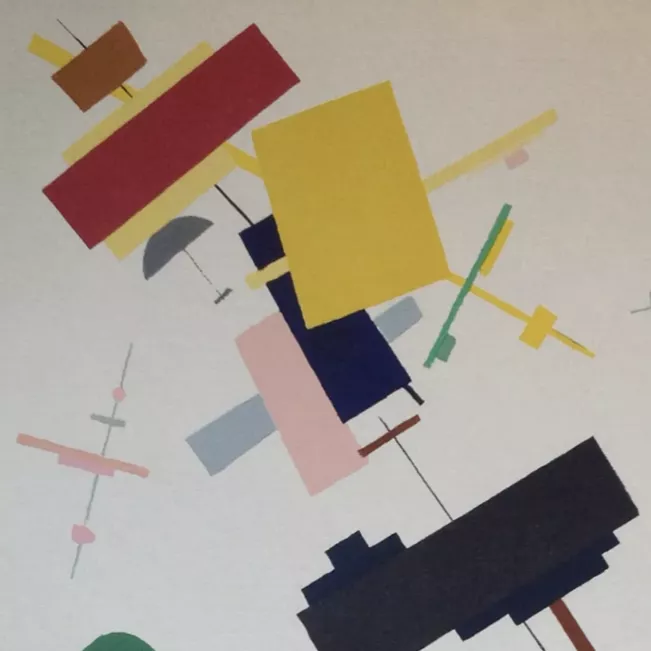
On the art market, his works sell for very good prices and keep a stable quotation. Thus, a work signed by the artist's hand can fetch millions of euros at auction, as evidenced by his oil on canvas Suprematist Composition, fetched €63,992,000 in 2018, testifying to the growing interest of collectors in Malevicth's works.
Order of value from the most basic to the most prestigious
Technique used | Result |
|---|---|
Sculpture - volume | From 60 to 650€ |
Ceramics | From 260 to 1 300€ |
Metal | From 3,000 to 5,200€ |
Estamp - multiple | From €10 to €134,000 |
Drawing - watercolor | From €330 to €7,740,400 |
Painting | From €600 to €63,992,000 |
Estimate in less than 24h
The artist's works and style
The strength of Kasimir Malevich's style and technique lies precisely in a radicality: how can we explain that an artist, deeply influenced by the Russian avant-gardes, came to abolish any mimetic relationship to reality, retaining only pure geometric forms?
With Carré noir sur fond blanc (1915), he inaugurated Suprematism, a visual language in which color and composition take precedence over figuration, relegated to the realm of the accessory.
This square, both dense and empty, is not a simple formal reduction, but an attempt to touch the absolute, to go beyond the visible to reach the spiritual essence of art.
Far from any anecdote or pictorial illusion, Malevich explores the possibilities offered by the purity of the plane and the contrast of surfaces. His deliberately limited palette sets off flat tints of white, black, red or blue, in asymmetrical compositions that elude any traditional hierarchy.
This quest for simplicity is accompanied by a precise technique: the canvas becomes a field of experimentation where the pictorial material almost disappears, replaced by a uniform, smooth application.
The artist's gesture, however, remains discreet, barely perceptible, affirming the human presence at the very heart of abstraction.
Through this rigorous aesthetic, Malevich invents an unprecedented pictorial space, suspended between art and metaphysics, where the visible becomes a springboard to the invisible.
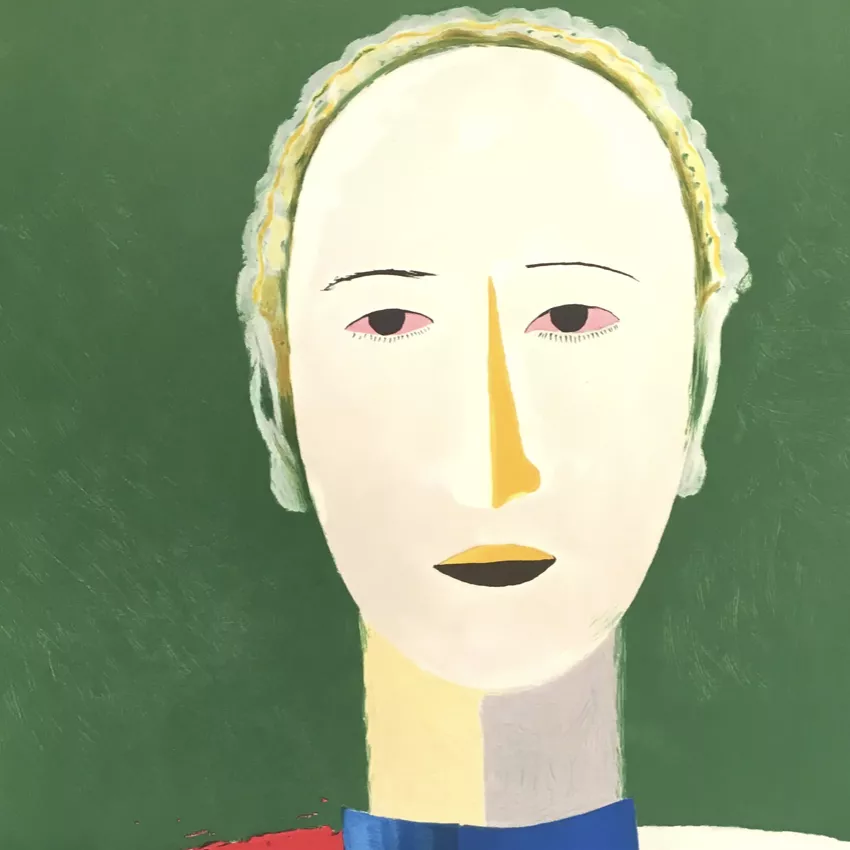
The life of Kasimir Malevich
Kasimir Severinovich Malevich (1879-1935) was a Russian artist born in Kiev (at the time in the Russian Empire), often referred to as a Suprematist in view of all the intellectual progress he made through his work.
Born of Polish parents, he was one of the first painters of his time to theorize and contextualize abstraction at its most total.
He trained in 1895 and 1896 at the Kiev School of Painting, where he studied with Nykolay Pymonenko. He then continued his training at the Imperial College in Parhomovka. After getting married, and having two children, he moved to Moscow in 1904, and really began his career as an artist as an industrial draughtsman for the railroads.
In Moscow, Malevich had the opportunity to see the collections of the Morozov brothers and Sergei Shchukin, and to become acquainted with the various European avant-gardes : Cézannean cubism, analytic then synthetic, futurism, impressionism, and fauvism.
Theoretically, Malevich became aware very early on of all the experiments taking place in painting in Paris and Europe, and immersed himself in them in order to operate a kind of theoretical synthesis, enabling him to see where he might be heading. Suprematism was not yet born.
In Russia, the avant-gardes also organized themselves to be exhibited outside the academic context, which totally rejected their productions. Thus, from 1910 onwards, Malevich was part of the Valet de Carreau, Queue d'Âne and Cible groups.
These exhibitions gave some visibility to the early experiments of the Russian avant-garde. He then joined the Futurists and the Zaoum trend, which linked poetry and painting in Russia - with elements of Futurism already born in Italy.
In 1913, he worked on the antagonisms of logic, which he transcribed in his drawings. Subsequently, he was asked to create an opera zaoum, in which he also designed costumes - which he wanted to be quite geometric.
In Petrograd, in 1915, he exhibited a set of 39 canvases which he named for the first time " suprématies ".
His most famous creative process thus began with Quandrangle, or Black Square on White Background, the first step on the road to his quest for total abstraction.
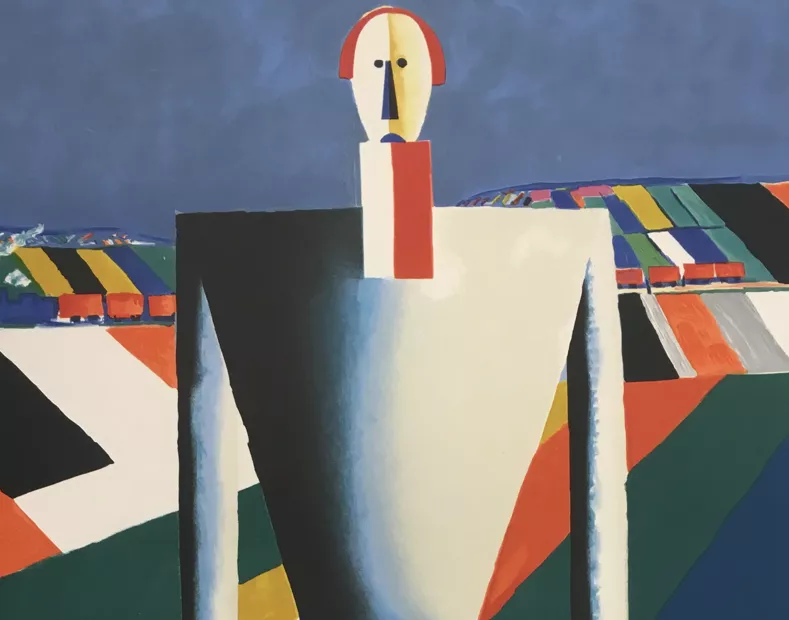
Contrary to other artists of his time, Malevich did not leave Russia after the 1917 revolution. He was elected deputy and campaigned for democracy. While carrying out his duties as a politician, he taught painting at the Moscow Academy.
He was already noticed by various French artists, including Chagall, who invited him to teach in Vitebsk. He then became a researcher at Petrograd University.
In 1918, his quest for total abstraction culminated in Carré blanc sur fond blanc, a work considered to be the first monochrome in modern painting, although the effects of texture and manner, art history admits, in a monochrome.
Malevitch thus established himself as one of the greatest artists of his time. He continued to produce for another ten years, before gaining international recognition from 1927 onwards, when retrospectives were organized in Warsaw and Berlin.
In addition to the 70 canvases he exhibited, he added to his work a manuscript entitled Le Suprématisme ou le Monde sans objet, which the Bahaus republished some time later.
Focus on White Square on White Background, Kasimir Malevich, 1918
It is precisely in this ultimate work, White Square on White Background (1918), that Kasimir Malevich's audacity reaches its climax: how can we understand, in a setting where even abstraction still seemed charged with meaning, this gesture of absolute stripping down?
This square, barely discernible on an immaculate canvas, goes beyond mere formal reduction to become a veritable philosophical statement. In it, Malevich does not represent absence, but rather essence: the idea of an art totally freed from matter, a space of pure potentiality.
The composition, disarmingly simple, challenges the viewer. The slightly tilted square suggests a fragility, an instability, as if this ethereal balance could at any moment dissolve into the background that encompasses it.
The work offers no detail or texture, save for the subtle variations in the painted surface, where the light reveals the minute differences between the white of the square and that of the background.
This is not an image to be looked at, but an experience to be lived, a meditation on infinity and emptiness.
With this gesture, Malevich proposes not just a work, but a radical questioning of expectations towards art itself, a space where each viewer is invited to project his or her own visions, his or her own interrogations.
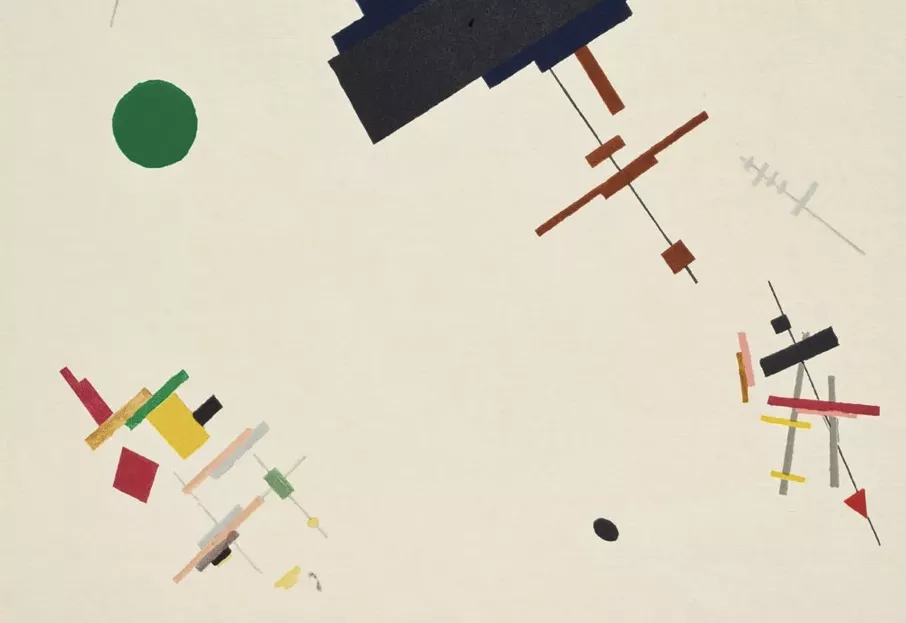
Kasimir Malevich's imprint on his period
It was precisely through his ambition to redefine the very foundations of art that Kasimir Malevich made an indelible mark on his era: how can we explain that an artist, evolving in the whirlwind of the Russian avant-gardes, was able to impose such a radical and solitary vision?
His Suprematism, by rejecting any anchorage in reality or narrative, stands in total rupture with the artistic and ideological conventions of his time.
In a Russia in full revolutionary turmoil, where art was often at the service of propaganda or tradition, Malevich offered a daring alternative: that of a universal visual language, turned towards the absolute and transcendence.
His influence extended far beyond Russian borders, nourishing the reflections of the Constructivist and Minimalist currents to come. The square, the circle and the cross, the elementary forms he erected as universal symbols, became tools of artistic liberation, freed from figurative expectations.
While the Soviet Union eventually rejected his abstraction in favor of imposed socialist realism, Malevich's impact persists in the history of modern art.
His work opened up a space for reflection where art detached itself from any decorative or narrative function to become an act of pure thought, a spiritual quest that continues to resonate in contemporary creations.
Later, he would influence artists such as Frantisek Kupka and Olivier Debré.
His signature
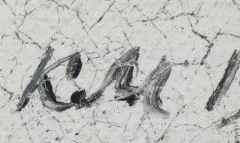
Not all of Kasimir Malevich's works are signed.
Although there are variations, here is a first example of his signature:
Expertise your property
If you own a work by Kasimir Malevich, don't hesitate to request a free appraisal by filling in our online form.
A member of our team of experts and certified auctioneers will contact you to provide an estimate of the market value of your work.
If you are considering selling your work, our specialists will also guide you through the various alternatives available to obtain the best possible price, taking into account market trends and the specific features of each work.
Estimate in less than 24h
Discover in the same theme

Rating and value of paintings by Georges Lapchine
Georges Lapchine is a 20th-century Russian painter who produced Russian Impressionist canvases that were highly successful at auction.
Learn more >

Rating and value of sculptures and bronzes by Charles Auffre...
Charles Auffret is a twentieth-century sculptor who produced works that are highly valued at auction. Estimate in 24h.
Learn more >

Rating and value of paintings by Georges Valmier
Georges Valmier was a cubist painter who lived through several currents of modern art. His works are of great value today.
Learn more >

Secure site, anonymity preserved

Auctioneer approved by the State

Free and certified estimates
Frequently asked questions
-
Who is Kasimir Malevich, and what is his major artistic movement?Kazimir Malevich (1879–1935) was a Russian artist who pioneered abstraction and founded Suprematism, an artistic movement based on simplified geometric forms and the reduction of shapes to squares, circles, and crosses. His masterpiece, *Black Square on a White Background* (1915), marked the inception of this revolutionary movement, which prioritized color and composition over figuration in an effort to capture the spiritual essence of art.
-
What is the price range for Malevich's drawings and lithographs at auction?Malevich’s drawings and watercolors vary considerably in value, ranging from €330 to several million euros depending on their significance and signature. Prints and multiples are estimated at between €10 and €134,000, while his paintings fetch much higher prices, as evidenced by the sale of *Suprematist Composition* for over €63 million in 2018.
-
How do you authenticate a work by Kasimir Malevich?To authenticate a work by Malevich, we recommend that you request a free, no-obligation appraisal from Auctie's. Our team of experts and state-certified auctioneers will examine your artwork and provide you with a detailed estimate within 48 hours, taking into account all criteria related to authenticity and market value.
-
Is this the right time to sell a work by Malevich?Yes, this is an excellent time to sell a work by Malevich. The market for abstract art and Suprematism remains very dynamic, with stable prices and growing interest from international collectors. Malevich’s historical recognition as the father of modern abstraction ensures steady demand for his works, regardless of medium or technique.
-
How does the appraisal process work at Auctie's, and how do I sell my artwork?Appraisals at Auctie's are free and non-binding: fill out our online form, and an expert will contact you to examine your piece and provide you with an appraisal within 48 hours. If you decide to sell, our auctioneers will guide you through the process from appraisal to auction, advising you on the best terms of sale to ensure you get the highest possible price.
