



Rating and value of drawing and silk paintings by Thang Tran Phenh

Key takeaways
- Thang Tran Phenh’s ink-on-silk works sell for between €3,200 and €350,000, with a record set in 2024 for “The Scholar Reading Before the Villagers” (1934), which sold for €350,000.
- Works from the 1930s and 1940s are particularly sought after and command prices 1.5 to 2 times higher than the Vietnamese artist’s later works.
- Scenes from traditional theater, female figures, and folkloric compositions constitute the main demand; provenance and authenticity are key factors in determining the estimate.
Thang Tran Phenh’s paintings and lacquerware fetch up to €350,000 at auction. An appraisal allows us to accurately determine the current market value of your Thang Tran Phenh artwork and, if applicable, optimize the sale of the piece.
If you own a work by Thang Tran Phenh and would like to know its value, our state-certified auctioneers will provide a free appraisal based on authenticity, market rating, and recent market results.
Market Value and Appraisal of Artist Thang Tran Phenh
The artist Thang Tran Phenh leaves behind a distinctive body of work, consisting primarily of lacquer and painting. He is Vietnamese. Currently, prices for his works are rising at auction.
The prices at which his works sell on the art market range from €3,200 to €350,000—a significant spread that speaks volumes about the value that can be attributed to Thang Tran Phenh’s works. He is particularly sought after by buyers in Hong Kong, Vietnam, and France.
In 2024, an ink-on-silk piece titled *The Scholar Reading Before the Villagers*, dating from 1934, sold for €350,000, despite an estimate of between €50,000 and €80,000.
Ranking of value from a simple work to the most prestigious
Technique used | Result |
|---|---|
Ink on silk | From €3,200 to €350,000 |
Estimate in less than 24h
Placing the Artist in Context
Period
Thang Tran Phenh (1895–1973) was an artist who played a key role in the formative period of photography and modern visual arts in Vietnam.
He was active primarily during the French colonial period, amid a transformation of visual practices and the rise of studio photography.
His career predated the institutional consolidation of modern painting emerging from the Indochina School of Fine Arts, but was contemporary with its earliest generations.
Artistic Movements
The artist engaged with various movements across different media. First, modernist photography, adopting Western photographic techniques to create formally constructed and aesthetically masterful representations.
He produced studio photographic portraits, specializing in the depiction of urban, literate, or bourgeois figures, using visual codes that blended local tradition with Western conventions.
He combines imported technical methods with Vietnamese cultural references (costumes, poses, inscriptions) and contributes to the construction of a national visual modernity, alongside modernist painters such as Luong Xuan Nhi, Hoang Lap Ngon, and Nguyen Anh.
The Life of Thang Tran Phenh
Cultural Context
Thang Tran Phenh belongs to the generation of artists active in the early 20th century, a period marked by the emergence of a Vietnamese artistic modernity within a colonial context.
This artist was largely self-taught and developed his body of work both before and alongside the institutionalization of academic training at the Indochinese School of Fine Arts, thereby occupying a unique position in the history of Vietnamese art.
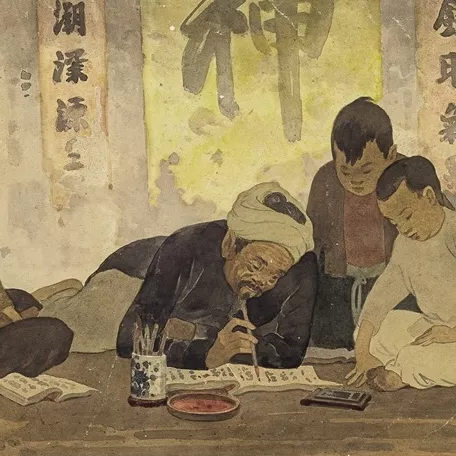
His work focuses on depicting theatrical scenes, popular performances, and figures drawn from traditional culture, contributing to the promotion of a national imagination. He played a role in the transition from a decorative aesthetic rooted in local traditions to a more structured approach to composition.
Artistic and Intellectual Circle
Although his body of work predates the full establishment of the Indochinese School of Fine Arts, his career was shaped by the intellectual climate that would lead to the modernization of art education under the leadership of Victor Tardieu.
He developed within a cultural environment that included artists and artisans committed to the preservation and transformation of traditional Vietnamese arts, contributing to a dynamic of aesthetic renewal.
His work foreshadows, in certain thematic and formal aspects, the later explorations of Vietnamese modernist painters trained within the academic system.

Techniques of Thang Tran Phenh
The Artist’s Style
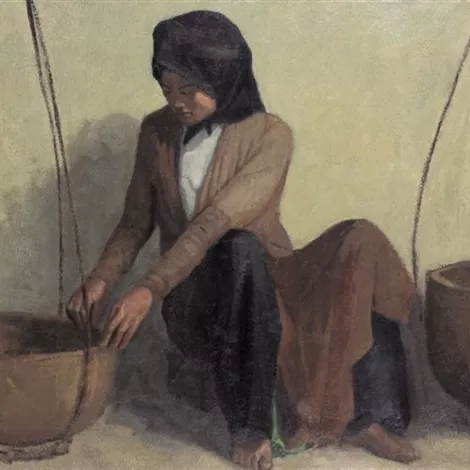
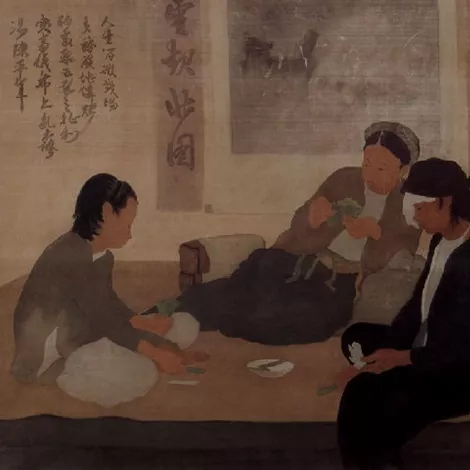
Thang Tran Phenh is part of the tradition of 20th-century Vietnamese painting, characterized by a blend of academic training and local visual traditions. He focuses on a structured figurative style that emphasizes the clarity of forms and the balance of composition.
His draftsmanship is firm and well-constructed, revealing a particular attention to anatomical accuracy and the clarity of contours. The simplification of forms is relative, reflecting a desire for formal synthesis rather than meticulous naturalism.
His color palette is generally well-controlled and based on harmonious color combinations and a moderate modulation of light. His body of work demonstrates an interest in scenes of daily life and human figures, rendered from a descriptive perspective tempered by subtle stylization.
He employs a relatively flat treatment of pictorial space, where depth remains subordinate to the decorative organization of the surface.
Focus on a Key Work
Market Scene (mid-20th century)
This composition is organized around a group of figures arranged in a horizontal rhythm that structures the visual narrative. The figures are rendered in a synthetic style, defined by sharp contours and simplified volumes.
He uses a balanced color palette, contributing to the overall unity without excessive dramatization, with a close integration between the figures and their surroundings, avoiding an overly pronounced hierarchy of planes.
The perspective is moderate, combining relative depth with a decorative flatness. This work exemplifies an approach that reconciles academic rigor, observation of everyday life, and the pursuit of formal harmony.
FAQ – How do you appraise a work by Thang Tran Phenh?
1) How important is the period of creation in determining value?
Works created in the early decades of the 20th century are particularly sought after due to their historical value and rarity; the date of creation is a key factor in determining the estimated value.
2) What stylistic criteria specific to Thang Tran Phenh are key?
For Thang Tran Phenh, the analysis focuses on the finesse of the line, the clarity of the composition, and the subtlety of color—characteristics that reflect a synthesis of Western academic training and Vietnamese painting traditions, particularly in genre scenes and depictions of daily life.
3) How does the market influence the estimate?
The estimate is based on a comparative analysis of auction results for modern Vietnamese art, taking into account the rarity of available works, the quality of their execution, and collectors’ interest in this generation of artists.
Market Segmentation
Artwork Prices
Thang Tran Phenh is a figure associated with the early days of Vietnamese modern painting and the Indochinese School of Fine Arts, and occupies a mid-range segment of the Indochinese art market, with genuine historical recognition but a lower market value than the most internationally renowned artists.
His body of work is dominated by works on silk, ink paintings, and watercolors. High-quality silk paintings generally sell for between €80,000 and €300,000, depending on quality and provenance. Ink and watercolor works fall within a mid-range segment between €15,000 and €90,000.
Studies and small-format works fall within a more accessible range of around €5,000 to €20,000. Some major works have exceeded €300,000, positioning the artist in the upper-middle tier of the historical Vietnamese art market.
Factors Affecting Value
Works from the 1930s–1940s correspond to the artist’s period of academic training and modernist experimentation and can fetch prices 1.5 to 2 times higher than his later works.
Scenes from traditional theater, female figures, and compositions related to Vietnamese folklore form the core of demand. Decorative or repetitive works fall at the lower end of the price range.
The market is relatively narrow, with moderate sales frequency and a strong emphasis on provenance. Well-documented works benefit from increased international competition.
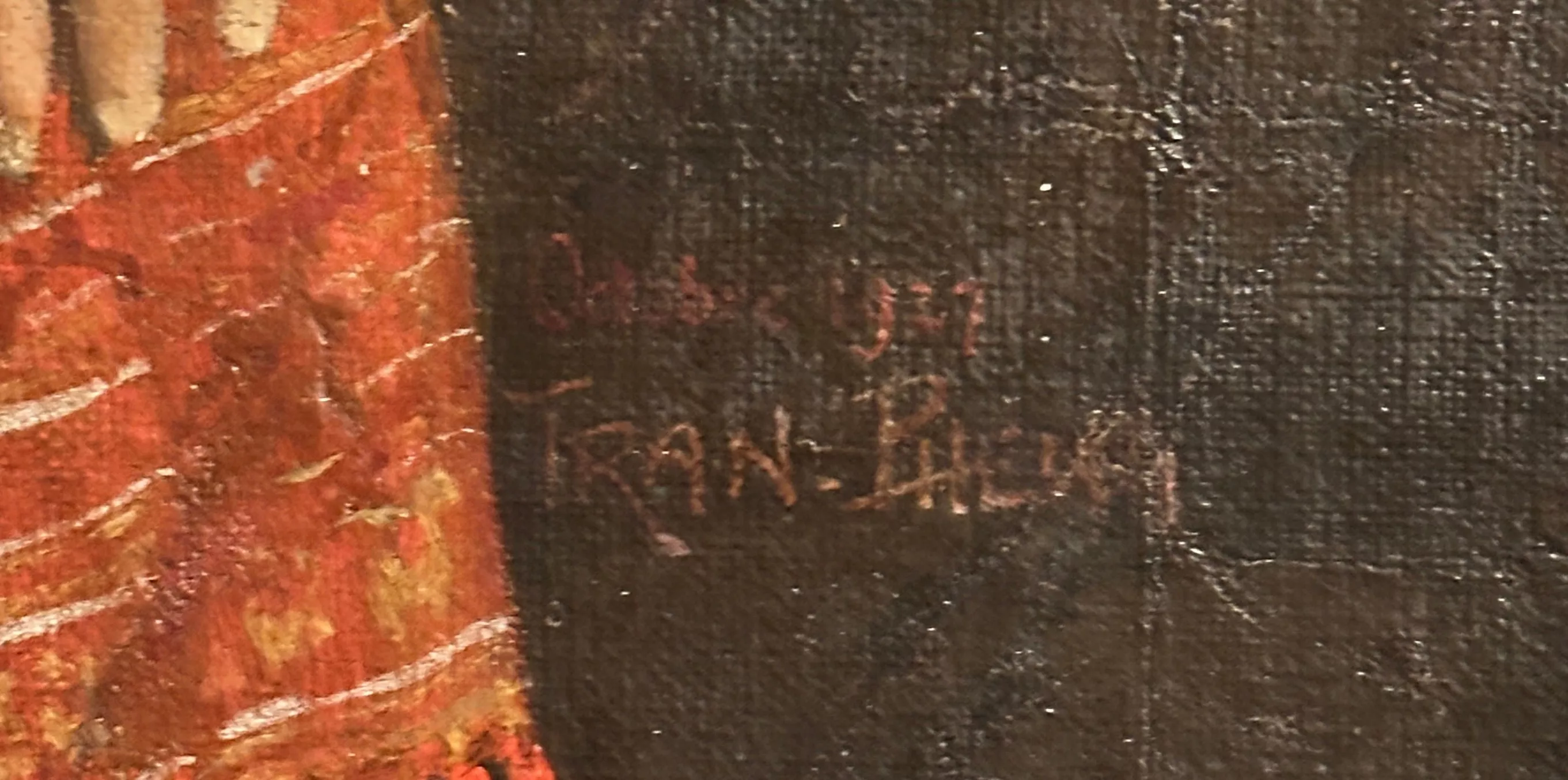
Recognizing the Artist’s Signature
Thang Tran Phenh usually signs his works. However, it is essential to have your piece appraised to ensure its authenticity.
Get Your Thang Tran Phenh Artwork Appraised
If you own a work by Thang Tran Phenh, an appraisal will help you determine its current market value.
Using our online form, our experts and certified auctioneers will conduct a free appraisal and provide you with a reliable estimate of your artwork’s market value.
If you’re considering selling it, we’ll guide you through the process to ensure you get the best possible price.
Estimate in less than 24h
Discover in the same theme

Rating and value of paintings, drawings and photographs by P...
Pierre Molinier is a figurative and surrealist artist whose works have recently skyrocketed in value at auction.
Learn more >

Rating and value of paintings by Tibor Csernus
Tibor Csernus is a Hungarian painter and pioneer of the over-naturalist style. His works are listed and have a high value at auction. 24h estimate
Learn more >

Edvard Munch (1863–1944) Market Data – Estimates and Values...
Discover Edvard Munch's market value: prices, auction records, and appraisal criteria. Auctie's will appraise your artwork for free in less than 24 ho...
Learn more >
Nos records d'enchères à l'hôtel Drouot

Estimated 10.000 - 15.000 €
Ebridge Ayer BURBANK(1858-1949), Young African-American boy, Oil on panel.

Estimated 20.000 - 30.000
EXCEPTIONAL LARGE OVAL DISH IN VINCENNES SOFT PASTE PORCELAIN FROM THE "BLEU CÉLESTE" SERVICE OF KING LOUIS XV AT THE CHÂTEAU DE VERSAILLES

Estimated 20.000 - 30.000
MANUFACTURE ROYALE DE SÈVRES, 18th century "L'Empereur de la Chine" - Portrait of the Emperor Qianlong, Hard porcelain bisque, 1775

Estimated 1.500 - 3.000
HERMÈS, "Kelly" 32 saddle bag in black box calf

Estimated Between €5,000 and €8,000
KRACHKOWSKY (1854-1914), Before the storm, oil on canvas

Estimated 40.000 - 80.000
Alexandre ROUBTZOFF (1884-1949), Portrait of Arbia, oil on canvas

Secure site, anonymity preserved

Auctioneer approved by the State

Free and certified estimates
Frequently asked questions
-
Who is Thang Tran Phenh, and what is his place in the history of Vietnamese art?Thang Tran Phenh (1895–1973) was a Vietnamese artist and a pioneer of modern Vietnamese painting, active during the French colonial period. Largely self-taught, he developed an approach that blended Western academic techniques with Vietnamese visual traditions, specializing in theatrical scenes, everyday life, and urban figures. His work foreshadowed the explorations of modernist painters trained at the Indochina School of Fine Arts.
-
What is the price range for Thang Tran Phenh's ink paintings and drawings on silk?Thang Tran Phenh’s works sell for between €3,200 and €350,000, depending on their size and quality. Inks and watercolors generally range from €15,000 to €90,000, while mature silk paintings fetch between €80,000 and €300,000. Smaller works and studies are priced around €5,000 to €20,000, and works from the 1930s–1940s can be worth 1.5 to 2 times more than his later works.
-
How can you authenticate a work by Thang Tran Phenh?To verify the authenticity of a work by Thang Tran Phenh, it is essential to have your piece appraised. Our state-certified auctioneers offer a free, no-obligation appraisal that analyzes the work’s authenticity, date, and quality. You’ll receive a reliable appraisal within 48 hours via our online form.
-
What factors influence the value of a work by Thang Tran Phenh?The value of a work by Thang Tran Phenh depends on several factors: the period in which it was created (works from the 1930s–1940s are more sought after), the subject matter (scenes from traditional theater, female figures, and Vietnamese folklore are particularly favored), the quality of execution, documented provenance, and condition. Rarity also plays a major role in an appraisal, as the market remains small and selective.
-
How do I sell a work by Thang Tran Phenh through Auctie's?Auctie's, an auction house, guides you through the process from a free appraisal to the successful sale of your artwork. After you submit your appraisal request online or in person at one of our offices, our experts will provide you with a reliable valuation based on current market conditions. We then handle the sale to ensure you get the best possible return on your investment.
