



Silverware Valuation: Appraisal and Auction

Key takeaways
- The value of a piece of silverware depends on its fine silver weight, the quality of the craftsmanship, the silversmith’s identity, and the hallmarks that allow for precise dating.
- Complete 18th- and 19th-century table services sell for between €20,000 and €500,000, while individual pieces of silverware remain affordable at between €200 and €5,000 each.
- The silversmith’s reputation can increase the value by a factor of 10 to 100 compared to the weight of the silver alone, particularly for great masters such as Thomas Germain or Robert Joseph Auguste.
Hallmarked silverware, tableware sets, and prestige pieces: the value of silverware varies greatly depending on the silversmith, the hallmark, and the weight of the silver.
Below you’ll find all our valuation guides dedicated to silverware—tableware, sets, serving pieces, and prestige items. Each guide details the price ranges observed at auction and the factors that determine a piece’s value before you entrust it to our state-certified auctioneers.
Guides on this type of item
See all guides >
Marseille Auctioneer: Art Valuation – Aucties
Have your artwork, jewelry, and collectibles appraised in Marseille by the experts at Aucties. 100% free online appraisal within 24 hours. ✅
Learn more >

Rating and value of boxes, inkwells and vases by Eugène Feui...
Eugène Feuillâtre is an Art Nouveau silversmith who produced few objects that have a significant value at auction. 24h estimate.
Learn more >

Rating and value of Luc Lanel's services, dishes and silverw...
Luc Lanel is a twentieth-century artist and designer who has produced numerous pieces of silverware that are highly prized and valued.
Learn more >

Rating and value of Fabergé objets d'art
Pierre-Karl Fabergé is a master goldsmith who has produced numerous works of high value at auction. 24h estimate.
Learn more >

Rating and value of vases, bowls, dishes by Henri Husson
Henri Husson was a 19th-century coppersmith and wrought-iron worker who produced works of considerable value at auction.
Learn more >

Rating and value of Jean Després' artworks, jewels, vases an...
Jean Després is a 20th-century French silversmith who produced jewelry, vases, services and other silver works that are highly prized at auction.
Learn more >

Rating and value of Tiffany lamps, objects and creations
Tiffany creations are esteemed for their excellence and exceptional craftsmanship, with high values. Find out more.
Learn more >
Understanding Silverware Valuations
What Is the Market Value of Silverware?
The market value of a piece of silverware refers to the reference value assigned to it by the market at a given time, resulting from a balance between the weight of fine silver, the quality and rarity of the silversmith’s craftsmanship, the identity of the silversmith or silversmithing house, the period of manufacture, and the strength of the supporting documentation.
Silverware occupies a unique place in the world of decorative arts: halfway between precious metal, from which it derives its intrinsic base value, and the art of silversmithing, from which it derives its cultural and historical value; it is subject to complex valuation principles that only a specialized auctioneer is capable of grasping with the necessary precision.
This market has a fundamental characteristic: the price of silver metal constitutes an absolute floor below which no piece can fall, regardless of the mediocrity of its craftsmanship or the poor condition of its preservation.
But above this floor, the artistic, historical, and aesthetic value of a piece can multiply that floor by ten, a hundred, or even more for the great works of silversmithing by Thomas Germain, Henri Auguste, or Odiot, whose creations are true masterpieces of French decorative art from the 17th, 18th, and 19th centuries.
Tableware sets, cutlery sets, individual pieces: what types of silverware are available on the market?
The silverware market is organized into several categories, each with its own distinct pricing logic.
Complete table services, consisting of several dozen or even several hundred pieces in the most ambitious sets, are the most prestigious and highly valued lots; their completeness and coherence represent a growing rarity as the centuries pass and individual pieces are dispersed.
Cutlery—spoons, forks, and knives with silver handles—constitutes the most liquid and accessible segment, as their standardization allows for rapid identification of silversmiths and periods.
Ceremonial pieces—soup tureens, teapots, chocolate pots, coffee pots, and terrines—constitute the most highly valued segment of table silverware; their size and the complexity of their decoration allow the silversmith to fully showcase their formal vocabulary and technical expertise.
Toiletry items—such as mirrors, boxes, brushes, and silver bottles—along with liturgical pieces like chalices, candlesticks, and monstrances, round out this overview of a highly diverse body of work.
Category | Characteristics | Estimated Price Range | Market Demand |
Complete table service (master silversmith, 18th–19th centuries) | Consistency, completeness, identified hallmarks | €20,000 — €500,000 | Very strong, institutional |
Single ceremonial piece (soup tureen, teapot, chocolate pot) | Ambitious scale, elaborate decoration | €2,000 — €50,000 | Very active, collectors |
Cutlery (spoon, fork, knife) | Identified model, legible hallmarks | €200–5,000 per piece | Highly liquid, accessible market |
Toiletries (box, mirror, brush) | Embossed or chiseled work, set | €500–15,000 | Active market, sought after by interior designers and collectors |
Liturgical silverware (chalice, candlestick) | Elaborate decoration, identified silversmith | €1,000 — €30,000 | Moderate, specialized collectors |
The criteria that determine the value of a piece of silverware
The market value of a piece of silverware is determined by a hierarchy of criteria that the auctioneer carefully weighs.
The weight of fine silver constitutes the minimum valuation threshold, but the artistic value can far exceed it: a soup tureen by Thomas Germain or Robert Joseph Auguste, royal silversmiths of the 18th century, is worth infinitely more than its weight in silver alone.
The quality of the silversmithing—including chasing, repoussé, and filigree—constitutes the second criterion, as the artistry of the chaser and the caster combine to produce the most exquisite surfaces in this market. Finally, hallmarks are the essential tool for identification and dating in any serious appraisal.
Estimate in less than 24h
Hallmarks, Silversmiths, and Prestigious Houses: What Drives Value
The French Hallmark System: A Guarantee of Gold and Silver
The French hallmark system, one of the most comprehensive and rigorous in Europe, allows for the remarkably precise identification of the date, place of manufacture, and silversmith of a piece of French silverware.
The master’s hallmark, affixed by the silversmith himself and consisting of his initials surrounded by a distinctive mark, is the most valuable indicator of attribution.
Hallmarks, which certify the metal’s legal fineness, are applied by assay offices and allow for precise dating to the period during which the relevant assayer was in office. Mastery of these codes—which constitute a technical language as precise as it is complex—is essential to any serious appraisal.
Master Silversmith | Period | Specialty | Level of Demand |
Thomas Germain | 18th century | Goldsmith to King Louis XV, a master of French goldsmithing | Institutional, extremely rare pieces |
Robert Joseph Auguste | 18th century | Neoclassical style, court silversmith | Very well-preserved |
Jean-Baptiste-Claude Odiot | 19th century (Empire) | Great goldsmith of the First Empire | Very active, international |
Christofle | 19th–20th centuries | Plated and solid silverware, prestigious industrial production | Active, broad appeal |
Puiforcat | 20th century | Art Deco, clean geometric lines | Highly sought-after, refined Art Deco |
French, English, and Russian table silver: the most highly valued
While 18th- and 19th-century French silverware sets the gold standard in the table silverware market in continental Europe, English silverware from the same period enjoys comparable recognition in the British and American markets, with its leading houses— Paul de Lamerie, Paul Storr, and Matthew Boulton, having produced pieces of remarkable technical quality and formal ingenuity.
Imperial Russian silverware—particularly the works of the Fabergé house and the great silversmiths of Moscow and St. Petersburg—constitutes a market in its own right, driven by Russian and international demand of a magnitude comparable to that supporting imperial Chinese porcelain.
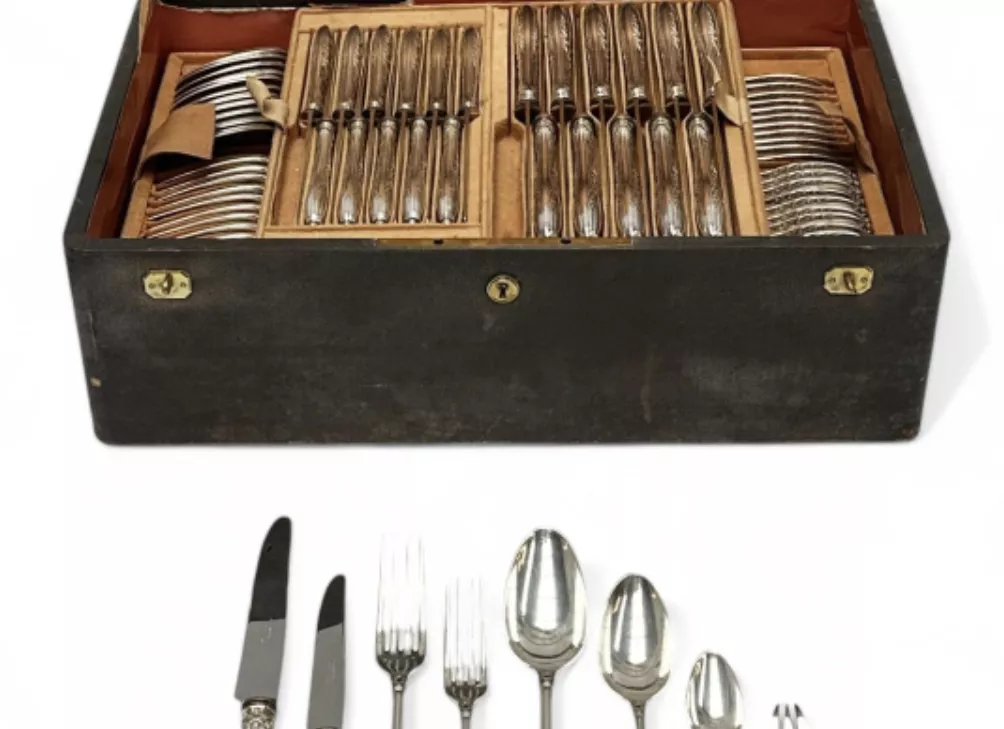
Get a Free Appraisal of Your Silverware
A certified appraisal in less than 24 hours
Deciphering a hallmark on an 18th-century spoon, identifying the "fermier général" associated with a hallmark, and determining the exact date of manufacture: these are just some of the specialized expert services that Auctie’s auctioneer offers you free of charge, with a certified response in less than 24 hours.
What you need to provide for an online appraisal
Clear photographs of all items, their hallmarks and marks, along with the total weight and composition of the lot, form the basis of an appraisal request. Any information regarding provenance will enhance the appraisal.
Hallmarks, weights, and condition: the pillars of grading
Criterion | Impact on Value |
Identity of the silversmith (master silversmith vs. unknown silversmith) | Can increase the value by a factor of 10 to 100 compared to weight alone |
Hallmarks (legible and consistent vs. struck or erased) | Legible hallmarks: reliable dating and attribution; erased: significant depreciation |
Fine silver weight | Absolute minimum value, sometimes accounting for 50 to 80% of the value of a common piece |
Goldsmithing (fine engraving vs. simple decoration) | High-quality chased decoration: very significant premium |
Condition (no holes, no repairs) | Perfect integrity adds value; repairs reduce value |
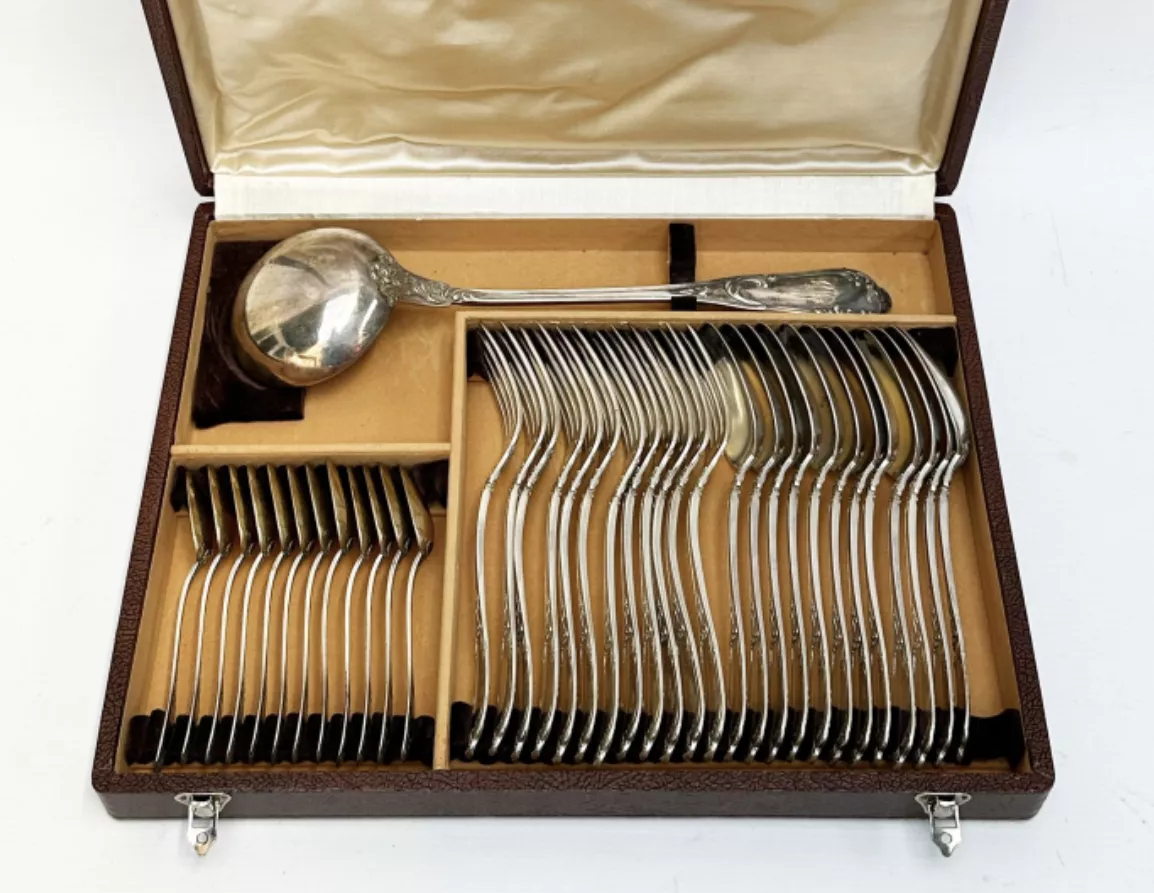
Sell Your Silverware at Auction with Auctie's
From the reserve price to the final bid
Auctions are the most suitable method for selling high-quality silverware, exposing the pieces to competition among collectors and dealers whose combined demand can drive final prices far above the value of the silver alone.
Auctie's holds its auctions at the Hôtel Drouot and online, reaching bidders from around the world.
Estates and Inheritance: Appraised Family Silver
Family silverware is very commonly found in estates, sometimes stored away in drawers for decades without the heirs knowing its exact value. Auctie’s steps in to compile detailed inventories, with each piece weighed, identified, and appraised individually.
Estimate in less than 24h
Let Auctie's appraise your silverware
A beautiful piece of silverware is an object that stands the test of time like few others: silver does not corrode or deteriorate, and its metal preserves the memory of the silversmith’s craftsmanship.
Perhaps this is why silverware has always been one of the most enduring forms of passing down family heritage, traveling through generations while carrying with it stories that Auctie’s auctioneer can decipher from the hallmarks. Entrust your pieces to us: we’ll restore them to the value they deserve.
Appraisals are free, with no obligation, and you’ll receive a response in less than 24 hours.
Discover in the same theme

Grand Est Auctioneer: Valuation – Aucties
Have your artwork, jewelry, and collectibles appraised in the Grand-Est region by Aucties experts. 100% free online appraisal within 24 hours.
Learn more >

Auctioneer Saint-Étienne: Valuation | Aucties
Have your artwork, jewelry, and collectibles appraised in Saint-Étienne by the experts at Aucties. Free appraisal within 24 hours. ✅
Learn more >

Auctioneer Perpignan: Art Valuation | Aucties
Have your artwork, jewelry, and collectibles appraised in Perpignan by the experts at Aucties. 100% free online appraisal within 24 hours. ✅
Learn more >

Secure site, anonymity preserved

Auctioneer approved by the State

Free and certified estimates
Frequently asked questions
-
What are the main factors that determine the value of a piece of silverware?The value of a piece of silverware depends first and foremost on its weight in fine silver, which serves as an absolute baseline. Above this minimum value, the silversmith’s reputation, the quality of the workmanship (chasing, repoussé), the condition of the hallmarks, and the period of manufacture can increase the value by a factor of 10, 100, or more. For pieces by a great master such as Thomas Germain or Odiot, the artistic and historical value far exceeds the weight of the metal alone.
-
How can you authenticate a piece of silverware and identify its hallmark?Authenticating a piece of silverware requires a careful examination of its hallmarks: the maker’s mark (the silversmith’s initials), fineness marks (indicating the metal’s purity), and the tax collector’s mark. For a thorough and reliable appraisal, we recommend submitting a request for a free estimate to Auctie’s: our specialized auctioneers will decipher your hallmarks and accurately date your piece in less than 24 hours.
-
What are the typical price ranges for silverware at auction?Prices vary widely depending on the category: individual pieces of cutlery range from 200 to 5,000 € each; toiletries (boxes, mirrors) range from 500 to 15,000 €; ceremonial pieces (soup tureens, teapots) between €2,000 and €50,000; liturgical silverware between €1,000 and €30,000; complete table services by a renowned silversmith can reach €20,000 to €500,000. These price ranges are approximate and depend heavily on the silversmith, the condition, and the provenance.
-
How does the free appraisal of a piece of silverware work at Auctie's?Appraisals at Auctie's are free and non-binding. You must provide clear photographs of your items, their hallmarks and marks, along with the total weight and composition of the lot. Any information regarding provenance will enhance the appraisal. A specialized auctioneer will provide you with a certified response within 24 hours.
-
Why sell your silverware at auction rather than to an antique dealer?An auction is the most suitable method for selling high-quality silverware, as it exposes your pieces to competition from collectors and institutions around the world. This competition can result in final bids that far exceed the value of the silver alone. Auctie’s holds its auctions at the Hôtel Drouot and online, reaching international bidders and maximizing the value of your silverware.
