



Rating and value of paintings by Hans Memling

Key takeaways
- Hans Memling’s paintings fetch up to €2,662,200 at auction, with major works by the artist estimated at between 10 and 30 million euros.
- A 15th-century German painter (1430–1494), Memling was a leading figure among the Flemish Primitives, active in Bruges, the artistic center of the former Burgundian Netherlands.
- Authenticity determines the range of values (5 to 10 times), requiring in-depth expertise including dendrochronology, pigment analysis, and documented provenance.
Paintings by Hans Memling or attributed to him sell for up to €2,662,200 at auction. An appraisal allows us to accurately determine the current market value of your Hans Memling artwork and, if applicable, optimize the sale of the piece.
If you own a work by Hans Memling and would like to know its value, our state-certified auctioneers will provide a free appraisal based on authenticity, market rating, and recent market results.
Market Value and Appraisal of Hans Memling
Hans Memling was a 15th-century German painter. Although he is a world-renowned figure, relatively few works attributed to him are found on the art market; however, those that are exist are highly prized and command high prices.
Most of his body of work consists of paintings, though a few drawings and engravings have also been preserved.
Hans Memling’s works sell for between €3,200 and €2,662,200 (attributed to him or his workshop for the lower-priced results). His oil on canvas *Christ Blessing* sold for €2,662,200 in 2013.
Ranking by value, from a simple work to the most prestigious
Technique used | Price |
|---|---|
Painting | From €3,200 to €2,662,200 |
Estimate in less than 24h
Placing the Artist in Context
Period
Hans Memling was a 15th-century painter (1430–1494) who lived at the heart of the Northern Renaissance. He was active primarily in Bruges, a major center of artistic production in the former Burgundian Netherlands.
Chronologically, he came after the founding generation of the Flemish Primitives and before the Mannerist developments of the 16th century.
His career spanned a period of economic and cultural prosperity that fostered private commissions (altarpieces, portraits, diptychs, and devotional works).
Artistic Movements
Hans Memling builds on the legacy of the Flemish Primitives, following in the tradition of the technical and stylistic innovations of Jan van Eyck and Rogier van der Weyden, particularly in his mastery of oil painting and precision of detail.
The Northern Renaissance was marked by meticulous naturalism, with an illusionistic rendering of materials and a rigorous integration of the landscape into the composition. He produced altarpieces and diptychs intended for individual meditation and characterized by expressive gentleness and narrative clarity.
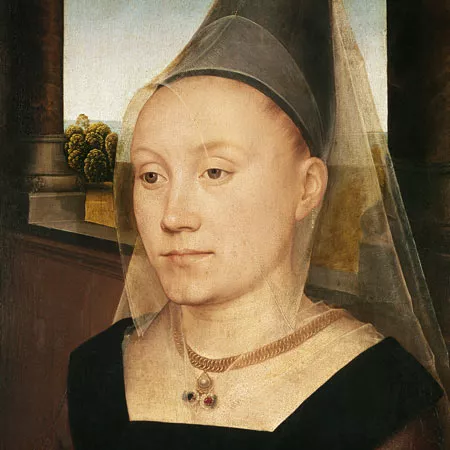
In the humanist tradition, he developed the independent portrait, based on measured frontal composition, psychological insight, and descriptive precision.
He assimilated earlier Flemish traditions while pursuing formal harmony and expressive serenity, giving his work a consistent coherence within 15th-century painting.
The Life of Hans Memling
Cultural Context
Hans Memling was born around 1430 in the Germanic region and worked primarily in Bruges, a major economic and artistic center of the former Burgundian Netherlands in the 15th century.
He was part of the tradition of the Flemish Primitives, which built upon the technical innovations in oil painting and the illusionistic precision developed at the beginning of the century.
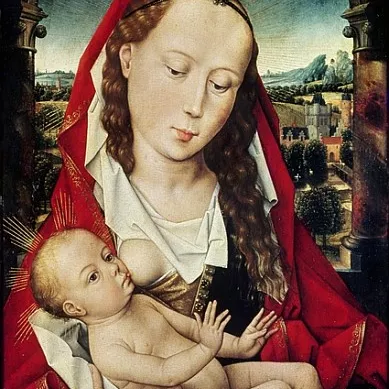
His work is characterized by a masterful rendering of textures, meticulous attention to detail, and rigorous spatial composition, all in the service of religious subjects intended for private devotion.
He also contributed to the dissemination of a stable and harmonious iconographic model, based on balanced compositions, gentle expressions, and narrative clarity. His work in Bruges catered to an international clientele and was part of a broader European artistic circulation.
Artistic and Intellectual Circle
Memling was trained in the tradition of Rogier van der Weyden, whose influence is evident in the structuring of the figures and the restrained expressive intensity. His work also bears a close resemblance to that of Jan van Eyck, particularly in terms of lighting, the rendering of textures, and optical precision.
Working in Bruges, he was part of an artistic milieu that included other Flemish masters such as Dieric Bouts, contributing to the rise of a school of painting with a European reach.

The Artist's Techniques
Hans Memling’s Style
Memling was a leading painter of the second generation of the Flemish Primitives, active in Bruges during the second half of the 15th century. He synthesized the legacy of Rogier van der Weyden with a quest for harmony characteristic of his personal style.
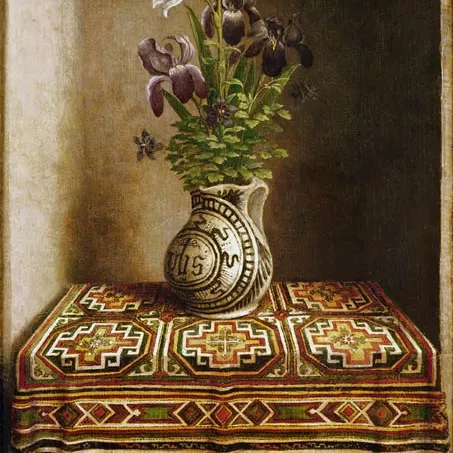
His drawing is precise and meticulous, and his rendering of textures is detailed (goldsmithing, fabrics, hair), demonstrating exceptional technical mastery. He made masterful use of oil paint, which allowed for transparent glazes and subtle transitions of light.
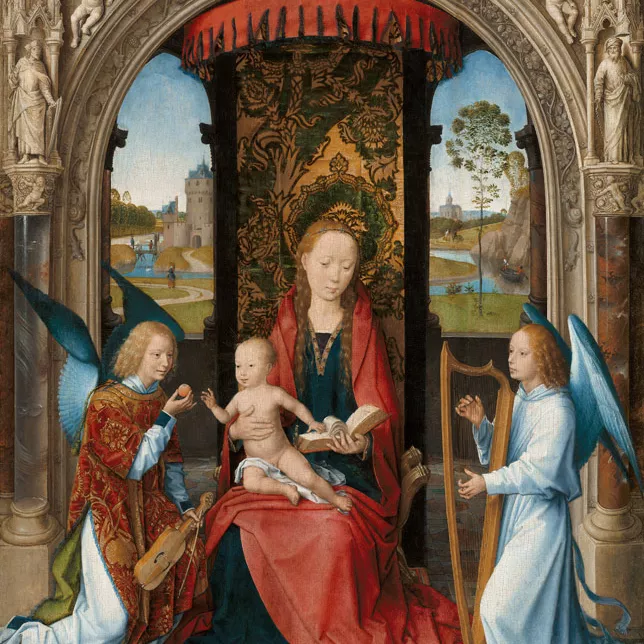
His compositions are balanced and symmetrical, promoting narrative clarity and visual stability. He gently idealizes his figures, with regular features and introspective expressions. The integration of the landscape in the background is carefully executed, contributing to the spatial depth and spiritual dimension of the image.
Focus on a Key Work
The Last Judgment (c. 1467–1471)
This triptych is structured according to a clear hierarchical organization, centered on the figure of Christ the Judge. The composition is symmetrical and organized around a vertical axis, which reinforces the scene’s theological solemnity.
The rendering of the figures, armor, and architectural elements is extremely precise, illustrating Memling’s technical virtuosity. He uses saturated, luminous colors, modulated by subtle glazes.
A clear distinction is made between the celestial realm and the earthly world, structured through superimposed registers. This work is emblematic of Memling’s stylistic maturity, combining narrative rigor, technical refinement, and internalized spirituality.
FAQ – How do you appraise a work by Hans Memling?
1) What is the first step in appraising a work attributed to Hans Memling?
The appraisal begins with a thorough examination to determine the authenticity and nature of the work (painted panel, fragment of an altarpiece, or diptych), including an analysis of the support—which is usually wood—the painting technique, the date of creation, and the condition of the work.
2) How important is the scientific study of the support and materials?
Technical examinations such as panel dendrochronology, pigment analysis, and scientific imaging are essential tools for confirming the date and distinguishing an autograph work from a workshop piece or an early copy.
3) What role do provenance and collection history play?
A long-established and well-documented provenance, mention in historical inventories or scholarly publications, as well as inclusion in a recognized scholarly corpus, are decisive factors in establishing authenticity and value.
Market Segmentation
Artwork Prices
Hans Memling occupies a unique position in museums and on the art market. He is a major master of Early Flemish painting, belonging to an extremely rare segment of the Old Masters market.
Major altarpieces or panels that are entirely autograph command a theoretical market value of tens of millions of euros, due to their absolute rarity.
Standalone panels or autograph portraits are estimated to be worth between 10 and 30 million euros, depending on their condition and provenance.
Works by the artist’s workshop, circle, or followers belong to a distinct segment, generally valued between 200,000 and 3 million euros, depending on the degree of attribution.
Factors Affecting Value
The distinction between an autograph work, a workshop piece, or an attributed work determines value differences that can range from 5 to 10 times. Dendrochronological analysis, technical examinations, and scientific literature play a central role in determining the price.
High-quality individualized portraits and Madonnas with Child are the most sought-after segments, while fragments or dismembered panels are valued at lower levels.
There is structural stability over the very long term, linked to the absolute scarcity of the supply. Value is based more on heritage and scientific significance than on short-term market volatility, as is the case with other historical artists such as Osias Beert, Clara Peeters, or Rembrandt van Rijn in a different genre.
Recognizing the Artist’s Signature
Hans Memling does not always sign his paintings, and many works on the market are attributed to his followers (this does not mean the paintings have no value). In any case, for this artist, the involvement of a dedicated expert is essential.
Have Your Hans Memling Work Appraised
If you own a work by Hans Memling or attributed to him, a valuation will help you assess its value on the current market.
Using our online form, our experts and certified auctioneers will conduct a free appraisal and provide you with a reliable estimate of your artwork’s market value.
If you’re considering selling it, we’ll guide you through the process to ensure you get the best possible price.
Estimate in less than 24h
D'autres natures mortes vendues aux enchères

Estimated 15.000 - 20.000
Anthony II CLAESZ (1616-1642), Still life of flowers, oil on canvas

Estimated 8.000 - 12.000
Guillaume FOUACE (1837 - 1895), Still life with lobster, oil on canvas

Estimated 8.000 - 15.000
Maurice de VLAMINCK (1876-1958), Still life with jugs and leeks, oil on canvas

Estimated 4.000 - 6.000
Guillaume FOUACE (1837-1895), Still life with Roquefort cheese, Oil on canvas

Estimated 12.000 - 15.000
Paul AIZPIRI (1919-2016), Still life of flowers, Oil on canvas

Estimated 800 - 1.500
Pascal DAGNAN-BOUVERET (Paris 1852-1929 Quincey) Still life with apple and books, Oil on cardboard

Secure site, anonymity preserved

Auctioneer approved by the State

Free and certified estimates
Frequently asked questions
-
Who is Hans Memling, and what is his significance in art history?Hans Memling (1430–1494) was a leading painter of the second generation of the Flemish Primitives, active in Bruges during the 15th century. A world-renowned figure, he synthesized the legacy of Rogier van der Weyden and Jan van Eyck by developing a style characterized by exceptional mastery of oil painting, illusionistic precision in detail, and remarkable formal harmony. His work, intended for private devotion and an international clientele, contributed to the influence of the Flemish school of painting throughout Europe.
-
What is the price range for Hans Memling's paintings on the auction market?Hans Memling's paintings sell for between €3,200 and €2,662,200, depending on the authenticity and nature of the work. Major works painted by the artist himself (altarpieces and individual panels) can exceed 10 to 30 million euros, while works by his studio or associates generally range from 200,000 to 3 million euros. The distinction between a work by the artist himself, a workshop piece, or an attributed work results in value differences that can range from 5 to 10 times.
-
How can a work attributed to Hans Memling be authenticated?Authentication relies on in-depth expertise that combines an examination of the support (usually wood), analysis of the painting technique, and an assessment of the work’s date and state of preservation. Technical examinations such as panel dendrochronology, pigment analysis, and scientific imaging are essential for confirming authenticity. Our team of licensed auctioneers and experts offers a free, no-obligation appraisal based on these scientific criteria and the work’s documented provenance.
-
What role does provenance play in the value of a work by Memling?A documented historical provenance, references in historical inventories or scholarly publications, and inclusion in a recognized scholarly corpus are key factors in establishing a work’s authenticity and value. A solid provenance can significantly increase a work’s market value and is a key factor in experts’ appraisals.
-
How do you sell a work by Hans Memling, and what support does Auctie's offer?If you own a work by Hans Memling, Auctie's offers a free, no-obligation appraisal via our online form, with a response from an expert within 48 hours. If you decide to sell, our auction house will guide you through the process from appraisal to auction, ensuring your artwork fetches the best possible price, thanks to the expertise of our network of certified auctioneers and specialists in Old Masters.
