



Rating and value of Hermès porcelain services

Key takeaways
- Hermès tableware ranges in price from €110 to €15,000 depending on the model, condition, and rarity, with the Toucan holding the record at €15,000.
- The Toucan (69-piece) and Pivoines dinner sets are currently the most sought-after on the market for their artisanal quality and sophisticated designs.
- Hermès dinner sets are rarely counterfeited due to their exclusivity and must be appraised to confirm their authenticity and market value.
If you own a Hermès service, and would like to know its value, our state-approved experts and auctioneers will offer you their appraisal services.
Our specialists will carry out a free appraisal of your bag, and will provide you with a precise estimate of its value on the current market.
Then, if you wish to sell your bag, we will direct you to the best possible device to obtain the optimum price.
The price of a Hermès service can vary depending on its condition, production rarity, whether it is a limited edition or not, as well as the subject represented.
Rating and value of a Hermès service
The Hermès house has become particularly famous for its handbags, which have shaped its history. However, it also produces other objects that are less well known to the general public, such as furniture and services.
The price at which they sell on the art and auction market ranges from €110 to €15 000, a considerable delta but one that says a lot about the value that can be attributed to your Hermès services.
In 2023, a Hermès service, Toucans model, sold for €15,000, a record that shows the craze for the model. Along with the Pivoines service, the 69-seat service is currently the most popular on the market.
Order of value from a classic Hermès service to the most in-demand
Type of service | Result |
|---|---|
"La siesta" service | From €300 to €3,000 |
"Anchor chain" service | From €450 to €3 000€ |
Service "Balcon du Quadalquivir" | From 600 to 5 000€ |
Single course or part service | From 110 to 6 100€ |
"Oriental and Western Stone Marquetry" | From 400 to 7 000€ |
"Peonies" | From 350 to 11 520€ |
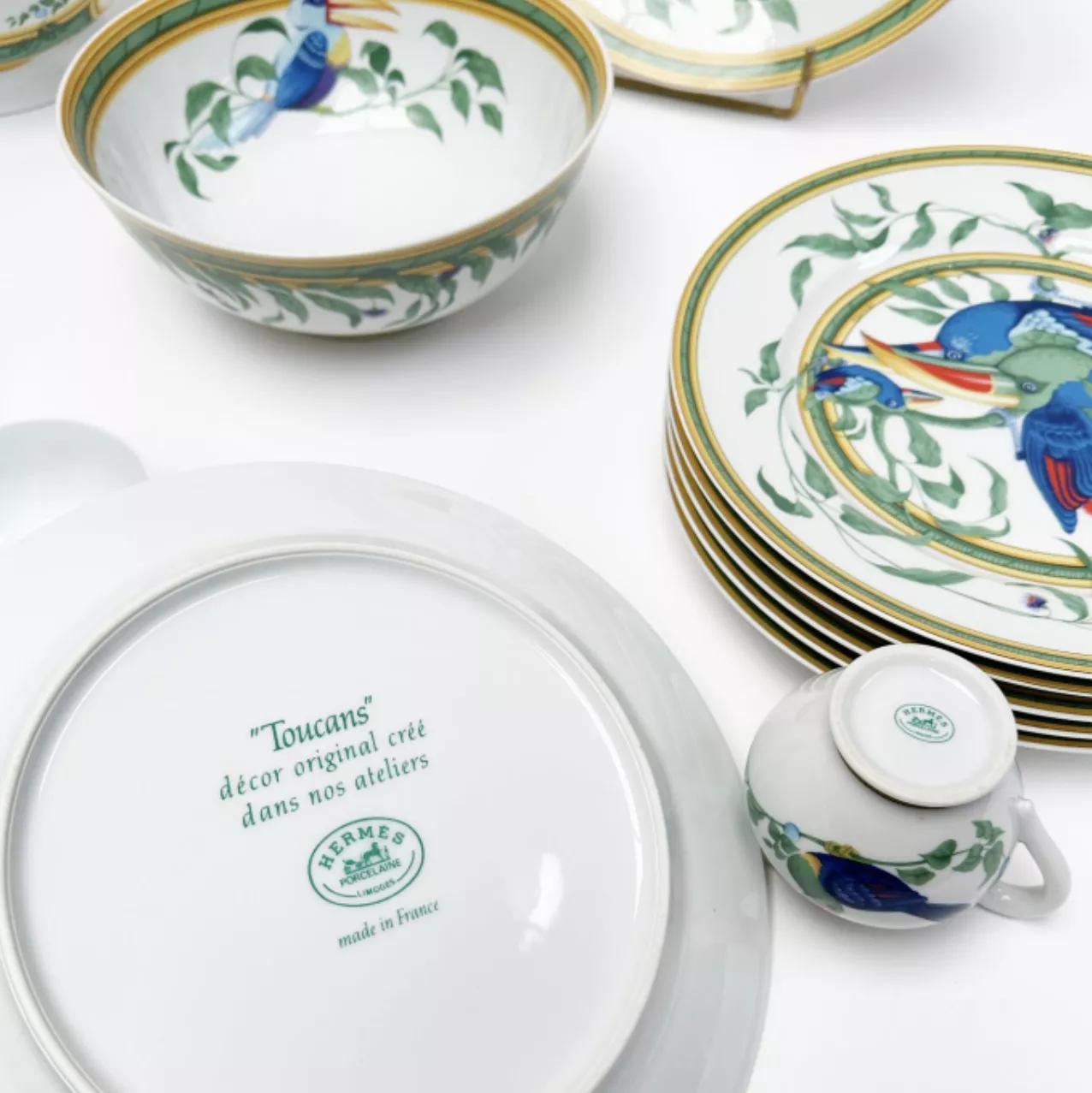
Service "Toucan" | From 400 to 15 000€ |
Estimate in less than 24h
The success of Hermès services
The success of Hermès services is played out in a unique relationship with materials, a constant search for perfection in every gesture.
We know the house's attachment to exceptional materials - rare leathers, precious fabrics - chosen not only for their quality, but also for their ability to tell a story through the craftsman's work.
"It's not just a product, but a work of craftsmanship", we might say, so much so that each creation embodies this fusion of traditional know-how and subtle innovation.
The rise of Hermès, from the 1930s onwards, is the fruit of this desire to combine tradition and modernity, where every detail, every finish, is the object of uncompromising attention. Technical rigor gives way to an infinite search for textures and shapes, with the utilitarian aspect giving way to the beauty of an object designed to endure the ages.
As one brand expert points out, Hermès succeeds in "fusing heritage and innovation into a coherent whole", where each creation finds its place in a living, evolving heritage.
This continuity of quality, far from standing still, constantly reinvents itself, giving luxury a new definition: no longer a mere sign of rarity, but the embodiment of absolute mastery, a perennial luxury, always at the service of an aesthetic quest.
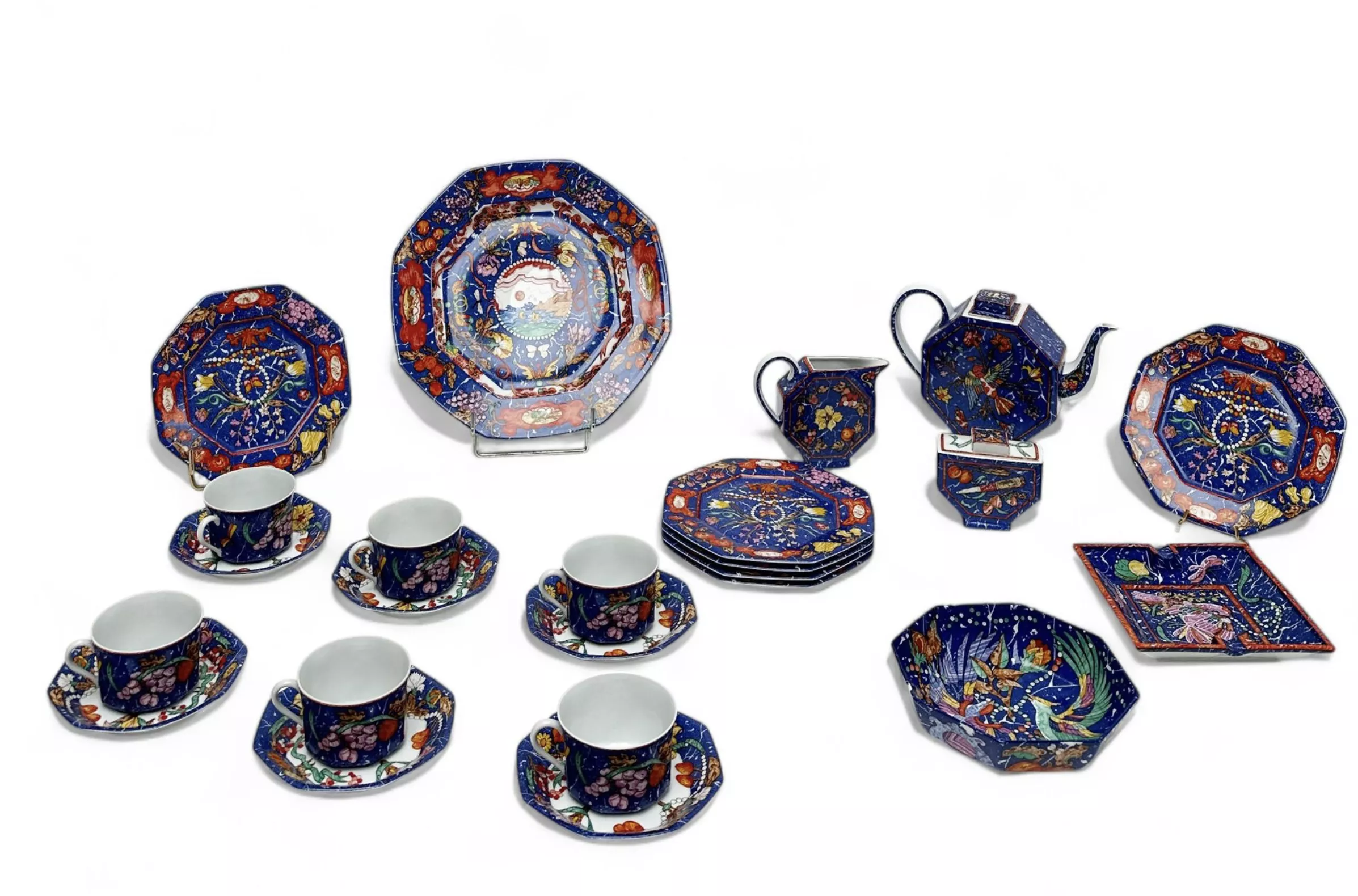
Craft processes and the vocation of Hermès services
The question of luxury, at Hermès, seems to be posed in terms of meticulousness. We know the house's attachment to the purity of materials - fine porcelains, rare leathers - to the detriment of a utilitarian approach, where the beauty of the object cannot be dissociated from its function.
"The important thing for us is to create a work that is both beautiful and functional, a work of art at the service of everyday life", we might say.
The development of table services, with pieces such as the "soy cups", is a direct consequence of this: a relentless quest for perfection where form and function dissolve into a single gesture.
The simplicity of the utilitarian object gives way to the unity of sophisticated design, where the material itself becomes a bearer of meaning. The attention paid to every detail, from the texture of the material to the cutting of the shapes, reveals a desire to sublimate the ordinary.
This quest for the exceptional, through the use of innovative scientific processes, guarantees porcelain of remarkable finesse, whose strength and purity are expressed by an almost unreal lightness.
As one Hermès expert puts it, Hermès manages to "combine technology and craftsmanship in a perfect alchemy", fusing the innovation of industrial processes with the sensibility proper to fine craftsmanship.
This fusion finds clear expression in the house's motifs and codes, such as the anchor chain, subtly integrated into the service designs. This motif, inherited from the brand's nautical universe, symbolizes rigor, stability and elegance.
In the dinner services, the anchor chain is transformed into a refined graphic motif that inscribes each piece in a tradition, while elevating it to a timeless dimension. As a connoisseur of the house points out, "these visual elements are not just decorative, but carry the history of a house, they are the soul of the product."
This attention to detail, omnipresent in every element of the service, testifies to a desire for continuity where luxury, far from freezing into a fixed form, is constantly renewed.
With each new collection, Hermès redefines luxury: no longer an outward sign of wealth, but a relentless pursuit of beauty, elegance and functionality, where each object becomes a work of art, an invitation to a total sensory experience.
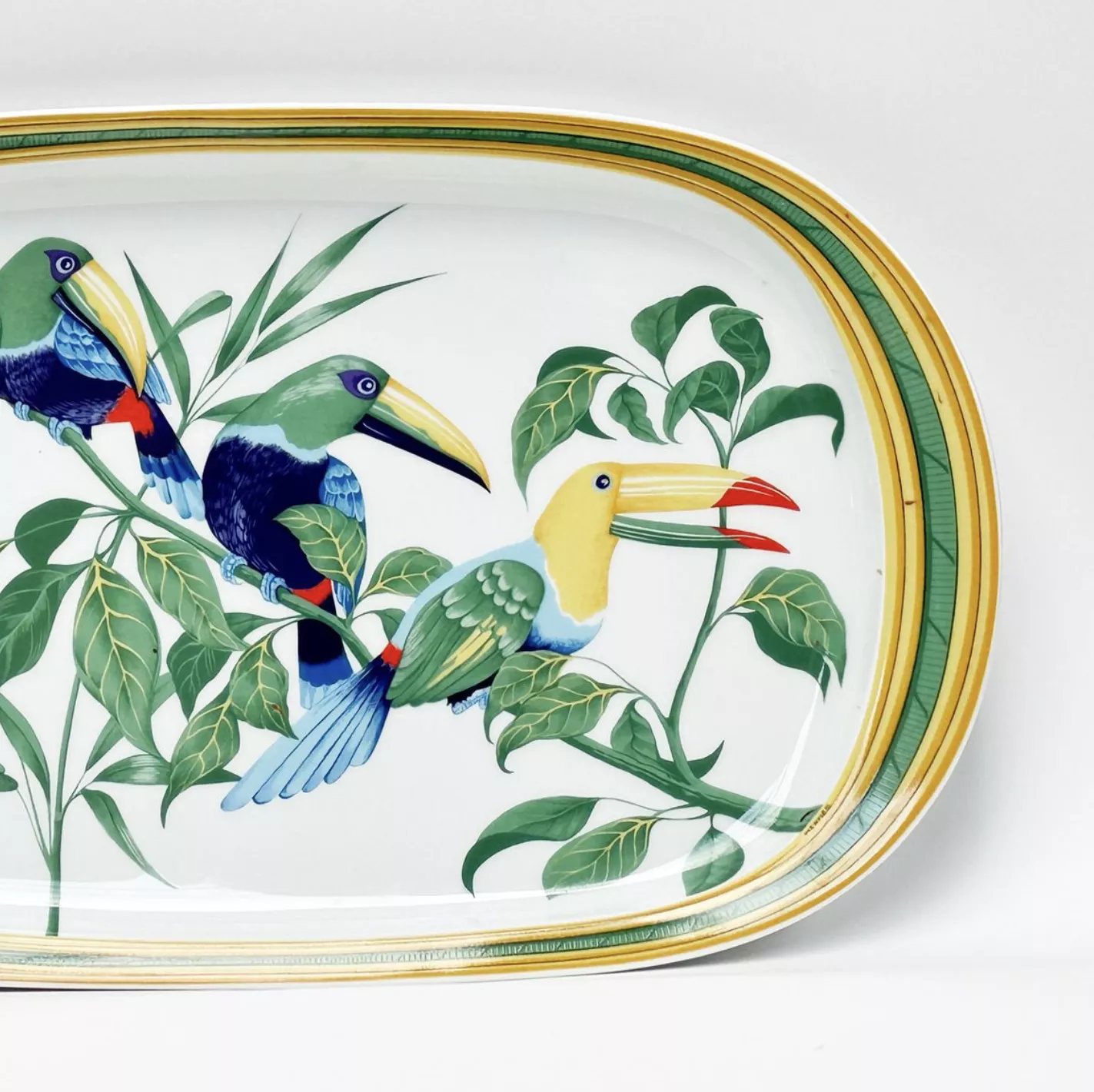
Focus on the Toucan d'Hermès service
The question of motif, in the Toucan d'Hermès service, seems to be posed in terms of expression and transformation.
We know the house's attachment to the imaginary natural world - the toucan, vibrant with color, becomes the standard-bearer of a vision where nature is no longer limited to mere inspiration but reinvents itself as a terrain for artistic experimentation.
"For us, it was a matter of capturing not just the bird, but evoking the forest itself", explain the designers.
The motif, circa 1980s, thus becomes the result of a bold approach that transforms porcelain into a medium of expression, where animal and decorative ornament merge into a single organic reality.
From the animal frozen in its classical representation gives way to a fluidity of line and color, a chromatic dance that lends the object a new lightness, where the exuberance of nature blends with the purity of form.
As one astute observer wrote, Hermès manages to "breathe a dynamic into each motif, where every curve seems to unfold and metamorphose".
This unprecedented continuity between the toucan's silhouette and the object's contours breaks free from strict figuration to explore an almost unreal space.
Far from limiting themselves to simple delineation, the lines dilate, merge and expand, making each plate, cup or dish not a mere receptacle, but a veritable tableau vivant, a space where art and nature merge.
This could be called the reinvention of a naturalistic motif in the world of porcelain, transforming each piece into a reflection on the world and the imaginary.
The reasons for auctioning a Hermès service
The question of auctioning a Hermès service seems to be posed in terms of rarity and desirability.
We know the house's attachment to exclusivity - each piece, meticulously designed, is not limited to its function, but becomes a collector's item.
"It wasn't just a matter of creating table services, but of cultivating a form of prestige and timelessness," the craftsmen would say. The auction, in this context, becomes the consecration of this object as a symbol of luxury and elegance.
From the utilitarian object gives way to a broader perception of value, which goes beyond mere possession to touch on the art of living.
As one expert puts it, auctions offer a "spotlight on the object, where each piece becomes witness to a history and know-how".
The service, whose production is sometimes limited, transforms each sale into a unique event, where rarity becomes a decisive factor, like those of Birkins, the Kelly, and to a lesser extent the carrés, which can also be rare.
The uniqueness of the object gives way to the desire to acquire it, to become its privileged holder, a privilege symbolizing the culmination of a refined and demanding taste. This could be called the revaluation of the Hermès service through an auction.
Recognizing an original Hermès service
The counterfeit market is increasingly strong in manufacturing various items by passing them off as luxury items.
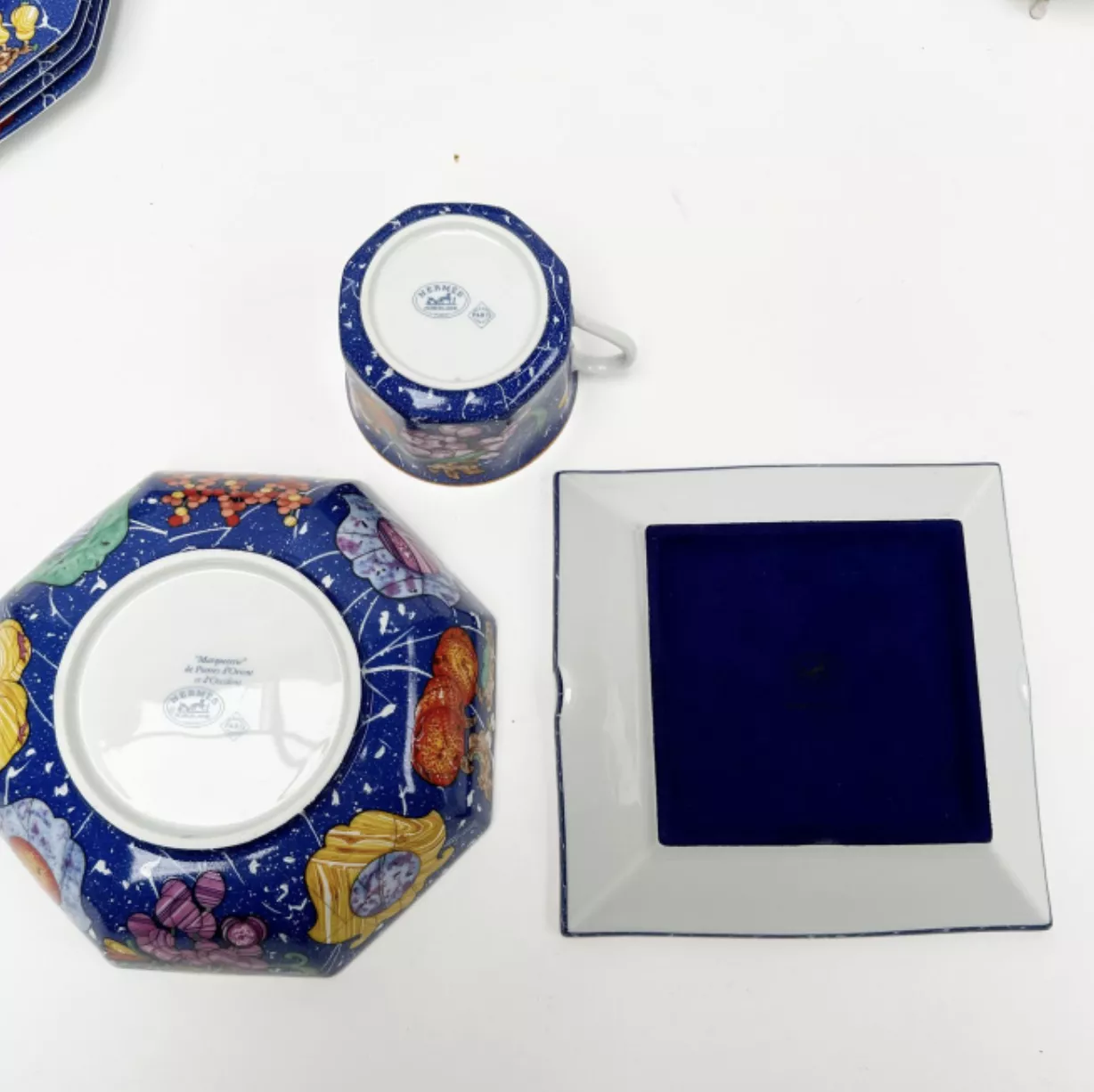
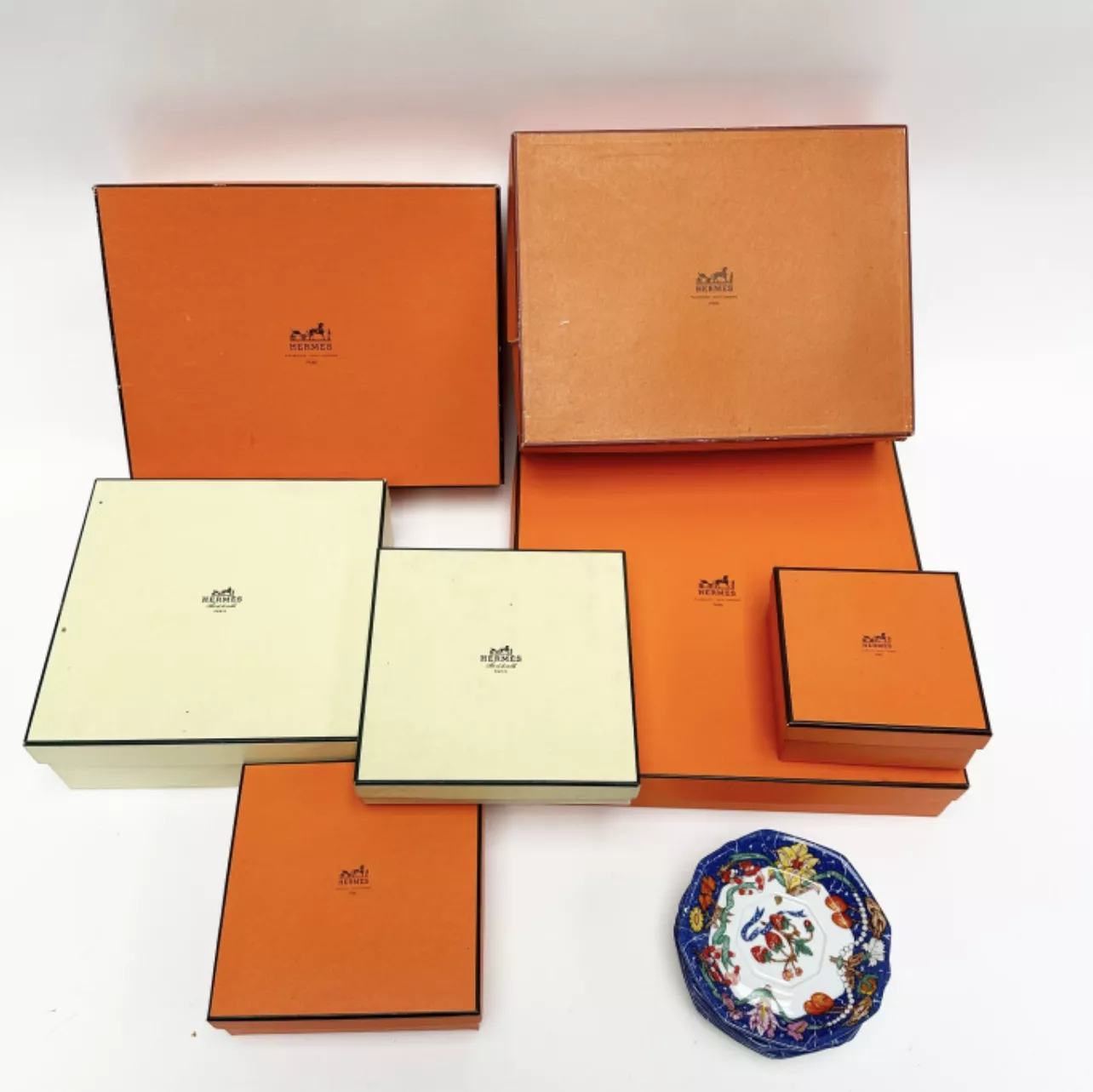
On online platforms, the resale of these items is constantly increasing and many customers are being tricked. Despite this, services are more confidential objects that remain less counterfeit, and are almost always signed.
This is why, even if techniques exist to recognize an authentic object, such as looking at the seams, or the inscription of the serial number, or the signature, it is essential if you think you own an object from the house to have it appraised.
Know the definite value of your service
If you happen to own a Hermès service or think you might, don't hesitate to request a free appraisal using our form on our website.
A member of our team of experts and licensed auctioneers will contact you promptly to provide you with an estimate of the market value of your service, as well as any relevant information about it.
If you wish to sell your service, you will also be accompanied by our specialists in order to benefit from alternatives for selling it
.Estimate in less than 24h
Discover in the same theme

Get a free appraisal of your Tribal and Primitive Art object...
Often used in ceremonies or rites to represent spirits or divinities, Art Premier masks should be viewed by an expert.
Learn more >

Rating and value of old paintings
Antique paintings are those produced from the Renaissance to the early 19th century. They can be very valuable at auction. Estimate in 24h
Learn more >

Rating and value of Sèvres cookies
Sèvres porcelain cookies are unique works of art that are highly prized on the auction market. Their value is very high.
Learn more >
Other objects from the house sold at auction

Estimated Between €5,000 and €7,000
HERMES - Kelly in brown ostrich leather

Estimated 500 - 1.000
HERMÈS PARIS, Silver bracelet (925) anchor chain

Estimated 2.000 - 4.000
HERMÈS PARIS, Kelly 28 cm in burgundy leather box

Estimated 2.000 - 4.000
HERMÈS PARIS, 23 cm Constance bag in chocolate brown box calfskin

Estimated 1.500 - 2.500
HERMÈS, 32 cm Kelly bag in black box calf

Estimated 4.000 - 8.000
HERMÈS, Handbag Constance 23 cm in brown porosus crocodile leather

Secure site, anonymity preserved

Auctioneer approved by the State

Free and certified estimates
Frequently asked questions
-
What are the price ranges for Hermès porcelain sets?Hermès tableware generally sells for between €110 and €15,000, depending on the model and its condition. The most sought-after models, such as the Toucan and Peony tableware sets, command the highest prices, while classic sets or individual pieces fall within a lower price range. Rarity of production and limited editions significantly influence value.
-
How can you authenticate a Hermès product and verify that it is genuine?Authentic Hermès tableware is almost always marked and features verifiable characteristics such as the signature, serial number, and quality of the porcelain. To obtain a reliable certification, we recommend requesting a free appraisal from Auctie's: a certified expert will examine your set and provide you with a comprehensive authentication report with no obligation.
-
Is this the right time to sell a Hermès service?Yes, now is an excellent time to sell a Hermès item. The market is showing growing interest in these handcrafted pieces, particularly rare models such as the Toucan and the Peonies. Demand for timeless luxury items remains strong, and auctions offer the best way to showcase your item.
-
How does the appraisal of a Hermès item work at Auctie's?The appraisal is free and non-binding. Simply fill out a form on our website, and a certified auctioneer will contact you shortly. They will provide you with an accurate estimate of the market value of your items within approximately 48 hours, along with all the necessary information.
-
How do I sell a Hermès item at auction?Auctie's, an auction house, guides you from the initial appraisal through to the final sale. After evaluating your item, our specialists will recommend the best sales approach to achieve the highest possible price and will manage the entire auction process.
