



Rating and value of sculptures, bronzes and marbles by Henri Honoré Plé

Key takeaways
- Henri Honoré Plé (1853–1922), a French academic sculptor, sees his works fetch prices ranging from €600 to €52,600, depending on the technique and quality.
- Bronzes constitute the main segment of the market, particularly medium-sized pieces (30–60 cm) featuring female figures and symbolic groups, which are highly sought after.
- The sculpture “Arab Warrior” sold for €52,600, exceeding its estimate of €30,000–50,000, confirming the stability and liquidity of the French market.
If you own a work by or after the artist Henri Honoré Plé, and would like to know its value, our state-approved experts and auctioneers will offer you their appraisal services.
Our specialists will carry out a free appraisal of your work, and provide you with an accurate estimate of its value on the current market.
Then, should you wish to sell your work, we will direct you to the best possible arrangement to obtain the optimum price.
Rating and value of the artist Henri Honoré Plé
Henri Honoré Plé is a sculptor at the transition from the 19th to the 20th century. His legacy includes paintings and drawings. At present, the prices of his works are exploding under the auctioneers' gavel.
His sculptures are particularly prized above all by French and American buyers, and the price at which they sell on the art market ranges from 600€ to 52,600€, a considerable delta but one that speaks volumes about the value that can be attributed to Plé's works.
A bronze sculpture, Arab warrior, sold for €52,600 while it was estimated at between €30,000 and €50,000. The artist's quotation is high and varies according to the quantity of works present on the auction market.
Order of value ranging from a single work to the most prestigious
Technique used | Result |
|---|---|
Marble | From €600 to €30,000 |
Bronze | From €80 to €52,600 |
Estimate in less than 24h
Style and technique of the artist Henri Honoré Plé
Henri Honoré Plé (1853 - 1922) was a French sculptor who was trained in a classical academic context and then enrolled in the currents of the 18th and 19th centuries, with a transition to a style that blends realism, neo-classicism and Art Nouveau influences.
His body of work shows a predilection for human, heroic, allegorical or mythological figures, as well as narrative subjects, often imbued with gravity or symbolism.
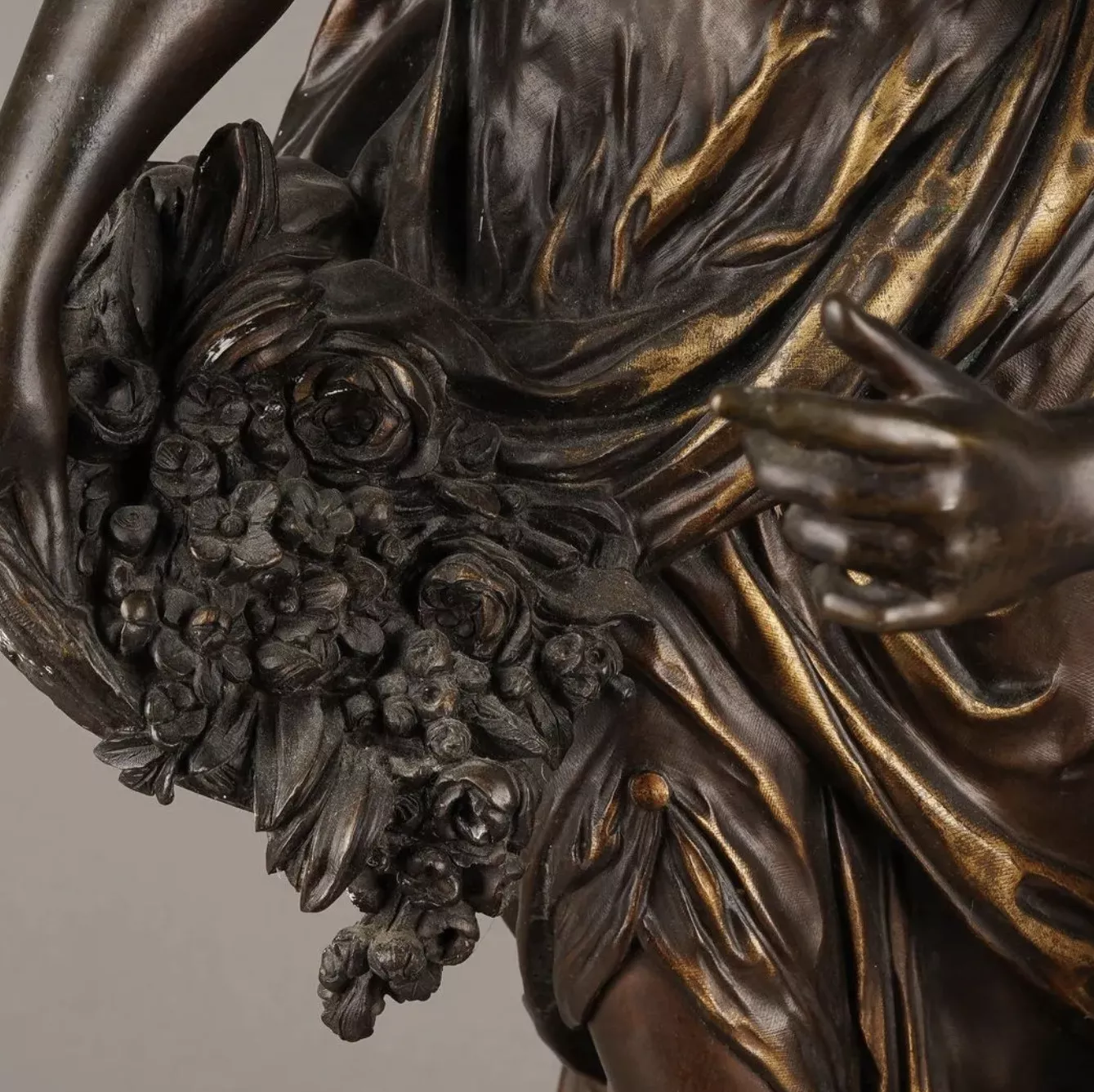
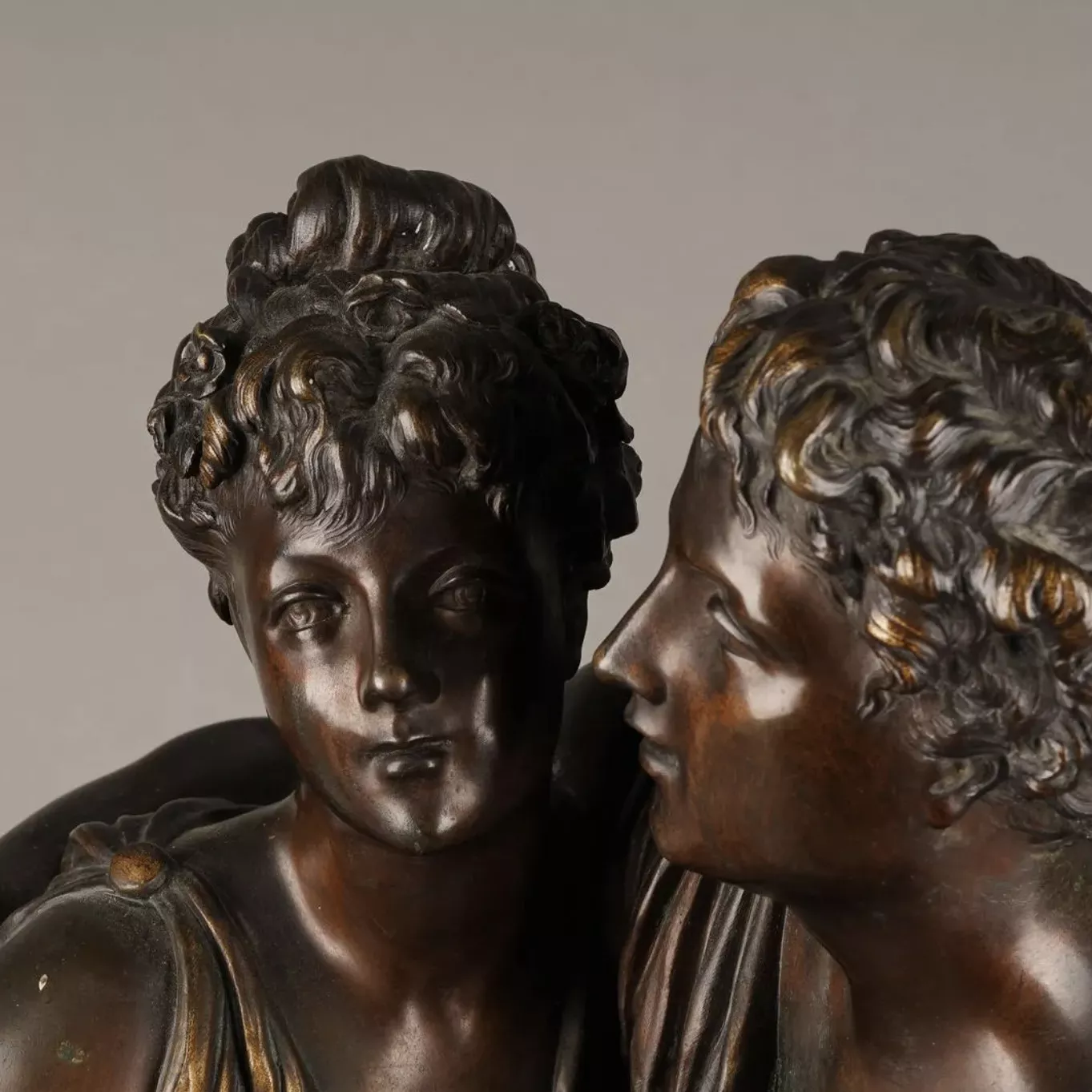
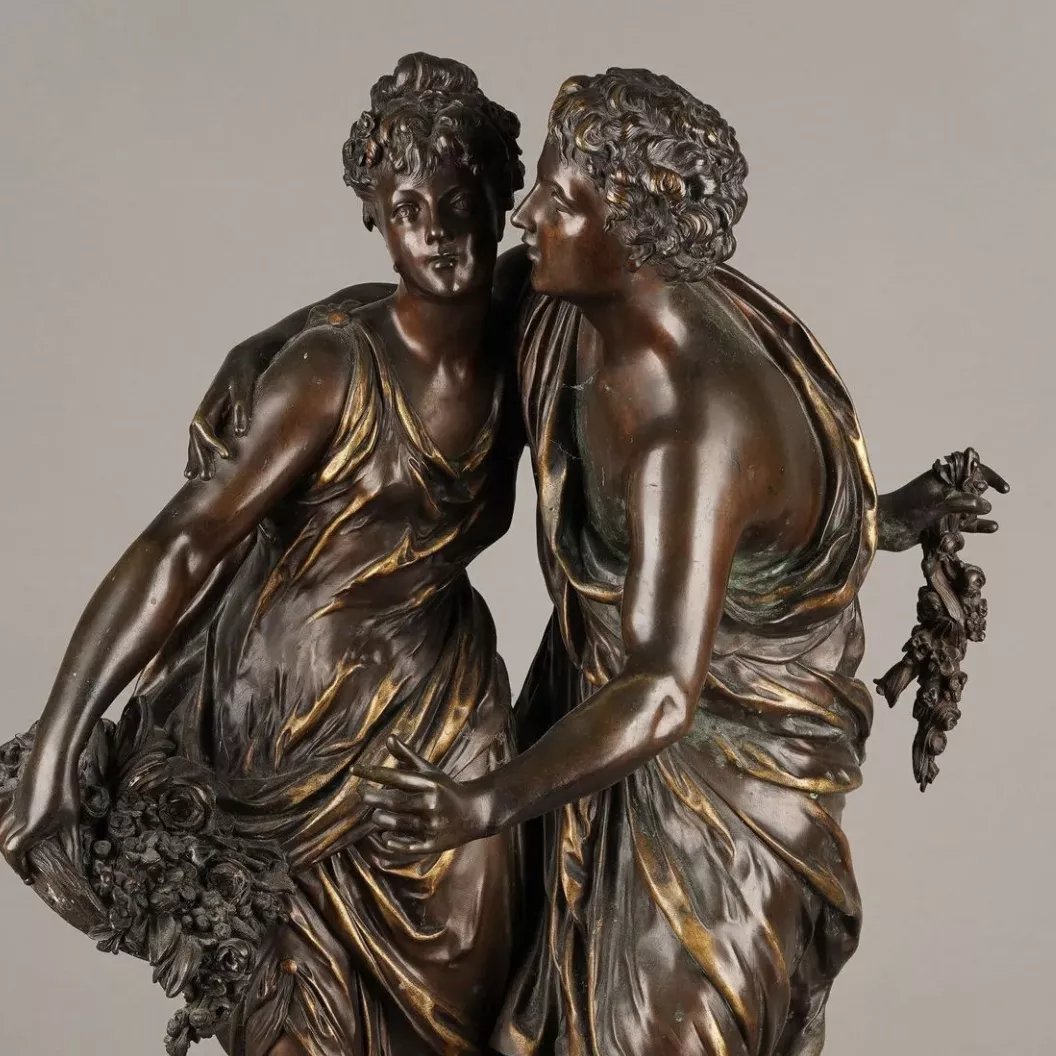
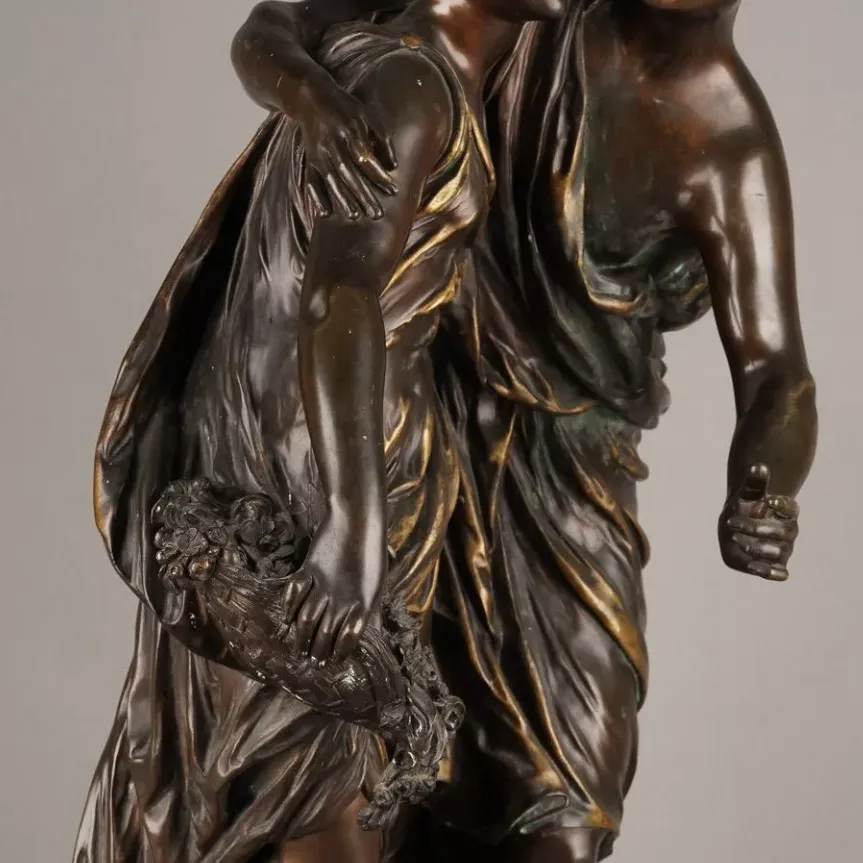
He works with figures in the round, often standing, in studied poses, with classical proportions and careful modeling, as in the group Le Premier Pas and the statuette David victor.
The drapery and clothing are carefully sculpted, sometimes with a decorative concern close to the Art Nouveau aesthetic, and a search for elegance in pose and gesture. The subjects are varied: mythological figures, allegories, narrative groups and even decorative vases, demonstrating a stylistic flexibility.
He works his models with plaster or clay, for rigorous preparation of the cast, a classic method inherited from his master's workshop. He pays particular attention to the quality of the chasing, the detailed finishes (faces, hands, volumes) and the patina.
The patinas he uses are varied, with warm brown, russet brown or nuanced brown, which he adapts to the mood of the work. On certain sculptures, the patina contributes to the depth of the volumes and the legibility of the shadows.
He shows a preference for balanced compositions, centered and often vertical. Groups remain measured, movement contained and expression controlled. Pedestals are sober and stable, most often integrated into the sculpture but without decorative excess, in order to emphasize the figure.
For groups like Le Premier Pas, the interactive balance of the figures is precisely designed with the contrast between motif and counter-motif, the fluidity of gesture and spatial logic.
His work blends classicism and romanticism, with historical, mythological or allegorical themes that reflect a narrative ambition imbued with gravity and dignity. The influence of Art Nouveau can be seen in some works, with moderate decorative stylization, drapery and rhythmic lines that do not betray the sacredness of the figure.
The life of Henri Honoré Plé
Henri Honoré Plé (1853 - 1922) was a sculptor born in Paris, in a context favorable to the decorative arts and academic sculpture. He received rigorous training at the École des Beaux-Arts de Paris.
He was a pupil of two major sculptors : Mathurin Moreau and Auguste Delaherche, who steered him towards refined figurative sculpture that blended naturalism and decorative elegance. From this period onwards, he developed a solid mastery of modeling, plaster, bronze and ornamental techniques.
He made his first appearances at the Salon des Artistes Français in the 1870s - 1880s. He presented statuettes, groups and allegorical figures that caught the eye with their fine modeling and narrative clarity.
He established himself early on as a sculptor capable of handling both mythological themes and scenes from everyday life. He won several awards at the Salon, establishing a lasting reputation.
Plé became a sought-after sculptor for his decorative bronzes, elegant figures and heroic or sentimental subjects. He collaborated with foundrymen renowned for the quality of their castings, which contributed to the wide distribution of his works.
He also produced decorative objects (vases, ornaments, applied sculptures), which linked him to the Parisian decorative arts milieu. His initial style is marked by academic naturalism, with well-proportioned figures, precise anatomy and noble themes.
From the 1890s, he discreetly incorporated Art Nouveau influences (cf Agathon Léonard, Auguste Rubin) with supple drapery, sinuous lines and elegant curves. Yet he retains a strong academic grounding with a mastery of proportions, classical balance and restrained expression.
His preferred themes are historical figures, allegories, familiar scenes, and depictions of youth and motherhood. The slender human figure, imbued with gravity, is also one of his recurring subjects.
He works regularly with art bronze companies, reinforcing his presence in Belle Époque decorative sculpture. He produced pieces for both bourgeois interiors and modest public spaces.
He belongs to the generation of sculptors who participated in the Parisian influence of the decorative arts before the rise of pure Art Nouveau. He continued to exhibit at the Salon until the 1910s, and remained active until the end of his life, while seeing the emergence of more modern styles that moved away from the figurative tradition.
He is renowned for the impeccable quality of his modeling, the finesse of his drapery and the solidity of his compositions. His figurative bronzes, often distributed in multiple editions, remain highly prized on the art market and feature in numerous private collections.
Market segmentation and artist's rating
Bronzes are the main segment of the artist's market, with statuettes, allegorical figures, mythological subjects and sentimental scenes. Figurative groups (children, maternities, family scenes) are highly sought-after for decoration.
Plasters are rarer on sale, and constitute a study segment with a lower value but appeal to connoisseurs. He also produced decorative objects (vases, applied sculptures).
Small formats (20 - 30 cm) are part of the accessible market. Medium formats (30 - 60 cm) are at the heart of demand, particularly for bronzes with refined modelling. Large formats (over 60 cm) are much rarer, with a much higher valuation.
The most sought-after subjects are elegant female figures, allegories of youth, music and poetry. Dynamic groups such as Le Prmeier Pas combine sentimentality with academic mastery.
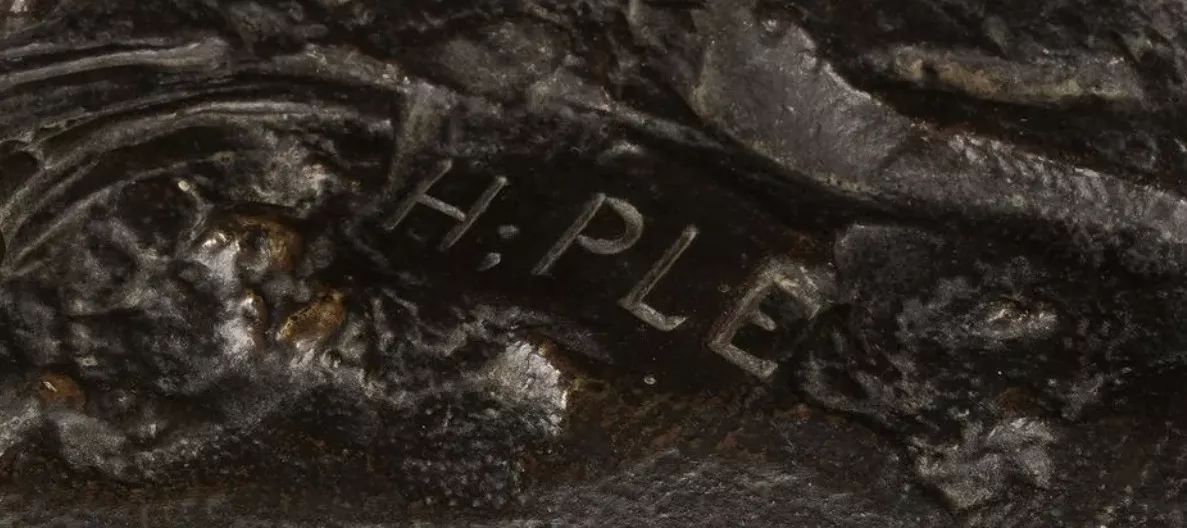
Valuation criteria include the signature " Henri Plé ", the quality of the cast, its age, the finesse of the chasing, and the homogeneity of the patina. Provenance is also important, as is condition (integrity of fingers, attributes, drapery, absence of visible retouching).
The main market is in France, with very good liquidity for medium bronzes and groups. The market is stable and steady, with Plé belonging to the much-followed corpus of academic sculptors of the Belle Époque. Demand is strong for elegant models and symbolic groups.
Recognizing Henri Honoré Plé's signature
The artist doesn't always sign his works. If you think you own one, it's best to have it appraised. The signature may differ depending on the type of work: sculpture, drawing or other. There are also copies, which is why expertise is important.
Estimate in less than 24h
Discover in the same theme

Rating and value of paintings and drawings by Jean-Joseph We...
Jean-Joseph Weerts is a 19th-century neoclassical painter. His paintings are appreciated on the art market and have a stable value.
Learn more >

Rating and value of paintings by Louise Abbéma
Louise Abbéma is a 19th-century artist who produced many paintings that are highly valued at auction. Estimated 24h.
Learn more >

Rating and value of sculptures, marbles and bronzes by Josep...
Joseph Antoine Bernard is a sculptor somewhere between Art Deco and Symbolism, who produced numerous works of great value.
Learn more >
D'autres bronzes anciens vendus aux enchères

Estimated Between €5,000 and €8,000
Agathon LEONARD (1841-1923), Dancer with scarf, bronze lamp, ed. Susse frères

Estimated 3.000 - 5.000
Raoul LARCHE (1860-1912) The fisherman, Bronze with green patina

Estimated 600 - 800
Hercules Farnese, bronze, reproduction after Glycon of Athens

Estimated 1.500 - 3.000
Jules FRANCESCHI (1825-1893) Hébé et l'aigle de Jupiter, gilded bronze

Estimated 800 - 1.500
Henry Étienne DUMAIGE (1830-1888), bronze print

Estimated 1.500 - 3.000
Antoine Louis BARYE (1796-1875) Eagle and heron, bronze print with shaded brown-green patina

Secure site, anonymity preserved

Auctioneer approved by the State

Free and certified estimates
Frequently asked questions
-
Who is Henri Honoré Plé, and what is his historical context?Henri Honoré Plé (1853–1922) was a French sculptor who trained at the École des Beaux-Arts in Paris under renowned masters such as Mathurin Moreau. During the Belle Époque, he established himself as a leading figure in academic figurative sculpture, combining naturalism, neoclassicism, and subtle Art Nouveau influences. His works, regularly exhibited at the Salon des Artistes Français beginning in the 1870s, earned him several awards and established him as one of the most sought-after sculptors for decorative bronzes and elegant figures.
-
What is the price range for Henri Honoré Plé's sculptures?Prices for works by Henri Honoré Plé vary considerably depending on the technique and format. Marble sculptures range from €600 to €30,000, while bronzes—the market’s largest segment—can reach prices between €80 and €52,600. These variations depend on the quality of the casting, the finesse of the chiseling, the rarity of the model, and its size, with medium-sized pieces (30–60 cm) constituting the core of demand.
-
How can I have a work by Henri Honoré Plé appraised and authenticated?To authenticate a work attributed to Henri Honoré Plé, we recommend that you request a free appraisal from Auctie's. Our state-certified auctioneers and experts will examine your sculpture, verify the signature (which is not always present), analyze the quality of the cast and the patina, and provide you with an accurate estimate of its value. This process is non-binding and will help you distinguish originals from copies.
-
Is this the right time to sell a sculpture by Henri Honoré Plé?Yes, now is a good time to sell a work by Plé. The market for Belle Époque academic sculptures remains stable and liquid, with strong demand—particularly in France—for medium-sized bronzes and symbolic group sculptures. Prices continue to rise for high-quality, signed pieces, particularly elegant female figures and narrative compositions such as *Le Premier Pas*.
-
How does the sales process work at Auctie's?Auctie's guides you from the appraisal to the auction. After you request a free, no-obligation appraisal, our experts will provide you with an evaluation within approximately 48 hours. If you wish to sell, we’ll guide you toward the best possible auction platform to achieve the highest price, highlighting the artwork’s provenance, condition, and artistic merits during the auction.
