



Rating and value of sculptures and bronzes by Pierre-Nicolas Tourgueneff

Key takeaways
- A French animal sculptor of Russian origin (1853–1912), Turgenev specialized in military equestrian statuary, characterized by exceptional anatomical precision.
- Prices for Turgeneff’s bronze sculptures range from €120 to €28,700, with a steady upward trend in the French market since 2012.
- The Susse Frères foundry guarantees the authenticity and quality of the works; a legible signature, the original patina, and the condition of the piece are the key criteria for determining value.
If you own a work by or after the artist Pierre-Nicolas Tourgueneff, and you'd like to know its value, our state-approved experts and auctioneers will offer you their appraisal services.
Our specialists will carry out a free appraisal of your work, and provide you with an accurate estimate of its value on the current market.
Then, should you wish to sell your work, we will direct you to the best possible arrangement to obtain the optimum price.
Rating and value of the artist Pierre-Nicolas Tourgueneff
Animal sculptor, Pierre-Nicolas Tourgueneff produced mainly bronze sculptures. At present, the prices of his works are rising recurrently at the auctioneers' gavel.
His sculptures are prized above all by French buyers, and the price at which they sell on the art market ranges from €120 to €28,700, a considerable delta, which speaks volumes, however, about the value that can be attributed to Tourgueneff's works.
In 2012, one of his untitled bronze sculptures depicting two Cossacks on horseback sold for €28,700, while it was estimated at between €15,000 and €23,000.
Order of value from a simple work to the most prestigious
Technique used | Result |
|---|---|
Sculpture - volume | From €120 to €28,700 |
Estimate in less than 24h
Style and technique of the artist Pierre-Nicolas Tourgueneff
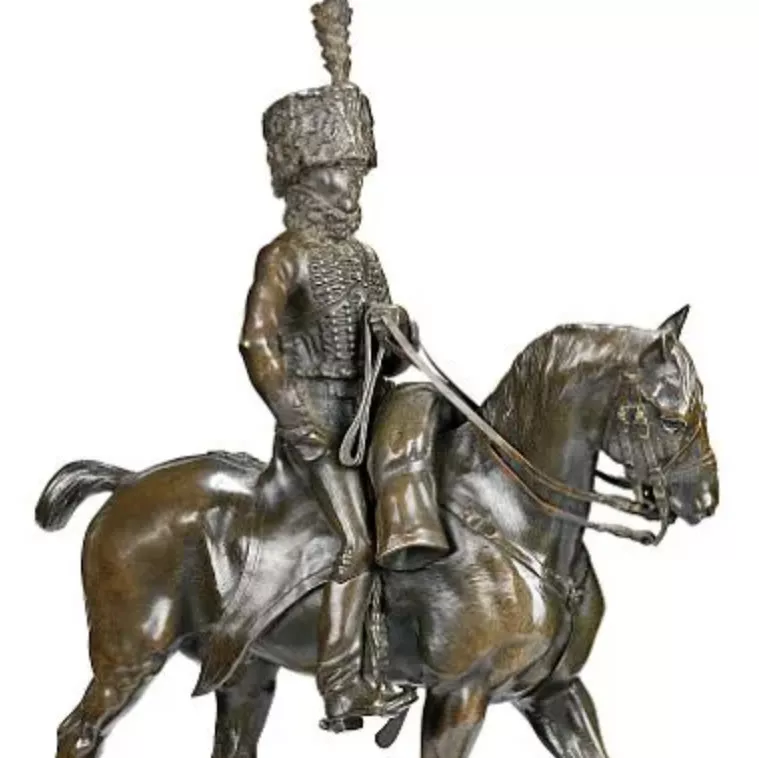
Pierre-Nicolas Tourgueneff (1853 - 1912) was a French animal sculptor and statuary of Russian origin, active in the naturalist tradition of the late 19th century. His work is situated between military realism, equestrian portraiture, animal sculpture and ceremonial bust.
He seeks an exact, vivid and psychologically legible representation, without over-stylisation. In his formal vocabulary, he specializes in horses : military riders, saddle horses and draught horses. His output is rich in busts, full-length portraits, figures of riders and historical scenes.
The depiction is often narrative, with controlled movement, dignified poses and balanced compositions. He tends to use military iconography, with uniforms, French army figures and cavalry scenes.
Anatomy is treated with great rigor in the study of the horse, precise musculature and real observation of proportions. He has a thorough knowledge of equestrian postures, with the reins held and tensioned, the neck flexed and the head carried.
Human anatomy is rendered with honest realism, without emphasis. Features are strong and volumes clear. He conducts preparatory studies in plaster or wax, with dense, structured modeling.
His sculptures are solid, compact, often built with full, stable volumes. He carefully finishes the details : hips, boots, uniforms, military equipment, careful treatment of materials (leather, cloth, metal).
Casting is almost exclusively carried out by the Susse Frères foundry, guaranteeing high quality and stylistic uniformity. Classic late 19th-century patinas (dark browns, green browns, slightly nuanced warm patinas). The chasing is fine, particularly in the accessory parts (arms, bridle, harness).
His corpus shows a preference for vertical and frontal compositions : busts, static or slightly walking riders. Equestrian scenes are often built on a dynamic but moderate diagonal, characteristic of controlled realism.
He is heir to animal sculpture (Mène, Barye, Cain) but specialized in equestrian military statuary. His style is immediately identifiable by the anatomical accuracy of the horses and the expressive sobriety of the military portraits.
The life of Pierre-Nicolas Tourgueneff
Pierre-Nicolas Tourgueneff was born in Paris in 1853 into a family of Russian origin, related to the intellectual circle of the Tourguenievs, which immediately placed him in a cultivated, Francophile milieu.
He received a classical academic training at the École des Beaux-Arts in Paris. He was a pupil of Emmanuel Frémiet, a master of animal and equestrian sculpture, whose influence would be decisive in his work.
He first exhibited at the Salon des Artistes Français in 1879, and quickly won critical acclaim for the anatomical precision of his horses and the quality of his busts. From the outset, he specialized in equestrian sculpture, a demanding field requiring perfect morphological knowledge.
He became one of the most respected equestrian sculptors of the late 19th century in France, and frequently worked on military subjects : riders, officers, gendarmes, uniforms and martial attitudes.
He received public and private commissions, in particular for busts, commemorative figures and equestrian models. He is admired by military clients and lovers of naturalistic animal sculpture.
He works almost exclusively with the Susse foundry, one of the most prestigious in Paris. His style is fairly constant, faithful to naturalism, with anatomical precision and expressive sobriety. He did not inflect his aesthetic towards Art Nouveau or Art Deco, and remained deliberately attached to classical realism.
Over time, he perfected his equestrian vocabulary : his horses are increasingly accurate in their proportions, the attitudes more controlled and the compositions more balanced.
He continued to produce until the end of his life, despite the emergence of new modernist currents. He died in 192, leaving an abundant body of work, mainly bronzes. His works are preserved in several French museums and specialized private collections.
Market segmentation and artist's rating
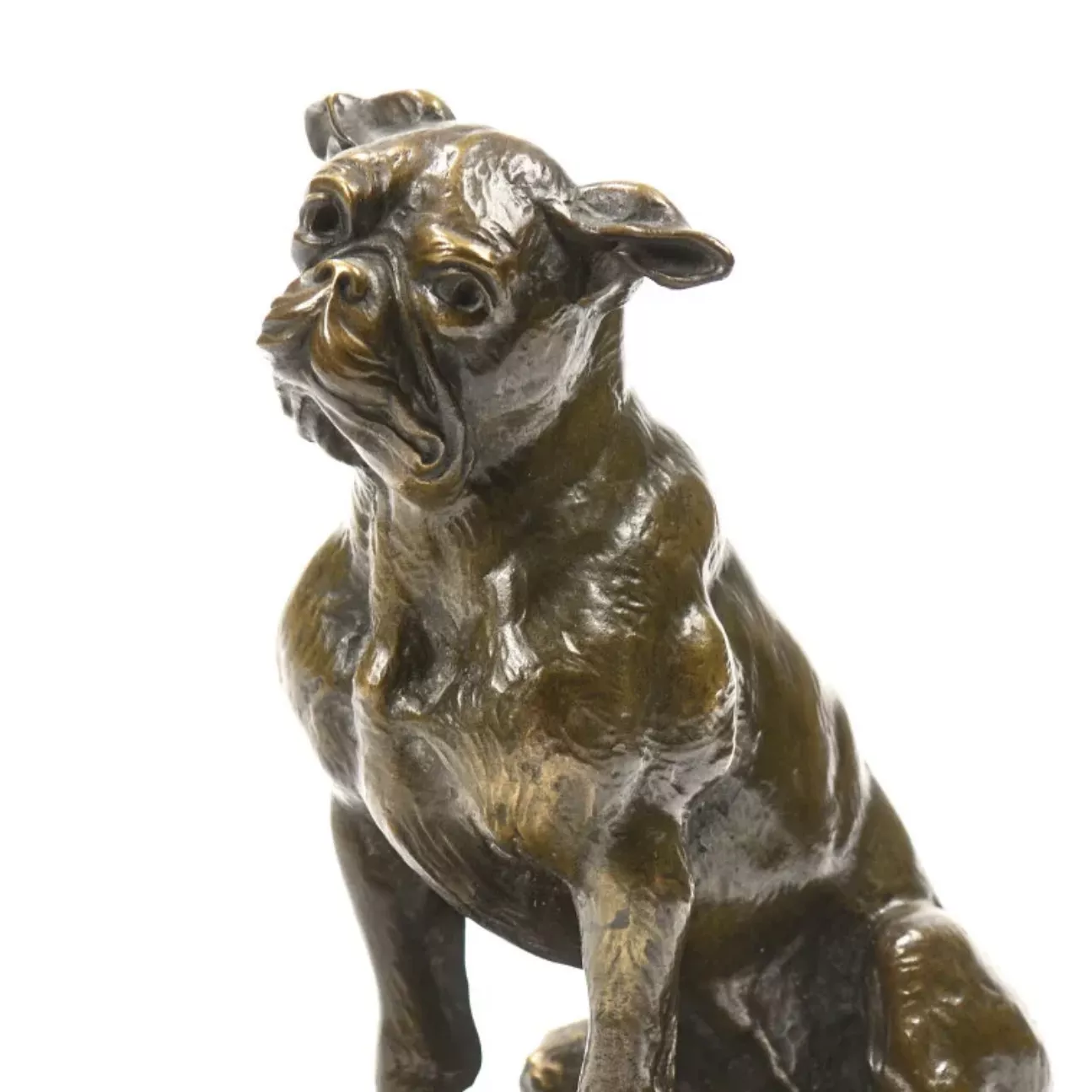
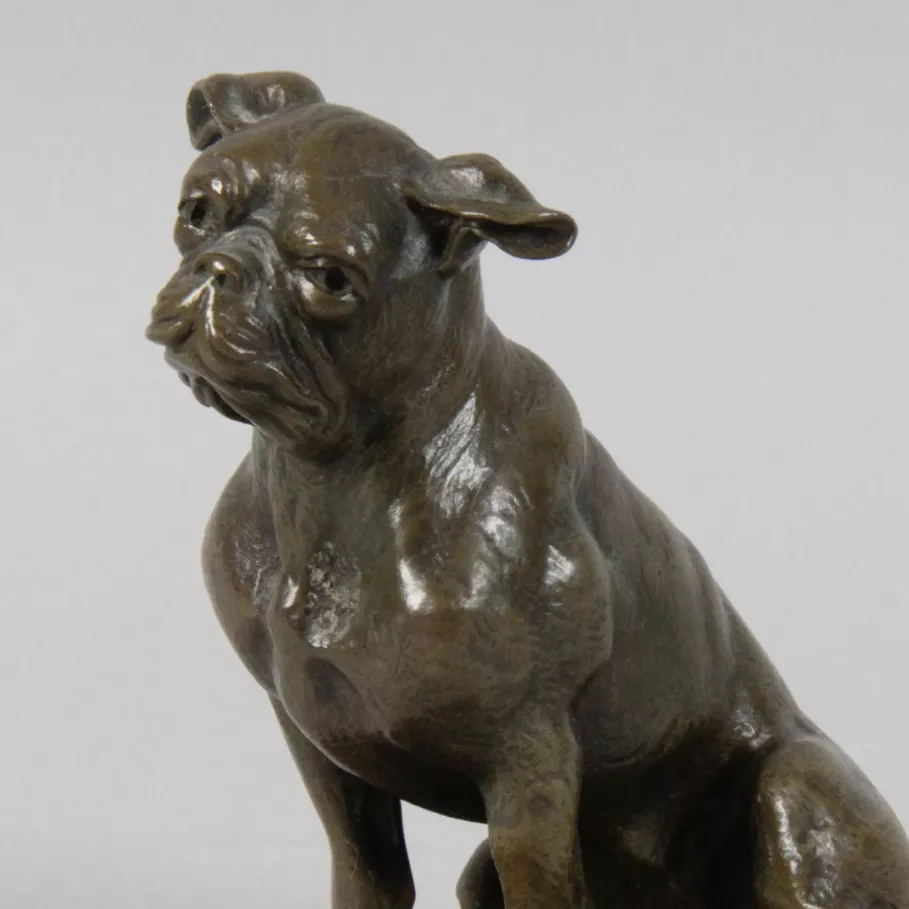
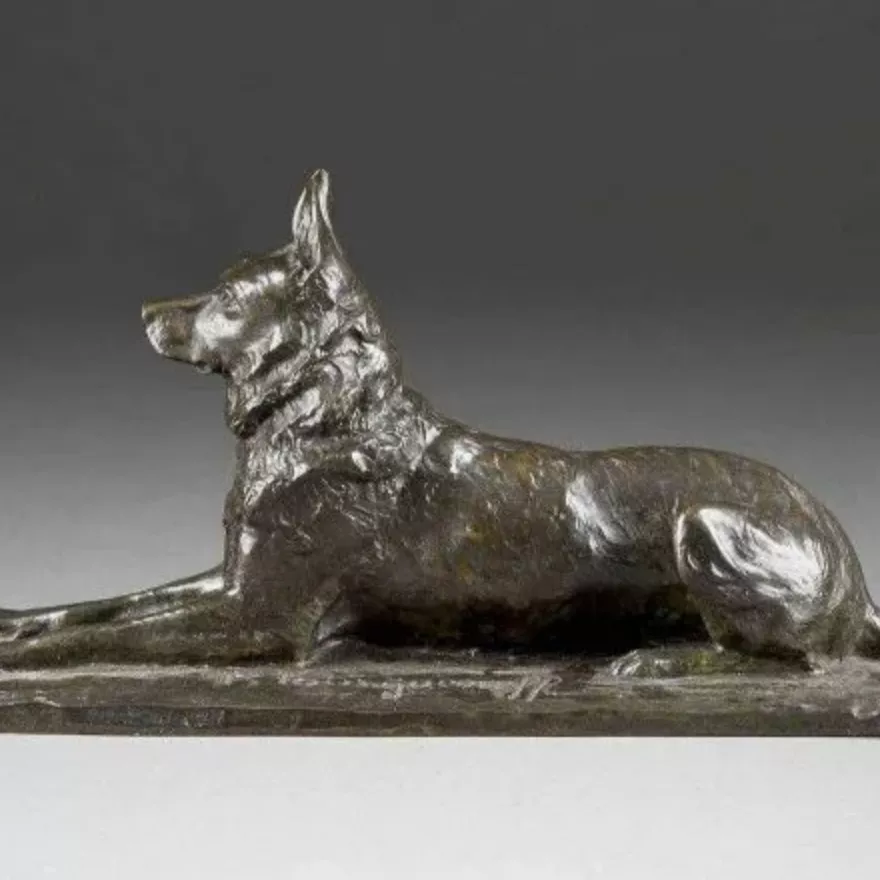
Bronzes are the mainstay of the market, with animal (horses, dogs) or equine and military sculptures, often cast by Susse Frères.
Small animal or dog sculptures are the entry-level segment, with small-format bronzes. Equestrian and military sculptures are the most sought-after segment, particularly for riders, horses, grenadiers and crossbowmen.
Small formats (under 20 - 30 cm) are mostly animal figures (dogs, small subjects) belong to an accessible segment, with good liquidity. Medium formats (30 - 50 cm) form the core of the market for animal and equine bronzes.
Large formats or ceremonial sculptures (horses, riders, military pieces) form a high-end segment, with high demand and a rarer print run. Valued subjects include horses, riders and military pieces, as well as dogs and small-format animal sculptures.
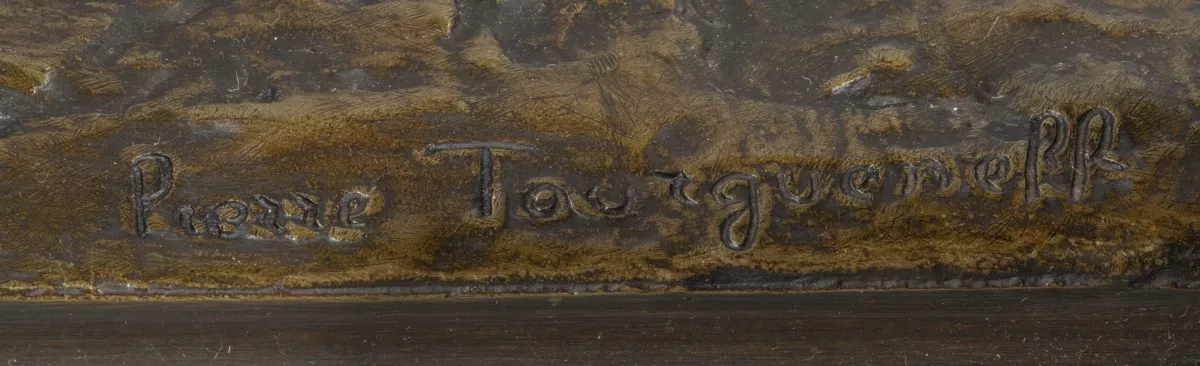
Valuation factors include the legible signature " Pierre Tourgueneff ", the foundry mark (Susse Frères) which guarantees quality and authenticity, good original patina, state of preservation, confirmed attribution, and provenance which are essential for the estimate.
The market for Tourgueneff's sculptures is mainly French, particularly for animal and equestrian bronzes. The price remains moderate to high depending on the type of work, with a stable market for quality animal sculptures and increased interest in historic equestrian sculptures.
Recognizing the signature of Pierre Nicolas Tourgueneff
Pierre-Nicolas Tourguneff sometimes signs his sculptures, most of the time. However, expertise remains paramount.
Knowing the value of a work
If you happen to own a Pierre-Nicolas Tourgueneff work or one after the artist, don't hesitate to request a free appraisal using our form on our website.
A member of our team of experts and chartered auctioneers will contact you promptly to provide you with an estimate of the market value of your work, as well as ad hoc information about it.
If you are considering selling your work, you will also be accompanied by our specialists in order to benefit from alternatives for selling it at the best possible price, taking into account the inclinations of the market.
.Estimate in less than 24h
Discover in the same theme

The value of Hyppolite Lazerges' paintings
Hippolyte Lazerges, one of the last neoclassical painters, produced paintings that are still highly valued on the auction market.
Learn more >

Value and quotation of works, paintings by Jules Adler
Jules Adler, a 20th-century naturalist painter, produced a number of drawings and oil paintings that are both valuable and stable.
Learn more >

Rating and value of works, drawings, paintings by Alphonse O...
Alphonse Osbert was a Symbolist painter of the 19th and 20th centuries who produced a number of paintings that were highly prized at auction.
Learn more >
D'autres bronzes anciens vendus aux enchères

Estimated Between €5,000 and €8,000
Agathon LEONARD (1841-1923), Dancer with scarf, bronze lamp, ed. Susse frères

Estimated 3.000 - 5.000
Raoul LARCHE (1860-1912) The fisherman, Bronze with green patina

Estimated 600 - 800
Hercules Farnese, bronze, reproduction after Glycon of Athens

Estimated 1.500 - 3.000
Jules FRANCESCHI (1825-1893) Hébé et l'aigle de Jupiter, gilded bronze

Estimated 800 - 1.500
Henry Étienne DUMAIGE (1830-1888), bronze print

Estimated 1.500 - 3.000
Antoine Louis BARYE (1796-1875) Eagle and heron, bronze print with shaded brown-green patina

Secure site, anonymity preserved

Auctioneer approved by the State

Free and certified estimates
Frequently asked questions
-
Who is Pierre-Nicolas Tourgueneff, and what is his artistic style?Pierre-Nicolas Tourgueneff (1853–1912) was a French animal and figure sculptor of Russian origin who specialized in military equestrian sculpture. A student of Emmanuel Frémiet at the École des Beaux-Arts in Paris, he is known for the anatomical precision of his horses and draft horses, as well as for his busts and figures of military horsemen rendered with classical realism and expressive restraint. His work, primarily in bronze, is characterized by a deep understanding of equestrian postures and a rigorous mastery of anatomy.
-
What is the price range for a sculpture of Turgenev?The prices of Pierre-Nicolas Tourgueneff’s sculptures range from €120 to €28,700, depending on the size, subject, and condition. Smaller pieces (less than 30 cm) featuring animals or dogs are the most affordable, while large-scale equestrian and military sculptures represent the high-end segment, which is particularly sought after by collectors.
-
How can you authenticate a sculpture by Turgenev?To authenticate a sculpture by Turgenev, it is recommended that you consult qualified experts. Auctie's offers a free, no-obligation appraisal by its state-certified auctioneers, who will examine the legible signature “Pierre Tourgueneff,” the Susse Frères foundry mark, the original patina, the condition of the piece, and its provenance. You will receive an expert’s response within 48 hours.
-
Is this the right time to sell a sculpture by Turgenev?Yes, now is a good time to sell a sculpture by Turgenev. Prices for his works are rising steadily at auction, with stable demand for high-quality animal sculptures and growing interest in historical equestrian sculptures, particularly among French buyers.
-
How does the appraisal and sale process work at Auctie's?Appraisals at Auctie's are free, with no obligation, and conducted by certified experts and auctioneers. You’ll receive a response within 48 hours with an accurate assessment of your artwork’s market value. If you decide to sell, Auctie's will guide you through the process from appraisal to auction, offering you the best options for selling your item at the highest possible price.
