



Rating and value of paintings by Victor Brugairolles

Key takeaways
- Works by Victor Brugairolles (1869–1946) sell for between €250 and €38,000, with his most prestigious oil-on-canvas paintings commanding the highest prices.
- His pictorial approach is based on an autonomous surface without depth, using flat areas of color, sharp contours, and a strict economy of means to organize forms.
- The artist maintains a minimal and structured figurative style on the fringes of the avant-garde, rejecting narrative in favor of a purely plastic syntax and formal silence.
If you own a work by or after Victor Brugairolles, and would like to know its value, our state-approved experts and auctioneers will offer you their appraisal services.
Our specialists will carry out a free appraisal of your work, and provide you with an accurate estimate of its value on the current market.
Then, if you'd like to sell your work, we'll direct you to the best possible arrangement to obtain the optimum price.
Rating and value of the artist Victor Brugairolles
The artist Victor Brugairolles leaves behind a body of work characteristic of academic painting, he is famous for his canvases and drawings. Now, prices for his works are rising under the auctioneers' gavel.
His paintings are particularly prized, especially by French buyers. The price at which they sell on the art market ranges from €250 to €38,000, a substantial gap but one that says a lot about the value that can be attributed to Brugairolles' works.
Le Berger et la mer, an oil on canvas dating from 1895 sold for €38,000, up from an estimate of €30,000 to €40,000 in 2017.
Order of value from a simple work to the most prestigious
Technique used | Result |
|---|---|
Drawing - watercolor | From €250 to €1,200 |
Oil on canvas | From €80 to €38,000 |
Estimate in less than 24h
Style and technique of artist Victor Brugairolles
Victor Brugairolles' work is based on a rigorous conception of the surface, thought of not as a place of expression but as a structure to be built. Color, applied in flat matte strokes, does not seek nuance or depth: it delimits, stabilizes and distributes. Each shape is held in place by a precise contour, each plane by a clean line, without overflow or transition.
The line doesn't guide the eye, it orders the zones. The pictorial space is not developed according to perspective or narrative; it is cut up according to a horizontal logic, segmented into autonomous fields, sometimes disjointed, but always balanced.
The motif is reduced to its function: to designate a place, organize a form, maintain a figure. Nothing floats, nothing overflows. There are no shadows, no matter, no vibration.
This refusal of modeling, this absence of illusionistic depth, imposes a frontal, often static reading, where painting asserts itself as a surface and not as a window. The whole is constructed according to a strict economy of means: few colors, few lines, few gestures.
It is in this deliberate limitation that Brugairolles' technique is defined. The image is not made to seduce, it's made to hold. It doesn't appeal to emotion, it questions position. Painting thus becomes an organized, autonomous visual object, in which each element refers only to the structure that produced it.
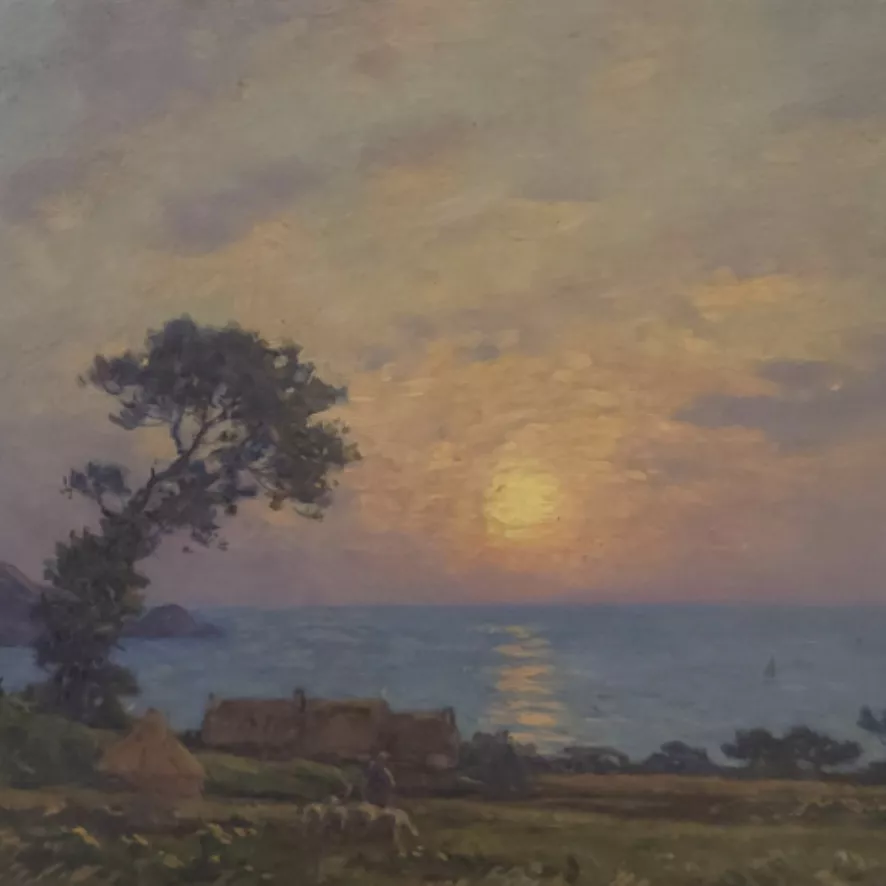
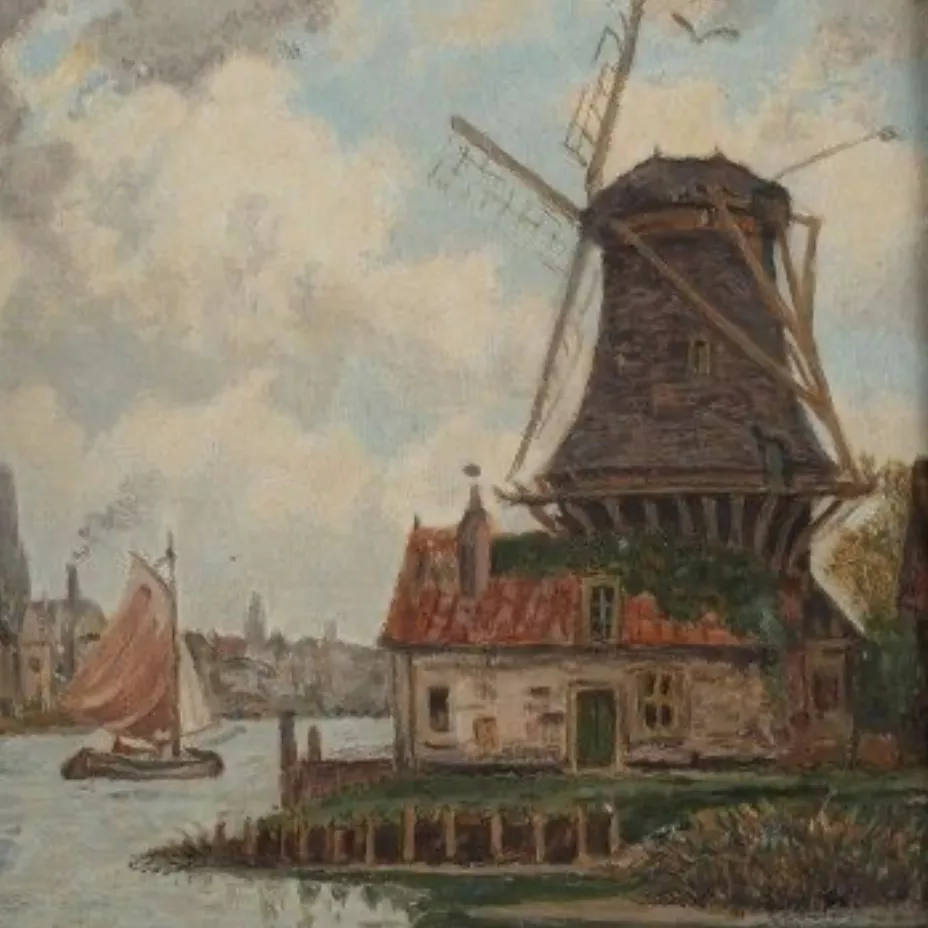
Victor Brugairolles, his life, his work
Victor Brugairolles, born in Ganges in 1869 and died in Vichy in 1946, developed a trajectory that resisted immediate classification. He was trained within the academic framework of the late XIXᵉ century, but his painting is not fixed in the imitation of reality, nor in narrative, nor in effect.
It is organized around a principle of visual clarity, where the image is conceived as an autonomous surface, structured by the distribution of masses and the adjustment of lines. He does not seek to break with inherited models, but to absorb them into a grammar of restraint.
His career, little commented on, little documented, traverses the great aesthetic mutations without opposing them head-on, but without ever merging with them. It is partly formed by Fernand Cormon.
The figuration he proposes, often reduced to the essential, is based on a constructive logic, which favors the ordering of forms over their expressiveness. His use of color, restrained and non-expressive, is part of a desire for balance, where light does not model but stabilizes.
Thus, his painting is not to be read as a narrative or a mirror, but as a visual field organized according to an internal logic.
In this way, Brugairolles' life, little marked by institutions or schools, is inscribed in a discreet continuity, where each work seems to replay the same hypothesis: how to make an image stand up without overload, without depth, without anecdote - solely through line, plane and color.
Focus on La femme au fauteuil, Victor Brugairolles, 1905
In La Femme au fauteuil, the image is thought of as a continuous surface, with no depth and no internal hierarchy. The figure, seat and background are not organized according to an illusionist reading, but according to a logic of distribution, in which color acts as a structuring element.
The pictorial field is divided into distinct zones, each carrying its own intensity, not to suggest volume or shadow, but to install a geometry of form.
The drawing, clean, linear, circumscribes the masses without modeling, without matter, without gestural vibration. The whole is based on a principle of equalizing planes, in which the figure ceases to be a subject to be represented and becomes a unit to be placed.
The painting is not based on mimesis. It's not about describing, but organizing. Every element, every surface, every curve is subjected to a precise visual protocol, where the eye is directed not by perspective, but by the distribution of flat areas.
The composition is akin to an operation of subtraction: subtraction of depth, of directional light, of expressiveness. In this way, La Femme au fauteuil proposes a reduction of the visible to its minimal conditions of existence: a line, a shape, a color.
The painting then functions as an autonomous structure, without an exterior, in which the gaze does not seek to penetrate, but to measure relationships. The space is enclosed, the figure contained, the image becomes a surface. The work thus presents itself as an exercise in stability, in which all narrative is discarded in favor of a purely plastic syntax.
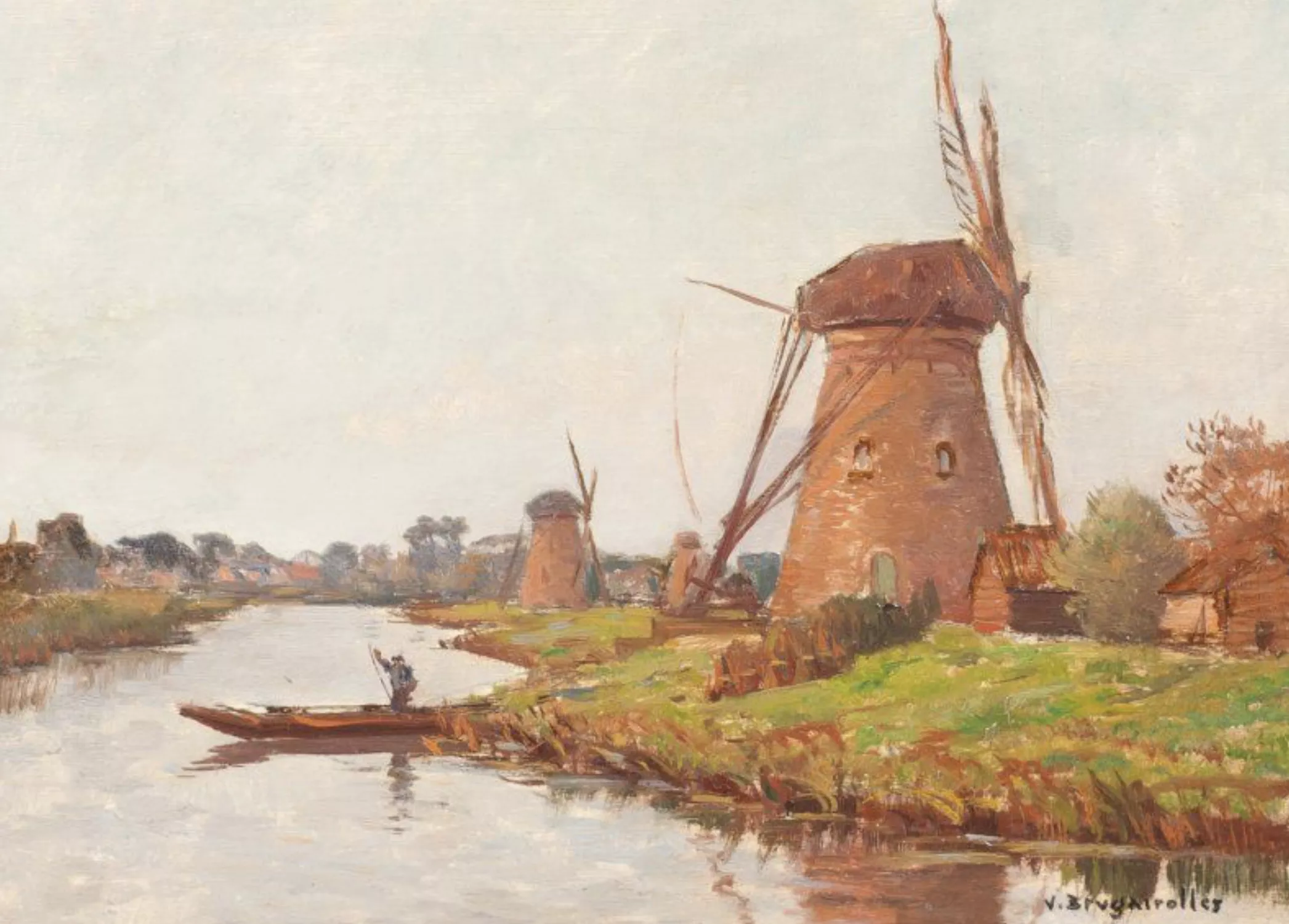
Symbolism in the work of Victor Brugairolles
In the work of Victor Brugairolles, the link to symbolism manifests itself neither through iconography nor allegory, but through a more diffuse tension between visible form and its latent charge.
Unlike Gustave Moreau or Odilon Redon, he doesn't mobilize a mythological repertoire, he doesn't invoke any elsewhere. It doesn't represent the dream, it condenses it. The image doesn't tell, it resists.
The figure, often frozen, frontal, with no apparent interiority, doesn't express an emotion, it designates a presence. It doesn't speak, it settles into a silence. This neutrality, far from excluding the symbolic dimension, installs it within the form itself.
The link with Maurice Denis, sometimes evoked, is neither spiritual nor decorative, but in the same desire for an ordered surface, a contained plan, a posed composition.
Symbolism, in Brugairolles' work, does not involve narration but structure. He doesn't suggest, he stabilizes. He doesn't comment on the world, he suspends it. The pictorial space thus becomes a place of latency, a field of slow appearance, where visible elements refer only to their own organization.
In this way, his painting joins certain logics of symbolism by emptying them of all narrative, reducing them to a minimal formal syntax - a figure, a plane, a silence.
Victor Brugairolles' imprint on his period
In Victor Brugairolles' work, the imprint is neither manifest nor rupture.
The image, reduced to its essential elements - surface, line, color - does not seek to capture the actuality of its time, but to divert its logic. It rejects speed, fragments and disorder. It settles and stabilizes.
In a context marked by Fauvist experimentation, Cubist constructions and Futurist vibrations, Brugairolles maintains a rigorous economy of means, without overflow or plastic tension.
Unlike his contemporaries, he does not seek to redefine the visible, but to measure its conditions. His language does not vary. It doesn't expand. It narrows. Each work affirms the same formal hypothesis: the image as a structured, autonomous, silent field.
In this way, his imprint lies not in immediate history, but in the persistence of a method. Figuration without narrative. Surface without depth. Color without expression.
Far from the hotbeds of the avant-garde, Victor Brugairolles inscribed in his period another way of painting: without noise, without system, but with constant precision.
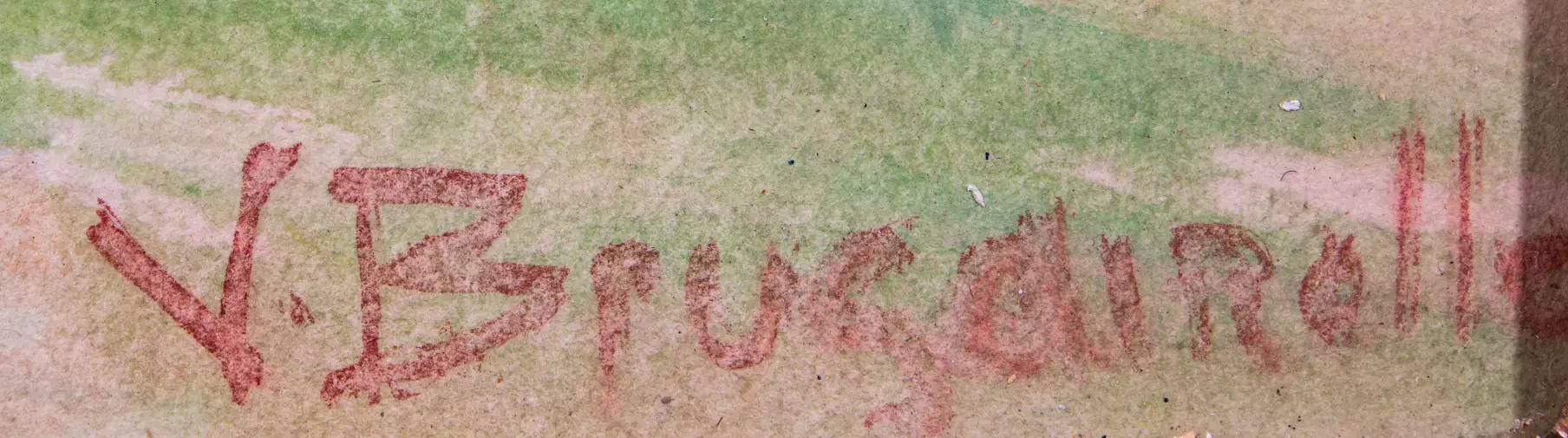
Recognizing the artist's signature
Not all the painter's works are signed. However, with or without a mention, it's important for you to have the work appraised to ensure its originality and to be able to date it. And of course, copies do exist.
Knowing the value of a work
If you happen to own a work by or after Victor Brugairolles, don't hesitate to request a free valuation using our form on our website.
A member of our team of experts and chartered auctioneers will contact you promptly to provide you with an estimate of the market value of your work, as well as ad hoc information about it.
If you wish to sell your work, you will also be accompanied by our specialists in order to benefit from alternatives for selling it at the best possible price, taking into account the inclinations of the market.
.Estimate in less than 24h
Discover in the same theme

Rating and value of drawings and paintings by Nicolas August...
Auguste Gallimard is a 20th-century painter of religious art and stained glass. He produced drawings and oils on canvas that were highly regarded at a...
Learn more >

Rating and value of paintings by Victoria Fantin-Latour
Victoria Fantin-Latour was a 19th-century artist who mainly produced still lifes of flowers, which are highly prized at auction.
Learn more >

Rating and value of sculptures, marbles and bronzes by Josep...
Joseph Antoine Bernard is a sculptor somewhere between Art Deco and Symbolism, who produced numerous works of great value.
Learn more >
D'autres tableaux modernes figuratifs vendus aux enchères

Estimated 800 - 1.500
Jean Roger SOURGEN (1883-1978) Trees and dunes Oil on panel

Estimated 3.000 - 5.000
Georges LAPCHINE (1885-1951) The port of St Tropez Oil on canvas

Estimated 18.000 - 30.000
Charles CAMOIN (1879-1965) "Le Port de Marseille, 1928" Oil on canvas.

Estimated 1.500 - 3.000
Jean VANDEN EECKHOUDT (1875-1946), Basket of persimmons, Oil on canvas

Estimated 2.000 - 4.000
Charles LACOSTE (1870-1959) Starry night, Oil on paper mounted on canvas

Secure site, anonymity preserved

Auctioneer approved by the State

Free and certified estimates
Frequently asked questions
-
Who was Victor Brugairolles, and what was his painting style?Victor Brugairolles (1869–1946), born in Ganges and died in Vichy, was an academic painter trained by Fernand Cormon. His style is characterized by a structured surface treatment, without illusionistic depth, based on a rigorous economy of means: clean lines, restrained areas of flat color, and an absence of modeling. His figurative art, reduced to the essentials, prioritizes the arrangement of forms over their expressiveness, setting him apart from the major avant-garde movements of his time.
-
What are the prices at which Victor Brugairolles' works sell?Prices for Brugairolles’ works vary considerably depending on the medium and quality. Drawings and watercolors sell for between €250 and €1,200, while oil paintings on canvas range from €80 to €38,000. For example, *Le Berger et la mer* (1895) sold for €38,000 in 2017, confirming the rise in market prices for this artist, who is particularly popular among French buyers.
-
How can I authenticate and have a work by Victor Brugairolles appraised?To authenticate a work of art, we recommend that you request a free appraisal from Auctie's using our online form. A certified expert or auctioneer will contact you shortly to examine the work, verify its authenticity, and provide you with an estimate of its value within 48 hours, with no obligation on your part.
-
Is this the right time to sell a work by Victor Brugairolles?Yes, now is a good time to sell. The market for Brugairolles is trending upward, with prices rising at auction, particularly among French collectors. His gradual rediscovery as a major figure in structured painting is driving increased interest in his works.
-
How does the sale of a work of art through Auctie's work?Auctie's supports you every step of the way: a free appraisal and accurate estimate, followed by guidance on the best sales approach to achieve the highest possible price. Our experts and licensed auctioneers manage the entire process, from the initial appraisal to the final sale, taking market trends into account.
