



Rating and value of paintings by Thomas Couture

Key takeaways
- Thomas Couture’s works are valued between €160 and €130,000, with significant variations depending on the medium used (painting or watercolor drawing).
- His preparatory drawing “The Decline of the Romans” sold for €110,000 in 2013, far exceeding its initial estimate of €11,000 to €15,000.
- A French academic painter (1815–1879) specializing in portraits and historical scenes, he influenced a generation of artists, including Édouard Manet and Fantin-Latour.
If you own a work by or after the artist Thomas Couture and would like to know its value, our state-approved experts and auctioneers will offer you their appraisal services.
Our specialists will carry out a free appraisal of your work, and provide you with an accurate estimate of its value on the current market.
Then, should you wish to sell your work, we will direct you to the best possible arrangement to obtain the optimum price.
Rating and value of the artist Thomas Couture
A French academic painter par excellence, Thomas Couture devoted himself mainly to portraits. The bulk of his work is based on a wide range of paintings, but there are also drawings, on the other hand very few prints.
The prices at which his works are auctioned range from €160 to €130,000, a consequent delta but one that speaks volumes about the value that can be attributed to the artist's works.
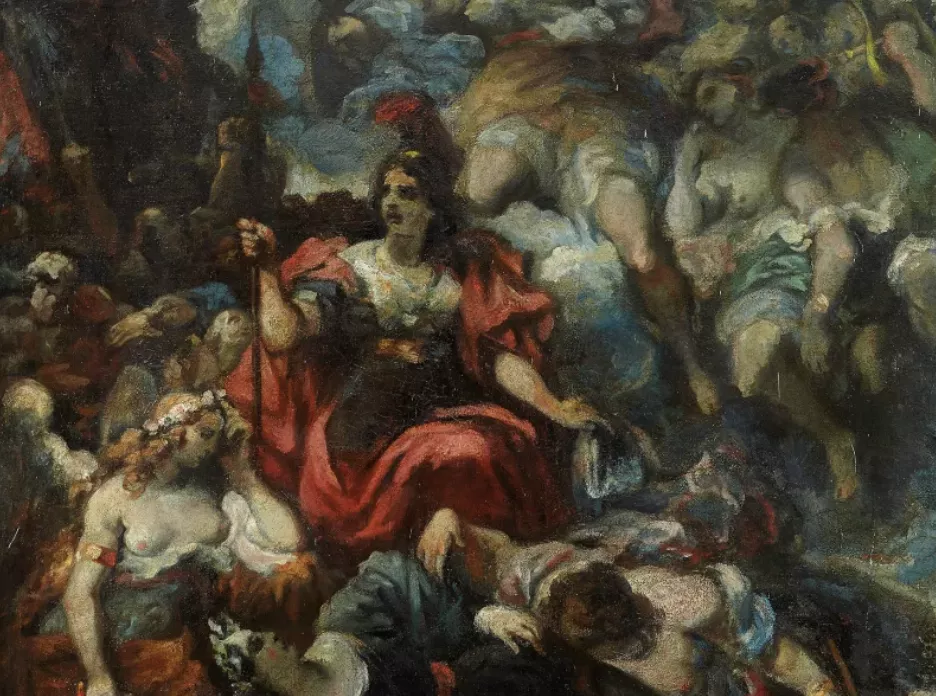
In this case, his study drawing La décadence des Romains, measuring 35 cm x 60 cm, sold for €110,000 in 2013, while it was estimated at between €11,000 and €15,000.
Order of value from a simple work to the most prestigious
Technique used | Result |
|---|---|
Painting | From €240 to €80,000 |
Drawing - watercolor | From €160 to €130,000 |
Estimate in less than 24h
Style and technique of Thomas Couture
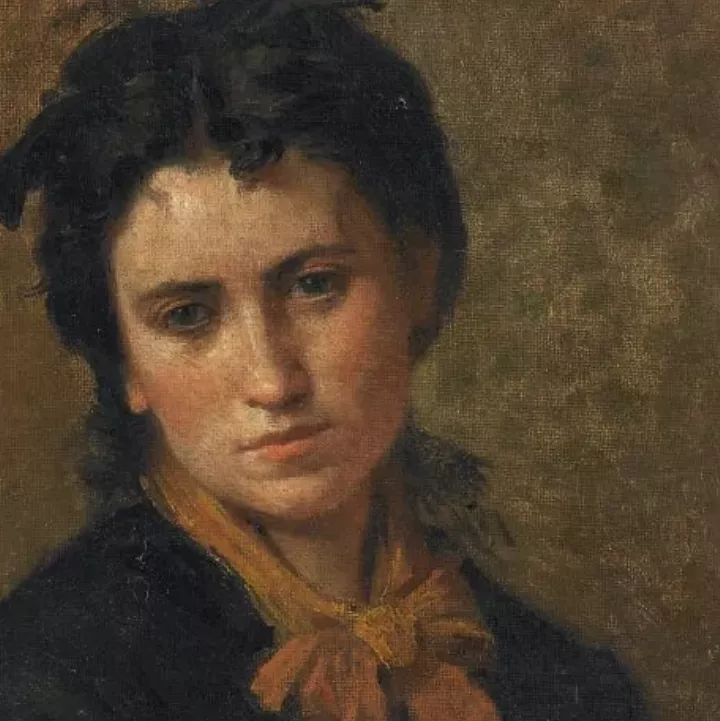
Thomas Couture develops a unique style that draws on several influences, including Academism, while flirting with Romanticism through his interest in expressiveness and intense emotions.
Trained at the École des Beaux-Arts in Paris, he draws inspiration from the great Italian and Flemish masters, and adopts a meticulous technique, often close to chiaroscuro to accentuate the dramatic force of his compositions.
He excels in the art of portraiture and historical scenes, where he depicts his subjects with striking anatomical precision, but without ever lapsing into pure realism.
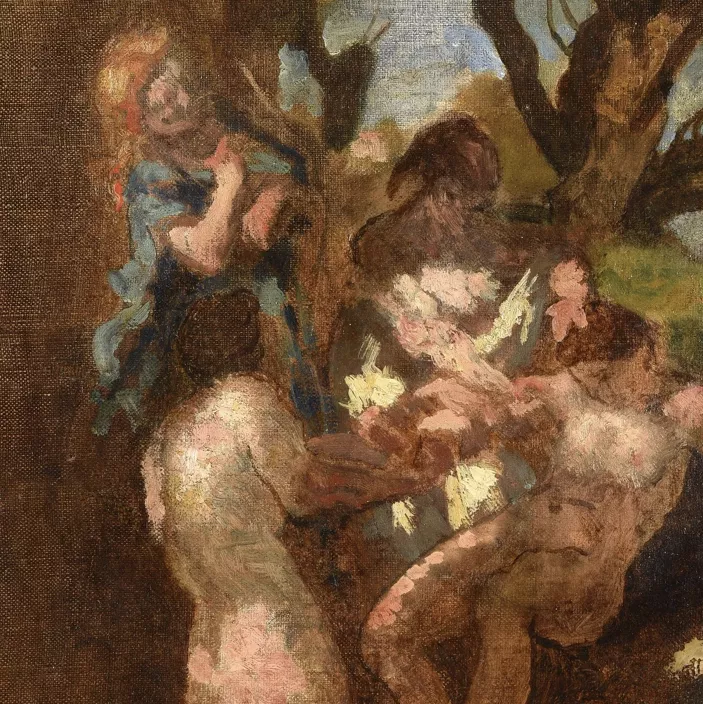
The contours of his figures often remain softened, testifying to a mastery of sfumato that lends his works an aspect both dreamlike and theatrical.
Couture sometimes favors the "non finito", leaving certain parts of his canvases sketched or blurred, accentuating the contrast between detail and abstraction.
His paintings capture a world where reality and dream coexist, a universe where history comes to life with psychological depth and a hint of melancholy.
Thomas Couture's influence extended far beyond his studio, where he trained artists who would become figureheads of modernism, starting with Édouard Manet.
Under his teaching, Manet, fascinated by Couture's realism and thematic audacity, adopted this same freedom, daring contemporary and disturbing subjects.
This influence is also felt in Henri Fantin-Latour and Puvis de Chavannes, who draw on the dramatic intensity and attention to human expression in Couture's work.
These artists, each in their own way, explore the ambivalences of the human soul and the paradoxes of their times, just as their master had done in Les Romains de la décadence, the major work of his career.
With his innovative approach, Couture pushed his students to break with academic conventions, planting the seeds of a more introspective and critical art, where the view of society takes center stage.
The life of Thomas Couture
Thomas Couture (1815-1879) was a 19th-century French painter who established himself as one of the major figures of his time. Born in Senlis, he displayed a talent for drawing from an early age, which quickly led him to the École des Beaux-Arts in Paris.
There, he studied with Antoine-Jean Gros, absorbing academic principles while forging his own style, marked by a great freedom of spirit.
Inspired by the Italian and Flemish masters, he immersed himself in Renaissance techniques, particularly those of Titian and Rubens, which he copied and reworked to nourish his own art.
In 1847, he achieved a major breakthrough with Les Romains de la décadence, a vast historical composition that won him a triumph at the Salon and established his reputation.
This painting, acclaimed by public and critics alike, highlights Couture's fascination with history and moral allegories.
Refusing to conform to the strict codes of the Académie, Couture opened a studio in 1848 where he taught his students a more liberated and personal approach, privileging the search for emotion and expression over pure technique.
He became an influential mentor for many young artists, including Édouard Manet, whose sensitivity and artistic independence he encouraged.
Returning to Paris, Couture exhibited regularly at the Salon, although he was notoriously selective and did not produce prolifically, preferring to delve into each canvas with meticulous exactness.
His painting, tinged with symbolism and drama, plunges his figures into ambitious compositions where psychology and light occupy an essential place.
Until his death in 1879, Thomas Couture continued to work passionately, influencing an entire generation of painters and leaving a legacy that endures well beyond his works.
Thomas Couture by Paul Lang
Focus on The Romans of Decadence, Thomas Couture, 1847, Musée d'Orsay
In The Romans of Decadence, Thomas Couture transports us to a scene of moral decline, where glib, elongated Roman figures embody the decadence of a once-powerful civilization.
This vast, meticulous composition, bathed in theatrical light, depicts a banquet where the drunken, carefree participants seem to revel in debauchery, symbolizing the fragility of human greatness in the face of excess and corruption.
Couture, as an astute observer of history, here uses ancient Rome as a critical mirror of the French society of his time, expressing disillusionment with hypocrisy and the degradation of values.
His rich, contrasting palette, blending deep reds, bright golds and ominous shadows, lends the work an atmosphere both sumptuous and oppressive, like a feast tinged with foreboding.
This tension between beauty and decadence reinforces the allegorical power of the work, where each character seems lost in a futile quest for immediate pleasure, oblivious to the precariousness of their own civilization.
In the context of the 19th century, marked by revolutions and social upheavals, Couture is part of a trend that seeks to interrogate the present by going back to the myths and lessons of the past.
The scene, though populated by historical figures, takes on a timeless dimension; it reminds us that cycles of greatness and downfall, the temptation of excess and the erosion of moral values are universal themes, recurrent in human history.
The spectators of the time, confronted with the violent contrasts of this work, could not fail to see in it an echo of their own society.
By playing on the symbols of decadence - the nonchalance of bodies, the half-empty wine cups, the lost glances - Couture subtly criticizes the emptiness of an existence centered on the satisfaction of pleasures and superficiality.
However, this is not just a condemnation: the artist opens up a reflection on the fragility of ideals and the difficulty of maintaining lasting greatness in the face of the trials of time.
The Romans of Decadence is thus less a simple history painting than a meditation on the illusions and vulnerability of humanity, a warning to his contemporaries and to future generations.
The artist's imprint on his period
Thomas Couture marks art history with a profound and contrasting imprint, where academic rigor mingles with subtle social criticism.
His major work, Les Romains de la décadence, doesn't just depict ancient Rome: it questions the public on the moral decay of all society in the face of temptation.
This canvas, a veritable visual punch, becomes a mirror for 19th-century France, offering history painting a new role as a bearer of societal reflections.
Couture, by making art a space for questioning, sets himself apart from the painters of his time and invites a critical reading of history, tinged with irony and depth.
As a teacher, Couture passes on this vision to his students, and his influence quickly spreads. His studio became a melting pot for young talent, including Édouard Manet, to whom he taught the importance of creative freedom.
This freedom, reflected in an exploration of subjects, techniques and symbols, paved the way for modernity.
Couture, in encouraging his students to go beyond convention, was part of a precursor current of realism and engaged art, reminding us that painting can be a reflection of the moral issues of its time.
Through this approach, Thomas Couture leaves an indelible mark, making him not only a master of technique but also a pioneer of a more introspective and engaged art.
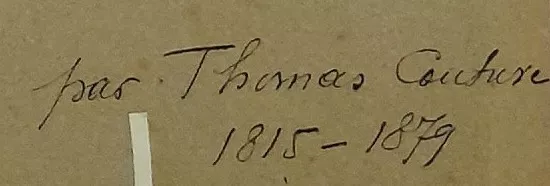
Recognizing Thomas Couture's signature
The painter didn't sign all his works, which doesn't make expert appraisal any easier. When his works are signed, the signature appears in a fluid script.
Know the value of a work
If you happen to own a work by Thomas Couture, request a free appraisal without further delay via our form on our website.
A member of our team of experts and accredited auctioneers will contact you promptly to provide you with an estimate of the value of your work, as well as any relevant information about it.
If you are considering selling your work, our specialists will also be on hand to help you find alternatives for selling it at the best possible price.
.Estimate in less than 24h
Discover in the same theme

Rating and value of works, sculptures by Albert-Ernest Carri...
Carrier-Belleuse was a sculptor of the Second Empire who was highly prized at auction. His works are highly prized at auction.
Learn more >

Rating and value of works, drawings, paintings by Lucien Lév...
Lucien Lévy Dhurmer is a 19th-century Symbolist artist who produced works that are highly regarded and sought-after on the auction market.
Learn more >

Rating and value of bronzes and sculptures by Pierre Lenorde...
Pierre Lenordez is a 19th-century animal sculptor whose sculptures are highly prized at auction.
Learn more >
Works from the same period sold at auction

Estimated 4.000 - 6.000
Atelier d'Antoine Jean, baron GROS (Paris 1771-1835 Meudon), oil on canvas

Estimated 200 - 400
Joseph Gabriel TOURNY (Paris 1817-1880 Montpellier) Portrait of a painter with a moustache, in bust form, Pastel on paper, oval format

Estimated 3.000 - 5.000
Guillaume FOUACE (1837-1895), Still life with oysters, Oil on canvas

Estimated 1.000 - 2.000
French school, circa 1860 Presumed portrait of Églé Ney de la Moskowa (1832-1890), Duchess of Persigny

Estimated 3.000 - 5.000
Henri Adrien TANOUX (1865-1923) The Slave Trader, oil on canvas

Secure site, anonymity preserved

Auctioneer approved by the State

Free and certified estimates
Frequently asked questions
-
Who is Thomas Couture, and what is his role in art history?Thomas Couture (1815–1879) was a major 19th-century French academic painter who trained at the École des Beaux-Arts in Paris. He is best known for his masterpiece *The Romans in Decline* (1847) and for his decisive influence as a teacher: he taught Édouard Manet, Henri Fantin-Latour, and Puvis de Chavannes, encouraging them to break with academic conventions and thereby paving the way for realism and modern art.
-
What are the prices and price ranges for works by Thomas Couture?Prices for works by Thomas Couture range from €160 to €130,000. Paintings generally sell for between €240 and €80,000, while drawings and watercolors fetch prices ranging from €160 to €130,000. For example, the preparatory drawing “The Decline of the Romans” exceeded its estimate (€11,000–15,000) when it sold for €110,000 in 2013.
-
How can you authenticate a work by Thomas Couture and determine its exact value?Auctie's offers a free, no-obligation appraisal of your artwork, conducted by state-certified experts and auctioneers. Simply fill out a form on our website, and a member of our team will contact you shortly to provide an accurate estimate and detailed information about your artwork.
-
Why is now the right time to sell a work by Thomas Couture?The market for works by Thomas Couture remains strong: his paintings and drawings retain significant value, particularly his major works and preparatory studies. The enduring interest in 19th-century academic masters, combined with the relative scarcity of his works (Couture was not a prolific artist), keeps demand at a level favorable to sellers.
-
How does the sale of a work of art work at Auctie's?Auctie's supports you from start to finish: after a free, no-obligation appraisal, our specialists will help you choose the best sales approach to achieve the best possible price. As a licensed auction house, we guide you through the entire process, from appraisal to the final bid.
