Rating and value of Russian military and knighthood orders
Rating and value of Russian military and knighthood orders
Key takeaways
Russian military orders sell for between €100 and €338,000, depending on the model, condition, and provenance, with the Order of Saint Alexander Nevsky commanding the highest prices.
The diamond Order of Saint Alexander Nevsky exceeded its estimate in 2021, selling for €338,000 instead of the projected €200,000–€300,000.
Five major orders make up the hierarchy: Saint Stanislaus (€100–32,000), Saint George (€50–42,000), Saint Anne (€100–85,000), Saint Catherine (€120,000–€150,000), and Saint Alexander Nevsky (€150,000–€338,000).
If you own a Russian military order or order of chivalry, and would like to know its value, and if you don't know, the period and model of the decoration, our state-approved experts and auctioneers will offer you their appraisal services.
Our specialists will carry out a free appraisal of your work, and provide you with a precise estimate of its value on the current market.
Then, should you wish to sell your work, we will guide you towards the best possible arrangement to obtain the optimum price.
Russian military and chivalric orders
Military and chivalric orders are sought-after items for collectors, and Russian orders in particular. However, price differences can be considerable, depending on the order, its state of preservation, who it belonged to, and other criteria.
Now, prices for these objects can rise considerably at the auctioneers' gavel. Buyers from all over the world are interested in sales of certain rare pieces.
The price at which they sell on the art market ranges from €100 to €338,000, at the moment, a consequent gap but one that says a lot about the value that can be attributed to these decorations.
In 2021, an order of Saint Alexander of Newski in diamonds sold for €338,000 while it was estimated at between €200,000 and €300,000.
Order values range from a simple order to the most prestigious
Order
Result
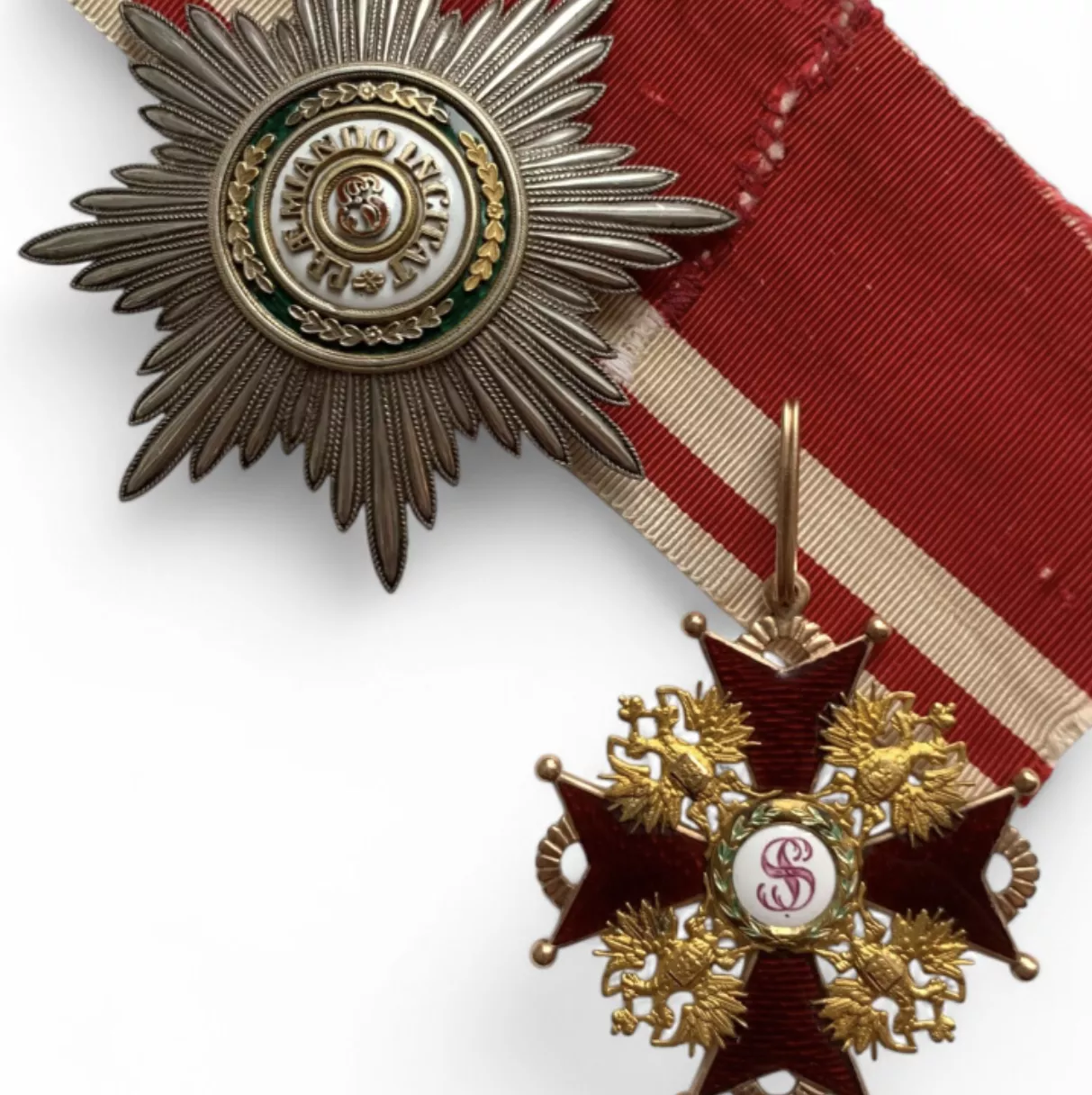
Order of Saint Stanislas
From €100 to €32,000
Ordre de Saint Georges
From €50 to €42,000
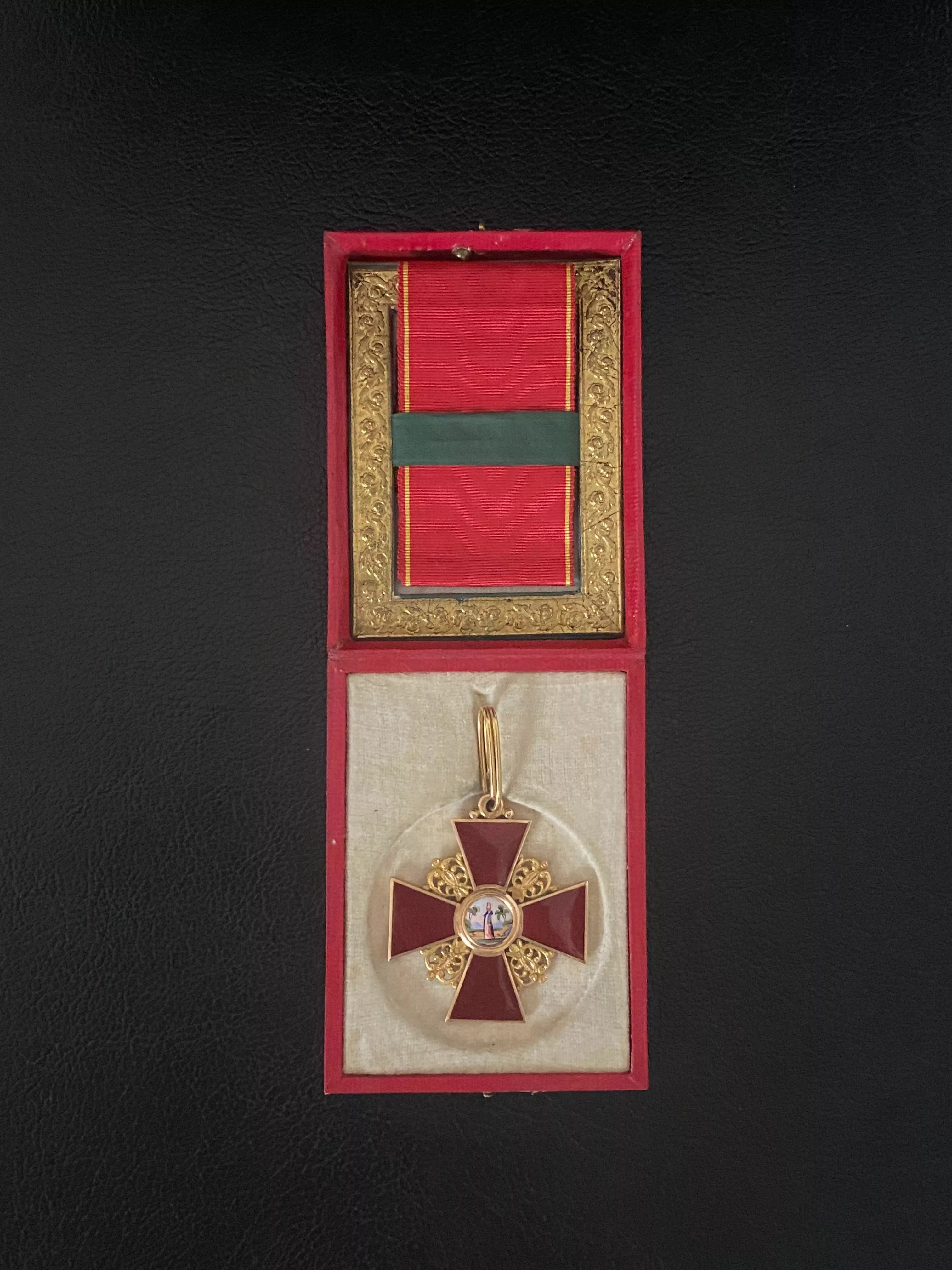
Ordre de Sainte Anne
From 100 to 85 000€
Ordre de Sainte Catherine
From €120 to €150,000
Order of Saint Alexander Newski
From €150 to €338,000
Have your objects estimated for free by our experts
Estimate in less than 24h
The history of Russian military orders
This stratification of honorary distinctions in Russia is part of a heritage at the crossroads of Byzantine and Western influences, where the military order and order of chivalry were not conceived as a mere honorific distinction, but as a cog in imperial power.
The Order of St. Andrew, instituted by Peter the Great in 1698, inaugurates a series of distinctions where the hierarchy of merit is materialized through insignia, motto and ceremonial.
His blue ribbon crossed the century like a golden thread, worn by the Empire's most eminent servants, aristocrats and generals whose loyalty was sealed in the brilliance of diamonds and enamel.
With Catherine II, the distinction was extended and codified: the Order of St. George, created in 1769, established military bravery as an absolute principle. Hierarchically divided into four classes, it consecrates victories, inscribes generals' names in stone and engraves battles on medals.
At the crossroads of heroism and politics, its award is a subtle balance between reward and exemplarity, consolidating a military aristocracy where prestige is measured by feats of arms.
The Order of St. Vladimir (1782), intended for civil and military officials, structured a bureaucratic nobility, while the Order of St. Anne (1797), integrated into Russian honors after the annexation of the Duchy of Holstein-Gottorp, completed a cartography of merit where each badge corresponds to a degree of power and service.
In the 19th century, this proliferation of orders was accompanied by a multiplication of ribbons, crosses and stars, transforming dignitaries' chests into veritable palimpsests of accomplished duty.
The Empire, in its expansion, made them instruments of integration: victorious generals in Central Asia wore the Order of St. George, while administrators of newly conquered territories received the Order of St. Stanislaus, integrated in 1831 after the incorporation of Poland.
But as the order became more institutionalized, its lustre was diluted. The end of the 19th century saw the appearance of more and more distinctions, in which personal merit faded behind an almost automatic award system.
The order, once a sign of exception, became the ordinary attribute of an elite who, by adorning themselves with its insignia, were merely re-enacting past glory.
On the eve of the Revolution, these orders, symbols of a power on borrowed time, are no more than the reflection of a world that is collapsing: crosses scatter, medals change hands, and the pomp of ceremonies freezes in the last glimmers of a flickering empire.
Maxime Charron
Having worked at Christie's Paris and London, Maxime Charron now specializes in Russian art and historical memorabilia. For Auctie's, he is in charge of appraising, valuing and presenting your objects corresponding to his field of specialization in our sales at the Hôtel Drouot.
Send a message
Ordre de Sainte Anne, Russie, 2ème classe
The Order of Saint Alexander Newski
Instituted by Peter the Great in 1725, the Order of Saint Alexander Nevsky is part of that tradition of Russian honors where military merit and civil service are entwined in enamel and gold.
Its name evokes the memory of the warrior prince who defeated the Teutonic knights on the Neva in 1240, and sets itself up as a model of devotion to the state.
Originally designed to reward military valor, it soon became a badge of imperial power, awarded to dignitaries and diplomats whose loyalty to the throne was measured as much by their ancestry as by their influence.
The central medallion, bearing the effigy of the saint in armor, surrounded by the inscription "For work and country", became an emblem of social elevation, a seal that the Empire affixed to its most eminent servants.
Under Catherine II, the order adopted a strict ceremonial, where the silver star and the enamelled red cross were accompanied by the distinction between Russian and foreign holders, according to a protocol that reinforced its prestige.
At the crossroads of the military elite and imperial administration, it embodies a hierarchy where personal merit is always backed by the sovereign's favor.
In the 19th century, it became one of the most sought-after distinctions, not only for generals crowned with victories, but also for ministers and ambassadors, whose role in extending Russian influence justified the award of the insignia.
Its prestige culminated under Alexander III, when the cross was adorned with brilliants for the highest dignitaries, transforming the award into a sign of belonging to the state aristocracy.
However, at the dawn of the twentieth century, while the multiplication of distinctions dulled its value, the Order of St. Alexander Nevsky retained a special aura, like a vestige of the time when chivalry and service to the throne went hand in hand.
But in 1917, the last recipients of the order, generals or high officials, saw their insignia become a vestige of an abolished world. The Red Cross disappeared in the revolutionary turmoil, buried with the Empire it served to glorify.
Russie, ensemble 1ère classe de l'ordre de Saint Stanislas
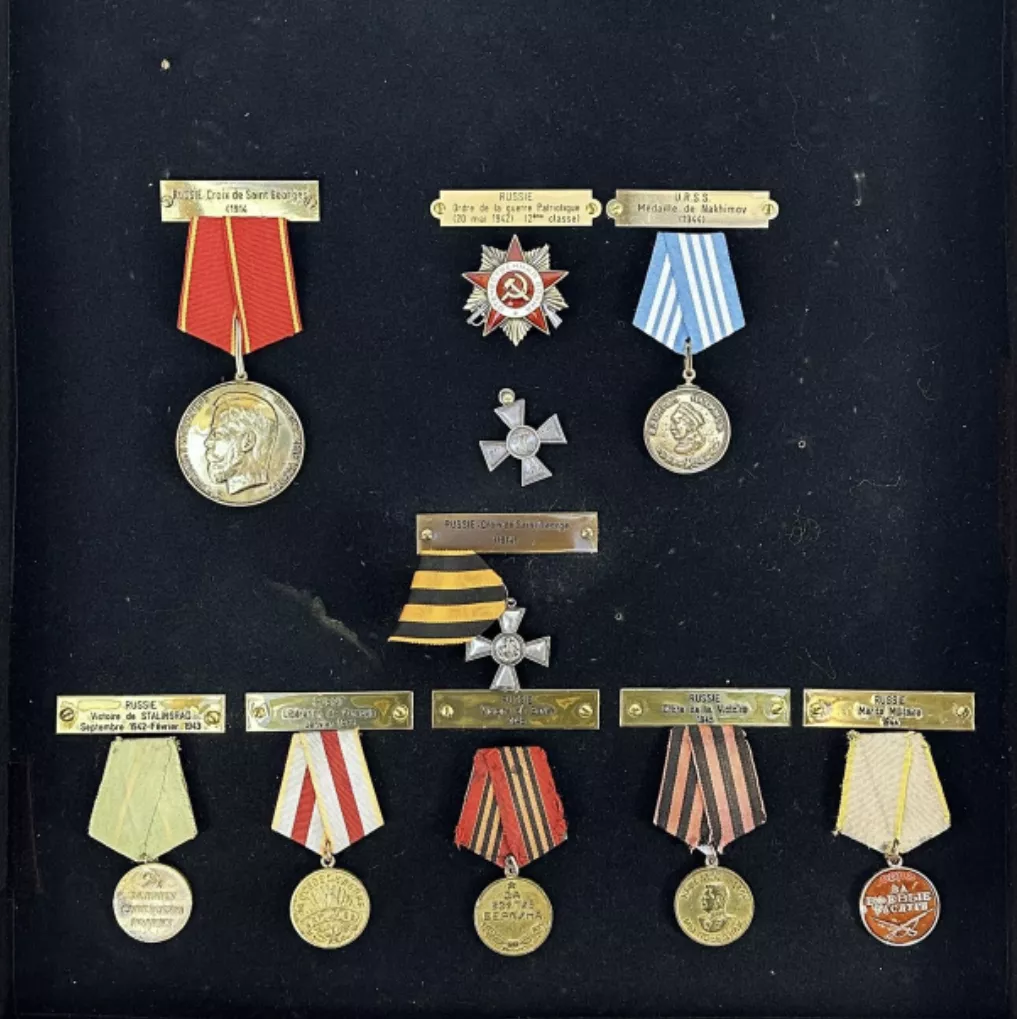
Russie, ensemble de décorations dont Saint Georges
The Order of Saint Stanislaus
Founded in 1765 by King Stanislaus II August Poniatowski, the Order of Saint Stanislaus was born in the last gasp of a still sovereign Poland, where the chivalric ideal was fading behind the influence of neighboring powers.
Originally designed to reward civil and military merit, it is distinguished by its red cross edged in gold, stamped with the image of the eponymous saint, martyred bishop and tutelary figure of a nation in search of renewal.
But in 1831, when Poland was absorbed into the Russian Empire after the crushing of the November Uprising, the order changed hands: Nicholas I integrated it into the imperial honorific system, aligning it with the Russian hierarchy of distinctions.
From then on, its vocation broadened: it became one of the tools of imperial policy, distributed to state servants, deserving officers and civil servants whose zeal consolidated the tsarist administration over the Polish provinces.
In contrast to the older orders, marked by an exclusively military or aristocratic ancestry, Saint Stanislaus democratized by opening up to bourgeois and merchant circles, whose economic or philanthropic commitment was sufficient to justify the granting of the insignia.
The red-and-white ribbon, in the Polish colors, then unfurled on Russian uniforms, becoming a paradoxical symbol of an order absorbed by the one that had conquered it.
At the end of the 19th century, as the imperial bureaucracy grew denser, the order gradually lost its prestige, eclipsed by more exclusive distinctions such as Saint-Alexandre Nevski or Saint-Vladimir.
But it remained, until 1917, one of the most widely distributed, crossing all strata of administration, from chancelleries to governorates, from intendants to judges, imprinting on the servants of the Empire the imprint of a distinction whose pomp faded behind the effectiveness of its award.
With the fall of the Romanovs, it disappeared from official protocol, leaving behind the image of an order whose original vocation was gradually absorbed by the imperatives of a wider domination than the one it had been designed to serve.
Whether it's the Order of St. Stanislaus or other Russian military orders, they are among the most prized at auction, along with the French orders, the Spanish orders, often displayed alongside antique weapons.
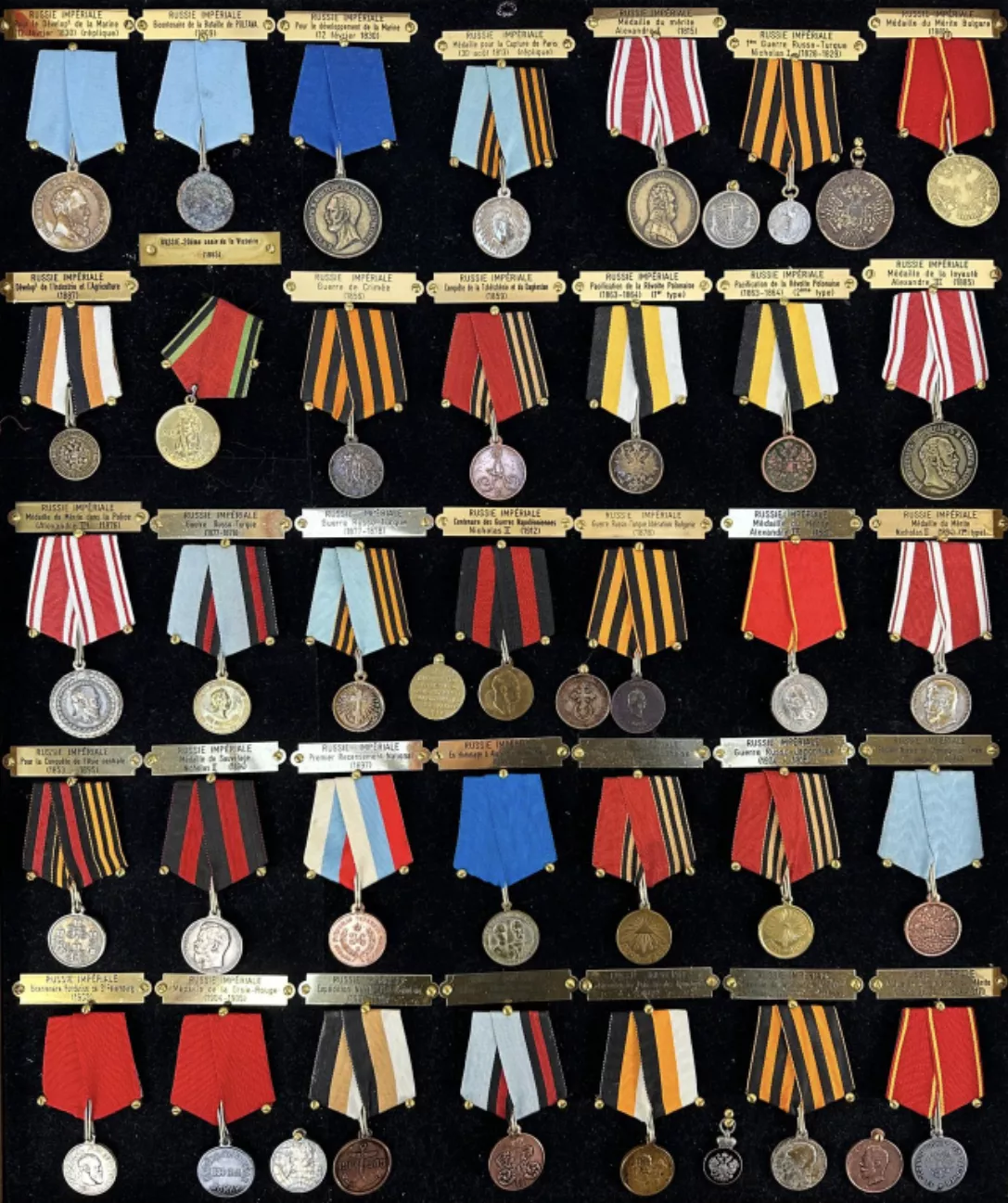
Russie, ensemble de 42 reproductions modernes de médailles
Reasons to sell a military order or order of chivalry at auction
If you own a military order or order of chivalry and don't know how to sell it, auctions are one solution.
In fact, collectors use this medium to find models that correspond to a particular battle or that belonged to their ancestors. Prices can reach unprecedented heights.
Knowing the value of a military or knighthood order
If you happen to own a military or knighthood decoration, and would like to know its value, don't hesitate to request a free appraisal using our form on our website.
A member of our team, made up of experts and certified auctioneers, will contact you promptly to provide you with an estimate of the market value of your piece, not forgetting to send you ad hoc information about it.
If you wish to sell your item, you will also be accompanied by our specialists in order to benefit from alternatives for selling it at the best possible price, taking into account market inclinations.
Have your objects estimated for free by our experts
What is the Order of Saint Alexander Nevsky, and why is it so highly sought after?
The Order of Saint Alexander Nevsky, established by Peter the Great in 1725, is one of Russia’s most prestigious honors, intended to recognize military exploits and imperial service. It is part of a tradition in which military and administrative merit are intertwined in enamel and gold, and it remains the most sought-after order on the auction market, with prices reaching as high as €338,000.
What is the price range for Russian military orders, broken down by type?
Prices vary considerably depending on the order and its condition. The Order of Saint Stanislaus ranges from 100 to 32,000 euros, the Order of Saint George from 50 to 42,000 euros, the Order of Saint Anne between €100 and €85,000, the Order of Saint Catherine between €120,000 and €150,000, and the Order of Saint Alexander Nevsky between €150,000 and €338,000.
How can I have a Russian military or chivalric order appraised?
Request a free, no-obligation estimate using the form on the Auctie's website. A certified expert or auctioneer will contact you shortly to appraise your item, determine its era and model, and provide you with its exact market value within 48 hours.
Is this a good time to sell a Russian military or chivalric order?
Yes, Russian military decorations are among the most sought-after items by collectors worldwide at auctions, and prices continue to rise. Buyers from around the world are actively interested in these rare items, making this an opportune time to sell them at the best possible price.
How do I sell a military or chivalric order through Auctie's?
Auctie's, an auction house, supports you every step of the way: free appraisals by certified experts, advice on the best sales strategy based on market conditions, and then a public auction to secure the best price. Our specialists develop the best options based on current trends.