



Rating and value of Silvia Bächli's drawings

Key takeaways
- Silvia Bächli’s works sell for between €60 and €30,800, with a notable increase in value since 2010, particularly for her drawings.
- A Swiss artist born in 1956, she represented Switzerland at the 2009 Venice Biennale and won the Meret Oppenheim Prize in 2014.
- Her watercolor and gouache drawings on paper are the most highly valued segment of her work, far surpassing prints and photographs.
If you own a work by artist Silvia Bächli or based on her work and would like to know its value, our state-approved experts and auctioneers will guide you.
Our specialists will carry out a free appraisal of your work, and provide you with an accurate estimate of its value on the current market.
Then, should you wish to sell your work, we will direct you to the best possible arrangement to obtain the optimum price.
Artist's rating and value
Swiss artist Silvia Bächli won over the art critics, dealers and collectors of her day. Since then, the artist's works have made their mark on the auction market.
From the 2010s onwards, her stock has been on the rise, particularly for her drawings.
As a result, the price at which Silvia Bächli's works sell ranges from €60 to €30,800. A gouache on paper depicting an untitled light bulb went for €30,800, while it was estimated at between €2,600 and €4,400.
Order of value ranging from the most basic to the most prestigious
Technique used | Result |
|---|---|
Estamp - multiple | From €60 to €1,000 |
Photography | From €250 to €1,100 |
Drawing - watercolor | From €300 to €30,800 |
Estimate in less than 24h
The artist's works and style
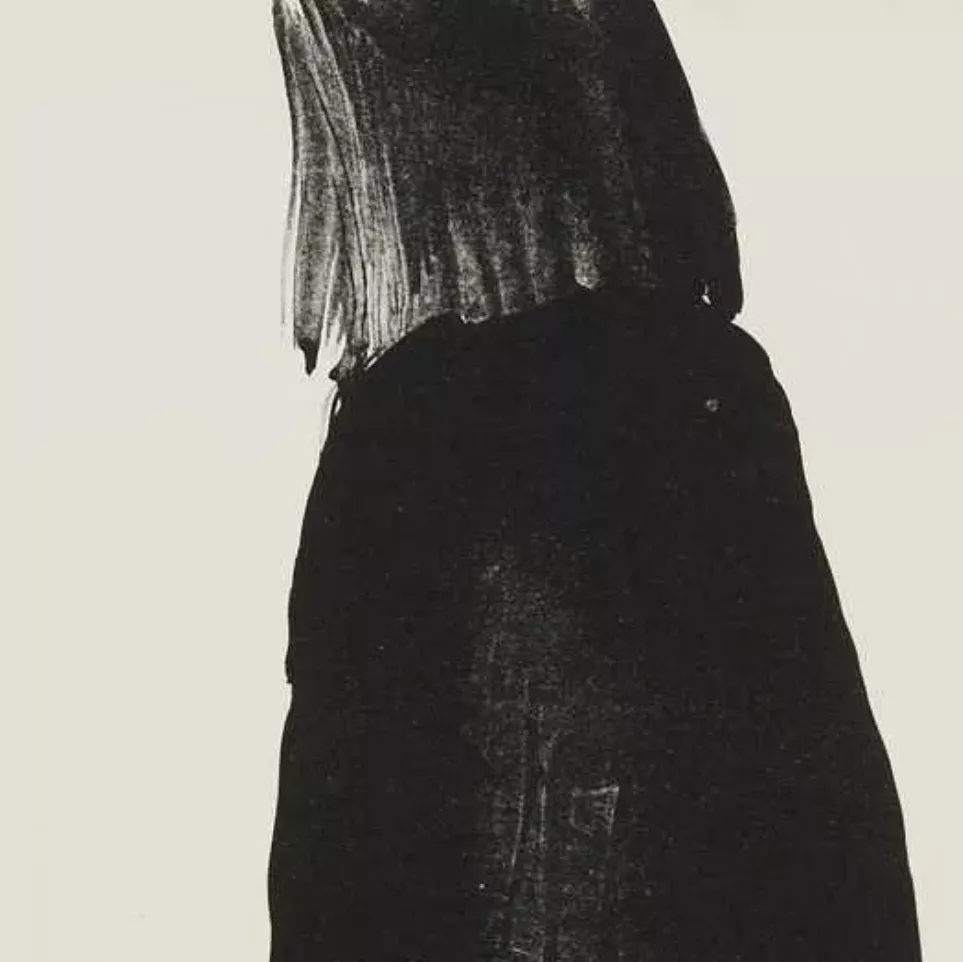
Silvia Bächli is an artist born in 1956, who has focused her artistic practice on the medium of drawing. Her medium is almost exclusively drawing on paper, in variable formats ranging from small sheets to entire walls.
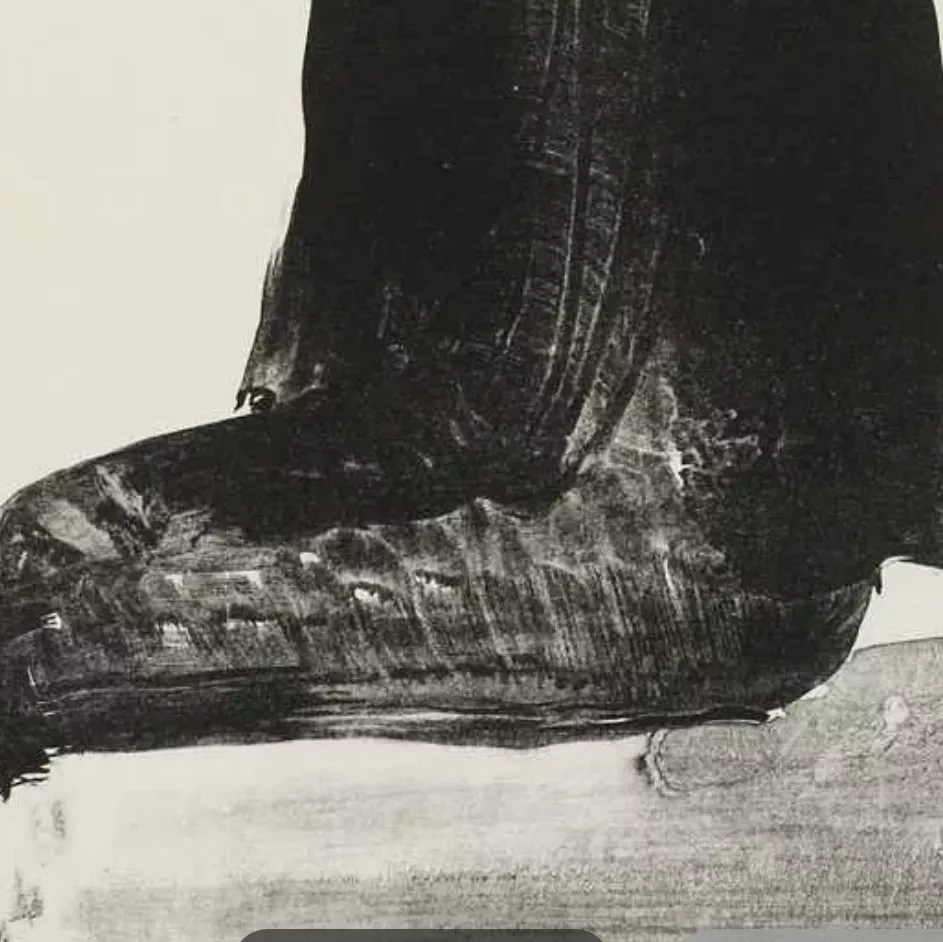
Silvia Bächli works with ink, gouache, watercolor and graphite pencil, fluid mediums that encourage variations in density and transparency. The paper she uses is left unprimed, the grain is perceptible, and the capillarity of the support contributes to the effects of edge and dilution.
The gesturality is controlled, the strokes are continuous, the tremors assumed and the speeds varied (slowed down, accelerated), producing a plastic writing. The importance of misses is mastered by the artist, with overflows, interruptions and repeats, as an indication of execution time.
She uses a repertoire of elementary forms (bars, loops, arcs, fragmented silhouettes), oscillating between abstraction and figurative allusion. For tonality and color, she uses a reduced range (blacks, grays, browns, rare muted colors), favoring value and saturation over polychromy.
The artist also uses thin superimpositions approaching glaze, with ink washes, which create layers of transparency. Her works are conceived in sequences (series, diptychs, polyptychs) where each sheet constitutes a variation of the same motif. She uses repetition and variation as a method (micro-shifts of axis, scale and density to explore the internal grammar of the motif).
Silvia Bächli makes systematic use of reserve: the white of the paper is an active space (breathing, counter-form, silence). The edges of the sheet actually serve to structure the reading (clean cuts, framing and visual " end of sentence ".
For the hanging, the artist works in ensembles, with open grids, alignments and clusters. The hanging is worth mentioning here because it is an integral part of the work, with a spatial montage that creates rhythm, pauses and syncopations.
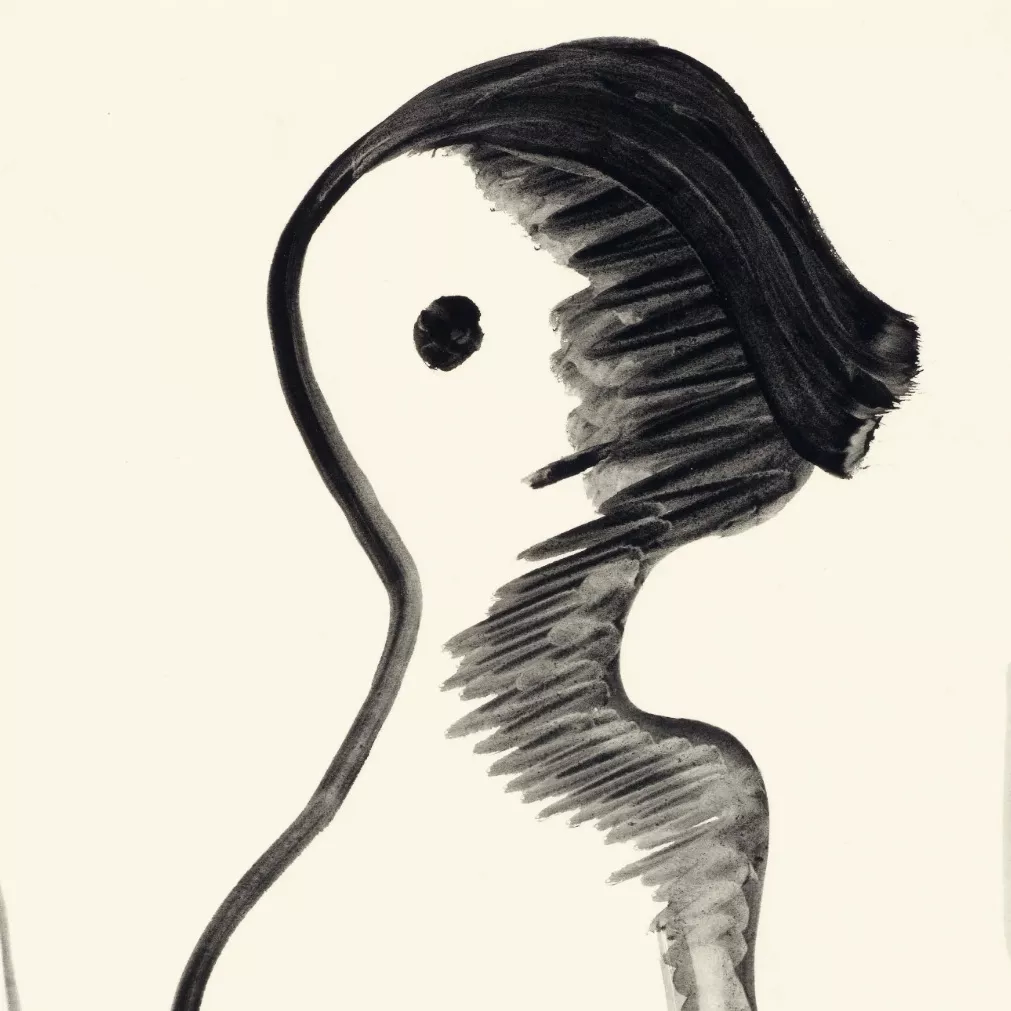
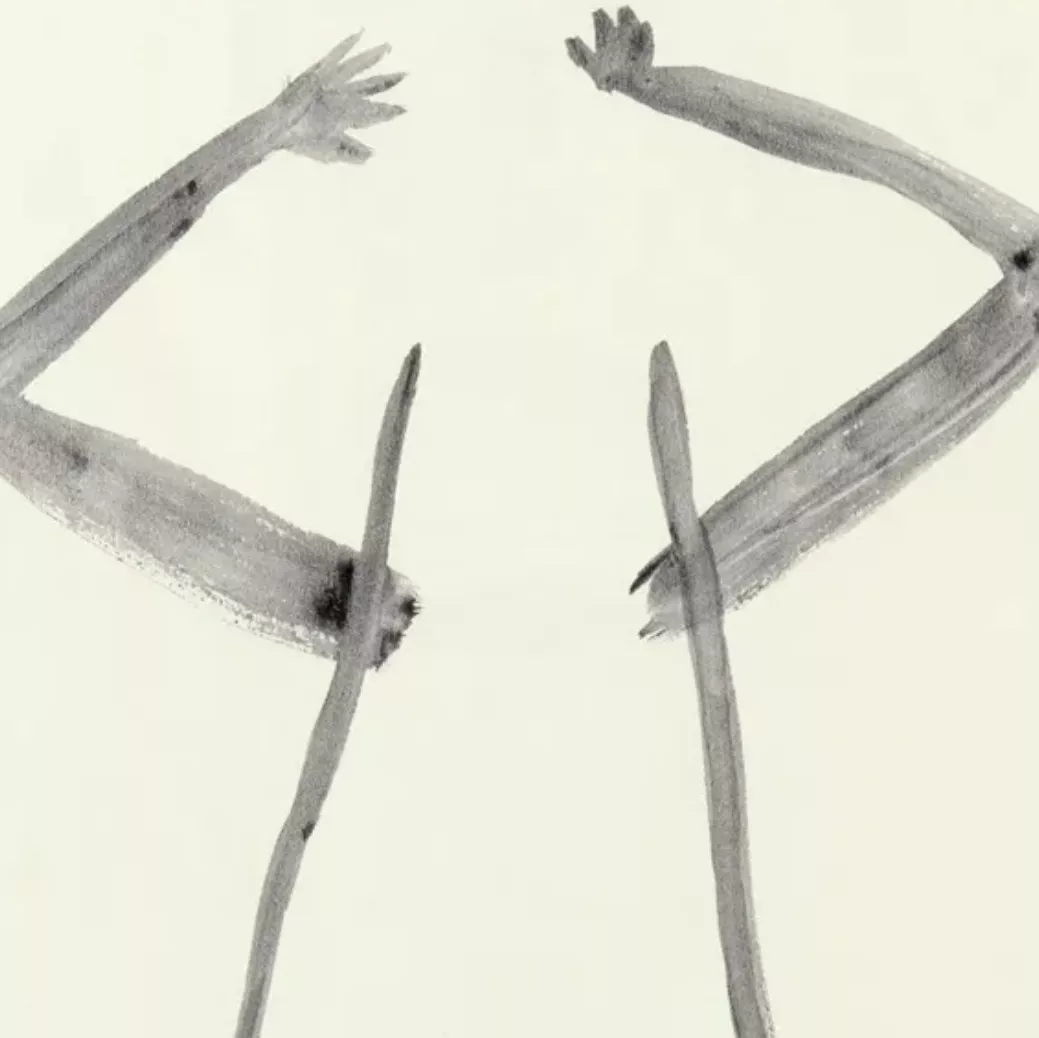
The presentation is often unframed, or under minimal protection to preserve the paper's material presence. She also pays close attention to corporality and perception, using fragmentary motifs (suggested hands, profiles, torsos). The body is evoked through segments and gestural memory.
The body of work known to date shows a deliberate ambiguity between figure and sign, which triggers phenomena of projective reading (controlled pareidolia). His work is iterative, leaving traces of trial and error, whether deferred or not. The series thus record the duration and distance of the gaze.
The economy of means leads to high rhythmic precision, where the little is conceived as a vector of intensity. The artist conceives of drawing as an autonomous practice, meaning that there is no preparatory study in the classical sense. It is also an exhibition device.
His work has affinities with visual poetry, choreography (notion of score) and a sensitive abstraction centered on perception.
.
The life of Silvia Bächli
Silvia Bächli was born in Baden, Switzerland, in 1956. She studied at the Basel Art Academy (Kunstgewerbeschule) and then at the Geneva School of Fine Arts (École supérieure d'art visuel). The artist began drawing in the 1970s-80s, when the medium was still marginalized in relation to painting and sculpture.
She soon specialized in drawing on paper as her exclusive medium, refusing to use it as a mere preparatory study. Her artistic practice develops through series and wall hangings, which are conceived as open ensembles.
Her first hangings in the 1980s arouse the interest of galleries and institutions for the singularity of her approach. From the 1990s onwards, she was exhibited in major European museums (Centre Pompidou, Kunsthalle Basel, Museum für Moderne Kunst).
She represented Switzerland with Fabrice Gygi at the 2009 Venice Biennale, in the Swiss Pavilion, marking her entry onto the most prestigious international scene. Bächli takes part in numerous group exhibitions devoted to contemporary drawing as an autonomous discipline.
In addition, her career is also marked by her academic commitment, as she teaches for many years at the Staaliche Akademie der Bildenden Künste Karlsruhe (Academy of Fine Arts, Karlusruhe, Germany). Her teaching role has helped to disseminate an approach to drawing as an independent language, influencing a generation of European artists.
Silvia Bächli is also the recipient of various Swiss and European prizes, including the Meret Oppenheim Prize in 2014, which rewards a major contribution to contemporary art. Her works can be found in numerous public collections : Centre Pompidou, MoMA, Kunsthaus Zürich, Museum of Modern Art Frankfurt ...
Today, she lives and works between Basel and Karlsruhe, pursuing an artistic practice centered on drawing, which she regularly exhibits in Europe and internationally, with an emphasis on spatial and serial dimensions.
The success of 20th-century female artists at auction
Since 2020, auctions devoted to women artists have seen steady growth, based on an active re-reading of the market, a critical re-evaluation of works, a new structuring of demand.
The figures, published by the major auction houses, confirm this dynamic: Yayoi Kusama, Joan Mitchell, Louise Bourgeois, Georgia O'Keeffe, Cecily Brown are reaching heights rarely equaled until now, not for conjunctural reasons, but because their works are now part of a broader reading of the history of modern and contemporary art.
The results do not merely reflect a phenomenon of belated correction, they translate a transformation of the gaze, a redefinition of value.
The multiplication of thematic sales organized by Sotheby's or Christie's, exclusively dedicated to women artists, is another indication: the market is not adjusting, it is reconfiguring. Works are extracted from the margins, presented in museum contexts, published, analyzed, integrated into mainstream narratives.
This recognition is neither marginal nor temporary; it alters established hierarchies. It imposes a new cartography, in which works by Tanning, Saint Phalle, Hepworth or Leonor Fini find their place, not as objects of rehabilitation, but as constitutive structures of another history.
The evolution is slow but steady: it does not correct an omission, it transforms the visible foundations of artistic recognition.
Focus on an isolated sheet from the 2008 series
This isolated sheet, exhibited at the 2009 Venice Biennale and produced in black ink on paper in a medium format (60 x 42 cm), is materialized by a minimal surface (a single, slightly undulating black line that occupies the center of the sheet.
The work is characterized by great formal economy, with an absence of decoration or filler; the paper's reserve plays a central role in perception. The white of the paper is treated as an active, non-neutral space, intended to frame and interact with the line.
The single line expresses a restrained gesturality: neither virtuosity nor rigidity, but slow writing. The vibration of the line suggests a perceptible execution time, a presence of the artist's body in the gesture. The line comes close to a musical or choreographic notion, inviting us to read the drawing as a score.
The drawing leaves an ambiguity between pure abstraction, with the line as an autonomous structure, and figurative allusion (silhouette, profile or body fragment). The extreme simplicity forces the viewer to activate his or her own visual and bodily memory in order to make sense.
The drawing functions in this way as an open fragment, eliciting multiple associations rather than a univocal reading. The work is presented with other sheets from the same series, the drawing thus acquiring a rhythmic and sequential value.
The wall becomes a montage space on which each sheet is a visual word or phrase, and the whole composes a non-verbal text. Through this work, the artist questions the boundary between figuration and abstraction, asking whether a simple line can suffice to say the body, the world and presence.
She claims the autonomous status of drawing, freed from its study function, to establish itself as a major medium in contemporary art, and inscribes herself in a minimal tradition while affirming a corporeal sensibility.
Her signature
Not all Silvia Bächli's works are signed, and copies exist.
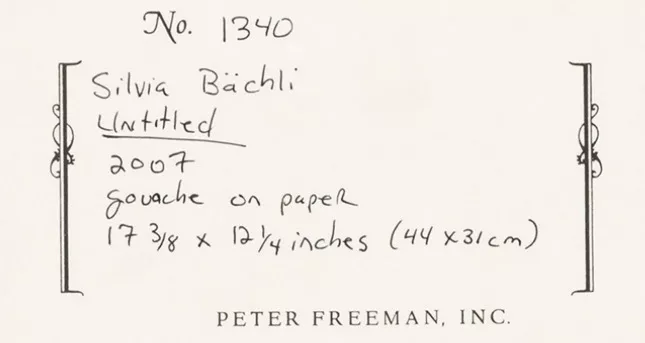
An example of her signature can be seen in the drawing below.
Expertise your property
If you own a Silvia Bächli work, feel free to request a free appraisal by filling in our online form.
A member of our team of experts and licensed auctioneers will contact you to provide an estimate of the market value of your work.
If you are considering selling your work, our specialists will also guide you through the various alternatives available to obtain the best possible price, taking into account market trends and the specific features of each object.
Estimate in less than 24h
Discover in the same theme

Rating and value of Josiane Cantin's sculptures and bronzes
Josiane Cantin is an artist who has produced a number of sculptures that are becoming highly valued at auction. Estimate in 24h.
Learn more >

Rating and value of sculptures, bronzes and elephants by Fra...
François Vandenberghe is a contemporary sculptor who has mainly produced bronzes of elephants, which are highly prized and valued.
Learn more >

Rating and value of drawings and paintings by Kate Hooray Os...
Kate Hooray Osmond is an American artist whose works command high prices at auction. 100% free appraisal.
Learn more >
D'autres tableaux abstraits vendus aux enchères

Estimated 2.000 - 4.000
Serge POLIAKOFF (1900-1969), Composition en rouge et bleu. 1965, Lithograph

Estimated Between €5,000 and €8,000
Jean MIOTTE (1926-2016), acrylic on canvas

Estimated 3.000 - 5.000
Roberto MATTA (1911-2002), Composition, Gouache on canvas

Secure site, anonymity preserved

Auctioneer approved by the State

Free and certified estimates
Frequently asked questions
-
Who is Silvia Bächli, and what is her artistic background?Silvia Bächli is a Swiss artist born in 1956 and a pioneer of contemporary drawing as an autonomous medium. Trained in Basel and Geneva, she has focused exclusively on drawing on paper since the 1970s and 1980s, a period when this medium was still marginalized. Internationally recognized, she represented Switzerland at the 2009 Venice Biennale, and her works are included in the collections of the Centre Pompidou, MoMA, and the Kunsthaus Zürich.
-
What are the price ranges for Silvia Bächli's drawings?Prices for works by Silvia Bächli range from €60 to €30,800. Drawings and watercolors are the most highly valued category, with prices ranging from €300 to €30,800. Multiple prints range from €60 to €1,000, while photographs range from €250 to €1,100. Her market value has seen a notable increase since the 2010s.
-
How can you authenticate a drawing by Silvia Bächli?To authenticate a work by Silvia Bächli, we recommend requesting a free appraisal from Auctie's. Our team of experts and state-certified auctioneers will examine your artwork and provide you with an accurate estimate of its market value. Please note that not all of this artist’s works are signed, and that copies exist.
-
Is this a good time to sell a work by Silvia Bächli?Yes, this is a good time to sell a work by Silvia Bächli. Since 2020, the market for works by female artists has been growing steadily and gaining increased critical recognition. The artist enjoys significant museum visibility and has been incorporated into the major narratives of contemporary art, which supports the rising value of her drawings at auction.
-
How does the appraisal process work at Auctie's?Appraisals at Auctie's are free and non-binding. Simply fill out our online form with information and photos of your artwork. A certified expert or auctioneer will contact you to examine the item and provide you with an estimate of its market value within 48 hours. If you decide to sell, we’ll guide you toward the best option to get the best possible price.
