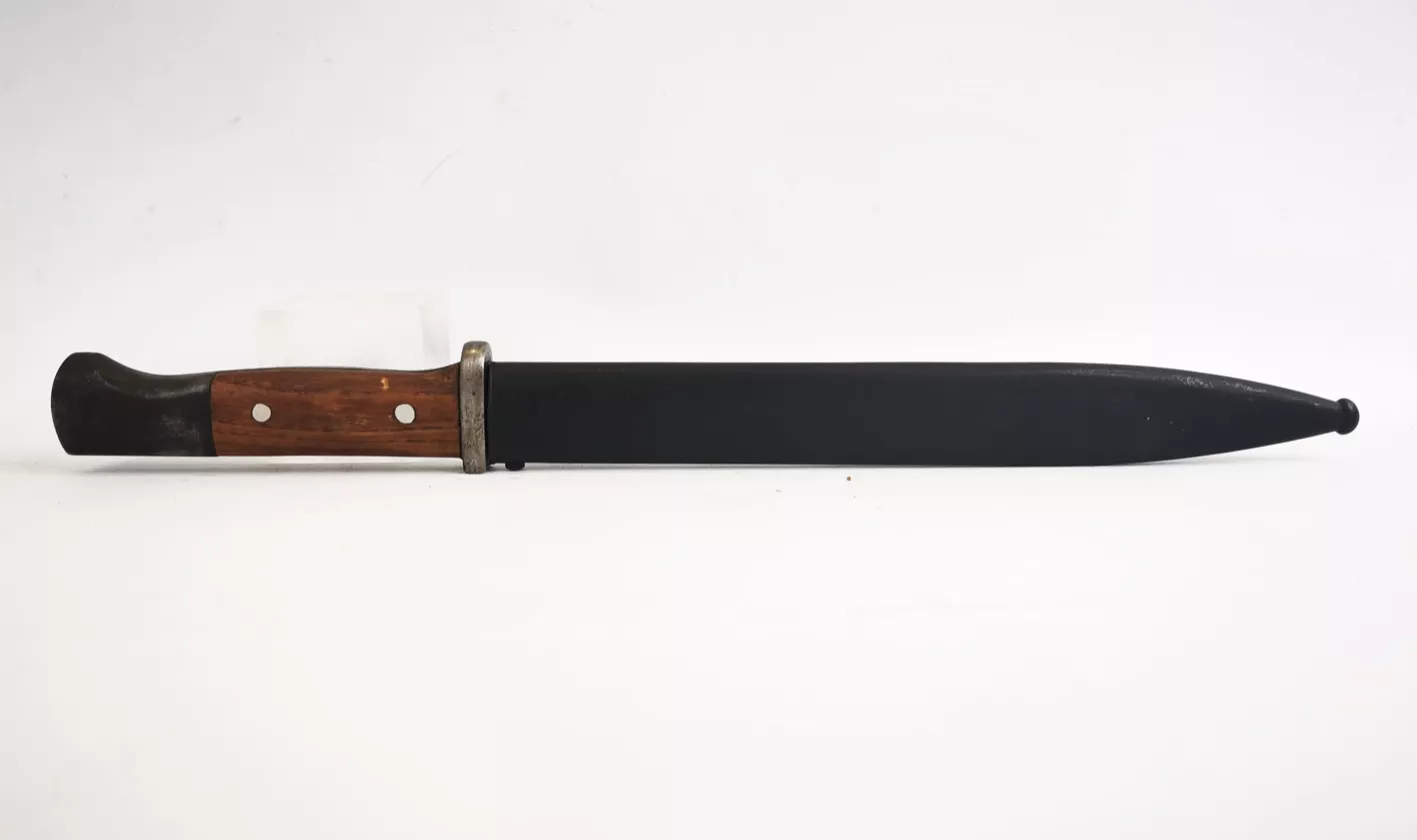
Rating and value of German, Russian and English bayonets...
Rating and value of your German, Russian and English bayonets
Key takeaways
Collectible bayonets sell for between €10 and €6,200, with exceptional historical pieces fetching up to €4,700 in 2016.
First appearing in Europe in the 18th century, bayonets evolved from plug-type models (1640) to socket-type models (1695) and eventually to the modern bayonet knives adopted by Germany in 1933.
Their value depends on the era, materials, manufacturer, associated military history, and the craftsmanship evident in the weapon.
If you own a collectible bayonet, and would like to know its value, our state-approved experts and auctioneers will offer you their appraisal services.
Our specialists will work to carry out a free appraisal of your work, and will send you an accurate estimate of its value on the current market.
Then, if you wish to sell your work, we will direct you to the best possible arrangement to obtain the optimum price.
Rating and value of bayonets
Appearing in the 18th century and adopted by Western armies, bayonets today are becomingtrue collector's items.
These bladed weapons have often crossed the ages and can bear witness to more or less ancient conflicts, or take on value because they belonged to specific personalities.
These are auctioned at very dissimilar prices, ranging from €10 to €6 200. In 2016, a brass-handled bayonet with iron scabbard, dating from 1866, sold for €4 700.
Estimation
Bayonets can be worth between €10 and €6,200.
Have your objects estimated for free by our experts
Estimate in less than 24h
The utility of the bayonet
Designed to be attached to the end of the barrel of a rifle or similar weapon, the bayonet is a bladed weapon, in other words a cutting weapon that relies on the physical effort of the user, as opposed to firearms that depend on the propulsion of projectiles.
As such, it can be used to engage in close combat, hand-to-hand fighting with a technique close to that of a spear.
This transformation makes the rifle much more than a simple ranged instrument; it becomes a versatile weapon, capable of fulfilling two distinct functions: that of a firearm and that of a hast weapon, a white weapon typically composed of a metal point attached to a wooden shaft.
Bayonets came into general use in the West from the 18th century onwards, a period when pikes and halberds, weapons of the old tradition, slowly gave way to rifles equipped with bayonets.
As the evolution of military tactics gave way to more mobile and adaptable formations, the infantrymen of European armies increasingly turned to this innovative weapon, which enabled them to retain a capacity for close defense, even in the absence of ammunition.
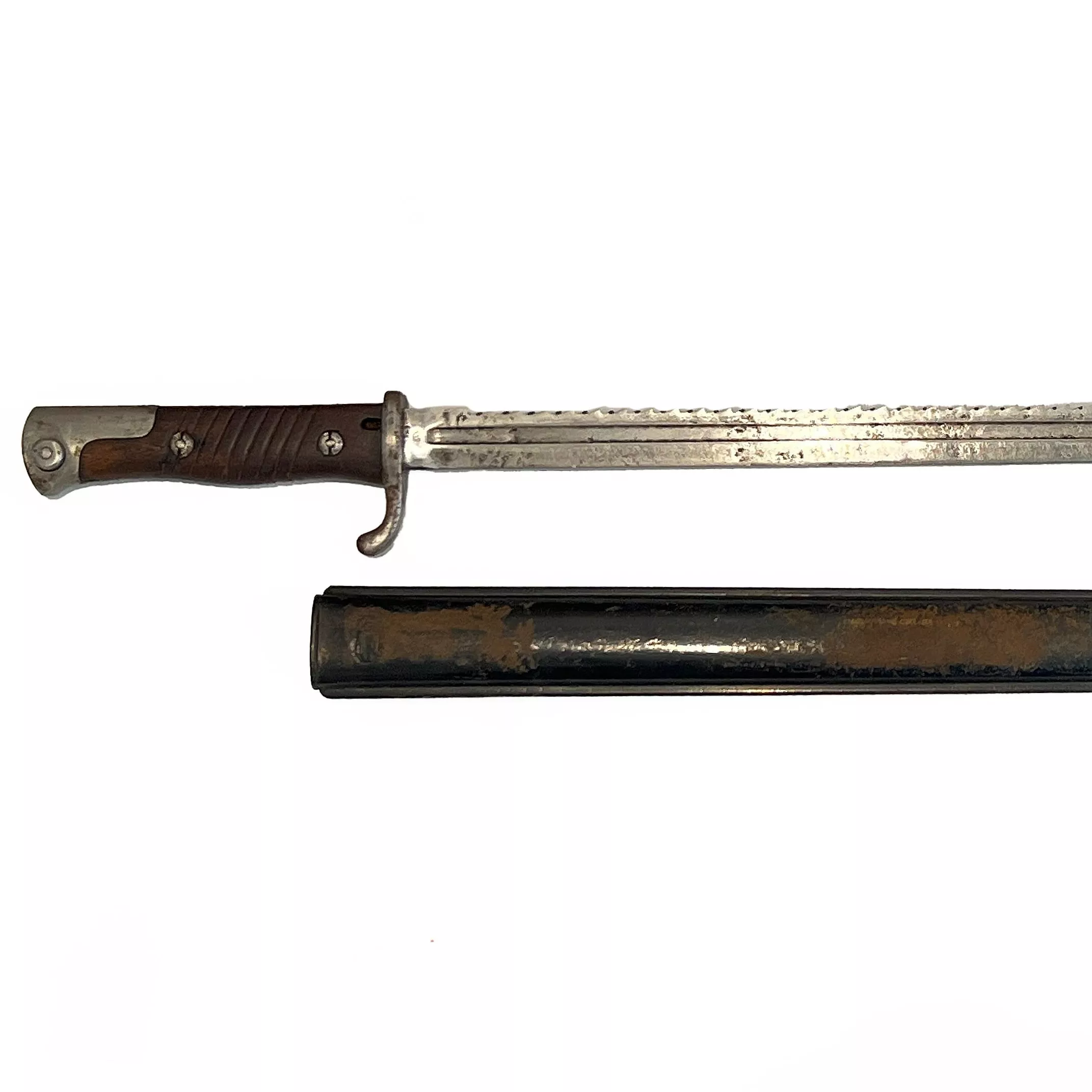
Baïonette allemande
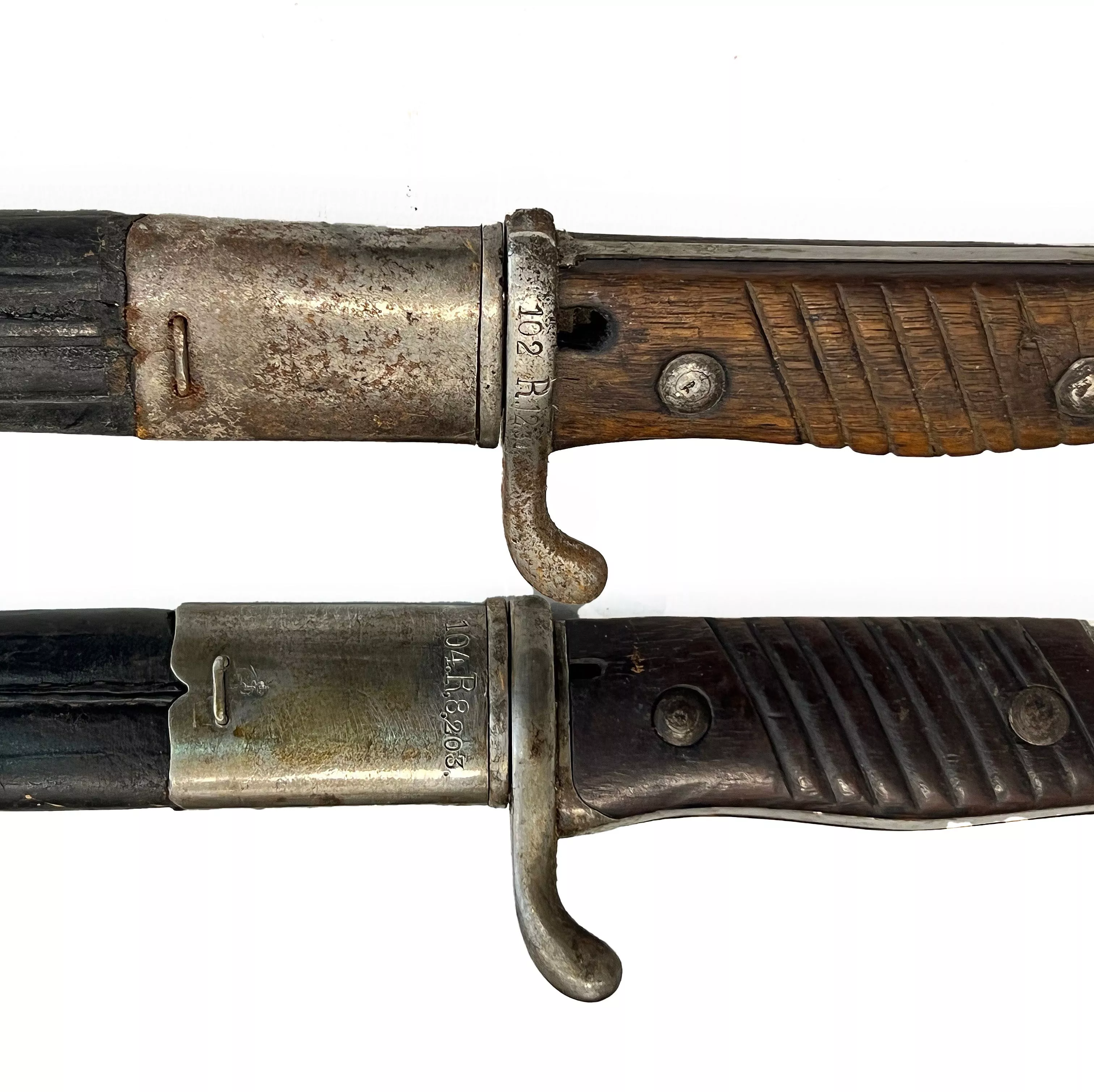
Détails de marquage sur une baïonnette
The history of the bayonet
The invention of the bayonet is generally attributed to the peasants of Bayonne, who, during their revolt and the sporadic conflicts of the 1660s, would have resorted to this weapon for lack of ammunition.
These Bayonnais would have attached hunting knives to the end of their sticks, in order to increase their defensive capacity. However, it's important to note that as early as the 17th century, the ancestor of the bayonet was already mentioned and used by the king's musketeers.
The latter added blades directly to the barrels of their muskets to transform them into melee weapons, and thus be able to defend themselves when engaged in close combat.
Parallel to this, there are several accounts of French archers using this weapon to protect themselves in field battles. It was in 1640 that the first bayonets were officially employed by the French armies.
At the time, under the reign of Louis XIII, these bayonets measured around thirty centimeters and were of the "bouchon" type. They were fitted with a cylindrical handle that enabled them to be attached securely to the musket barrel.
While this model was effective for close-range fighting, it could not replace the pikemen, those soldiers armed with long halberds or pikes, whose main function was to protect the shooters against enemy charges.
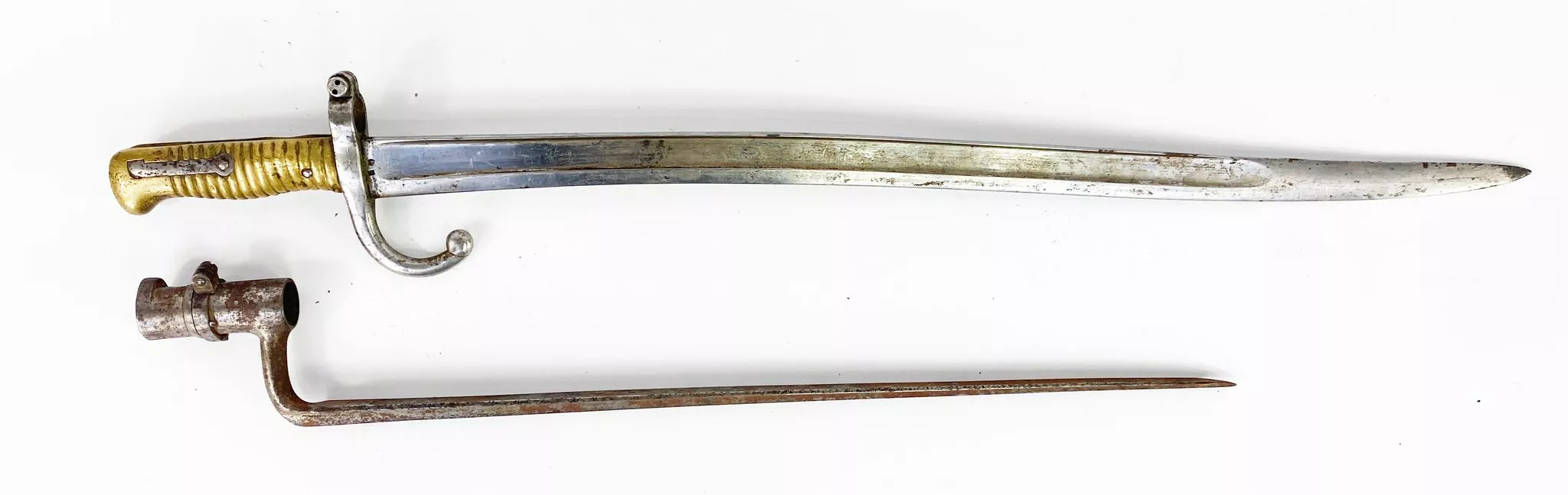
Chassepot 1866 en haut et en bas une baïonnette à douille Début XIXème siècle
Bayonet production
Initially, there were two types of bayonet: the plug bayonet and the socket bayonet. The wooden handle of the plug bayonet is inserted into the barrel.
This model of bayonet was introduced into Europe around 1640-1647, it is therefore the very first model, initially designed for hunting. Although it has the advantage of being sharp on both sides, it is impossible to shoot when fixed.
The socket bayonet appeared in 1695, consisting of a tube to which the blade is fixed. This model underwent modifications in 1703 to reload the weapon, then in 1770 with the addition of the ferrule, which allowed for better attachment. The straight-bladed saber-bayonet was then invented by the UK in 1800 and adopted by France in 1840.
As military tactics evolved, the bayonet became similar to a relatively short sword, from its beginnings until the mid-19th century, one of whose archetypal models remains the Baker rifle, used by the British infantry until the 1840s. The bayonet became versatile with the invention of the "rifled rifle" as early as 1854, in the style of the "Sawback model", invented by Prussia in 1865.
In 1869, the British appropriated this model to invent a very similar weapon. The bayonet knife was definitively adopted by Germany and Italy in the year Hitler came to power, along with the USA in 1944. This model thus became standardized for all armies using bayonets.
In principle, recent bayonets have a visible gutter on the emerging part of the blade. Designed to limit the weight of the bayonet, this gutter forms a concave depression. More recently, the modern U.S. M9 sawback bayonet was introduced in 1984. It incorporates one of the features of the Russian AK-47 model, which can slice through barbed wire with a cutting brush.
The M7 bayonet of the 1960s has been replaced by the M9 bayonet. Today, bayonets take the form of a knife with a handle, part of which attaches to the rifle in the manner of the SKS. The type of SKS bayonet blade varies according to the place and date of manufacture, the blade may take on a knife-like appearance (Romania, Russia, Yugoslavia), a cruciform appearance (modern China) or triangular (Albania).
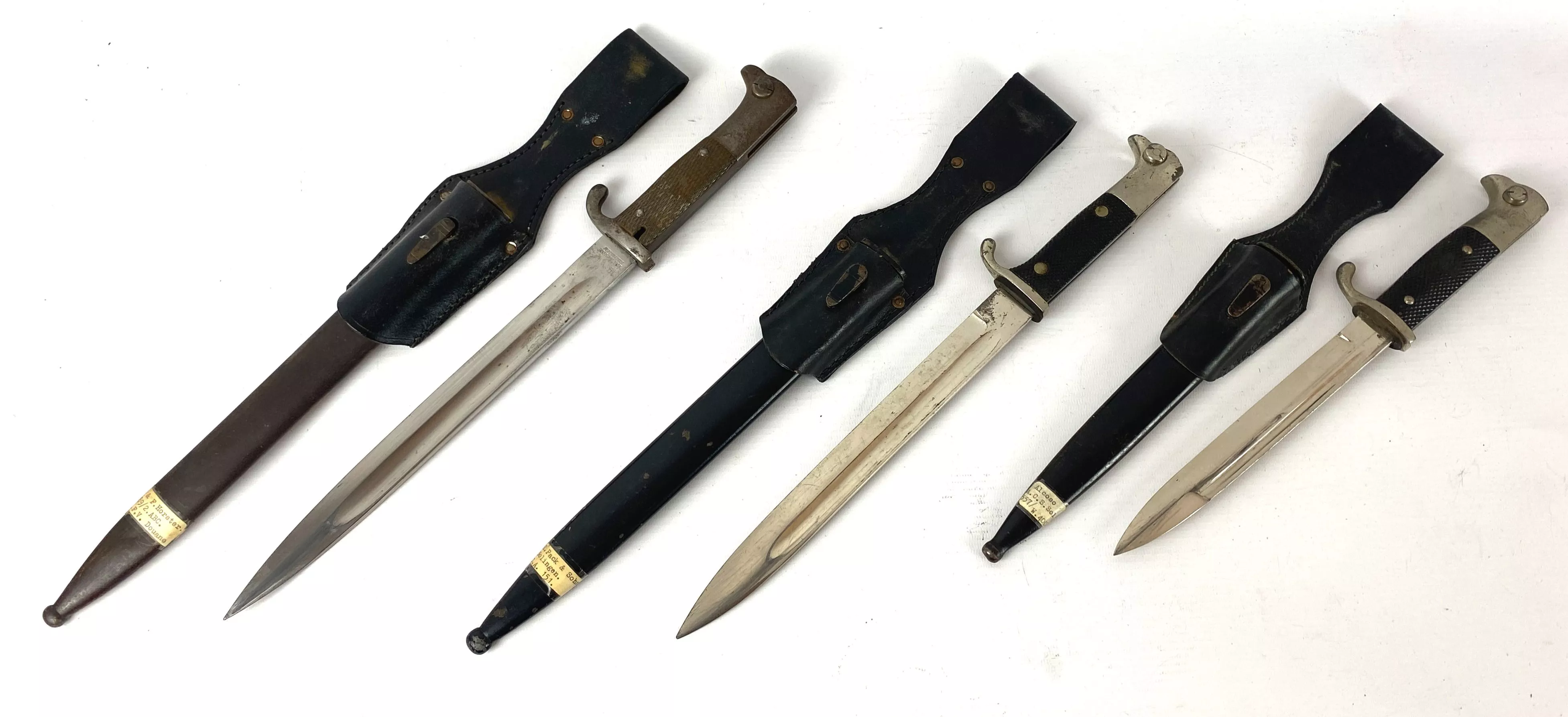
Baionette Solingen, Henkel, Solingen Début XXème siècle
Point Histoire : La baïonnette à Verdun
One of the most famous anecdotes involving a bayonet takes place during the First World War, at the Battle of Verdun in 1916.
Verdun, the symbol of French resistance, was the scene of one of the fiercest battles in history, where the bayonet, as never before, took a prominent place on the battlefield.
In February 1916, the French and German armies fought a war of positions that lasted several months.
Soldiers, trapped in muddy, narrow trenches, regularly find themselves having to fight hand-to-hand, for lack of space to deploy their firearms.
One of the most striking moments of this battle comes during a heroic charge by French troops.
With the defensive line on the brink of collapse under the relentless onslaught of the German army, a French lieutenant, Charles de Gaulle, later General and President of the French Republic, leads his men in a desperate offensive.
At the decisive moment, the order is given: "Fix bayonets!". The soldiers, exhausted but determined, leap into the fray, bayonets forward.
The scene is one of unprecedented violence: the bayonets, at the end of the rifles, are transformed into veritable makeshift swords, used to pierce enemy lines in an outburst of brute force.
Hand-to-hand combat, with the use of the bayonet, illustrates both the brutality and the necessity of this weapon in a context where space and time were reduced to their strict minimum.
Thanks to this charge, albeit costly in terms of human lives, the French succeeded in retaking a strategic position. The bayonet, in this crucial moment, embodies not only the violence of trench warfare, but also the resilience and self-sacrificing spirit of the soldiers.
The bayonet, in this crucial moment, embodies not only the violence of trench warfare, but also the resilience and self-sacrificing spirit of the soldiers.
Alban Degrave
Making a name for himself in 2016, Alban Degrave quickly established a standard of excellence. He is now recognized for his mastery in appraising a multitude of weapons, from Renaissance sabers to First World War bayonets, from unique Corsican stylets to rifles and carbines from different eras. For Auctie's, he appraises and values your objects in accordance with French and European standards.
Send a message
Baïonette allemande de type Mauser
Why are these items prized on the auction market?
The market for antique weapons is relatively unknown to the general public, but is fueled by collectors who resell and buy antique weapons, such as bayonets.
Highly linked to the Historyof France, Europe and beyond (we also find Ottoman, Asian or American weapons), antique weapons are both sought-after for the know-how they bear witness to and for the History they bring back.
By going through the auction process, your weapon is submitted to an expert who scrutinizes it in minute detail. The expertise thus enables future bidders to know, if you don't, the era of the weapon, the materials in which it was made, the manufacture, or even the conflicts in which it may have been used.
Have your objects estimated for free by our experts
Estimate in less than 24h
Knowing the value of an object
If you happen to own a weapon similar to a bayonet, request a free appraisal without further delay via our form on our website.
A member of our team of experts and certified auctioneers will contact you promptly to provide you with an estimate of the value of your work, as well as any relevant information about it.
If you are considering selling your work, you will also be accompanied by our specialists in order to benefit from alternatives for selling it at the best possible price.
Bayonets can be worth between €10 and €6,200, depending on their origin, condition, and historical context. For example, a bayonet with a brass handle and an iron scabbard dating from 1866 sold for €4,700 in 2016. Price variations depend on factors such as the manufacturer, the era, and the conflicts in which they were used.
How can you authenticate a bayonet and determine its exact value?
The best approach is to request a free estimate from Auctie's, an auction house. Our experts and state-certified auctioneers will examine the firearm in great detail to determine its period, materials, manufacturer, and historical context. You’ll receive a response within 48 hours, with no obligation.
When is the right time to sell a collectible bayonet?
Yes, it's a good time to sell. The market for antique weapons, particularly bayonets, remains strong year-round among collectors. These items are sought after for the craftsmanship they exemplify and the historical significance they represent, especially bayonets associated with major European conflicts.
What is the appraisal and sales process at Auctie's?
The process begins with a request for a free, no-obligation estimate. An Auctie's expert will contact you to examine your bayonet and provide you with an appraisal within 48 hours. If you decide to sell, our specialists will guide you through the entire process to ensure you get the best possible price at auction.
Why are bayonets such sought-after items at auction?
Bayonets are sought after for several reasons: they reflect the military expertise of their era, they are closely tied to major historical events (particularly the world wars), and they come in a wide variety depending on their origin (French, German, Russian, English, etc.). At auction, a detailed appraisal allows collectors to know precisely the authenticity and context of each piece.