



Rating and value of works, paintings, drawings by Sam Szafran

Key takeaways
- Works by Sam Szafran (1934–2019), a French figurative artist of Polish origin, sell for between €15 and €720,000, depending on the medium and rarity.
- In 2019, *L'imprimerie Bellini* sold for €720,000, exceeding its initial estimate of €400,000 to €600,000 and confirming the artist’s very high market value.
- His oil paintings sell for between €350 and €174,000, while his drawings and watercolors fetch up to €720,000; prints remain more affordable (€15 to €41,000).
If you own a work by or after the artist Sam Szafran, and would like to know its value, our state-approved experts and auctioneers will offer you their appraisal services.
Our specialists will carry out a free appraisal of your work, and provide you with a precise estimate of its value on the current market.
Then, if you wish to sell your work, we will direct you to the best possible arrangement to obtain the optimum price.
Rating and value of artist Sam Szafran
Sam Szafran comes from figuratism. He leaves behind works inspired by the important moments of his time. His legacy consists of paintings, prints and drawings.
At present, prices for his works are exploding at auctioneers' gavels. His paintings are particularly prized above all by French buyers, and the price at which they sell on the art market ranges from €15 to €720,000, a considerable delta but one that speaks volumes about the value that can be attributed to Sam Szafran's works.
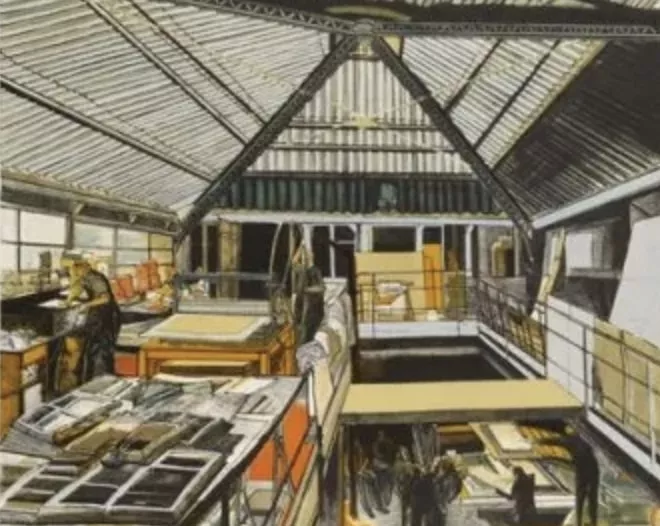
In 2019, his composition L'imprimerie Bellini sold for €720,000 while it was estimated at between €400,000 and €600,000. The artist's quotation is very high and varies according to the quantity of work present on the auction market.
Order of value ranging from a single work to the most prestigious
Technique used | Result |
|---|---|
Estamp | From €15 to €41,000 |
Oil on canvas | From €350 to €174,000 | Drawing - watercolor | From €30 to €720,000 |
Estimate in less than 24h
Style and technique of artist Sam Szafran
Sam Szafran is part of figurative art, influenced by the Académie de la Grande Chaumière. There is a slight surrealist influence in his work.
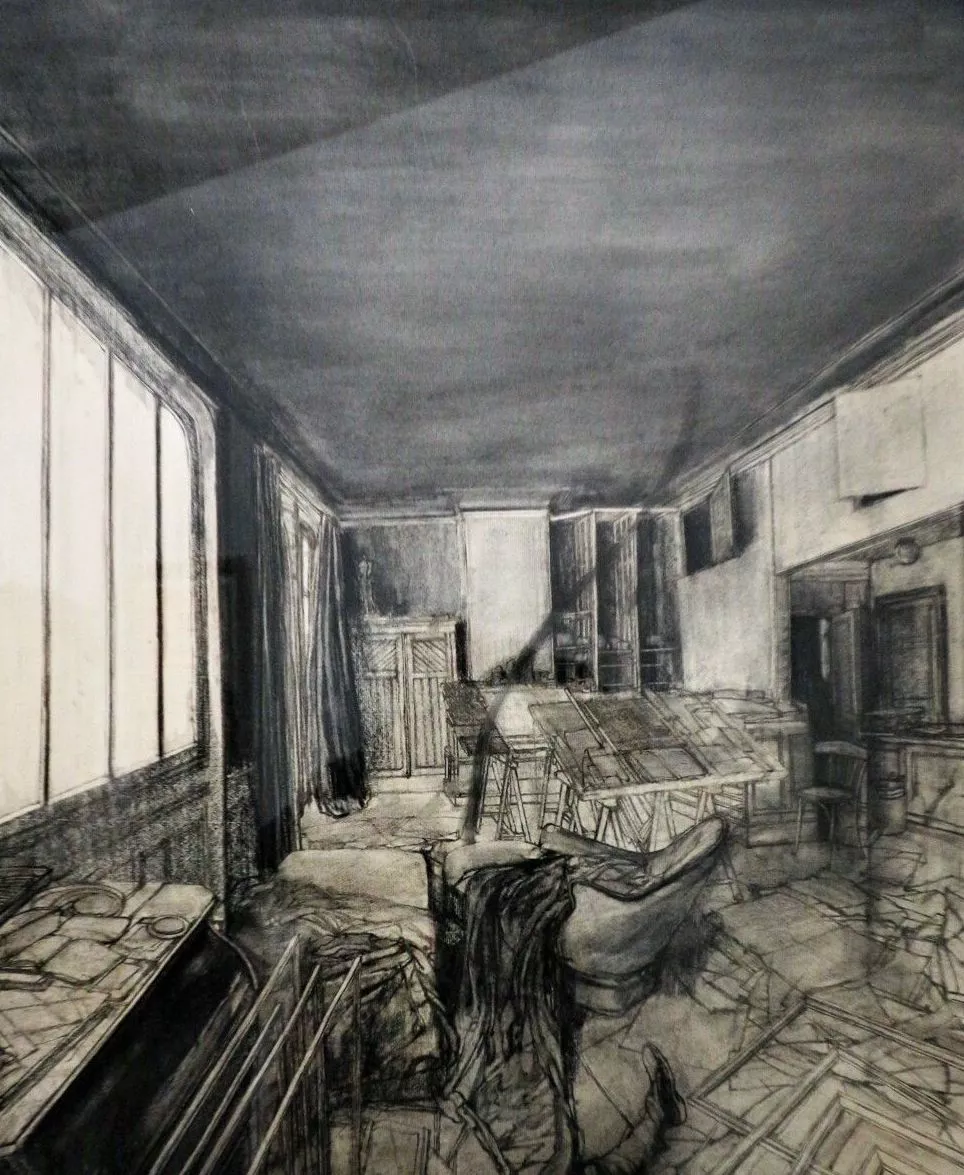
In Sam Szafran's pastels, the material retains this ability to render the density of space, the infinite depth of enclosed places.
But it's at the price of a shift: no longer limited to a faithful transcription of the visible, it becomes the vehicle of a shifting perception, where every surface, every detail, seems sucked into a whirlpool of light and shadow.
The line remains, but is fragmented, embracing the distortions of perspective without freezing them, while color stretches out in superimposed strata, drowning outlines in a network of unstable vibrations.
In his compositions, space is no longer structured by the rigor of drawing but by a play of controlled distortions, where illusion and reality merge in a precarious equilibrium.
Thus, freed from its traditional role, pastel no longer coincides with the meticulous recording of reality for which it was primitively intended; it is now devoted to the exploration of an inner vision, to the recreation of an organic space, in perpetual metamorphosis.
The life of Sam Szafran
The life of Sam Szafran
Sam Szafran (1934-2019) was a French artist of Polish origin, famous for his work as a painter, draughtsman and printmaker. He is best known for his works inspired by landscapes, domestic interiors and architectural motifs.
He was of Polish origin, his parents were Jewish and died in the concentration camps. He was adopted and moved to Paris when he came of age. He attended the Académie de la Grande Chaumière, where he met Yves Klein.
Szafran was particularly renowned for his series of drawings and prints depicting staircases, corridors and bedrooms, exploring the relationship between architectural space and human psychology. His works often feature a keen sense of perspective and meticulous detail, creating an intriguing and sometimes mysterious atmosphere.
He also explored a variety of media, including oil painting, watercolor, etching and pastel. His style is characterized by a meticulous, meticulous approach, as well as a subtle use of color and light to create particular moods in his compositions.
A surrealist influence can be discerned in his work, finding hints of Magritte in the distribution of space and use of color.
Focus on L'Escalier, Sam Szafran
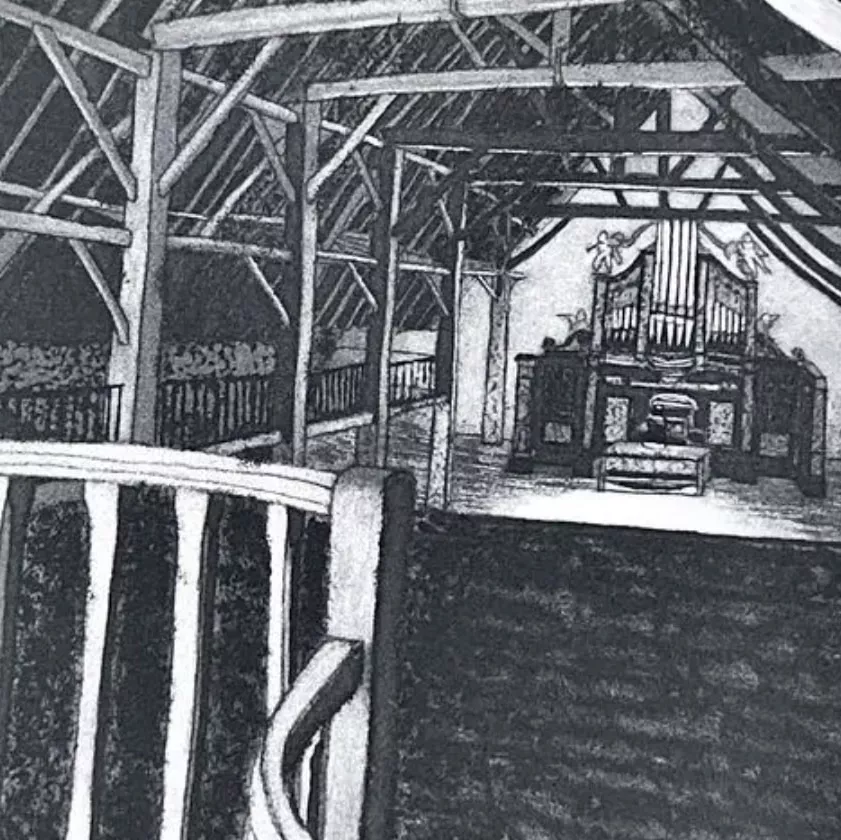
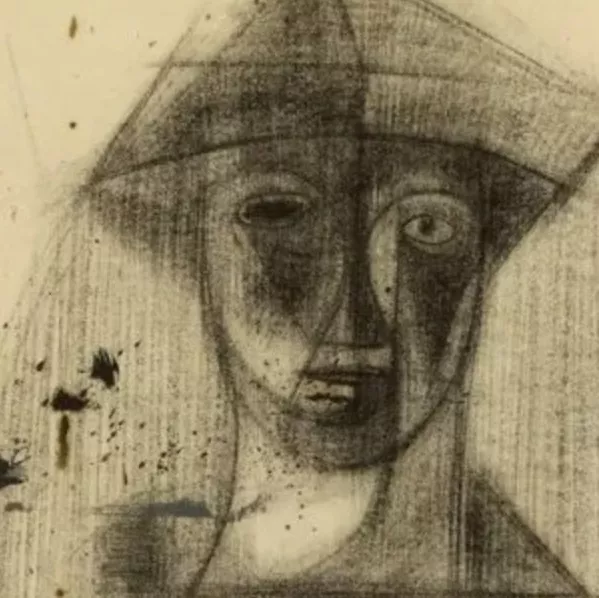
In L'Escalier (fig. 1), a pastel work, Sam Szafran pushes the twisting of space to the extreme, to the point of giving it a dizzying instability.
There are photographs of his studio, in which these spiral staircases are recognizable, but the painting operates a displacement: it no longer describes a tangible space but a continuous field, traversed by shifts and dilations.
Architecture no longer imposes itself as an ordering structure, it becomes the site of a shift, a network of lines and curves that frees itself from the laws of perspective.
Pastel inflicts a subtle conversion on the material, taking it from a structuring outline to an undulating mesh, where color seems to detach itself from form.
Steps and ramps, far from articulating depth, dissolve into a shifting weave, an unstable space that only light can organize.
In this incunabulum of Szafran's painting, classical perspective seems to go back in time. But it does so at the cost of a shift, an inflection, and the architectural structure becomes detached from its foundations.
The legacy of Sam Szafran
In the decades that followed, Sam Szafran's work made its mark on a generation of artists fascinated by exploring the visible.
But it's at the cost of a shift: it's no longer a question of representing space, but of making it vacillate, of subjecting it to a dynamic of its own, where matter and light interpenetrate.
The studio, the staircase, the greenhouse are no longer motifs, but moving territories, surfaces of inscription where pastel, worked to saturation, unfolds its infinite modulations.
This "perversion" of the traditional framework of painting is accentuated in those who follow in his wake: depth is no longer ordered according to Cartesian logic, it diffracts in splinters, in elusive reflections.
In this diffuse posterity, space ceases to be a stable container, becoming the site of a tension, a vertigo, a suspended movement that defies all fixity.
Today, his works are highly valued on the art market, and he is one of the most sought-after artists in France.
Sam Szafran's stylistic influences
In Sam Szafran's world, pictorial filiations are not limited to a declared heritage; they infuse, transform, distend until they become diffuse resonances.
But this is at the cost of a shift: echoes of Symbolism, Surrealism and Impressionism no longer manifest themselves as direct quotations, they infiltrate the very structure of the image, in its interplay of appearance and disappearance.
The influence of Degas persists, but it no longer organizes the composition, it dissolves within it, absorbed in a network of distortions and perspectival vertigo.
Szafran's pastels are no longer merely a reminiscence of the master, they are a field of experimentation, where the dust of pigment becomes living matter, fluid, unstable.
If we perceive in him an echo of the atmospheres of Vuillard or Bonnard, it's in a deviant form, where the domestic scene dislocates, fragmenting into a shifting weave.
This "perversion" of illusionist codes goes from strength to strength, until space becomes an uncertain territory, saturated with echoes and superimpositions.
In Szafran's staircases, perspective no longer obeys a rational logic; it twists, repeats, refracts, until it abolishes the distinction between inside and outside, between empty and full.
In this approach, there's an extension of Cubist research, but it's no longer governed by angle and structure: it's based on fluidity, on a dissolution of the frame that sometimes evokes Escher's distortions or the meanders of an organic labyrinth.
Color, often reduced to subdued shades, plays a part in this suspension, in the manner of a Rothko whose chromatic vibrations would have condensed into a concrete space.
In this constellation of transfigured influences, Szafran's studio becomes a laboratory where forms never stabilize, where painting ceaselessly questions its own status.
His compositions, traversed by invisible correspondences, lie neither in reality nor in pure abstraction; they establish a continuum where references float, overlap and vanish.
There is no longer a fixed horizon, no hierarchy of planes, only a drift, an incessant displacement, a shift where each motif becomes an echo, a fleeting imprint of a pictorial memory in perpetual metamorphosis.
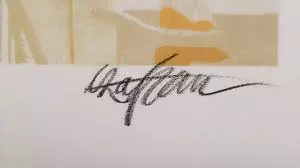
Recognizing Sam Szafran's signature
Sam Szafran doesn't always sign his works. If you think you own one, it's best to have your painting appraised.
Knowing the value of a work
If you happen to own a work by or after Sam Szafran, don't hesitate to request a free appraisal using our form on our website.
A member of our team of experts and certified auctioneers will contact you promptly to provide you with an estimate of the market value of your work, as well as any relevant information about it.
If you're thinking of selling your work, our specialists will also be on hand to offer you alternatives for selling it at the best possible price, taking into account market inclinations.
Estimate in less than 24h
Works from the same period sold at auction

Discover in the same theme

Rating and value of drawings, mirrors, lamps by Archibald Kn...
Archibald Knox is a twentieth-century Art Nouveau artist who produced works that are highly rated and valued at auction.
Learn more >

Rating and value of Lalan's paintings and drawings
Lalan is a Chinese artist who has produced abstract paintings that are highly rated and valued at auction. Estimated in 24h.
Learn more >

Rating and value of paintings by Félix Varla
Félix Varla is a painter close to the Nouveau Réalisme movement. He has produced many works that are highly valued at auction.
Learn more >

Secure site, anonymity preserved

Auctioneer approved by the State

Free and certified estimates
Frequently asked questions
-
Who is Sam Szafran, and what is his artistic style?Sam Szafran (1934–2019) was a French artist of Polish origin and a leading figure in the Figurative Art movement. Trained at the Académie de la Grande Chaumière, he distinguished himself through his paintings, drawings, and engravings that explored architectural space and human psychology, particularly through series depicting staircases, hallways, and interiors. His work, influenced by Surrealism and characterized by a meticulous approach to perspective, lends space a dizzying and shifting dimension.
-
What is the price range for Sam Szafran's works?The prices of Sam Szafran’s works vary considerably depending on the medium and the prestige of the piece, ranging from €15 to €720,000. Prints sell for between €15 and €41,000, oil paintings on canvas for between €350 and €174,000, and watercolor drawings for between €30 and €720,000. In 2019, his work *L'imprimerie Bellini* exceeded its estimate, selling for €720,000.
-
How can you authenticate a work attributed to Sam Szafran?Sam Szafran did not always sign his works, which makes authentication difficult. We recommend that you request a free appraisal using the Auctie's form: a certified expert or auctioneer will examine your artwork and provide you with their opinion within 48 hours, with no obligation on your part.
-
Is this the right time to sell a work by Sam Szafran?Yes, now is a good time. Sam Szafran is one of the most sought-after artists on the French art market today, with a very high market value that continues to rise. Demand for his paintings, in particular, remains strong, ensuring a good return on sale.
-
How does the sale of a work of art work at Auctie's?Auctie's supports you every step of the way: a free, no-obligation appraisal conducted by our experts and certified auctioneers, followed by guidance on the best sales options to achieve the highest possible price given current market conditions. Our specialists will advise you on the sales strategy best suited to your artwork.
