



Rating and value of paintings, oils on canvas by Georges Mathieu

Key takeaways
- Georges Mathieu is a leading artist in the field of lyrical abstraction whose market value is steadily rising, with prices ranging from €5 to €1,666,170.
- Large-format paintings dated between 1950 and 1980 command the highest prices, with estimates ranging from €70,000 to €150,000, while those created after 1980 are valued at €12,000 to €20,000.
- His auction record was set in 2020 with *Souvenir de la maison d’Autriche* (1978), which sold for €1,514,670, reflecting the strong demand for his monumental compositions.
If you own a work by artist Georges Mathieu or based on his work and would like to know its value, our state-approved experts and auctioneers will guide you.
Our specialists will carry out a free appraisal of your work, and provide you with an accurate estimate of its value on the current market.
Then, should you wish to sell your work, we will direct you to the best possible arrangement to obtain the optimum price.
Artist's rating and value
Considered a major artist of lyrical abstraction, Georges Mathieu exhibited widely during his lifetime. As a result, he has already achieved a certain notoriety and presence on the art market.
Today, his stock continues to rise, the artist establishing himself as a sure bet on the art market, with prices at which they sell ranging from €5 to €1,666,170 on the art market.
A work by Mathieu can fetch hundreds of thousands of euros at auction, as demonstrated by his composition Souvenir de la maison d'Autriche, dating from 1978 sold for €1,514,670 in 2020, whereas it was estimated at between €1,490,000 and €2,560,000.
Order of value from the most basic to the most prestigious
Technique used | Result |
|---|---|
Ceramics | From €150 to €800 |
Estamp - multiple | From €5 to €2,800 |
Sculpture - volume | From €10 to €5,800 |
Drawing - watercolor | From €60 to €47,200 |
Painting | From €300 to €1,666,170 |
Estimate in less than 24h
Artist's style and technique
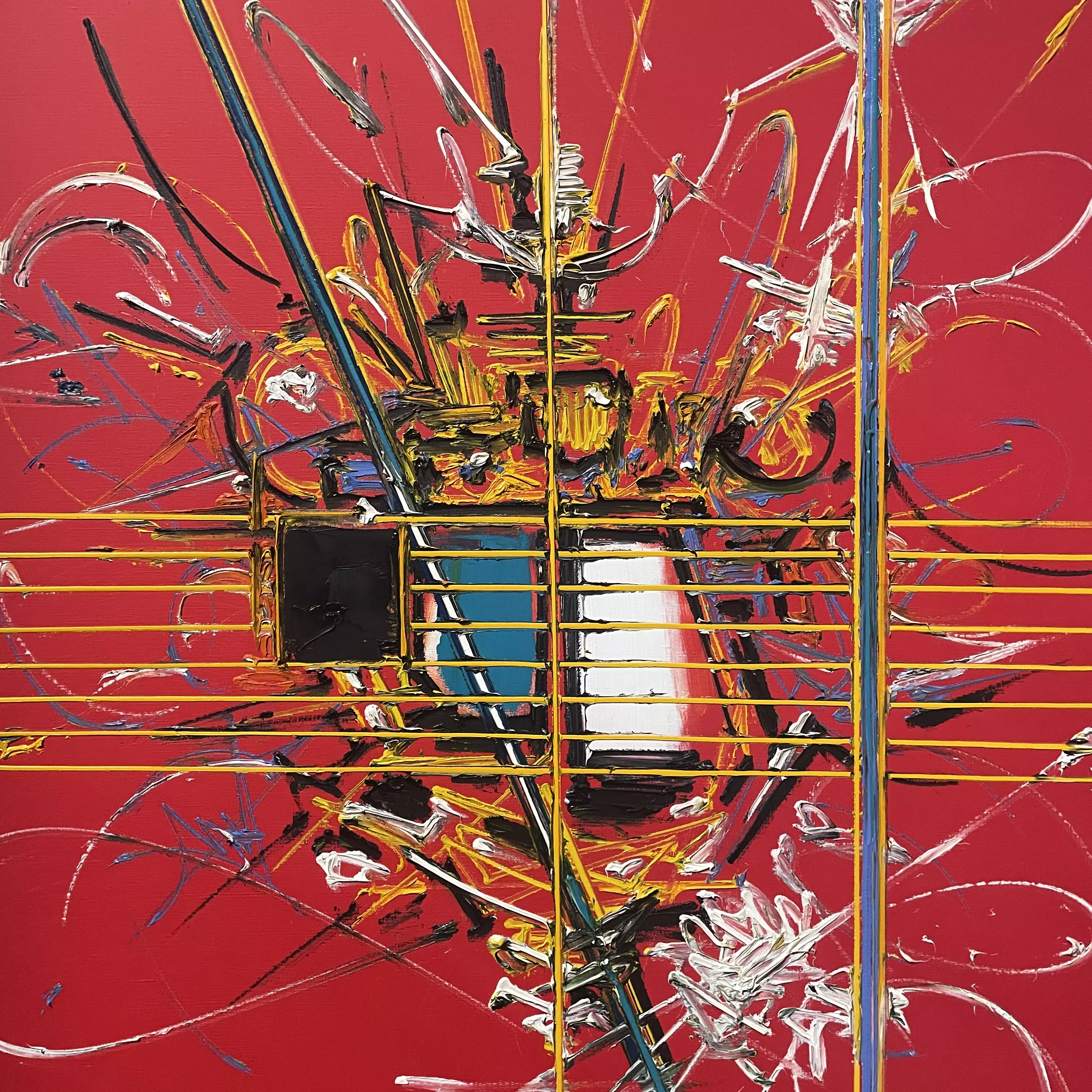
Georges Mathieu (1921 - 2012) uses oil paint and then acrylic applied to loose or stretched mounted canvas in his media and supports, and often in large format, with canvases up to several meters in length.
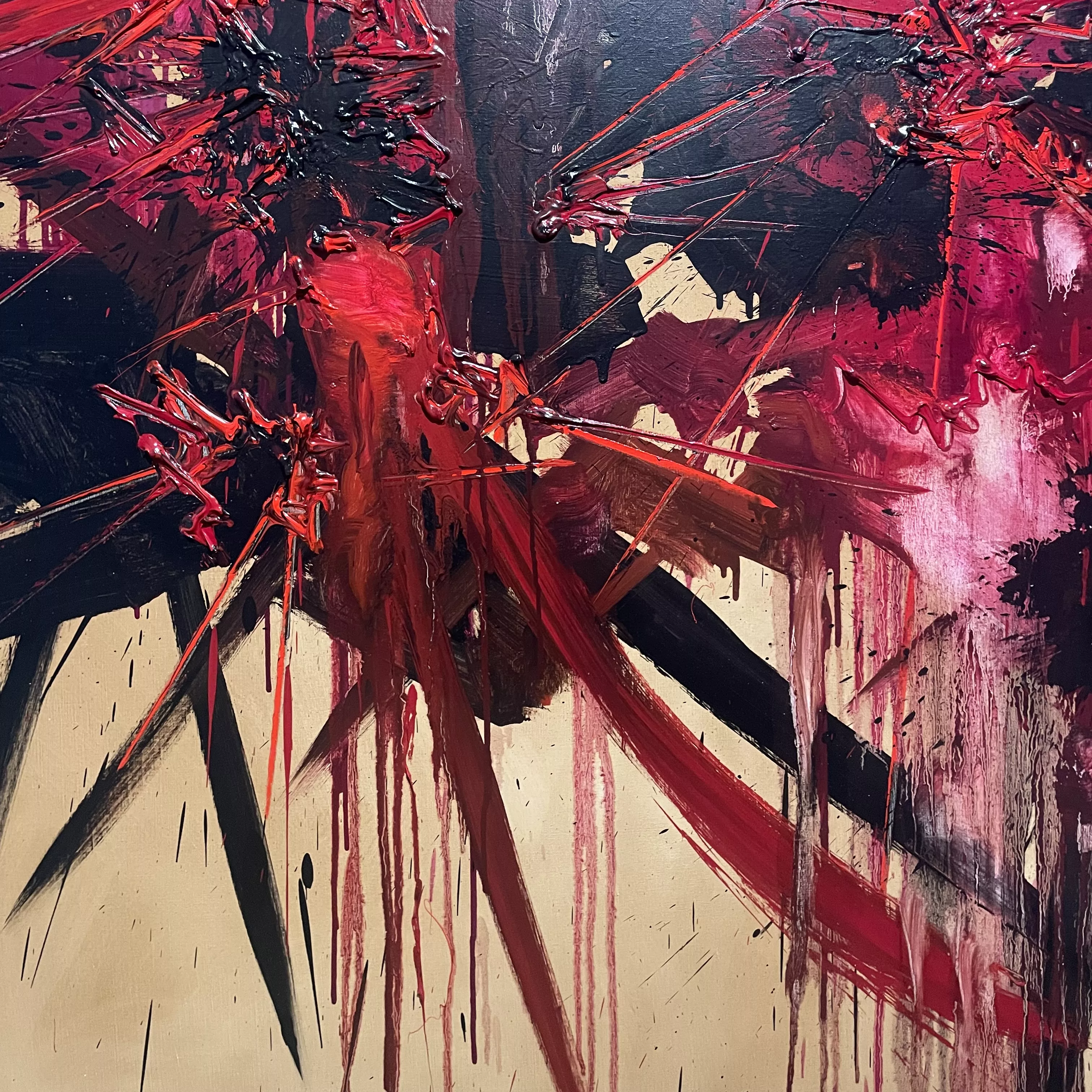
The painter uses non-traditional tools : large brushes, brushes, syringes, directly pressed tubes, sometimes sticks or even his fingers. He has a preference for pure pigments and quick-drying binders such as acrylic, which allow instant execution.
He develops a rapid, improvisatory, quasi-calligraphic gesturality, working with spray application, splashing, throwing and dripping, in a centrifugal and centripetal dynamic inscribing movement in the material.
Mathieu works vertically, often in front of an audience, giving a performative dimension to the pictorial act. He attaches great importance to the tempo of execution : his works are sometimes completed in a matter of minutes, exalting spontaneity as a plastic value.
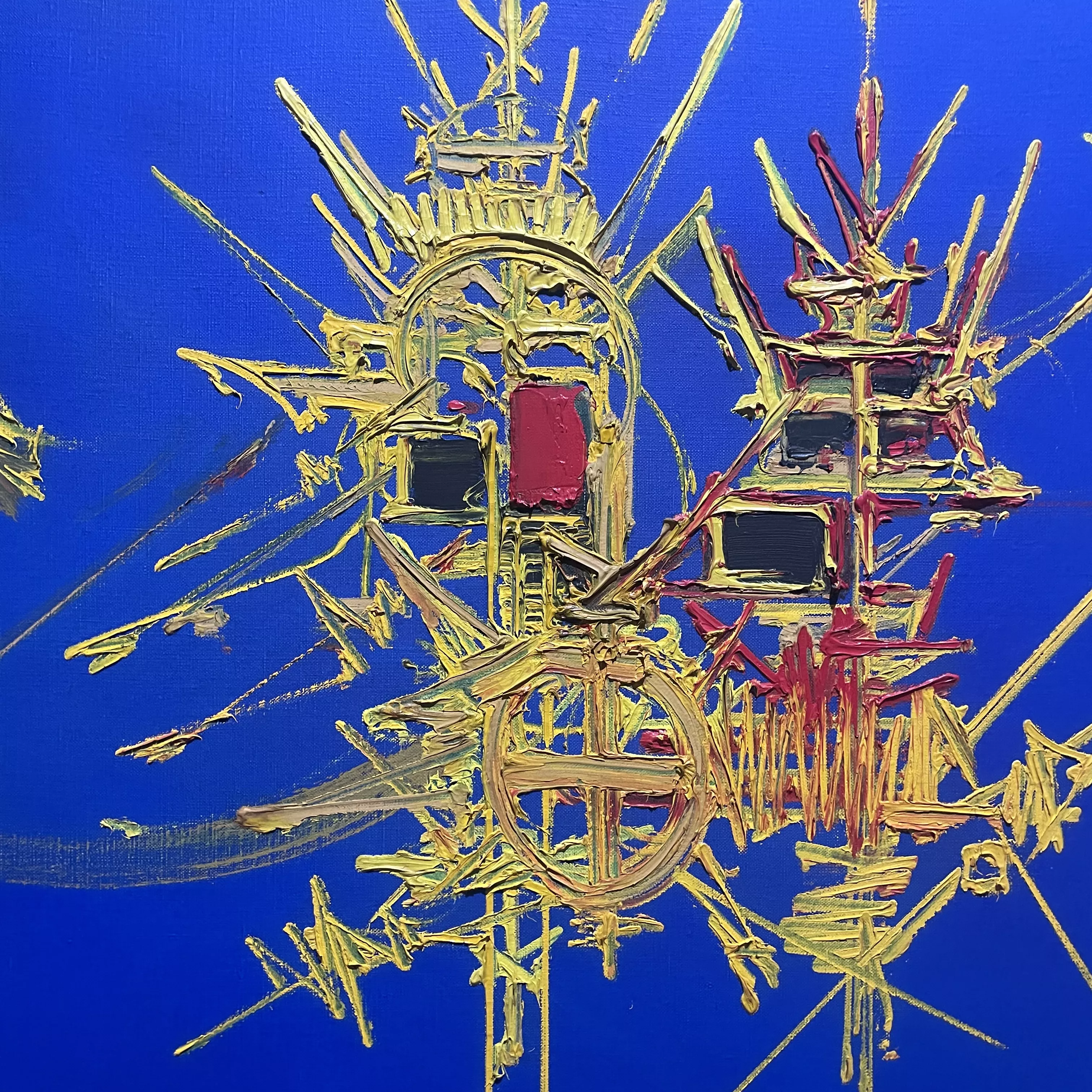
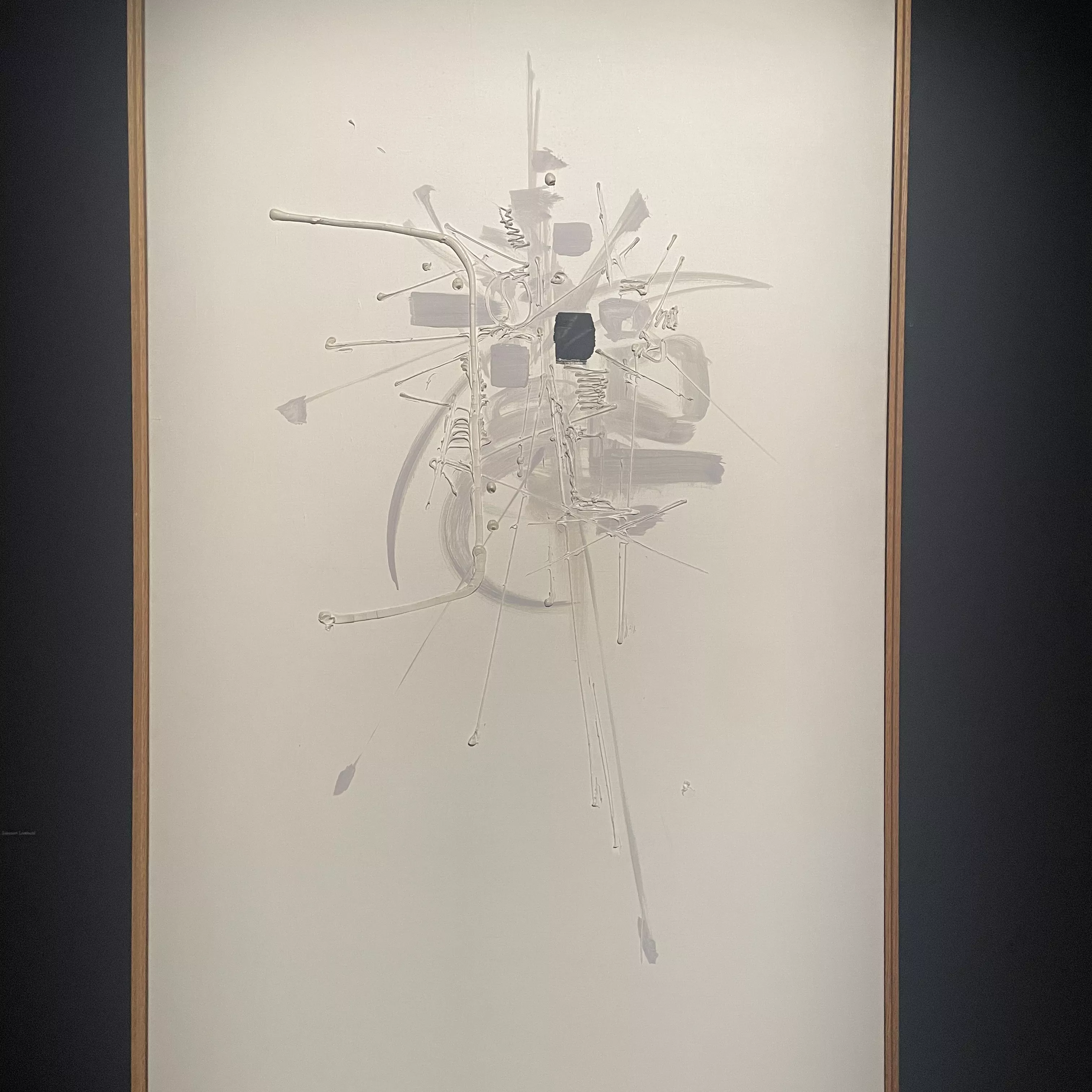
His organization is not geometric and without prior preparation, his composition is based on the dispersion and concentration of signs. We note the presence of nodal forms (clusters of strokes, bursts of color) organized in an exploded pictorial field, sometimes centered.
The works function as energetic fields, with no hierarchy of foreground or background. The artist makes use of vivid chromatic contrasts (reds, blues, whites, blacks, golds) with the aim of reinforcing visual tension.
The material is projected in thin or thick layers, creating accidental accumulations, reliefs and impastos. The superimpositions are random, with gestural stratification producing optical interference.
The rapid execution gives the painting the dimension of an event trace, since the paint is the material memory of a gesture. The dimension is close to Far Eastern calligraphy : the single, irreversible stroke condenses energy, rhythm and intention.
He began happening (public performance) as early as 1956, in turn inscribing painting in a logic of artistic performance that anticipates the action painting of Pollock and Sobel. His aesthetic positioning will remain that of lyrical abstraction, in opposition to the geometrism of cold abstraction.
He rejects preparatory composition, with primacy given to intuition, gesture and the instant, seeking an absolute of the pictorial sign, where the painting is both process and result.
The life of Georges Mathieu
Georges Victor Mathieu d'Escaudoeuvres (1921 - 2012) was born in Boulogne-sur-Mer, Pas-de-Calais. He studied law, literature and philosophy, already beginning to develop a profile as a versatile intellectual. He was initially an English teacher, then worked in communications and cultural relations, among others at NATO.
In the 1940s, he produced his first abstract paintings, which were influenced by surrealism and lyricism. In 1947, he co-founded the lyrical abstraction movement, in opposition to geometric abstraction.
From the 1950s, he developed the performative practice of painting, and executed monumental canvases in front of his public, acquiring international notoriety.
Politically, Georges Mathieu was a convinced royalist, hostile to parliamentary democracy, which he judged ineffective and declining. In his writings (cf De l'abstrait au possible and Au-delà du tachisme), he defends a hierarchical, aristocratic vision of society. He advocates a return to a constitutional monarchy in France, which he believes is the only way to guarantee stability and national greatness.
His political thinking is inspired by both traditionalism and an admiration for the symbolic structures of the Ancien Régime. His convictions are not passive conservatism, but a desire for order and transcendence, consistent with his artistic search for an absolute sign.
He thus published several essays in which he articulated aesthetics and political vision. He sees art as the expression of a spiritual elite, which ties in with his conviction that only a monarchical political elite can guide society.
His aesthetics of speed and dazzle find a parallel in his desire to break with the democratic system deemed slow and bureaucratic.
He takes part in numerous international exhibitions (USA, Japan, Europe) and executes monumental canvases for institutions and companies, including Air France. He is a member of the Académie des Beaux-Arts (elected in 1975), a symbol of institutional recognition in France.
Georges Mathieu continued to paint and write in his final years, while defending his monarchist convictions in various intellectual circles. He leaves an ambivalent legacy, as a pioneering painter in European gestural abstraction and a marginal political thinker, yet consistent in his fusion of the aesthetic and the political.
Focus on Hommage à Louis IX, Georges Mathieu, 1950
Hommage à Louis IX is a medium-format oil on canvas (119 x 160 cm) held at the Centre Pompidou in Paris, on loan to the Monnaie de Paris for the monograph organized on the artist.
The background is uniformly gray, and neutral, which serves as a visual field and brings out the chromatic violence of the central motif. The central mass is composed of tangles of black and red strokes, accented by a few flashes of white.
The arrangement of shapes creates an explosive core, with a concentration of lines and impasto in the center, and peripheral expansion at the edges. There is no geometrical structure, the composition is built on densities, contrasts and movements.
The strokes are fast and energetic, made in projection and broad brushstrokes, combined with finer, calligraphic signs. Mathieu uses gestural superimposition, with successive layers of black, followed by interventions in red, energized by white accents.
Nervous impastos contrast with lighter zones, producing an alternation of density and transparency. The painting registers the speed of execution and immediacy of gesture characteristic of lyrical abstraction.
The palette is restricted (gray, black, red, white), accentuating the dramatic, memorial dimension. The bright red, concentrated at the heart of the composition, can be read as a sign of tension, blood or symbolic violence.
Black acts as a structuring force, while white introduces luminous flashes, highlighting areas of impact. The title, Hommage à Louis IX, links gestural abstraction to a national historical memory.
Louis IX, the pragmatic king sometimes nicknamed " the universal spider " is evoked here by a web network of lines and knots, a visual metaphor for his political art of intrigue and strategy.
Mathieu transposes the evocation of a historical figure into a gestural language, without figurative representation but through intensity and chromatic conflict. The work is representative of Mathieu's research in the 1950s: lyrical abstraction turned towards history, where the painting is both a trace of gesture and a symbolic memory.
It combines calligraphic energy and a memorial dimension, marking the link between action painting and sublimated historical narrative. With this work, Georges Mathieu also prefigures the great performative compositions he would later execute in public.
Market segmentation and artist's rating
The Souvenir de la maison d'Autriche (1978) is one of the biggest auction records, at around 2.2 million USD at Christie's Hong Kong in December 2020 ; The Abduction of Henri IV by Archbishop Anno of Cologne dating from 1958 meanwhile went for 1.8 million USD at Sotheby's Paris.
The historic national record in France is held by a monumental three-meter canvas sold for €1,182,375 in 2022. Historic large formats are often the best performers, with sales frequently between €800,000 and €1.2m, with a high realization rate compared to estimates.
Large canvases dating between 1950 and 1980 are frequently estimated between €70,000 and €150,000, with realizations often above that. Paintings dating from after 1980 are on average estimated at between €12,000 and €20,000 for fine quality pieces. Small formats or studies are often estimated at between €10,000 and €20,000 for the low end, and sometimes less for very modest or unfinished works.
Sales recorded range from US$11 to US$2,354,000, attesting to a highly polarized market. Large formats have performed particularly well since the artist's death, with an acceleration in records to be noted since 2020.
His signature
Although there are variations, here is a first example of his signature :

Expertise your property
If you own a work by Georges Mathieu, don't hesitate to request a free appraisal by filling in our online form.
A member of our team of experts and certified auctioneers will contact you to provide an estimate of the market value of your work.
If you are considering selling your work, our specialists will also guide you through the various alternatives available to obtain the best possible price, taking into account market trends and the specific features of each work.
Estimate in less than 24h
Discover in the same theme

Rating and value of works, drawings, paintings by Jean Royèr...
Jean Royère is a 20th-century decorator who produced furniture such as pedestal tables and sofas that are appreciated and quoted at auction.
Learn more >

Rating and value of paintings by Lee Ufan
Lee Ufan is a contemporary South Korean artist who has produced works of considerable value at auction.
Learn more >

Rating and value of drawings and paintings by Gustave Madela...
Gustave Madelain is a Post-Impressionist artist whose paintings command high prices at auction.
Learn more >
D'autres tableaux abstraits vendus aux enchères

Estimated 2.000 - 4.000
Serge POLIAKOFF (1900-1969), Composition en rouge et bleu. 1965, Lithograph

Estimated Between €5,000 and €8,000
Jean MIOTTE (1926-2016), acrylic on canvas

Estimated 3.000 - 5.000
Roberto MATTA (1911-2002), Composition, Gouache on canvas

Secure site, anonymity preserved

Auctioneer approved by the State

Free and certified estimates
Frequently asked questions
-
Who is Georges Mathieu, and what is his artistic movement?Georges Mathieu (1921–2012) was a leading artist of lyrical abstraction, a movement he co-founded in 1947. A pioneer of performative painting, he created monumental canvases in front of an audience using non-traditional techniques (syringes, splattering, dripping), producing rapid, improvised gestures inspired by calligraphy. His work contrasts intuitive lyrical abstraction with cold geometric abstraction.
-
What is the price range for Georges Mathieu's oil-on-canvas paintings?Mathieu's oil-on-canvas paintings range in price from €300 to €1,666,170, depending on the size and the period. Large-format works from the 1950s–1980s generally range from €70,000 to €150,000, while works created after 1980 are estimated at between €12,000 and €20,000. Major works regularly fetch several hundred thousand euros, with a record price of over $2.2 million in 2020.
-
How do I have a work by Georges Mathieu appraised?To have a work by Mathieu appraised, contact Auctie's via our online form to request a free, no-obligation estimate. A certified expert or auctioneer will contact you to evaluate your artwork and provide you with a precise estimate within 48 hours. This preliminary appraisal allows you to determine the exact market value before making any decision to sell.
-
Is this the right time to sell a work by Georges Mathieu?Yes, the market for Georges Mathieu is currently thriving. Since the artist’s death in 2012, his market value has continued to rise, establishing him as a safe bet in the art market. A surge in record prices has been observed since 2020, particularly for large-format works, making this a favorable time to sell.
-
How does the sale of a work of art work at Auctie's?Auctie's supports you from the free appraisal through to the auction. After the appraisal, our specialists will help you choose the best sales option, taking into account market trends and the unique characteristics of your artwork. We’ll guide you through the entire process to ensure you achieve the best possible price at auction.
