



Rating and value of paintings by Paul Madeline

Key takeaways
- Paul Madeline (1863–1920), a French Post-Impressionist painter of the Crozant school, specialized in rural landscapes using a combination of Impressionist and Post-Impressionist techniques.
- His works sell for between €100 and €96,610, with watercolor drawings fetching between €350 and €5,500 and paintings reaching up to €96,610 in 2015.
- The artist favors oil on canvas in small or medium formats, using a luminous palette with pastel tones and an en plein air technique characterized by light, layered brushstrokes.
If you own a work by or after the artist Paul Madeline, and would like to know its value, our state-approved experts and auctioneers will offer you their appraisal services.
Our specialists will carry out a free appraisal of your work, and provide you with an accurate estimate of its value on the current market.
Then, should you wish to sell your work, we will direct you to the best possible arrangement to obtain the optimum price.
Rating and value of the artist Paul Madeline
A postimpressionist painter of the Crozan school, Paul Madeline leaves behind his own artistic identity. This legacy consists mainly of oils on canvas.
At present, the prices of his works are rising at the auctioneers' gavels, his stock is on the rise. His canvases and other works are particularly prized, especially by French buyers, and the price at which they sell on the art market ranges from €100 to €96,610, a considerable delta but one that speaks volumes about the value that can be attributed to Paul Madeline's works.
In 2015, a polychrome composition entitled Prarie, and dating from 1903 sold for €96,610, while it was estimated at between €23,000 and €32,000.
Order of value from a simple work to the most prestigious
Technique used | Result |
|---|---|
Drawing - watercolor | From 350 to 5,500€ |
Painting | From 100 to 96,610€ |
Estimate in less than 24h
Style and technique of artist Paul Madeline
Paul Madeline (1863 - 1920)was a French post-impressionist painter associated with the Crozant school and landscapes of rural France.
He initially trained at the École des Beaux-Arts in Paris, and soon discovered the Impressionist aesthetic, notably Sisley, Seurat and Monet, who influenced his palette and treatment of light.
The artist took part in the Salon de la société nationale des Beaux-Arts, where he was noticed for his bucolic scenes and plein-air painting. He became involved in the Crozant circle, in the Creuse valley, a place frequented by Armand Guillaumin, who was to have a lasting influence on his career.
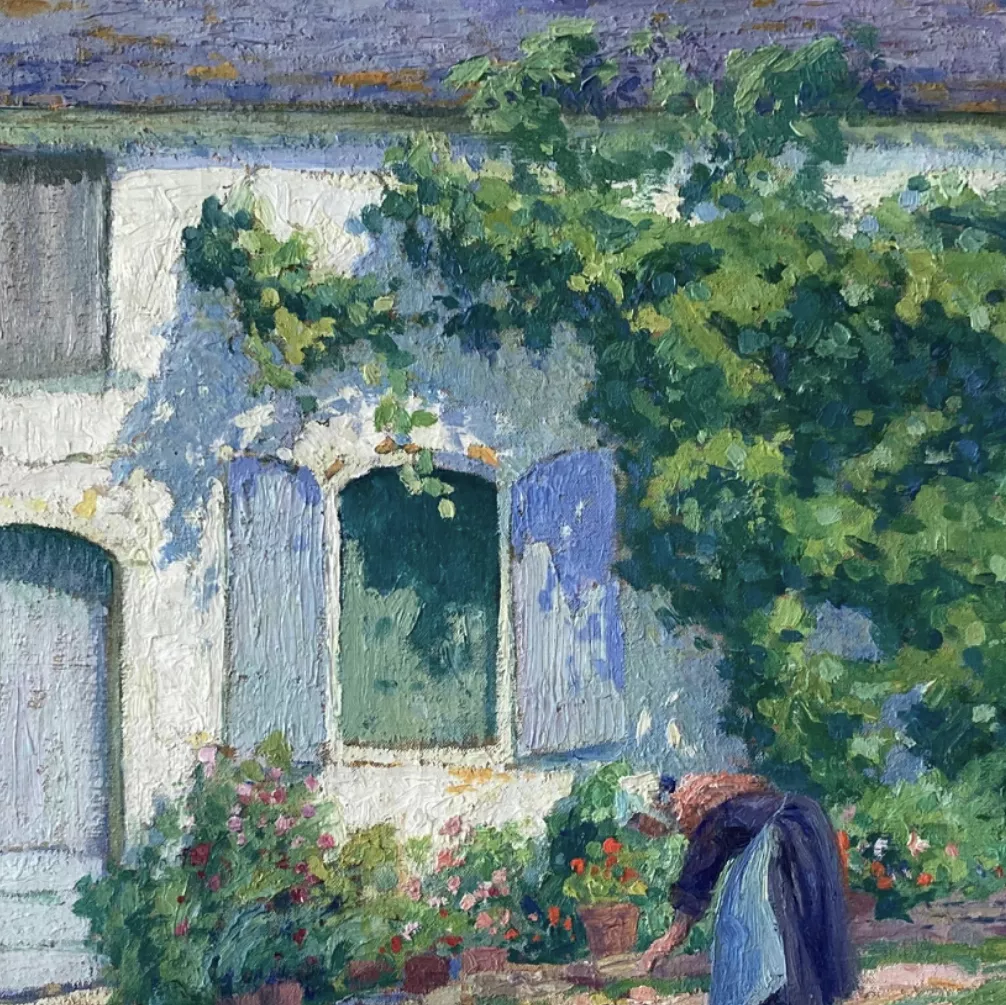
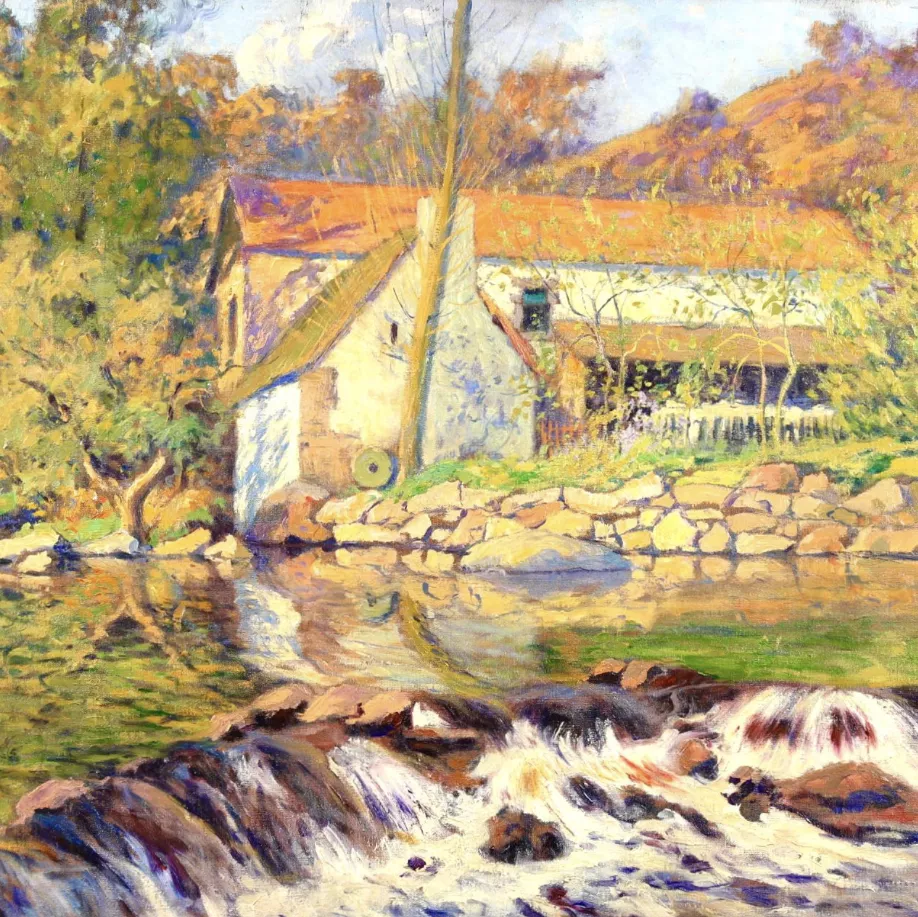
His landscapes of Creuse, Brittany, Quercy or Provence are often captured in precise seasonal moments (winter snows, blossoming trees, autumn light). Human figures are rare, often reduced to small, anonymous silhouettes in the landscape, serving to suggest scale and accentuate the poetic solitude of places.
He works with inspiration from rural landscapes (villages, rivers, washhouses, roadsides), his work emphasizing simplicity and ordinary places.
His compositions are often executed in oil on canvas, in small to medium formats, with a free and sometimes divided, highly vibrant brushstroke. She employs a light, luminous palette, dominated by pastel tones and shades of pink, bluish, gray or gold, depending on the time of day or season depicted.
He applies color quickly, with light, overlapping layers, sometimes allowing the canvas or undercoat to show through. Drawing is secondary, melting into the pictorial material, contours are rarely marked, creating an impression of floating.
He often works en plein air, in the Impressionist manner, but with a more constructed structure than among the early artists of this group.
His style is situated between late Impressionism and poetic postimpressionism, on the border of lyrical naturalism. The composition is balanced, often centered on a diagonal or axis structuring the landscape.
Paul Madeline, his life, his work
Paul Madeline (1863 - 1920) was a landscape painter associated with the Crozant school and French post-impressionist painting. Born into a modest family, he studied at the Beaux-Arts in Paris, where he quickly turned to landscape painting, which was then dominated by the Barbizon schools and the beginnings of Impressionism.
Early on, he showed an attachment to working outdoors, influenced by the example of nature painters. At first, he worked in a publishing house, while painting in his spare time.
Around 1894, he discovered the Creuse valley, during a stay in Fresselines with his friend Maurice Rollinat, and it was a revelation. This rural area became the main setting for his work, alongside Brittany and the South of France. He joins the group of painters known as the Crozant School, along with Guillaumin and Detroy.
He exhibits regularly at official Salons, notably the Salon d'Automne and the Société Nationale des Beaux-Arts, where he is a member of the society. In 1923, he co-founded the Salon des Tuileries, a posthumous project supported by those close to him to promote modern art rooted in the French landscape.
Paul Madeline was sought after by collectors during his lifetime for the luminous softness of his landscapes. The artist traveled to several regions of France, including Creuse, Corrèze, Limousin, Brittany and Province, always with a predilection for seasonal effects and the tranquility of the countryside. He also traveled abroad, but his career remained essentially French and regionalist in inspiration.
He died in Paris in 1920, aged 56, then at the peak of his artistic maturity. The Georges Petit gallery devoted a retrospective to him shortly after his death. Although forgotten for a time, he was rediscovered in the 1980s by art historians working on Crozant.
Focus on Village au bord de la rivière, Paul Madeline
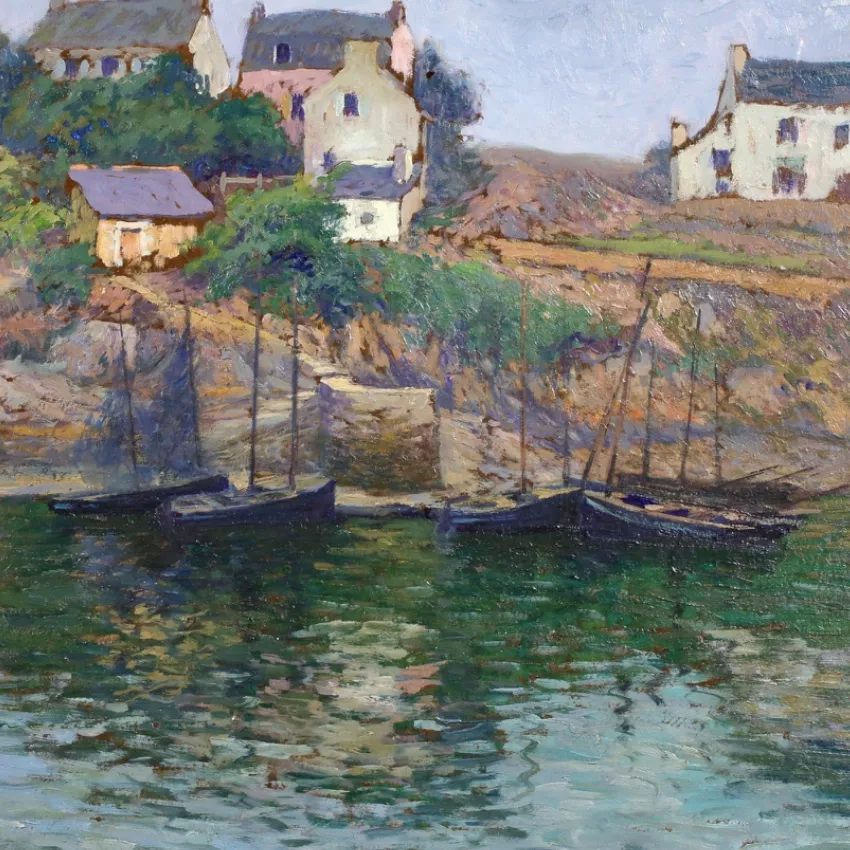
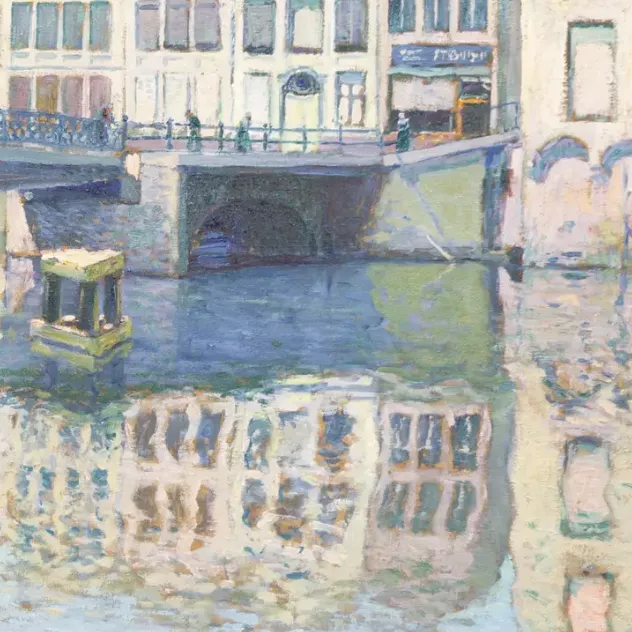
This painting is typical of Paul Madeline's corpus, and depicts a rural village, with a few red or brown roofs clustered around a bell tower, bordered by a calm river with shimmering reflections.
The composition is structured around a river diagonal, which guides the eye towards the background of the painting. The presence of a stone bridge or a boat can be discerned, recurring elements in the artist's work, creating a transition between man and nature.
The bare trees in bloom according to the season frame the scene, bringing rhythm and verticality. His chromatic range is luminous but soft, and dominated here by grayish blues, pinkish beiges, and muted greens, suggesting a spring morning or late winter.
The treatment of reflections in the water is very attentive, with doubled touches to evoke the river's gentle undulations. The atmosphere is peaceful and silent, almost suspended and typical of Madeline's poetic view of the French countryside.
The brushstrokes are fragmented and light, sometimes verging on pointillism in the foliage or reflections, without optical rigidity.
The whole is treated with a supple brush, without excessive impasto the pictorial material remains airy and transparent. The architectural lines are precisely sketched, but blend into the ambient light, without marked contours.
The work reflects a desire to celebrate traditional French landscapes, far removed from the urban bustle of the early twentieth century. Through the diffused light, harmonious forms and stripped-down nature of the scene, Madeline proposes an idealized yet sensitive vision of the rural world.
This painting thus participates in the aesthetics of the post-impressionist transition, combining rigorous composition and atmospheric emotion.
Recognizing the artist's signature
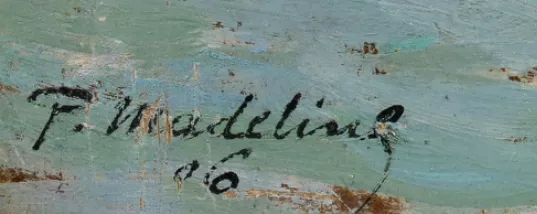
Paul Madeline very often signs his works, mostly at the bottom of the painting, in a color that contrasts with the background. Here's an example.
Knowing the value of a work
If you happen to own a work by or after Paul Madeline, don't hesitate to request a free valuation using our form on our website.
A member of our team of experts and certified auctioneers will contact you promptly to provide you with an estimate of the market value of your work, as well as any relevant information about it.
If you're thinking of selling your work, our specialists will also help you find alternatives to sell it at the best possible price, taking into account market trends.
Estimate in less than 24h
Discover in the same theme

Rating and value of works, paintings, drawings by Maximilien...
Maximilien Luce is a 20th-century post-impressionist artist who produced many paintings and drawings that are quoted on the art market.
Learn more >

Rating and value of twentieth-century war paintings and draw...
War paintings have had a lasting impact on twentieth-century art history. They are sought-after pieces, prized by collectors.
Learn more >

Rating and value of paintings by Francis Newton Souza
Francis Newton Souza is a contemporary Indian artist of the 20th century who has produced drawings and oils on canvas that are highly rated and sought...
Learn more >
D'autres tableaux impressionnistes vendus aux enchères

Estimated 6.000 - 8.000
Mikhail Markianovich GUERMACHEFF (1867 - 1930) House under the snow, oil on canvas

Estimated 2.000 - 4.000
Jean DUFY (1888-1964) Vase of anemones, Watercolor

Estimated 600 € - 800 €
Henri ZUBER (1844-1909), Bridge at Artemare. Oil on canvas.

Secure site, anonymity preserved

Auctioneer approved by the State

Free and certified estimates
Frequently asked questions
-
Who was Paul Madeline, and what was his artistic background?Paul Madeline (1863–1920) was a French Post-Impressionist painter associated with the Crozant School. Trained at the École des Beaux-Arts in Paris, he drew inspiration from the Impressionists (Monet, Sisley) and specialized in rural landscapes of the Creuse, Brittany, and Provence. He exhibited regularly at the official Salons and was rediscovered by art historians beginning in the 1980s.
-
What is the price range for Paul Madeline's paintings?Prices for Paul Madeline’s works vary considerably depending on the medium and quality. Watercolor drawings range from €350 to €5,500, while paintings range from €100 to €96,610. The artist’s market value is currently on the rise, with a record set in 2015 for “Prairie” (1903), which sold for €96,610 despite an estimate of between €23,000 and €32,000.
-
How can you authenticate a painting or drawing by Paul Madeline?To authenticate a work by Paul Madeline, we recommend that you request a free, no-obligation appraisal through our online form. A state-certified expert or auctioneer will examine the work, verify the signature (usually at the bottom of the painting), and provide you with an accurate appraisal within 48 hours.
-
Is this the right time to sell a work by Paul Madeline?Yes, now is a good time to sell a work by Paul Madeline. The artist’s market value is on the rise, particularly among French collectors, and his paintings regularly find buyers at auction. Our specialists will help you identify the best sales strategy to maximize the value of your piece.
-
How does the appraisal process work at Auctie's?The appraisal is free and non-binding. Simply fill out an appraisal request form on our website, and a certified expert or auctioneer will contact you promptly to examine the artwork and provide you with an estimate of its market value and detailed information. If you decide to sell, we’ll then work with you to get the best possible price.
