



An Art Deco icon: Camille Fauré

Key takeaways
- Camille Fauré, a 20th-century master enameler from Limoges, revived Limoges enamels in the 1920s with Art Deco creations prized by collectors.
- Fauré’s enameled vases (1920–1930) sell for between €3,000 and €20,000, while some pieces fetch over €20,900 at auction.
- His works are characterized by enamel-on-copper techniques, stylized floral motifs, and luminous, iridescent color palettes inspired by Cubism and the Parisian avant-garde.
If you own an object by or after Camille Fauré, and would like to know its value, our state-approved experts and auctioneers will offer you their appraisal services.
Our specialists will carry out a free appraisal of your work, and provide you with an accurate estimate of its value on the current market.
Then, if you'd like to sell your work, we'll direct you to the best possible arrangement to get the best price for it.
Rating and value of works by Camille Fauré
Camille Fauré is a French artist quite well known to collectors of Limoges ceramics and enamels.
If you own one of his works, its value may be higher than you think. On the art market, prices for Fauré's works can be very high at the auctioneer's hammer.
His ceramic works are particularly prized by French and European buyers, and the price at which they sell on the art market ranges from €70 to €2,200, a fairly substantial range,but one that says a lot about the value that can be attributed to Fauré's works.
In 2012, two art deco enamel vases sold for €20,900 while they were estimated at between €2,000 and €3,000.
Order of value from a simple work to the most prestigious
Technique used | Result |
|---|---|
Painting on ceramic | From 40 to €6,300 |
Lighting | From €200 to €14 800€ |
Vase | From 10 to 20 900€ |
Estimate in less than 24h
L'âge d'or de l'émail de Limoges : Camille Fauré
This great and beautiful tradition of Limoges enamel however, lost quality in the 17th and 18th centuries, only to return with the " revival " of the Middle Ages and the Renaissance in the 19th century.
French techniques and heritage were revived, and enamel made a comeback, on silverware and furniture.
It was, however, at the turn of the 20th century that enamel would experience its second golden age in Limoges, most notably with the productions of Camille Fauré.
Entrepreneur in a variety of sectors, Camille Fauré had the brilliant idea of relaunching the production of Limoges enamels. Surrounding himself with the city's finest craftsmen, he created his enamels d'arts company in the 1920s.
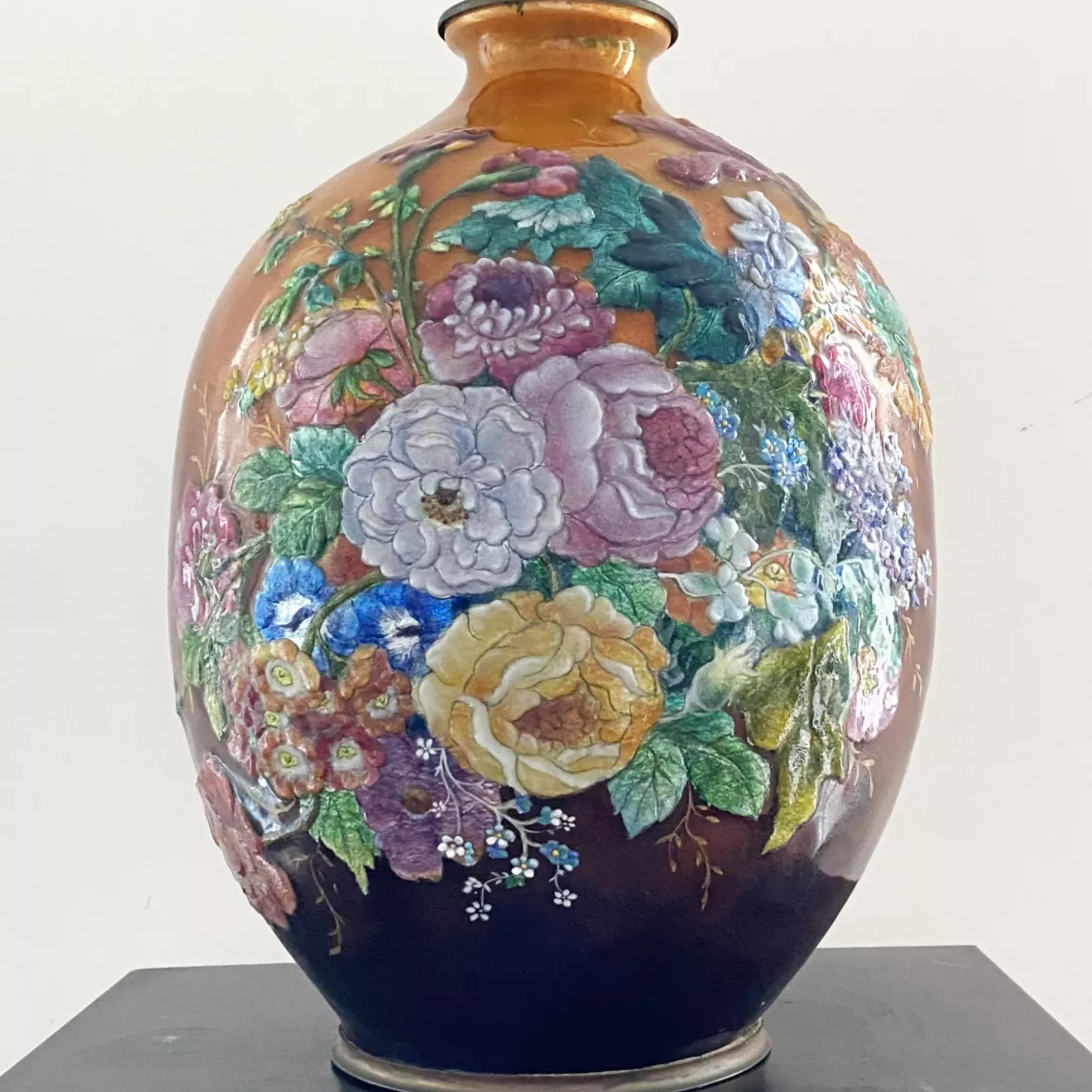
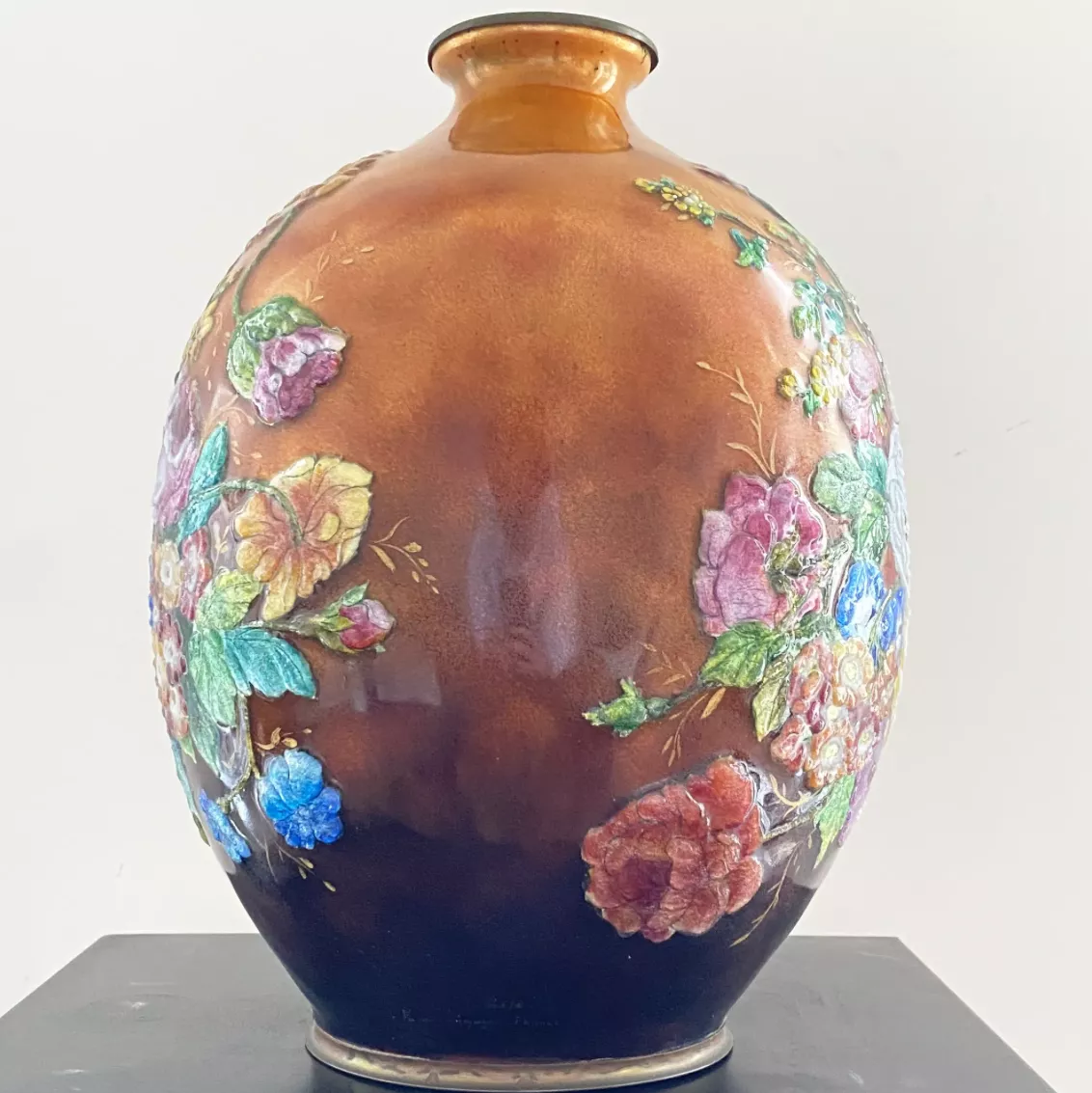
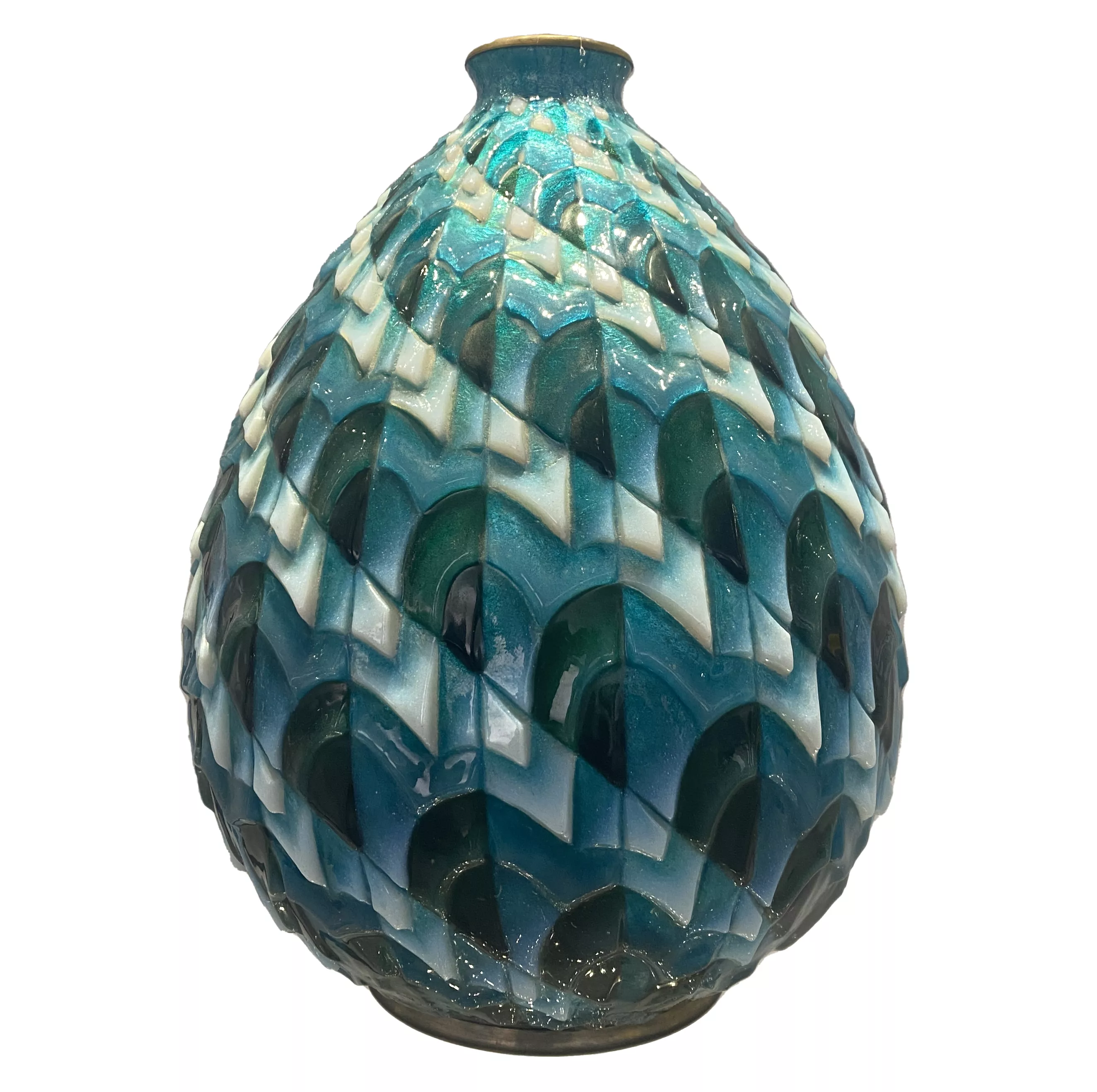
From his workshop emerges a production at the cutting edge of the fashion of his time - l'Art Déco - enamelled vases with stylized and geometric motifs, in bright colors, inspired by Cubism and the Parisian avant-gardes.
The whole of Paris buys these works - luxurious and trendy - until the stock market crash of 1929. This event deprived Camille Fauré of some of his bourgeois clientele and forced him to adapt his production to the more modest purses by offering less qualitative, mass-produced works.
The whole of Paris bought these works - luxurious and trendy - until the stock market crash.
Specifics of enamel vases
The specificity of this vase resides in its technique : enamel on metal plate - here, copper. An ancestral technique already employed in Ancient Greece, enamel is a substance made from crushed and heated glass, which is then tinted with colors by incorporating metal oxides.
It's worth noting that some regions will make it a great specialty : the Russians, for example, set tables richly enlivened by the presence of multicolored enamels with floral decor on serving pieces and other silverware.
Asian production and, more particularly, that from the Middle Kingdom - China, that is - reached exceptional levels of quality as early as the Middle Ages.
However, and as usual, our country is not lagging behind when it comes to arts and techniques, and this is also the case in the little-known field of art enamels.
The fashion for enamels
If during the Carolingian era, the fashion for enamels on jewelry and ceremonial pieces developed, it was in the 12th century that France - and specifically the city of Limoges- established itself as a nerve center for this art.
Production was initially devoted to liturgical objects : shawls, reliquaries and other processional crosses were made in gold or silver, embellished with polychrome enamels figuring episodes from the life of Christ or the Saints.
This production - almost exclusively destined for ecclesiastics - would, over the centuries, diversify to reach a golden age during the Renaissance. The technique evolved and gained in quality, and painted enamels became masterpieces of meticulous detail.
Production was now secular : rich and powerful sovereigns bought Limoges pieces to add to their art collections. Gone were the days of bondieuseries, replaced by pleasure and pageantry !
Princes commissioned their portraits from Limousin enamellers (for an example, see the Portrait of the Constable of Montmorency, preserved in the Louvre museum) and bought dishes and ceremonial pieces in a variety of decorative registers, from Greek or Roman mythology to the Old Testament, from the greatest dynasties of Limousin artists.
Estimation of a vase signed Camille Fauré
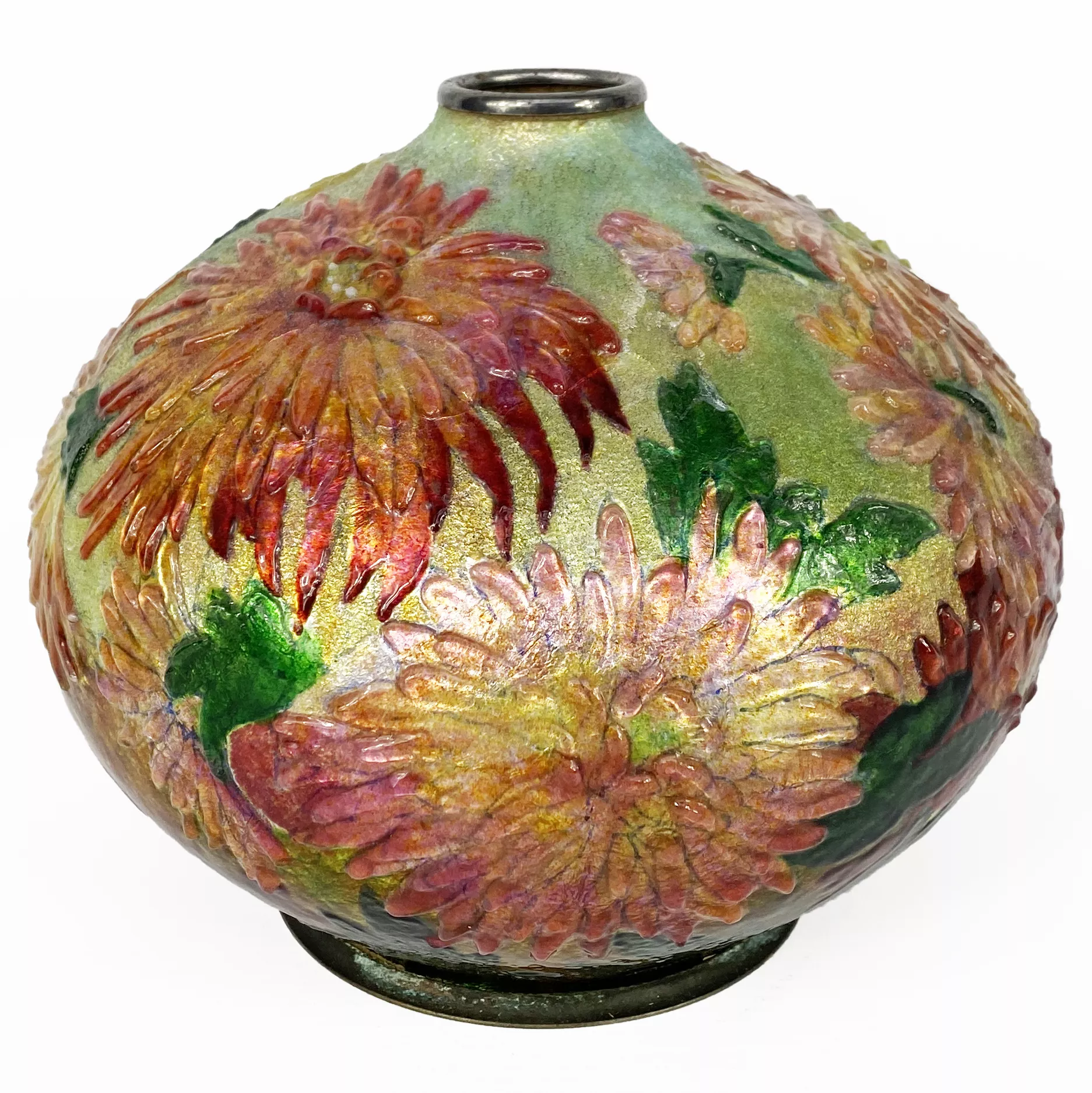
The period of production the most sought-after by Camille Fauré, is between 1920 and 1930.
Values range from 3,000€ to 20,000€ for vases from this period.
Light fixtures are also highly sought-after and can sell for between 300 and 5,000€.
The success story of Camille Fauré
We're all familiar with this Limoges enameller's dedication to pushing back the boundaries of traditional skills, transforming cloisonné enamel into an artistic language in its own right.
"For me, it was a question of expressing not only an aesthetic, but a palpable emotion", he confided to his collaborators, underlining a quest where technique and sensibility meet.
This decisive turning point, initiated in the 1920s, coincided with a time when Art Deco imposed its taste for luxury and modernity, and demand for exceptional objects grew in elite circles.
Spurred by prestigious commissions - including some from world's fairs - and international recognition, the Fauré workshops transcended their status as local craftsmen to become a leading reference in haute décoration.
To this meteoric rise contributed a skilful strategy: combining technical innovation with aesthetic refinement.
Sculpted reliefs and luminous, sometimes iridescent palettes give each piece a unique character, while captivating motifs - wisteria, exotic birds, abstract arabesques - reflect both an attachment to nature and a resolutely modern vision.
This duality, between tradition rooted in Limogesque techniques and openness to contemporary influences, sets Fauré apart from its peers.
His creations, both utilitarian objects and works of art, resonate with discerning collectors and lovers of rare objects.
Camille Fauré's recognition also rests on his ability to surround himself with a talented team, capable of materializing his visions.
Collaborations within the workshop become the crucible for a fertile dialogue between scientific innovation - new textures, ever brighter glazes - and meticulous attention to detail.
This is what we might call the blossoming of a craftsman-artist, at the heart of a century hungry for wonder and renewal, where technical excellence meets visual poetry to transform everyday objects into veritable icons of their time.
Focus on Glycines, Camille Fauré
The Glycines vase by Camille Fauré seems to question the material in terms of movement and light. We know of the artist's attachment to the sensuality of enamel - splinters and reliefs - beyond its simple decorative function.
"For me, it was a question of making the material vibrate so that it becomes alive", he would later say. The impetus of wisteria, around the 1920s, is the consequence of a new approach to ornament, where blossoming and chromatic nuances dissolve the boundary between naturalism and abstraction.
The rigor of outline gives way to a continuity of fluid lines, each petal seeming to blossom under the effect of an invisible breath.
This fluidity of surface is reminiscent of the work of René Lalique, for whom glass, worked in transparency, replaces enamel in a similar quest to capture light.
But where Lalique favors the delicacy of shadows, Fauré opts for a chromatic density that lends his works an almost sculptural presence.
Compared with the geometric works of Jean Dunand, whose lacquered metals celebrate order and structure, the "Glycines" vase seems to vibrate with controlled disorder, where nature and abstraction merge into a new harmony.
As a contemporary critic writes, "Fauré achieves an intensity where each detail, far from being isolated, is part of an organic dynamic".
This unity of the surface, where the plant becomes pure movement, is part of an approach that could be called the reinvention of the floral motif, halfway between art and alchemy.
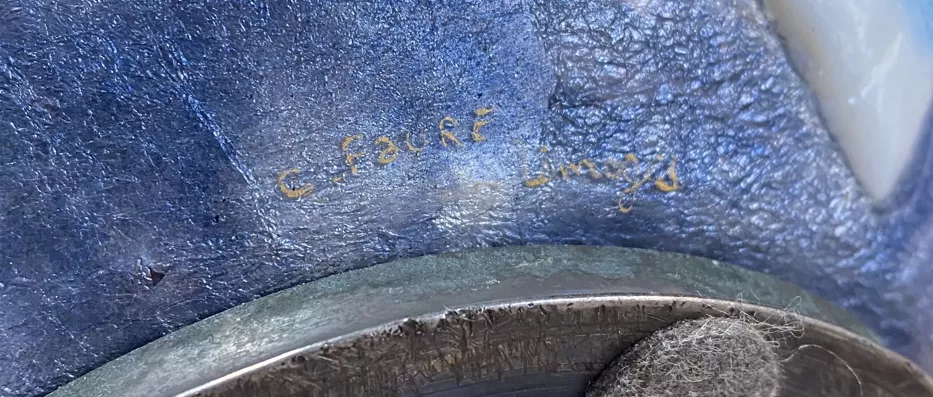
Recognizing Camille Fauré's signature
Not all objects produced by Camille Fauté are signed, or may be signed differently depending on the period. In addition, there are many copies, which is why it is important to appraise your work.
Knowing the value of a work
If you happen to own a work by or after Camille Fauré, don't hesitate to request a free valuation using our form on our website.
A member of our team of experts and certified auctioneers will contact you promptly to provide you with an estimate of the market value of your work, as well as ad hoc information about it.
If you are considering selling your work, you will also be accompanied by our specialists in order to benefit from alternatives for selling it at the best possible price, taking into account market inclinations.
Estimate in less than 24h
Discover in the same theme

Market Value and Pricing of André Dauchez's Paintings, Drawi...
André Dauchez is a French marine painter who has produced paintings that are highly rated and valued on the auction market.
Learn more >

Rating and value of paintings by Georges Valmier
Georges Valmier was a cubist painter who lived through several currents of modern art. His works are of great value today.
Learn more >

Rating and value of drawings and paintings by Hermann Nitsch
Hermann Nitsch is the founder of Viennese Actionism. His works command high prices and have significant value at auction. 24-hour estimate.
Learn more >
Price examples of Camille Fauré vases

Estimated 3.000 - 5.000€
Camille Fauré (1874-1956), Enamelled vase

Estimated 2000 € - 3000 €
Camille Fauré (1874-1956), Exceptional ovoid vase

Estimated 600 € - 800 €
Émaux d'Art Camille FAURÉ à Limoges "Bouquet de fleurs" (Bouquet of flowers)

Estimated Between €3,000 and €5,000
Camille Fauré, enamelled vase with geometric decoration

Estimated Between €3,000 and €5,000
Camille Fauré, enamelled vase with "Cascade" geometric design

Secure site, anonymity preserved

Auctioneer approved by the State

Free and certified estimates
Frequently asked questions
-
Who is Camille Fauré, and what is his role in the history of Art Deco?Camille Fauré was an iconic 20th-century French enamel artist who revived the production of Limoges enamels in the 1920s. Surrounding himself with the finest artisans, he created enameled vases featuring stylized, geometric motifs inspired by Cubism and the Parisian avant-garde, becoming a leading figure in high-end Art Deco design until the stock market crash of 1929.
-
What is the price range for Camille Fauré's works?Camille Fauré’s vases produced between 1920 and 1930—the most sought-after period—range in price from €3,000 to €20,000. Light fixtures can sell for between €300 and €5,000, while paintings on ceramic range from €40 to €6,300 depending on their quality and rarity.
-
How can you authenticate a work by Camille Fauré and determine its exact value?To authenticate a work by Camille Fauré and obtain an accurate estimate, contact Auctie's, which provides you with state-certified experts and auctioneers. The appraisal is free and non-binding, and you will receive a detailed assessment of your work’s market value.
-
Why is now the right time to sell a work by Camille Fauré?The Art Deco market—and particularly that of Camille Fauré’s Limoges enamels—is experiencing steady demand from French and European collectors. Prices regularly reach high levels at auction, especially for pieces from the 1920s and 1930s, making this an opportune time to sell.
-
How does the sale of a work by Camille Fauré at Auctie's work?Auctie's guides you through the process from the free appraisal to the final sale. After our experts have evaluated your piece, we’ll help you choose the best sales approach for your artwork and the current market, ensuring you get the best possible price at auction.
