



Rating and value of Russian paintings by Adolf Baumgartner Stoiloff

Key takeaways
- Works by Baumgartner Stoiloff, a major 19th-century Russian and Austrian painter, sell for between €70 and €24,000 at auction.
- His war paintings depicting Cossacks on horseback are highly sought after by collectors, particularly his oil-on-canvas works.
- *The Golden Siberian Convoy* fetched €24,000 in 2004, exceeding its initial estimate of €9,000 to €12,000.
If you own a work by or based on the work of artist Adolf Baumgartner Stoiloff and would like to know its value, our state-approved experts and auctioneers will guide you.
Our specialists will carry out a free appraisal of your work, and provide you with an accurate estimate of its value on the current market.
Then, should you wish to sell your work, we will direct you to the best possible arrangement to obtain the optimum price.
Artist's rating and value
A major artist of Slavic and Austrian painting, Baumgartner Stoiloff made his mark on the art market as early as the 19th century. Since then, his price has risen steadily, establishing the artist as a market leader.
Highly sought-after by collectors, Adolf Baumgartner Stoiloff's war paintings are among the most popular on the auction block.
The artist's works sell for between €70 and €24,000 at auction. In 2004, his oil on canvas Le convoi doré sibérien, sold for €24,000, whereas it was estimated at €9,000 to €12,000.
Order of value from the most basic to the most prestigious
Technique used | Result |
|---|---|
Drawing - watercolor | From €70 to €770 |
Painting | From €80 to €24,000 |
Estimate in less than 24h
The artist's works and style
Baumgartner Stoiloff developed a distinctive style characterized by Russian realism combined with the genre of military paintings. He also seeks out transparency effects, adding visual depth to his creations. He was also influenced by Austrian painting.
The work of Adolf Baumgartner Stoiloff is often characterized by complex compositions and a severe, austere spirit. His unique style has helped position him as one of the leading artists of Russian realism ; as well as Austrian military painters.
Adolf Baumgartner Stoiloff, Russian military painter
Adolf Baumgartner Stoiloff (or Adolf Konstantin Baumgartner Stoiloff, Constantin Stoiloff, Konstantin Stoilov Baumgartner) (1850-1924) was an Austrian, Russian and Bulgarian military painter.
He was born in Linz, Austria. He left his native country to study art in Russia; several Russian sources report that he studied at the Imperial Academy in St. Petersburg, as did several military painters of the time, including Franz Roubaud.
Contrary to his colleague, he focused more on depicting horses than soldiers per se. These animals, particularly those used in combat at the time, became a veritable iconography for the artist, as he used them in many of his paintings.
Thanks to the horses, he gradually turned his attention to depictions of Russian hunters, while retaining Cossack figures in his paintings. Cossacks are soldiers who have become symbols of the Russian Army, having fought and played an important role in the annexation of certain Russian lands.
Originals of the Pontic steppe, they were originally mercenaries and pirates who converted to Christianity and played a role above all as border guards. Originally, they arrived from Ukrainian and Armenian lands, but gradually from all Slavic countries.
Belonging to these groups allowed them rapid military training, as well as a less regular framework than those of the Imperial Army, with which they nevertheless exchanged. Geographers have even described the Pontic steppe as " the wild east of Europe ".
The Cossacks function as a direct democracy, electing their own military leader and developing their own fighting techniques. Known for using a lot of horses, forming lines with wooden carts, which explains why they feature so prominently in Baumgartner Stoiloff's paintings.
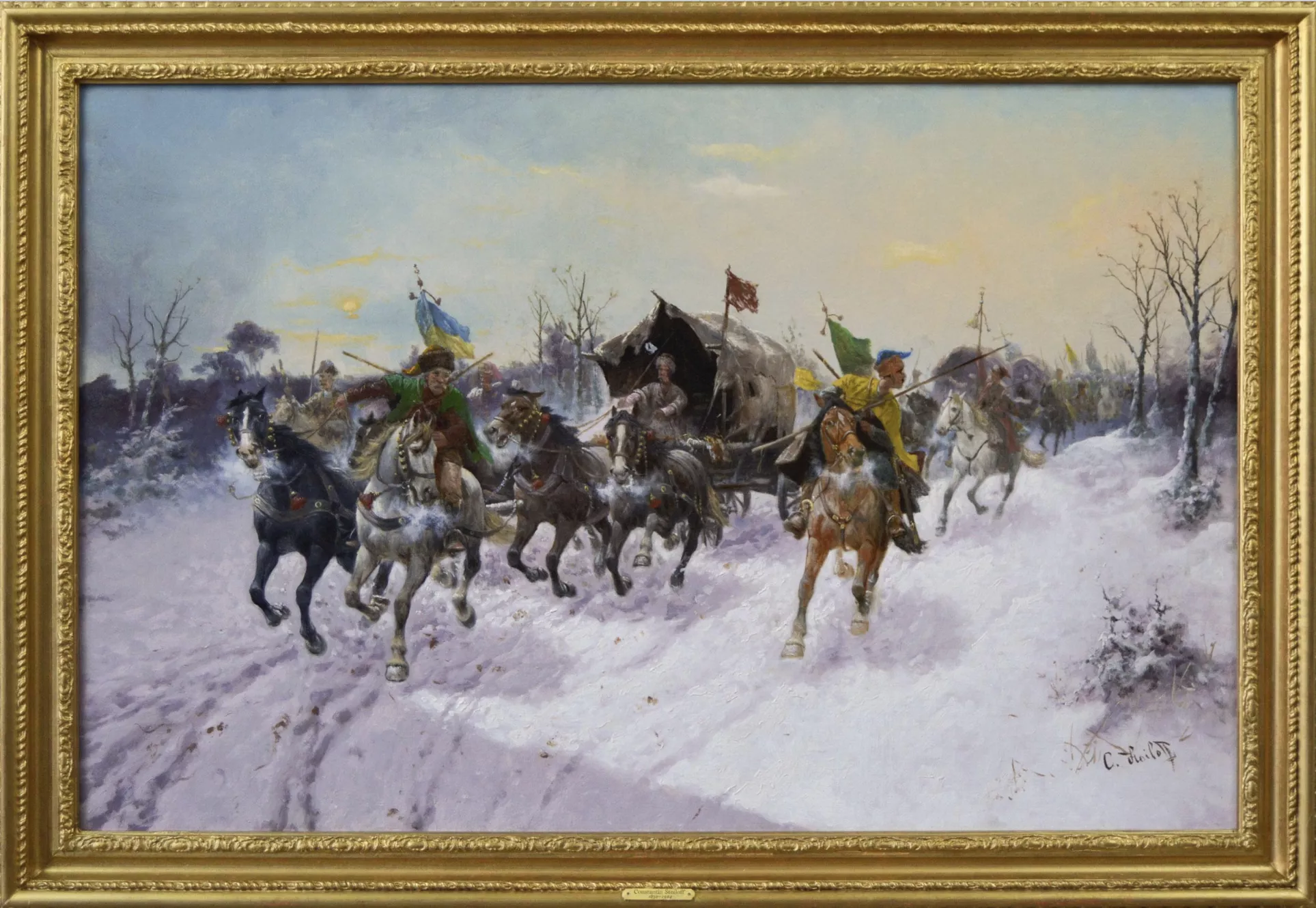
Focus on a painting of horsemen by Baumgartner
Adolf Baumgartner-Stoiloff, usually known for his epic, cavalier scenes, here reveals a frantic Cossack race in a wintry landscape. The artist brings to light a scene of intense movement, with horsemen speeding through the snow, pulling a covered wagon.
Several horsemen, dressed in colorful coats, are seen hurtling through a snowy landscape. The cold is palpable, with the snow kicked up by the horses' hooves, and the silhouettes of bare trees in the background.
The sky, lightly gilded by the last rays of the sun, softens the whole and brings a slight warmth to this icy scene.
The painter captures here a moment of tension and speed, the riders armed with spears and carrying banners suggesting an important mission or raid.
Everything, from the tense muscles of the horses to the concentrated faces of the riders, exudes urgency. The wagon in the background adds a narrative touch: is it carrying supplies, equipment, or a convoy of fugitives?
The details are meticulously crafted, especially the horses, whose manes and postures convey mastery and strength. The colors, although dominated by the cold tones of snow and sky, are contrasted by the riders' bright coats, drawing the eye to the main characters.
With this work, Baumgartner-Stoiloff demonstrates not only his ability to depict action, but also to inject a certain poetry into a scene yet full of contained violence.
The soft light that bathes the landscape, the details of the clothing and flags, all contribute to creating a lively, immersive scene, where every element has its place in telling a story.
The contrast between the brutality of the conditions and the beauty of the landscape creates a subtle balance, and the artist shows here that he excels not only in action but also in depicting nature and the details of everyday life.
Military painting in Eastern Europe and Russia in the 19th century
Military painting in Russia and Eastern Europe in the 19th century is characterized by a strong emotional charge and a care for detail that reflect the great historical upheavals of the period.
Marked by the Napoleonic Wars, national insurrections and conflicts over territorial expansion, this period gave rise to a rich pictorial tradition where art and history meet to immortalize battle scenes, military heroes and landmark events.
In Russia, military painters such as Franz Roubaud, Vasily Vereshchagin, or Bogdan Willewalde distinguished themselves with monumental works recounting the great victories of the Empire.
Roubaud, known for his epic panoramas, recreated immersive scenes, often on a grand scale, that plunged the viewer into the heart of the action.
His works, like the Panorama de Borodino (1887), which depicts one of the decisive battles against Napoleon, are vivid testimonies to the sacrifices and triumphs of the Russian armies.
Russian military painting, in general, focuses on the heroism of the soldiers, the immensity of the battles, but also the harshness of wartime conditions, often set against imposing, grandiose landscapes.
In Eastern Europe, military painting is often linked to struggles for national independence. In Poland, for example, artists such as Juliusz Kossak and his son Wojciech Kossak immortalized the uprisings against the neighboring powers (Russia, Prussia, Austria) that had partitioned Poland.
Their work highlights the national pride and bravery of Polish soldiers, particularly the famous uhlans (light cavalrymen). These artists depict battles with great attention to detail, both in uniforms and military strategies, while infusing a strong emotional dimension.
Military painting thus becomes a means of cultural resistance, a way of keeping alive the memory of past struggles.
Another striking aspect of military painting in this region is the importance attached to the depiction of Cossacks.
These fearsome horsemen from the border regions of the Russian Empire are often depicted in battle scenes, but also in moments of everyday life, illustrating their key role in the Empire's wars.
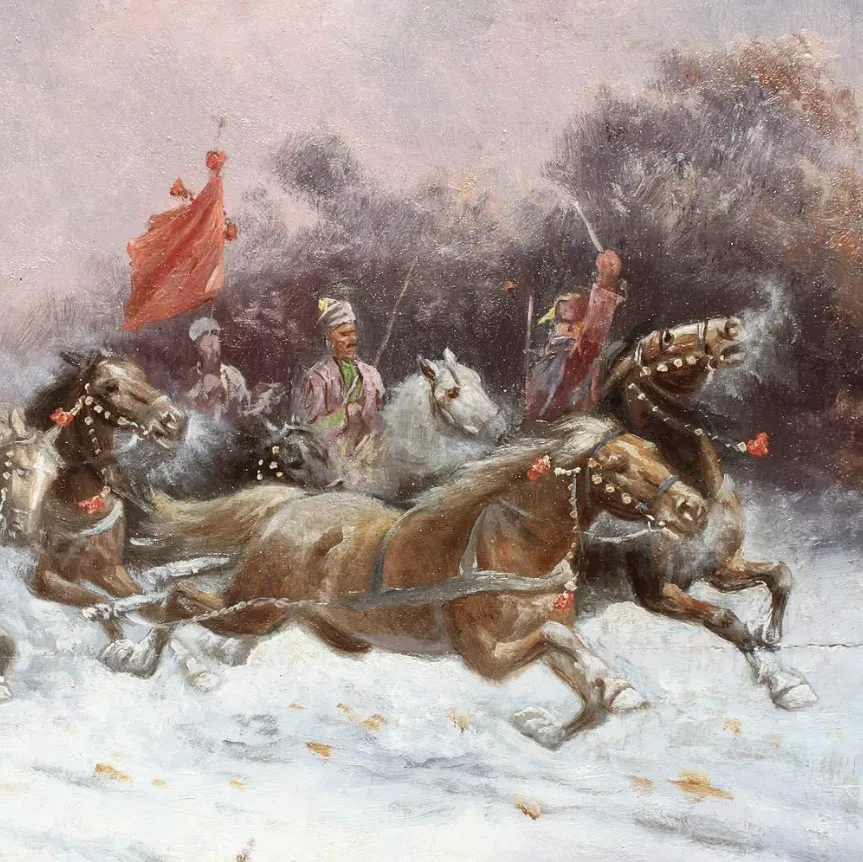
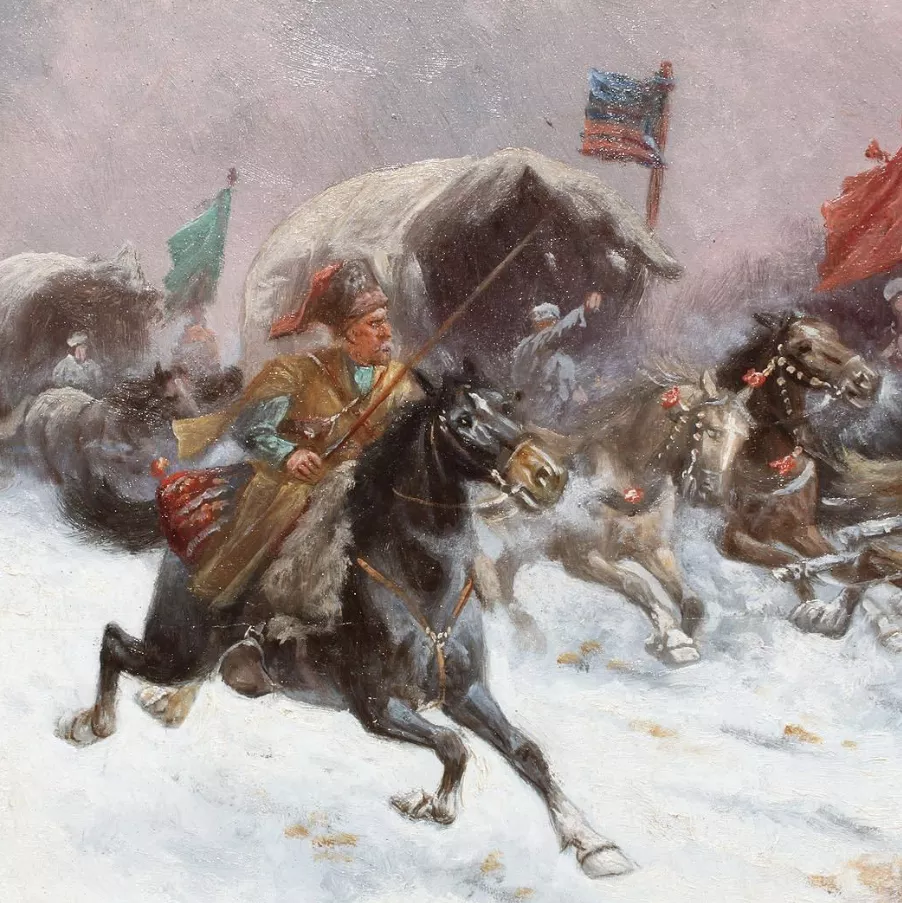
Artists such as Adolf Baumgartner-Stoiloff and Josef Brandt captured the mobility, speed and power of these warriors, creating dynamic works where horses and riders seem about to leap out of the frame, just as did Nicolas Toussaint Charlet or the baron François Gérard for France.
Military painting of this period is therefore distinguished by meticulous realism, bright, contrasting color shades, and a composition that emphasizes the importance of individual actions in the march of history.
Whether on the vast Russian plains or the mountains of Central Europe, artists of this period succeeded in magnifying both the beauty of the landscapes and the violence of the fighting, while highlighting the soldiers' emotions, whether of courage, suffering or camaraderie.
Adolf Baumgartner Stoiloff's imprint on his time
Adolf Baumgartner Stoiloff made a lasting mark on his time in Russia and the rest of the world, receiving numerous public commissions directly from the Tsar or from European states. Today, his works are still sought after by a number of collectors.
His paintings are preserved all over the world, including in Canada, the USA, Austria and Russia.
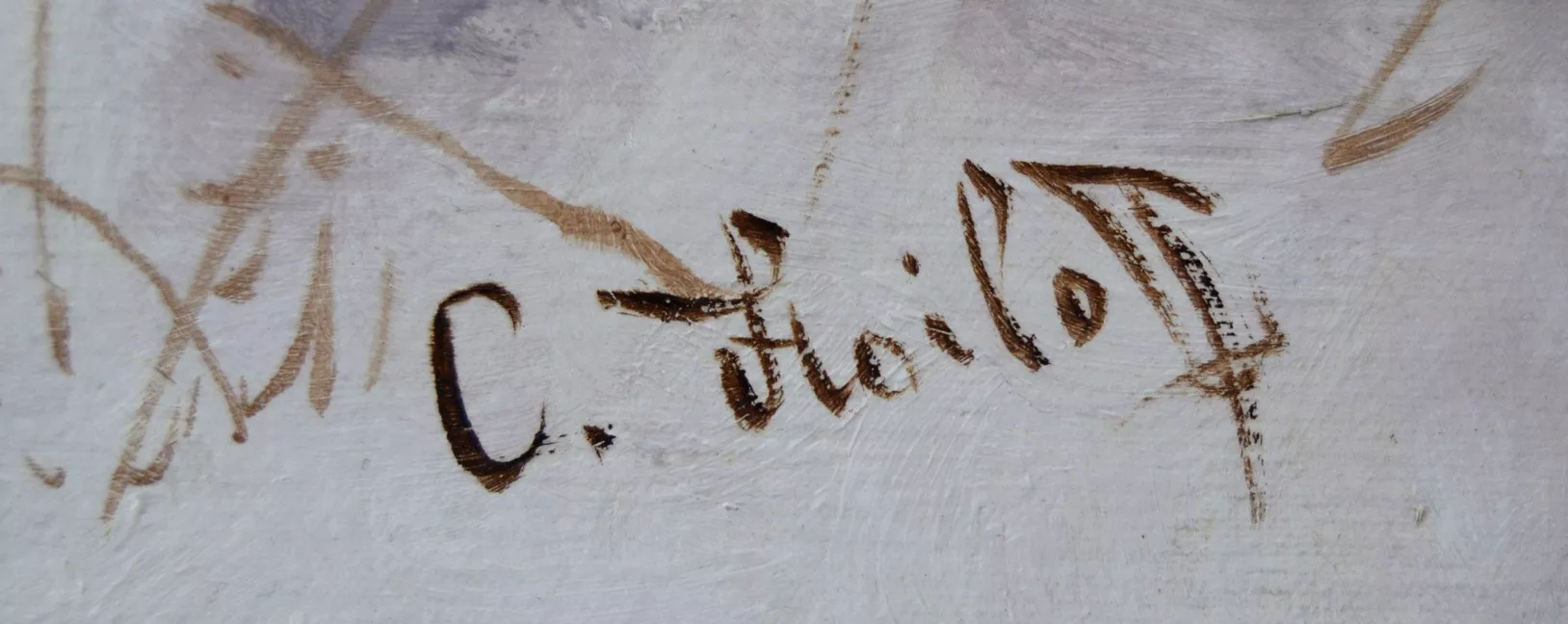
His signature
Not all of Adolf Baumgartner Stoiloff's works are signed.
Although there are variations, here is a first example of his signature:
Expertise your property
If you own a work by Adolf Baumgartner Stoiloff, don't hesitate to request a free appraisal by filling in our online form.
A member of our team of experts and licensed auctioneers will contact you to provide an estimate of the market value of your work.
If you are considering selling your work, our specialists will also guide you through the various alternatives available to obtain the best possible price, taking into account market trends and the specific features of each work.
Estimate in less than 24h
Discover in the same theme

Value and quotation of works, paintings by Ferdinand Roybet
Roybet is a 19th-century Caravaggio painter. His works are valuable and sought-after on the auction market. Estimated in 24h.
Learn more >

Rating and value of works, paintings, sculptures by Edgar De...
Edgar Degas was a 19th-century painter, sculptor and draughtsman. His works are highly valued at auction. Estimates in 24h.
Learn more >

Rating and value of paintings, drawings and sculptures by Er...
Ernest Meissonier was a 19th-century artist who produced many small-scale works and sculptures, which are now listed at auction.
Learn more >
Paintings from the same period sold at auction

Estimated 3000-5000€
Alexandre Roubtzoff - View of Tunis (small format)

Estimated Between €800 and €1,500
Alexandre ROUBTZOFF (1884-1949), View of Notre Dame de Paris, oil on canvas

Estimated Between €5,000 and €8,000
KRACHKOWSKY (1854-1914), Before the storm, oil on canvas

Estimated 4.000 - 6.000
Atelier d'Antoine Jean, baron GROS (Paris 1771-1835 Meudon), oil on canvas

Estimated 40.000 - 80.000
Alexandre ROUBTZOFF (1884-1949), Portrait of Arbia, oil on canvas

Estimated 5.000 - 8.000
Alexandre ROUBTZOFF (1884-1949), The Sidi Makhlouf Mosque, oil on canvas

Secure site, anonymity preserved

Auctioneer approved by the State

Free and certified estimates
Frequently asked questions
-
Who was Adolf Baumgartner Stoiloff, and what was his artistic style?Adolf Baumgartner Stoiloff (1850–1924) was an Austrian, Russian, and Bulgarian military painter, born in Linz, Austria. He distinguished himself through a style characterized by Russian realism combined with military scenes, featuring a strong iconography centered on horses and Cossacks. He is recognized as a major figure in 19th-century Slavic and Austrian painting, known for his complex compositions and use of transparency, which add visual depth to his works.
-
What is the price range for Baumgartner Stoiloff's paintings?Baumgartner Stoiloff’s works sell for between €70 and €24,000 at auction, depending on the medium used. Watercolors and drawings range from €70 to €770, while oil paintings can fetch between €80 and €24,000. In 2004, his oil on canvas painting “The Siberian Golden Convoy” sold for €24,000, exceeding its initial estimate of €9,000 to €12,000.
-
How can you authenticate a work by Baumgartner Stoiloff and determine its value?To authenticate and appraise a work by Baumgartner Stoiloff, we recommend that you request a free appraisal from Auctie's by filling out our online form. A state-certified expert or auctioneer will contact you to provide an accurate appraisal and an estimate of your item’s market value, with no obligation, within 48 hours.
-
Is this a good time to sell a painting by Baumgartner Stoiloff?Yes, now is a good time to sell a work by Baumgartner Stoiloff. Since the 19th century, this artist’s market value has been steadily rising, establishing him as a safe bet in the art market. His military paintings remain highly sought after by collectors, and auction results show an upward trend, particularly for scenes featuring horsemen and historical compositions.
-
How do I sell a work by Baumgartner Stoiloff at Auctie's?Auctie's supports you every step of the way in selling your artwork: after a free, no-obligation appraisal, our specialists will guide you toward the best sales option, taking into account market trends and the unique characteristics of your painting. We advise you throughout the process to help you achieve the best possible sale price.
