



The value of furniture by renowned cabinetmaker Adam Weisweiler

Key takeaways
- Adam Weisweiler (1744–1820), an 18th-century cabinetmaker, is known for his antique-style furniture featuring whimsical touches and crafted with virtuosity.
- Prices for Weisweiler’s works range from €994 to €105,000, with a small round table selling for €70,500 in 2020.
- His furniture is distinguished by the use of precious woods, Sèvres porcelain inlays, and gilded copper details on the legs.
If you own a work by or after the artist Adam Weisweiler, and would like to know its value, our state-approved experts and auctioneers will offer you their expertise. Our specialists will carry out a free appraisal of your work, and provide you with a precise estimate of its current market value. Then, if you wish to sell your work, we'll guide you towards the best possible arrangement to obtain the optimum price.
Rating and value of the artist Adam Weisweiler
Exercising in the second half of the 18th century and the first quarter of the 19th century, Adam Weisweiler is considered one of the most outstanding cabinetmakers of his time and stands out for his antique-style furniture with a whimsical intonation. He masterfully crafted pedestal tables, consoles, chests of drawers, secretaries and tables. The prices at which his pieces of prowess are sold range from €994 to €105,000. In 2020, a bronze pedestal table with an inlaid cookie porcelain panel sold for 70 500€.
Type of furniture | Price range price |
|---|---|
Chests of drawers and pedestal tables | 994€ -. 105.000€ |
Adam Weisweiler, 18th-century cabinetmaker
Adam Weisweiler (1744-1820) hails from the Rhineland, a region bordering the Netherlands and Belgium, where he is said to have trained in David Roentgen's workshop.
He took up residence in Paris on rue du Faubourg Saint-Antoine at the start of Louis XVI's reign and obtained his master's title in 1778. He quickly gained recognition in luxury cabinetmaking thanks to his talent, and satisfied the desires of prestigious patrons such as the Queen, who asked him to execute a service for the demeure royale de Saint Cloud.
It was once thought that after the fall of the Ancien Régime he had returned to his native Germany, but he decided to stay in Paris and overcome the economic crisis of the Terror period. At the dawn of the Empire, he abandoned his craft to enter the world of business and the furniture trade. He created furniture, sometimes fanciful, that rivaled the most refined works by Riesener or Martin Carlin.
Estimate in less than 24h
How did he mark his period ?
Adam Weisweiler had relatively little contact with Parisian clientele, and all his production was sold through merchant-merchants, in this case by Dominique Daguerre. He also worked for the courts of Naples and Russia. At the time, merchant-merchants imported panels of lacquer, generally transformed upon arrival in Europe and inserted into European furniture. For example, Weisweiler's chest of drawers at the Metropolitan Museum in New York, commissioned by Daguerre, marries Japanese lacquer with wood topping a frame with antiquis iconography.
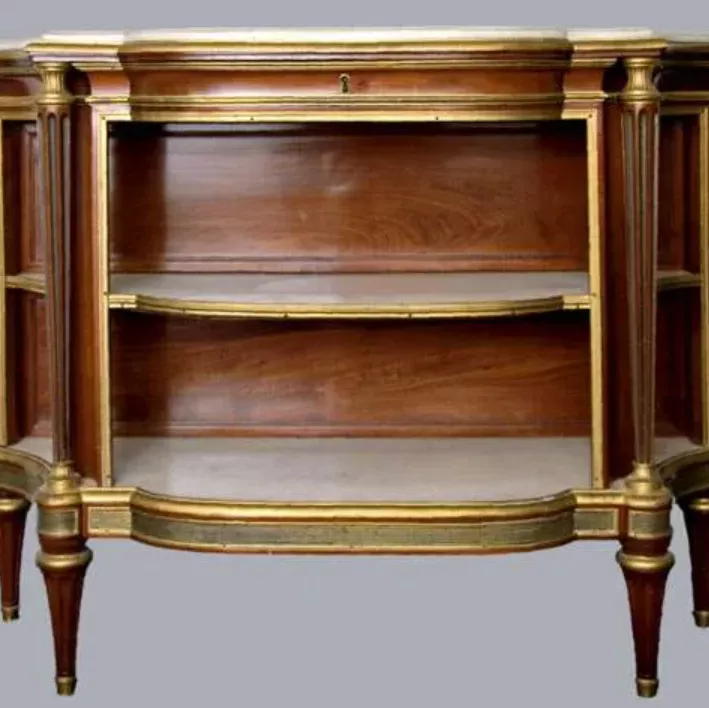
Weisweiler preferably used precious and exotic woods such as oak, mahogany and ebony. We can admire his mastery of detail by observing the addition of copper baguettes, at the feet elegantly adorned with Doric columns.
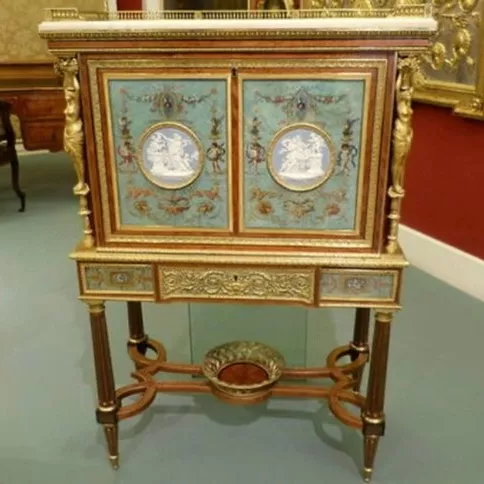
Although marquetry does not remain his specialty, Weisweiler incorporates decorative fragments such as Sèvres or Wedgwood porcelain plates. These tenuous ornaments mark the prestige of his art. He continued his research in the vein of mechanized furniture and secret desks. The Austrian Imperial Furniture Museum, for example, exhibits the above two-leaf secretary flanked by two caryatids with inlaid porcelain medallions, made by Adam Weisweiler, which belonged to Marie Antoinette and was then given by Napoleon III to Charlotte of Belgium.
In fine, Weisweiler achieved success with small-scale furniture, such as the guéridon of extreme rigor counterbalanced by lightness, which offered him epidermal success.
How to recognize the stamp
Furniture by Adam Weisweiler is often stamped once or twice on the uprights, signed " A. WEISWEILER ".

How to find out the value of a work ?
If you happen to own a work by or after Adam Weisweiler, don't hesitate to request a free appraisal via our form on our website. An Auctie's expert will contact you promptly with an estimate of the value of your work, and provide you with all the relevant information. If you are considering selling your work, you will also be accompanied by our specialists in order to benefit from alternatives for selling it at the best possible price.
Estimate in less than 24h
Discover in the same theme

Rating and value of paintings, drawings and miniatures by Ad...
Adelaïde Labille Guiard is an 18th-century artist who produced works whose value is exploding at auction.
Learn more >

Rating and value of paintings by Marguerite Gérard
Marguerite Gérard is a painter and engraver, a pupil of Fragonard. Today, her works are highly valued.
Learn more >

Rating and value of drawings, engravings and paintings by Si...
Sigmund Freudenberger was an 18th-century Swiss artist who primarily produced drawings and engravings that are highly prized and valuable.
Learn more >
Other objects from the same period sold at auction


Secure site, anonymity preserved

Auctioneer approved by the State

Free and certified estimates
Frequently asked questions
-
Who was Adam Weisweiler, and what is his significance in the history of furniture?Adam Weisweiler (1744–1820) was a Rhineland cabinetmaker trained by David Roentgen who settled in Paris on Rue du Faubourg Saint-Antoine. Having become a master craftsman in 1778, he is considered one of the most remarkable cabinetmakers of the 18th century, known for his antique-style furniture with whimsical touches, executed with virtuosity and rivaling the works of Riesener or Martin Carlin.
-
What is the price range for Adam Weisweiler's works?Adam Weisweiler's furniture, particularly his chests of drawers and pedestal tables, sells for between €994 and €105,000. For example, a bronze pedestal table with an inlaid biscuit porcelain panel sold for €70,500 in 2020.
-
How can you authenticate a work by Adam Weisweiler?Adam Weisweiler’s furniture is typically stamped once or twice on its legs, signed “A. WEISWEILER.” For certified authentication, we recommend requesting a free appraisal via our online form: an Auctie’s expert will analyze the piece and provide you with a non-binding authentication opinion.
-
What are the distinctive features of Adam Weisweiler's furniture?Weisweiler is distinguished by its use of precious and exotic woods (oak, mahogany, ebony), the incorporation of refined decorative elements such as Sèvres or Wedgwood porcelain plaques, and the addition of copper trim and legs adorned with Doric columns. He also crafted mechanized furniture and secret-compartment desks, excelling particularly in small pieces such as pedestal tables.
-
How does the appraisal of an Adam Weisweiler artwork work at Auctie's?The appraisal is free and non-binding. You fill out an online form with a photo and description of your piece. An expert auctioneer from Auctie's will contact you shortly to provide a precise estimate of its current market value. If you wish to sell, we’ll help you find the best solution to get the best possible price.
