



Rating and value of antique flintlock pistols

Key takeaways
- Flintlock pistols sell for between €240 and €1,700 on average, with exceptional pieces reaching €226,840.
- Models made by Boutet or those that once belonged to famous figures (Tolstoy, Napoleon) command prices far higher than those of reproductions.
- The majority of flintlock pistols sold at auction date from the 19th century and are of great interest to international collectors.
If you own a flintlock pistol and would like to know its value, and if you don't know, the period and model of your weapon, our state-approved experts and auctioneers will offer you their appraisal services. Our specialists will carry out a free appraisal of your weapon, and provide you with a precise estimate of its value on today's market. Afterwards, if you wish to sell your property, we will guide you towards the best possible device to obtain an optimal price.
Rating and value of flintlock pistols
Flintlock pistols are sought-after items by collectors. However, price differences can be considerable, depending on model and state of preservation. Nowadays, prices for these objects can rise considerably under the auctioneer's hammer. Buyers from all over the world are interested in the sale of certain rare pieces. The price at which they are sold on the art market ranges from €240 to €1,700, at the moment - a considerable difference, but one that says a lot about the value that can be attributed to these weapons. The box that belonged to Tolstoy, including two flintlock pistols made by Nicolas Boutet, sold for €120,000, whereas it was estimated at between €120,000 and €150,000.
Order of value from simple to most prestigious
Type of pistol | Result |
|---|---|
Reproduction flintlock pistol | From 10 to 100€ |
Pistolet Le Page | From €4,000 to €67,000 |
Pistolet Boutet (Versailles manufacture) | From €1,000 to €120,000 |
Precious-material pistol (gold, gems) | From €2,000 to €226,840 |
Estimate in less than 24h
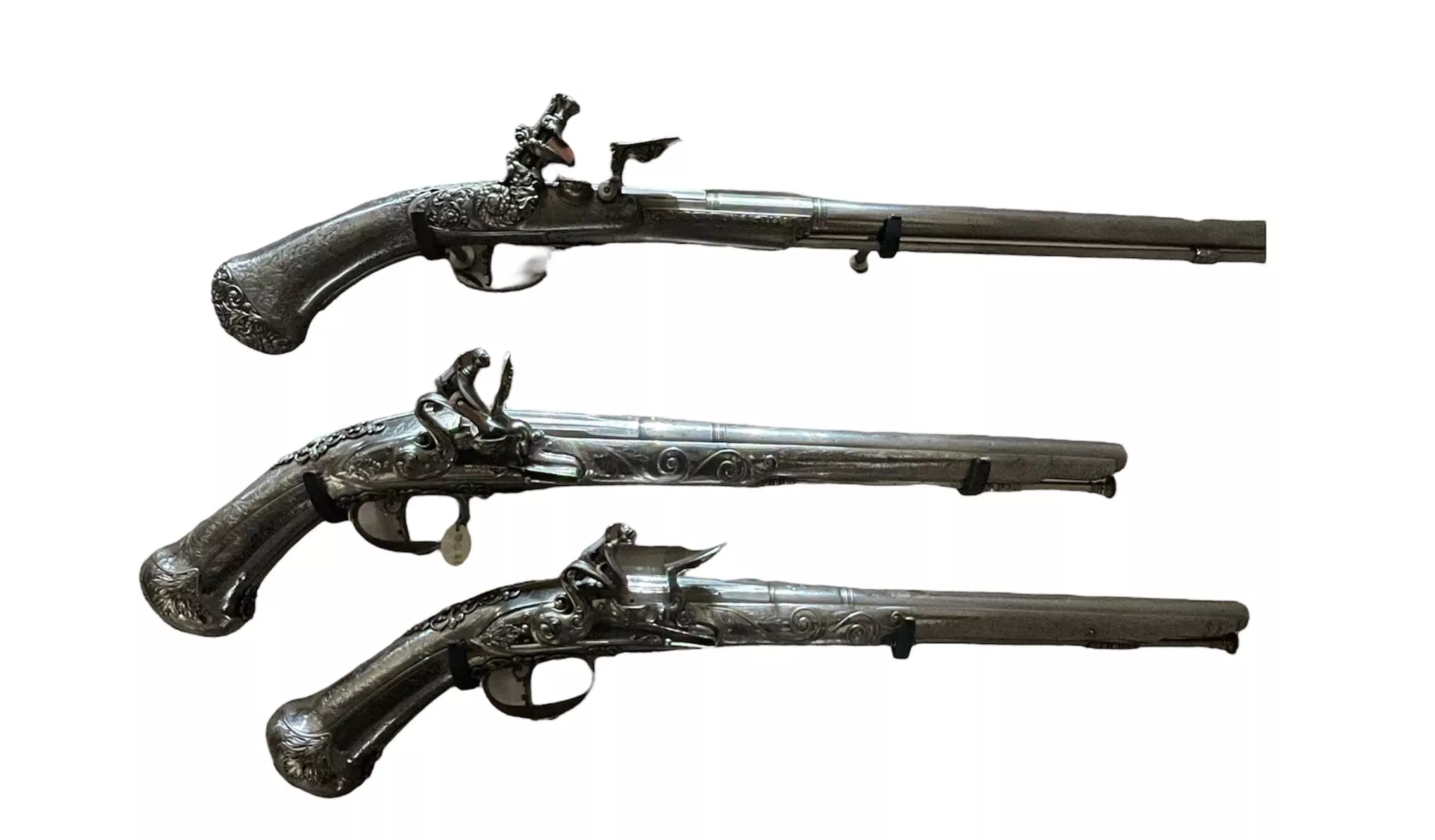
The flintlock pistol: definition
A flintlock pistol is an antique firearm that uses a flint-based firing mechanism to cause the ignition of gunpowder, which propels a projectile out of the gun's barrel. It works thanks to several components:
1. Barrel: The flintlock pistol features a barrel, a metal tube in which the projectile (usually a bullet) is placed. At the rear end of the barrel is a small cavity called the "powder chamber" where the gunpowder charge is inserted.
2. Powder chamber: The gunpowder charge is measured and poured into the powder chamber. This powder is highly flammable and serves as the propellant for the projectile.
3. Firing mechanism: The firing mechanism of a flintlock pistol consists of several essential parts:
- Flintlock: A piece of flint is attached to a movable jaw, called the hammer, located at the rear of the weapon.
- Hound: The hammer is held in the rear position by a spring. When released, it moves rapidly forward.
4. Primer: A small amount of percussion powder, called primer, is placed in a cavity called the bassinet. The bassinet is located near the dog's jaw, so that when the dog moves forward, the flint comes into contact with the primer.
5. Firing: When the shooter pulls the trigger, the hammer is released and moves rapidly forward. The flint, attached to the hammer, comes into contact with the primer in the bassinet. The impact between the flint and the primer creates a spark, which in turn ignites the charge of gunpowder in the gun's powder chamber.
6. Detonation: When the gunpowder charge ignites, it produces a high-pressure burning gas. This gas is confined within the barrel, causing a sudden increase in pressure inside the gun. This pressure pushes the projectile out of the barrel with great force, launching the shot.
The flintlock pistol mechanism is a classic example of a mechanically-fired firearm. Although this technology is now obsolete, it played an essential role in the history of firearms and preceded the development of modern firearms, such as centerfire and metal cartridge firearms.
The success of flintlock pistols in collecting
Flintlock pistols are successful at auction because they are a collectible weapon in demand. Production was very consistent, as it is a mechanism that was used for a long time and equipped many armies.
The more the model belonged to a famous and esteemed individual, the more the weapon's value can increase. This was the case with Tolstoy's pistols and Napoleon I's le Page pistols. On the auction market, the flintlock pistols found will mostly date from the 19th century.
Reasons to sell a flintlock pistol at auction
If you own a flintlock pistol or other model, and you don't know how to sell it, auctions are one solution. Many collectors are looking for old models.
These objects are not just weapons, but a historical witness to the scientific evolution of weapon design.
Knowing the value of a flintlock pistol
If you happen to own a flintlock pistol from any period and would like to know its value, don't hesitate to request a free appraisal using our form on our website. A member of our team of experts and chartered auctioneers will contact you promptly with an estimate of your item's market value, and provide you with all the relevant information. If you wish to sell your property, you will also be accompanied by our specialists in order to benefit from alternatives for selling it at the best possible price, taking into account market inclinations.
Estimate in less than 24h
More vintage weapons at auction

Estimated 3000 € - 5000 €
Flintlock general's or admiral's pistol, Vendémiaire an XII model

Estimated 600 - 800 €
Russian Shashka saber. Mounted in nielloed silver with chased plant decoration and strings of pearls.

Estimated 18.000 - 20.000 €
Hugo Borchardt patent C93 pistol, with original wood and leather stock.

Estimated 5.000 - 7.000 €
Ear dagger in the style of Diego Caias. Mounted in damascened iron, ivory and silver.
Discover in the same theme

Rating and value of Italian spinning-wheel pistols
Italian spinning-wheel pistols are highly collectible antique firearms that are much sought-after at auction. They are highly prized and fetch very go...
Learn more >

Rating and value of Empire rifles, model 1777, infantry
Model 1777 rifles appeared during the Ancien Régime and were the main weapons of the wars of the Empire. They were extremely valuable.
Learn more >

Rating and value of 1892 Saint Étienne revolvers (French Arm...
The Saint Étienne revolver was the standard sidearm of the French Army. It is sought-after at auction, and its value is stable.
Learn more >

Secure site, anonymity preserved

Auctioneer approved by the State

Free and certified estimates
Frequently asked questions
-
What is a flintlock pistol, and how does it work?A flintlock pistol is an antique firearm that uses a firing mechanism based on the impact of a flint against a primer to ignite gunpowder. The mechanism consists of a barrel, a powder chamber, a spring-loaded hammer, and a pan containing the primer. When the trigger is pulled, the flint strikes the primer and generates a spark that ignites the gunpowder, propelling the projectile.
-
What is the price range for antique flintlock pistols?Prices vary considerably depending on the model and condition. Reproductions sell for between 10 and 100€, Le Page pistols from €4,000 to €67,000, Boutet pistols from the Versailles arsenal from €1,000 to €120,000, and pistols made of precious materials from €2,000 to €226,840. Exceptional pieces that belonged to historical figures, such as Tolstoy’s case, can fetch much higher prices.
-
How do I have a flintlock pistol authenticated and appraised?Auctie's offers a free, no-obligation appraisal of your flintlock pistol. Simply fill out the form on our website, and one of our licensed auctioneers or experts will contact you to provide an accurate assessment of your firearm’s market value, along with relevant historical and technical information.
-
Is this a good time to sell a flintlock pistol?Yes, now is a good time to sell. Flintlock pistols continue to be popular among collectors worldwide, particularly 19th-century models. These items are sought after not only as firearms but also as historical artifacts reflecting technological advancements, which supports demand in the auction market.
-
How do I sell a flintlock pistol on Auctie's?Auctie's guides you through the entire process, from the free appraisal to the auction. After you request an appraisal, our specialists will help you identify the best options for selling your property at the best possible price, taking market trends into account and offering you the solutions best suited to your situation.
