



Rating and value of works, posters, paintings by Jules Chéret

Key takeaways
- Jules Chéret (1836–1932), a pioneer of the modern poster, revolutionized graphic art by elevating the medium to the status of a true work of art during the Belle Époque.
- Chéret’s posters and paintings sell for between €20 and €145,000 at auction, with signed original works fetching as much as several hundred thousand euros.
- His primary techniques include polychrome lithography, oil on canvas (€70,000 to €76,000), and watercolor drawings (€50,000 to €145,000), characterized by vibrant colors and dynamic female figures.
Pioneer of poster art, painter, lithographer and decorator, Jules Chéret (1836-1932) played a decisive role in the advent of commercial and cultural advertising. Nicknamed "the king of the poster" by his contemporaries, Jules Chéret expressed himself through a popular art form and made the poster a true artistic revelation.
If you own a work by or based on the artist Jules Chéret and would like to know its value, our state-approved experts and auctioneers will guide you.
Our specialists will carry out a free appraisal of your work, and send you a precise estimate of its value on the current market.
Then, if you wish to sell your work, we will direct you to the best possible arrangement to obtain the optimum price.
Our expert, Laurence Dantec, appraises your posters in collaboration with Auctie's and values them when they come up for sale.
Rating and artist's value
Highly prized by collectors worldwide, posters by Jules Chéret are highly prized at auction.
The price at which they sell at auction ranges from €20 to €145,000, a consequent delta but one that speaks volumes about the value that can be attributed to Jules Chéret's works.
A work signed by him, for example, can fetch several hundred thousand euros, as evidenced by his gouache on paper La Danse, which sold for €145,000 at Bailly Pommery-Voutier in 2005.
Order of value from the most basic to the most prestigious
Technique used | Result |
|---|---|
Sculpture - volume | From €396 to €10,500 |
Estamp - multiple | From €20 to €17,000 |
Oil on canvas | From €70 to €76,000 |
Drawing - watercolor | From €50 to 145,000 |
Estimate in less than 24h
Style and technique of Jules Chéret
The style and technique of Jules Chéret, often described as the "father of the modern poster", reflect a revolution in the art of visual communication at the end of the 19th century.
How, in a landscape still dominated by engraved and monochrome imagery, did he manage to impose an aesthetic where color and movement merge to captivate the eye?
Chéret, a master of color lithography, exploited the possibilities offered by this process to blend chromatic audacity and fluidity of line.
His compositions, in which the female figure often occupies a central place, are organized around curved, dynamic lines, lending his posters an almost theatrical vitality.
Like the Impressionists, he adopted a vivid palette, playing on contrasts of light to give his works an impression of lightness and effervescence.
However, where the latter sought to capture fleeting variations in light, Chéret focused on the immediate brilliance, the instant charm that draws the eye through crowded streets.
His figures, often dancing or in full action, seem to defy the fixity of the printed page, translating a joyful, festive modernity, proper to the spirit of the Belle Époque.
As a contemporary critic points out, Chéret succeeds in "elevating the poster to the rank of art while retaining its popular essence", a rare synthesis where virtuoso technique fades in favor of visual emotion.
The life of Jules Chéret
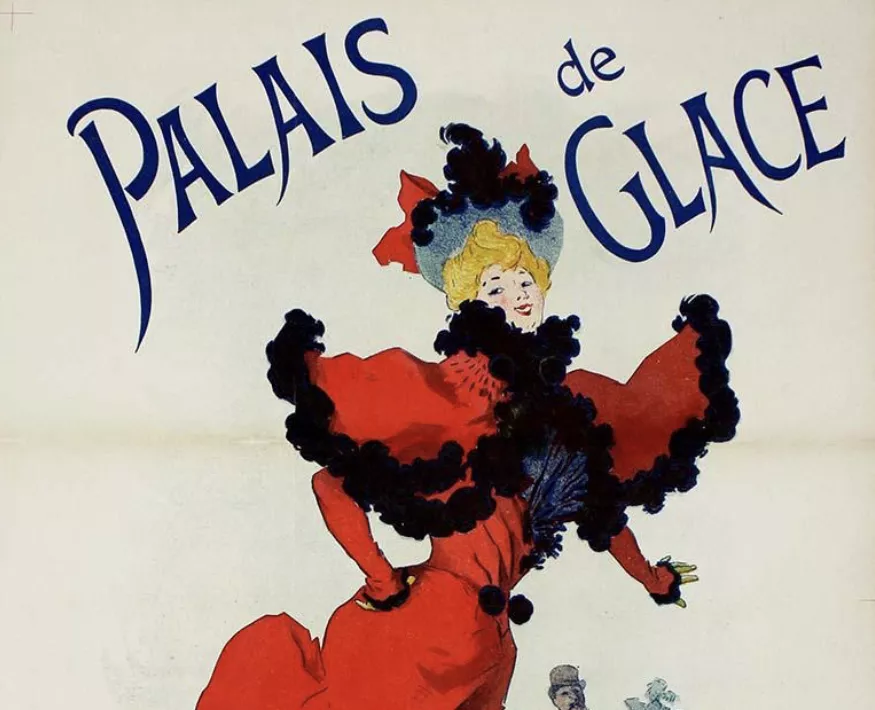
The life of Jules Chéret, born in Paris in 1836, is part of a trajectory where art and craft meet to redefine the contours of graphic creation. Coming from a modest background, he discovered the world of lithography at an early age, learning to master a technique still in search of recognition.
In 1859, a stay in London marked a decisive turning point: there he studied English innovations in color printing, absorbing the influence of English chromolithographs that favored vividness and clarity.
"Everything had to be reinvented", he would later say of his return to Paris, where he set about freeing the poster from its purely informative role.
By the 1860s, Chéret had established himself as the pioneer of the modern poster, combining technical virtuosity with visual daring. His compositions are distinguished by a quest for lightness, a vibrant palette and a fluid line that lends his female figures, often called "Chérettes", a jubilant grace.
This marriage of the aesthetic and the functional revolutionized the perception of graphic art, to the point where he is sometimes referred to as the "father of the artistic poster". By the end of the 19th century, his success was such that he became a key figure of the Belle Époque, his influence radiating far beyond the realm of advertising.
...
The legacy of Jules Chéret in his century
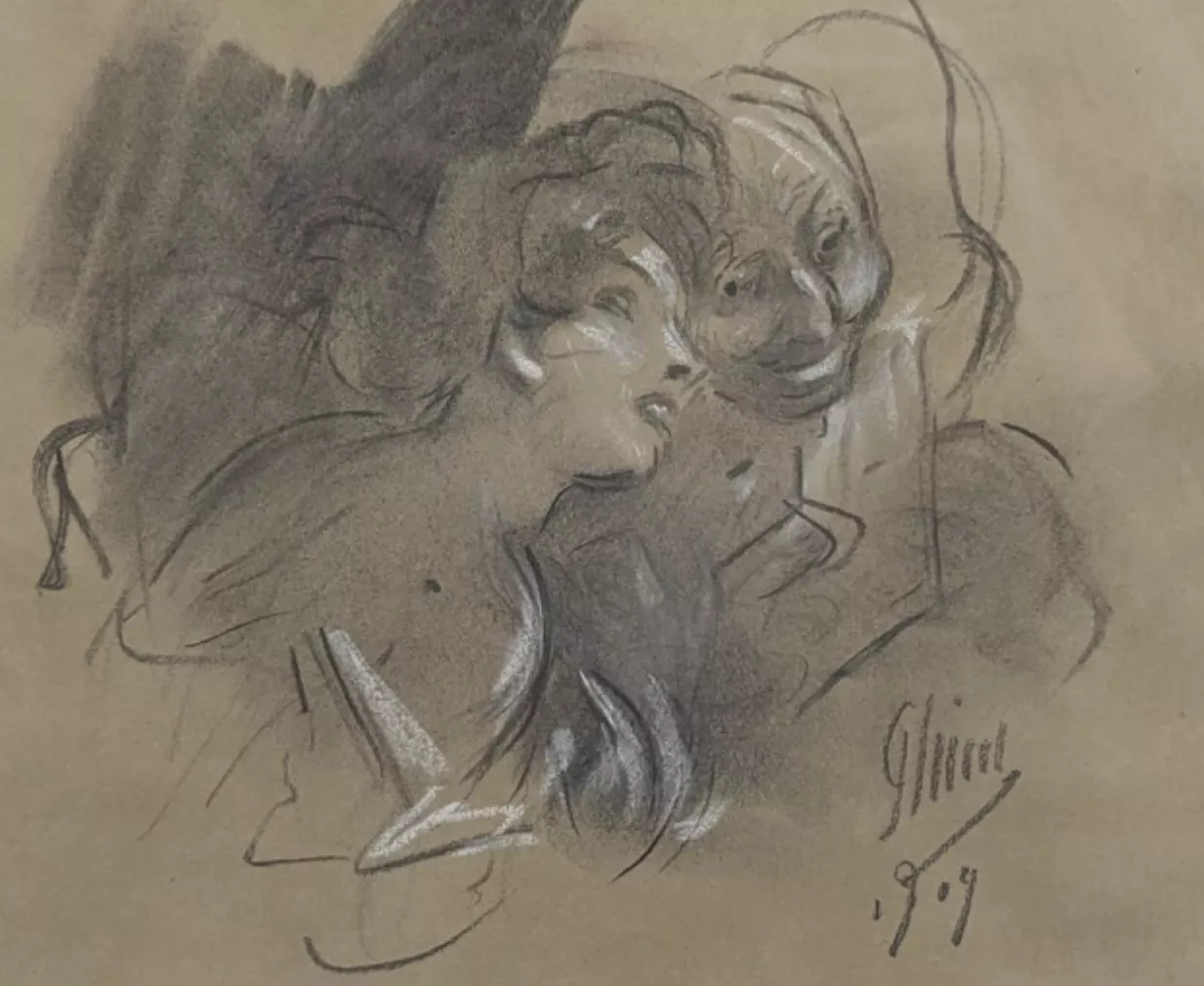
The legacy of Jules Chéret lies at the heart of the Belle Époque, redefining the status of the poster as a work of art in its own right. By transforming a utilitarian medium into a veritable graphic scene, he paved the way for generations of artists who found in his compositions a model of elegance and innovation.
His style, which blends spontaneity of line and brilliance of color, helped democratize art by making it accessible on city walls.
It was his "Chérettes", embodiments of joie de vivre and triumphant femininity, that made a lasting impression on the collective imagination, turning the poster into a mirror of modern aspirations.
Chéret didn't just inspire; through his prolific output and his role as passeur, he instituted a visual language that would influence currents such as Art Nouveau.
Figures such as Toulouse-Lautrec, Mucha or Bonnard find in his approach a starting point, taking up in their own way this exaltation of movement and light.
By popularizing lithographic art and elevating the poster to the status of an artistic medium, he traces a deep furrow in the history of the decorative arts, bearing witness to a modernity that continues to resonate long after his century.
Focus on Les folies bergères, Jules Chéret
In his poster for the Folies-Bergère, Jules Chéret deploys a visual brilliance that synthesizes the very essence of his art: an effervescent celebration of spectacle and modernity.
Dominated by a radiant female figure - emblematic of his famous "Chérettes" - the poster immediately captures the eye with its spiral composition, guiding the eye into a whirlwind of energy and light.
The woman, dressed in a light, brightly hued dress, seems suspended in a moment of pure exuberance, evoking both freedom and sensuality.
This choice of representation is not insignificant: Chéret here elevates the female figure into an icon of urban joy, a reflection of a rapidly changing society where entertainment is becoming a cornerstone of popular culture.
Technically, Chéret masters the art of polychrome lithography with rare virtuosity. Unlike contemporary posters, which are often limited to a restricted range of colors, he introduces vibrant hues and subtle gradations, giving the work an almost painterly luminosity.
Flats of color mingle with the fluid lines of the drawing, creating a visual texture that evokes both the spontaneity of a sketch and the richness of a finished painting. Here, the light seems to emanate from the composition itself, amplified by the use of a light background that contrasts with the bright hues of the central figure. This technique, revolutionary for its time, gives the poster an immersive quality that goes beyond its primary function of communication.
This visual dynamism finds an echo in the aesthetics of later poster artists, notably Alphonse Mucha and Henri de Toulouse-Lautrec, but it differs from them in its unabashed celebration of gaiety.
Where Mucha would introduce more stylized, structured motifs, and Lautrec would focus on intimate scenes imbued with a certain melancholy, Chéret favors a universal, direct, almost jubilant language. His art does not seek to analyze or deconstruct, but to amplify life in all its spontaneity.
The Les folies bergère poster also illustrates Chéret's ability to embody the spirit of the Belle Époque. By magnifying Paris's entertainment venues, he helped anchor the city as a cultural epicenter of its time.
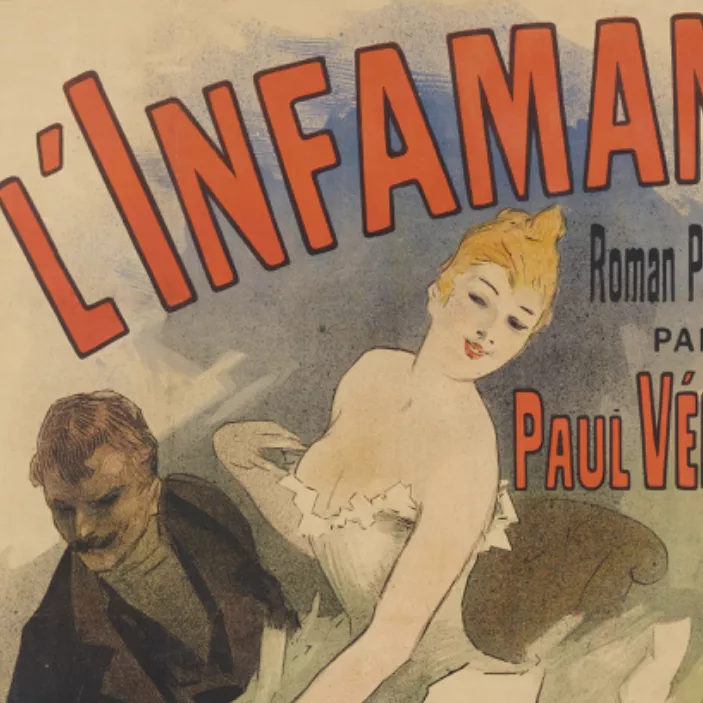
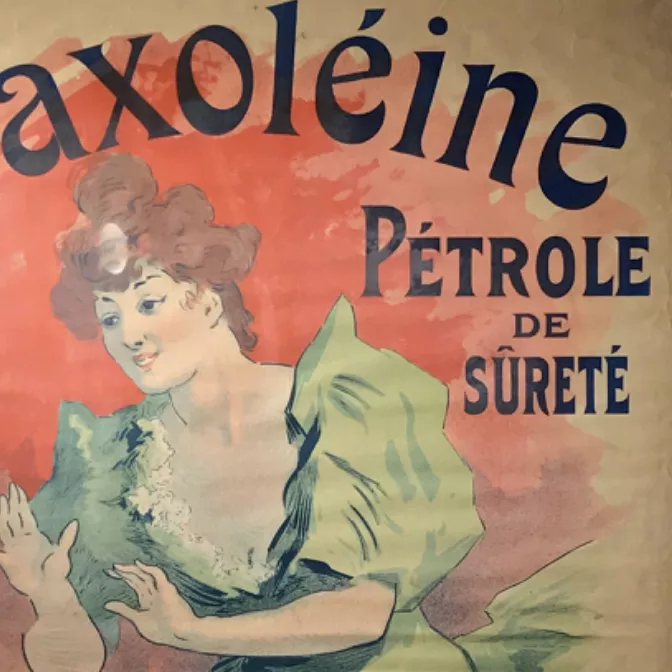
The female figure, omnipresent in his works, is more than mere ornamentation: it becomes the symbol of a modernity imbued with lightness, of a society looking to the future but deeply rooted in the pleasure of the moment.
This central role of women in his iconography could be compared to that they occupy in the works of Auguste Renoir, where they also embody an idealized vision of life.
However, in Chéret's work, this femininity unfolds in a specifically urban and dynamic context, in tune with the electric energy of Parisian life.
In the end, Les folies bergère goes beyond the advertising poster to establish itself as a celebration of festivity, color and modernity.
By combining technical virtuosity and emotional impact, Jules Chéret here signs a work that remains a major milestone in graphic art, while embodying the insouciance and vitality of an era.
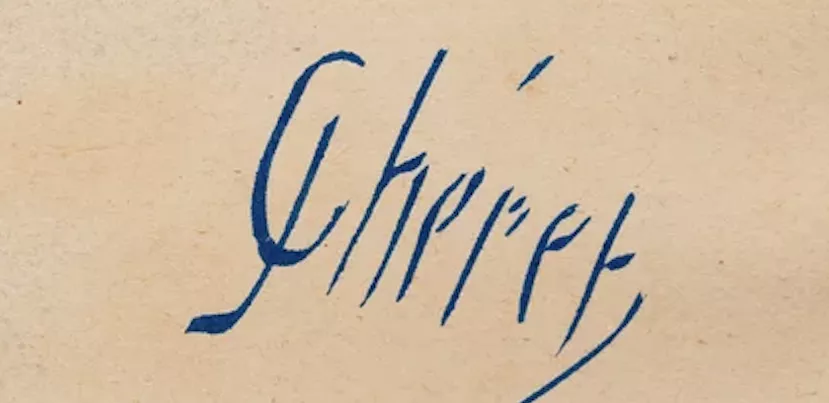
His signature
Not all of Jules Chéret's works are signed.
Although there are variations, here's a first example of his signature:
Expertise your property
If you own a work by Jules Chéret, don't hesitate to request a free appraisal by filling in our online form.
A member of our team of experts and certified auctioneers will contact you to provide an estimate of your work's market value.
If you are considering selling your work, our specialists will also guide you through the various alternatives available to obtain the best possible price, taking into account market trends and the specific features of each object.
Estimate in less than 24h
Discover in the same theme

Rating and value of the works, Alexandra Shchekotikhina-Poto...
Alexandra Shchekotikhina-Pototskaya is a twentieth-century Russian artist who mainly produced paintings on porcelain, which are highly valued.
Learn more >

Rating and value of works, drawings, paintings by Gen Paul
Gen Paul is a twentieth-century Cubist artist who produced drawings, paintings and oil on canvas that are appreciated and quoted at auction.
Learn more >

Rating and value of paintings by Reuven Rubin
Reuven Rubin is an Israeli modernist artist who has produced many works that are highly rated and valued at auction.
Learn more >
Works from the same period sold at auction

Estimated 800 - 1.500
Tsuguharu FOUJITA (1886-1968) On the wall, children and swallows, 1964 Lithograph

Estimated 1.500 - 3.000
CHOCOLAT PUPIER, The best French chocolate, Polychrome enamelled plate

Estimated 2.000 - 4.000
JONES Adrian. Buffalo Bills Wild West. 1903. Lithographic poster

Estimated 2.000 - 4.000
ANONYMOUS. Buffalo Bills Wild West and Congress of rough riders of the world. Circa 1900. Lithographic poster

Estimated 2.000 - 4.000
ANONYMOUS. William Frederick Cody, known as Buffalo Bill. Circa 1900. Lithographic poster

Estimated 2.000 - 3.000
Advertising object. MUCHA Alphonse. Bleu Deschamps.

Secure site, anonymity preserved

Auctioneer approved by the State

Free and certified estimates
Frequently asked questions
-
Who was Jules Chéret, and why is he significant in the history of art?Jules Chéret (1836–1932) was a pioneer of the modern poster and the “father of the artistic poster.” A painter, lithographer, and set designer, he revolutionized visual communication by elevating the poster to the status of a work of art in its own right, using color, movement, and dynamic female figures known as “Chérettes.” His influence extended far beyond advertising, inspiring the artistic movements of the Belle Époque, particularly Art Nouveau.
-
What is the price range for Jules Chéret's posters and paintings at auction?Prices vary considerably depending on the medium and the rarity of the work: prints range from €20 to €17,000, watercolor drawings from €50 to €145,000, oil paintings on canvas from €70 to €76,000, and sculptures from €396 to €10,500. A major gouache such as “La Danse” fetched €145,000 in 2005, demonstrating that works signed by the artist can exceed these price ranges.
-
How can you authenticate a work by Jules Chéret?To authenticate a work by Jules Chéret, we recommend that you request a free appraisal from Auctie's. Our state-certified auctioneers and experts will examine your item and provide you with an accurate estimate of its current market value, with no obligation.
-
How does the appraisal process work at Auctie's?Appraisals at Auctie's are free and non-binding. Simply fill out our online form with photos and information about your artwork. An expert or auctioneer from our team will contact you within 48 hours to provide you with an accurate appraisal based on current market trends.
-
How do I sell a poster or painting by Jules Chéret?As an auction house, Auctie's supports you from the free appraisal all the way through to the sale of your artwork. Our specialists guide you through the various options available and help you achieve the best possible price, taking into account the specific characteristics of your item and current market trends.
