



Rating and value of paintings and drawings by Varvara Fiodorovna Stepanova

Key takeaways
- Varvara Stepanova's works sell for between €380 and €1.7 million, with her paintings fetching the highest prices at auction.
- A Russian Constructivist artist (1894–1958), she favored geometric precision, angular forms, and primary colors to create a functional and collective visual language.
- Her work spans painting, drawing, printmaking, typography, and textile design, reflecting her commitment to social transformation through art in the USSR of the 1920s.
If you own a work by or based on the work of artist Varvara Fiodonova Stepanova and would like to know its value, our state-approved experts and auctioneers will guide you.
Our specialists will carry out a free appraisal of your work, and provide you with an accurate estimate of its value on the current market.
Then, should you wish to sell your work, we will direct you to the best possible arrangement to obtain the optimum price.
Artist's rating and value
Varvara Fiodonova Stepanova's work is uncommon and fairly highly rated on the auction market. Her works arouse interest among collectors and art lovers, particularly those who appreciate 20th-century Russian painting.
The price at which her works sell on the art market ranges from €380 to €1,722,000, a considerable delta but one that speaks volumes about the value that can be attributed to the artist's works.
Thus, a painting by Stepanova can fetch thousands of euros at auction, such as his Figure with guitar, adjudged for €1,722,000 in 2014, whereas it was estimated at between €310,000 and €430,000.
Order of value from the most basic to the most prestigious
Technique used | Result |
|---|---|
Estamp - multiple | From €380 to €2,200 |
Drawing - watercolor | From €360 to €52,600 |
Painting | From €210 to €1,722,000 |
Estimate in less than 24h
Style and technique of Varvara Fyodorovna Stepanova
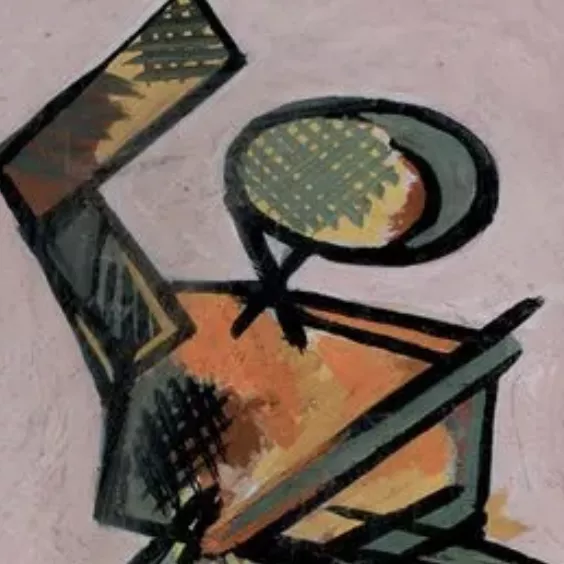
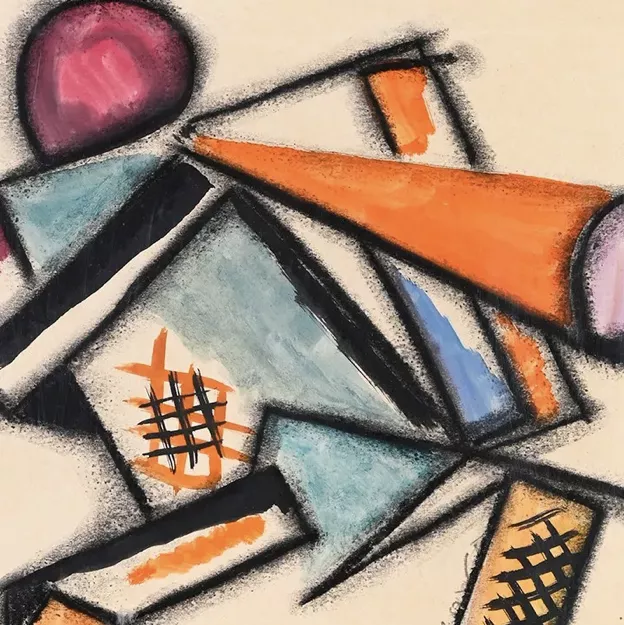
Varvara Fyodorovna Stepanova, in her graphic and textile compositions of the 1920s, favors rigorous linework and structured arrangement of forms, miniscences of constructivist principles formulated by Rodchenko and Tatline.
In her sketches for the stage - notably for La Mort de Tarelkine in 1922 - she modulates space with sharp lines, stark contrasts of black, white and red, where the human figure, reduced to a play of angular volumes, almost fades behind the geometry of the set.
Like Lissitzky's typographic experiments, she integrates text into the composition, juxtaposing letters and flat areas of color to inscribe the image in a visual rhythm akin to photomontage.
But if her contemporaries favored pure abstraction, Stepanova retained a functional logic that extended into textiles and clothing.
In her patterns printed for Soviet industry, the serial repetition of elementary figures - chevrons, diagonals, superimposed circles - obeys a quest for legibility and efficiency, where ornament disappears in favor of a pared-down graphic language.
Through these experiments, his style oscillates between construction and dynamism, where the line, sharp and cutting, inscribes the body and the object in an aesthetic of movement.
As with Popova, color is reduced to a few primary tones, arranged in clean surfaces, without modeling, abolishing any illusionist residue. Painting gives way to structure, the image becomes a schema, and art, now linked to industry, imposes a new formal grammar on Soviet modernity.
As with Popova, color is reduced to a few primary tones, arranged in clean, unmodelled surfaces, abolishing all illusionist residue.
Varvara Fiodorovna Stepanova : her life, her work
Born in 1894 in the province of Kovno, Varvara Fiodorovna Stepanova pursued her studies in Kazan before moving to Moscow, where she immersed herself in the artistic effervescence of the avant-garde.
Trained in the progressive circles of the turn of the century, she befriended Rodchenko, with whom she shared a radical conception of art as an instrument of social transformation.
From 1917, her pictorial research turned towards dynamic abstraction, where line, freed from all figuration, becomes a structural force.
An active member of the Constructivist group, she took part in the debates that redefined the function of the artist in the nascent Soviet Union, gradually abandoning the easel canvas for graphics, typography and textile design.
In the 1920s, her commitment was reflected in close collaboration with state institutions, notably through the design of utilitarian garments, where the geometric cut responded to the principles of efficiency and mass production.
Parallel to this, she developed a clear-cut visual language in publishing and set design, notably for revolutionary theater.
But with the ideological turnaround of the 1930s, constructivism gave way to socialist realism, and her work adapted to the new cultural guidelines.
Despite this retreat, Stepanova remained active until her death in 1958, continuing her research into the printed image and state graphics.
Through her experiments, she inscribed her name in the history of the Russian avant-gardes, where art, freed from individual subjectivity, became a structured language, a tool of collective modernity.
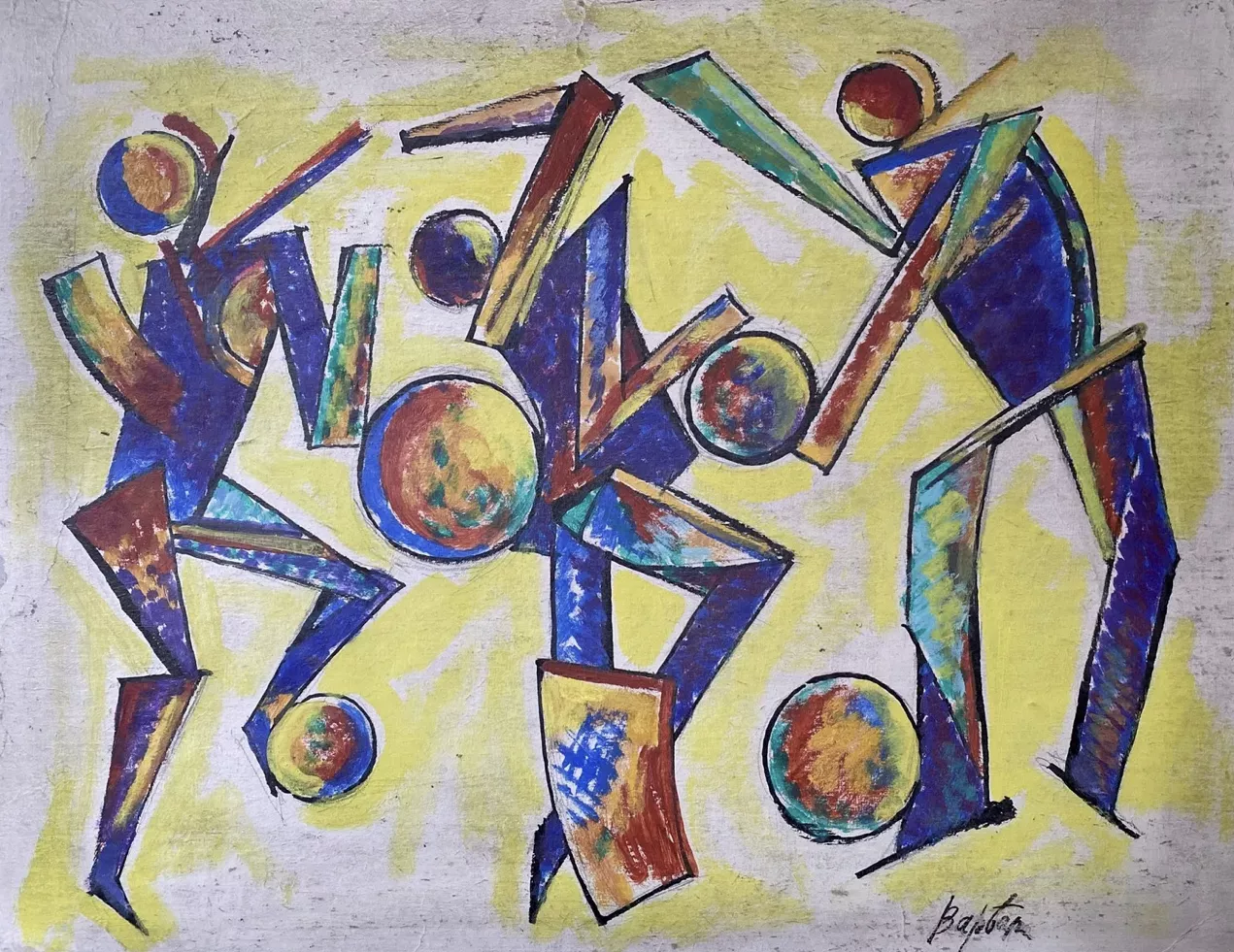
Stepanova's work is the result of a long process of experimentation.Focus on Sportsmen, Stepanova, 1923.
In Sportsmen (1923, Russian National Museum, St. Petersburg), Varvara Stepanova composes a scene in which the human figure dissolves into a succession of dynamic forms, reduced to essentials.
The body is no more than a sequence of planes and volumes, articulated by a play of curves and angles, where color intervenes in frank flat tints, structuring space with rigor.
Inspired by the principles of constructivism, it evacuates all naturalistic impulses: here, movement takes precedence over the individual, rhythm replaces narrative.
In this painting, the influence of machinismo shines through in the simplification of silhouettes, where arms and legs become functional segments, devoid of superfluous expressivity.
Like her parallel experiments in typography, Stepanova seeks a stripped-down plastic style, where each element obeys a logic of efficiency and visual impact. The image becomes a schema, reduced to its fundamental tensions.
Far from a simple sports illustration, Sportsmen translates the utopia of a humanity regenerated by speed and the rational organization of the body in motion.
This work is part of the dynamic of the 1920s, when Constructivism advocated art turned towards society, designed for the collective. Stepanova, by transposing these principles onto the human figure, anticipates the experiments in graphic design and utilitarian clothing that she would later develop.
The sharp, pared-down line is in line with the desire for formal stripping down that characterizes the Russian avant-garde, where the image, broken down, becomes a tool in the service of modernity.
The context of Stepanova's artistic creation
In the Russia of the 1910s-1920s, Varvara Stepanova evolved within a burgeoning avant-garde, where art was intended to drive social transformation.
A graduate of the Stroganov Institute, she joined the Constructivist circles, sharing with Rodchenko and Popova the ambition of a functional art, free from all academic tradition.
After the 1917 revolution, the political context imposed new imperatives: artistic production had to be aligned with the needs of the proletariat, abolishing the distinction between fine art and industry.
In this climate, Stepanova seized on the geometric language of Suprematism, but turned away from its mystical impetus to anchor her work in a materialist dynamic.
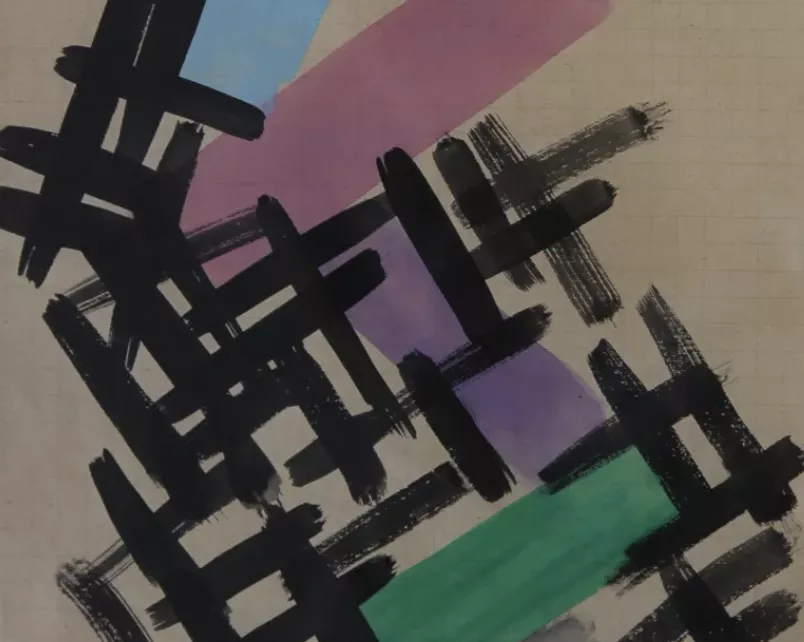
Her compositions, whether paintings, fabrics or typography, obey a structural rigor where each element is thought out in terms of efficiency and reproducibility.
The studio becomes a laboratory, the artist an engineer of forms. As early as 1921, she took part in the experiments of the INKhUK group, which redefined the function of art in a collectivist society.
Constructivism, to which she actively contributed, rejected the idea of individual, autonomous creation. Stepanova transposed these principles to textiles, posters and layouts, multiplying the media to inscribe art in everyday life.
Production had to be standardized, devoid of superfluous ornament, conforming to the imperatives of Soviet modernity. In this way, it illustrates the period when art, far from being a space for contemplation, became a propaganda tool and an instrument of social change.
Stepanova's imprint on her period
Varvara Stepanova established herself as a key figure of Constructivism, embodying that desire for fusion between art and industry that marked the 1920s in the Soviet Union.
With her research into mass production, she placed artistic creation within a logic of rationalization and social utility, rejecting all forms of individual expression in favor of a collective, functional visual language.
Alongside Alexander Rodchenko, she rethought the aesthetic object within a strictly material framework, whether posters, textiles or typography, where each graphic element responds to a structural necessity.
Her work on clothing revolutionizes the relationship between form and use: she designs streamlined models, adapted to the demands of movement and work, rejecting bourgeois ornamentation in favor of a rigorous aesthetic.
Her typographic experiments, visible in particular in her compositions for State editions, set the principles of a constructivist graphic design based on legibility and immediate impact.
This standardization, although carried by a progressive ideology, also heralds the drifts of an art subjected to political imperatives, where creation becomes above all an instrument of propaganda.
While the evolution of the Soviet regime gradually relegated constructivism to the background, Stepanova's legacy remains.
Her radical approach had a lasting influence on graphic and textile design, laying the foundations for a modernism that, beyond the Soviet framework, would find echoes in Bauhaus and 20th-century industrial design.
Today, she is establishing herself as a key figure on the French art market, alongside other Russian artists such as Kasimir Malevitch, Alexander Deineka or Seraphin Soudbinine.
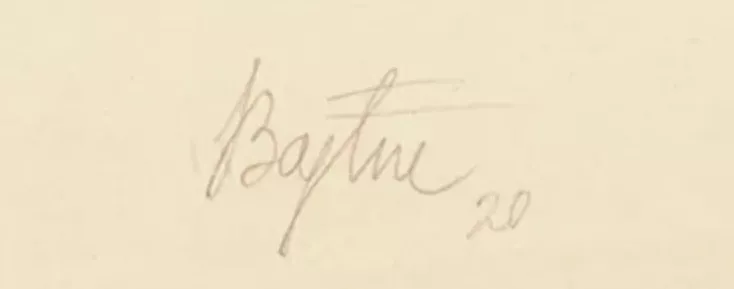
His signature
Not all of Stepanova's works are signed. It is also possible that it is a copy or that the mention has faded over time, which is why expertise is paramount.
Expertise your property
If you own a work by Varvara Fiordonorva Stepanova, don't hesitate to request a free appraisal by filling in our online form.
A member of our team of experts and licensed auctioneers will contact you to provide an estimate of the market value of your work.
If you are considering selling your work, our specialists will also guide you through the various alternatives available to obtain the best possible price, taking into account market trends and the specific features of each work.
Estimate in less than 24h
Discover in the same theme

Rating and value of Line Vautrin's mirrors, boxes and jewelr...
Line Vautrin is a 20th-century artist who created jewelry, mirrors and other objects that are prized and valued at auction.
Learn more >

Rating and value of paintings by Amédée Ozenfant
Amédée Ozenfant is a cubist and purist artist of the 20th century, who produced works in a variety of media that are highly rated and valued.
Learn more >

Rating and value of drawings and paintings by Arbit Blatas
Arbit Blatas is a painter from the School of Paris whose paintings and sculptures command high prices at auction.
Learn more >

Secure site, anonymity preserved

Auctioneer approved by the State

Free and certified estimates
Frequently asked questions
-
Who was Varvara Fyodorovna Stepanova, and what was her role in the Russian avant-garde?Varvara Fyodorovna Stepanova (1894–1958) was a leading Russian artist of the Constructivist and Soviet avant-garde movements. Trained at the Stroganov Institute and a close collaborator of Alexander Rodchenko, she redefined the role of the artist by merging art with industry, working in painting, graphic design, typography, textiles, and theatrical set design. Her radical approach, which rejected individual expression in favor of a collective and functional visual language, had a lasting influence on 20th-century graphic and textile design.
-
What is the price range for Stepanova's works on the auction market?Stepanova’s works sell for between €380 and €1,722,000, depending on their medium and size. Prints and multiples range from €380 to €2,200, while watercolors and drawings range from €360 to €52,600, while paintings command the highest prices, ranging from €210 to over 1.7 million euros for outstanding pieces such as “Figure with Guitar,” which was sold at auction in 2014.
-
How can you authenticate a work by Varvara Stepanova?To authenticate a work by Stepanova, we recommend that you request a free appraisal from Auctie's by filling out our online form. A certified expert or auctioneer will examine your work and contact you to provide an accurate estimate and an assessment of its authenticity, with no obligation on your part.
-
When is the best time to sell a work by Stepanova?The market for Varvara Stepanova’s works remains strong, and collectors’ interest in 20th-century Russian painting and Soviet Constructivism remains high. Now is a good time to sell, especially if your piece has significant qualities. Our experts will help you determine the best strategy to maximize the sale price.
-
How does the appraisal and sale of a work of art take place at Auctie's?Appraisals at Auctie's are free and non-binding: you fill out an online form, and a certified appraiser or auctioneer will contact you to evaluate your artwork and provide you with an estimate of its market value. If you decide to sell, our specialists will guide you toward the most suitable solution and support you from the appraisal through the auction, taking market trends into account.
