



Rating and value of Fernand Dresse's paintings and furniture

Key takeaways
- Fernand Dresse, a renowned abstract artist, sees his works sell for between €30 and €30,000, with exceptional pieces exceeding this range.
- His tables from the 1960s are the most sought-after by collectors; a coffee table fetched €30,000 at Piasa in 2022.
- Paintings range from €30 to €3,000, while furniture falls between €2,500 and €30,000, reflecting the artist’s rising market value.
If you own a work by or based on the artist Fernand Dresse and would like to know its value, our state-approved experts and auctioneers will guide you.
Our specialists will carry out a free appraisal of your work, and provide you with a precise estimate of its value on the current market.
Then, if you wish to sell your work, we will direct you to the best possible arrangement to obtain the optimum price.
Cote et valeur de l'artiste
During his lifetime, Fernand Dresse enjoyed great success and a high international rating that has not diminished today. His tables, produced in the 1960s, are the most sought-after and arouse great interest among collectors.
The price at which they sell on the art market ranges from €30 to €30,000, a consequent delta but one that speaks volumes about the value that can be attributed to the artist's works.
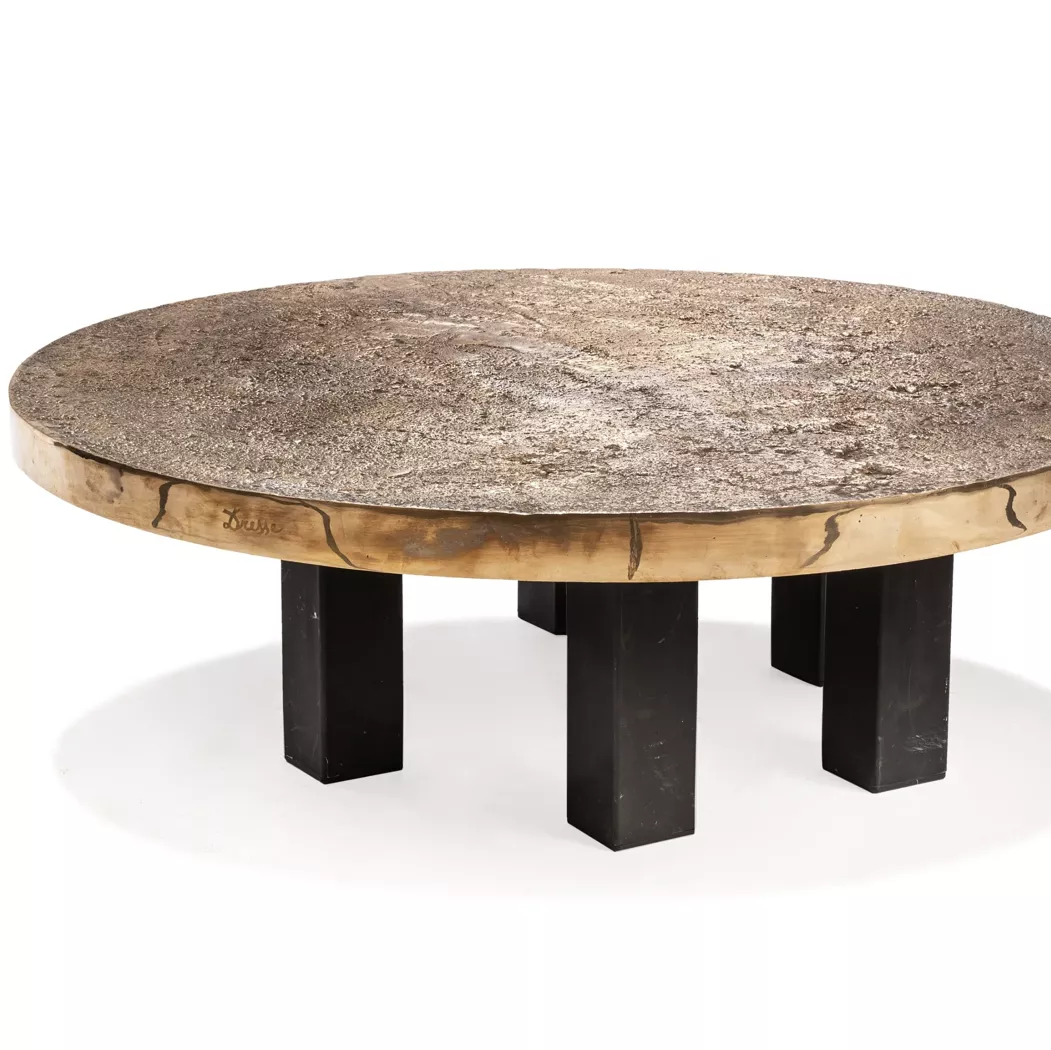
A work by Dresse can fetch hundreds of thousands of euros, as demonstrated by one of his coffee tables which sold for €30,000 at Piasa in 2022, whereas it was estimated at between €20,000 and €30,000.
The artist's value has consequently never been so high.
Order of value from the most basic to the most prestigious
Technique used | Result |
|---|---|
Paintings | From €30 to €3,000 |
Furniture | From €2,500 to €30,000 |
The artist's style and technique
Fernand Dresse's style is part of a methodical approach to lyrical abstraction, where the pictorial surface becomes a rigorous field of exploration.
Through a skilful play of superimpositions, the artist modulates textures that capture or diffract light, creating a depth of his own in his compositions.
Matter is never treated in a uniform manner: it unfolds in strata, sometimes smooth, sometimes granular, evoking a palpable tension between density and lightness.
This meticulous treatment is accompanied by a nuanced chromatic vocabulary, where vibrant tones intermingle with more subdued hues, building colorful rhythms that recall the dynamism of nature or the intensity of mental landscapes.
Dresse's technique is also based on a particular attention to gesture, which leaves nothing to chance: each intervention, whether addition or erasure, participates in a rigorous overall structure.
Yet this discipline does not exclude a certain spontaneity, perceptible in the fluid movements of the lines or in the subtle transitions between areas of light and shadow.
Relying on a rich and complex materiality, Dresse inscribes his works in a renewed tradition of European abstraction, while asserting a singularity that moves away from dogma to privilege an aesthetic of visual resonance.
His seemingly free canvases betray a thoughtful construction, where every detail participates in a precise formal orchestration.
The life of Fernand Dresse
In 1981, a retrospective in Liège devoted to Fernand Dresse unveiled a panorama of his works, celebrating a singular abstraction in which matter takes the place of language.
What strikes one immediately is the tactile density of his compositions, worked through thick strata that capture light as a relief captures shadow.
Dresse, like her Belgian contemporaries Marthe Wéry and Jozef Peeters, explores a pictorial territory where form becomes silent, pared down to the essential.
But where Wéry leans towards strictly geometric surfaces and Peeters towards constructivist dynamism, Dresse favors a more organic approach.
His paintings, often reduced to an earthy or mineral palette, recall ancient frescoes, worn by time. This almost archaic materiality inscribes his work in a continuity where past and present are superimposed.
His approach could be likened to that of classical engravers, where each incision, each line, becomes a founding act.
Dresse's painting, with its use of uneven textures and scarified surfaces, conjures up an aesthetic of palimpsest: beneath each visible layer, we guess buried strata, like so many silent narratives.
This research into matter is not unlike the meditative approach of twentieth-century Japanese artists, but Dresse retains a typically European distance, marked by an almost architectural rigor.
Far from seeking the spectacular or pure emotion, his works impose slow contemplation, sustained attention to detail.
Just as Renaissance engravers built their works around a network of methodical carvings, Dresse relies on a controlled vocabulary, where every gesture is thought through.
It is this dialogue between tradition and modernity, between rigor and intuition, that gives his work this timeless resonance.
Focus on the coffee table by Fernand Dresse
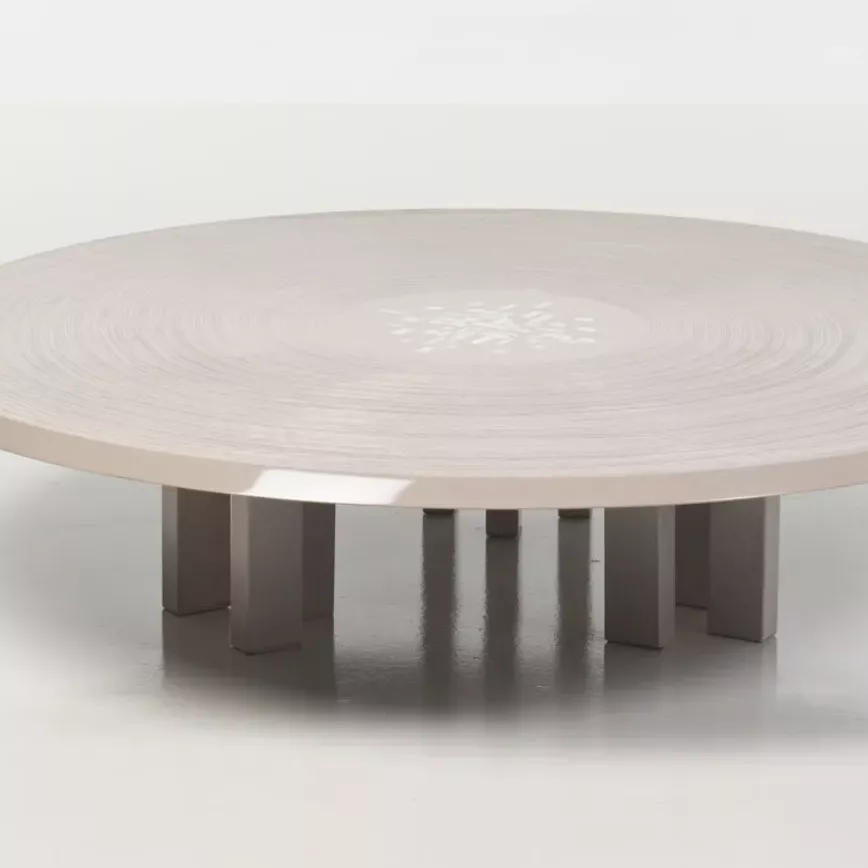
The coffee table by Fernand Dresse, an emblematic piece in his repertoire, perfectly illustrates this fusion of modernist rigor and exaltation of material that characterizes his work.
From a global perspective, it stands out for its monumental, almost architectural allure, where every detail seems the fruit of precise calculation, but also of profound sensitivity.
Dresse does more than simply design functional furniture: he creates an object that dialogues with space and light, an object in which the material becomes the protagonist of a work in its own right.
The top, often made of marble or travertine, evokes a sculptural quality. Its natural veining, carefully highlighted, recalls eroded frescoes or ancient mosaics.
The surface, polished but not stripped of its irregularities, invites the observer to a tactile reading, as if Dresse had wanted the eye to become a hand. This choice testifies to an almost archaic attention to the material, where every stone, every imperfection, is exalted rather than concealed.
As for the structure, often in metal or bronze, it is distinguished by a formal sobriety that contrasts with the textural richness of the top. The lines are clean, geometric, almost austere, but they elegantly support the density of the material.
This tension between the weight of the material and the lightness of the forms gives the table a unique presence: it seems simultaneously anchored in the ground and ready to rise.
In this table, we might find echoes of the modernist furniture of Jean Prouvé, Pierre Chapo or by Charlotte Perriand, but Dresse differs in a more organic, intuitive approach. Where Prouvé values technique and rationality, Dresse celebrates imperfection and raw nature.
It is in this subtle balance between art and design, between the utilitarian and the sculptural, that the singularity of Fernand Dresse's coffee table lies. It becomes much more than a piece of furniture: a work of art to be contemplated, where each glance reveals a new detail, a hidden richness.

Fernand Dresse's imprint on his period
Fernand Dresse's work stands out in the history of the decorative arts of his time. Just as the Cubist engravers reinterpreted the classical canons, Dresse borrowed from traditional craftsmanship to better renew its forms.
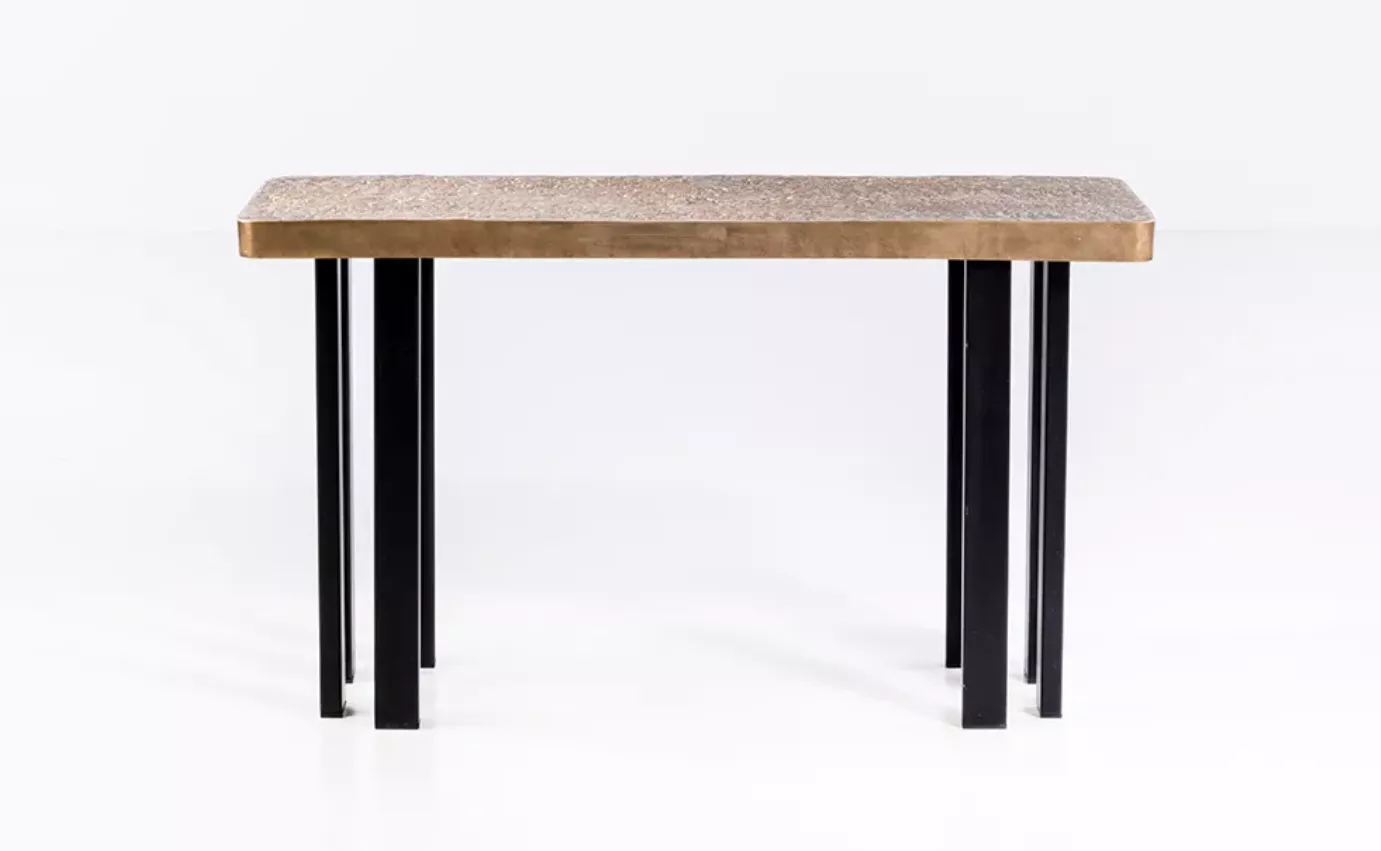
His tables and panels, made of hard stone and brass, reflect a quest for symmetry and weight. Each composition is based on an exemplary mastery of materials, evoking, through its polished surfaces and precise inlays, the meticulousness of ancient mosaicists.
However, far from limiting himself to academic reproduction, Dresse imbues his works with a bold modernity, where geometric abstraction dialogues with the nobility of materials.
His visual vocabulary, structured by regular networks of golden lines and repetitive motifs, recalls the methodical work of classical engravers such as Mellan or Bosse.
However, Dresse introduces a profoundly contemporary dimension by playing on contrasting textures and exploiting the natural shine of metal to catch the light.
This austere, almost mechanical refinement reinforces the idea of timeless elegance, stripped of all superfluity.
Like Villon or Marcoussis in their cubist engravings, Fernand Dresse systematizes his approach, codifying a singular decorative language.
He goes beyond simple craftsmanship to establish a total art, where each piece becomes a harmonious expression between tradition and innovation.
This rigor, combined with a sensitivity for the nuances of matter, gives his work a unique place in modernity, while linking it to the great epochs in the history of decor.
The quotation of Fernand Dresse at auction
Like the works of the great furniture masters, the work of Fernand Dresse is part of a methodical and constant evolution that finds its echo in the auction rooms.
The value of his creations, particularly his tables and marquetry, rises steadily, similar to that of artists who, over time, see their work mature and become established.
Precise, elegant pieces that bear witness to exceptional craftsmanship are now fetching increasing prices, reflecting collectors' interest in an art form distinguished by rigorous craftsmanship and the purity of its materials.
Like the great names of turn-of-the-century furniture, whose creations have seen their value increase over time, Fernand Dresse emerges as an artist whose importance, initially perceived on a local scale, is today finding its place among the most sought-after names.
The auction confirms this status as a master of decorative furniture, following in the footsteps of other emblematic figures, and testifies to the evolving recognition of his work in the art world.
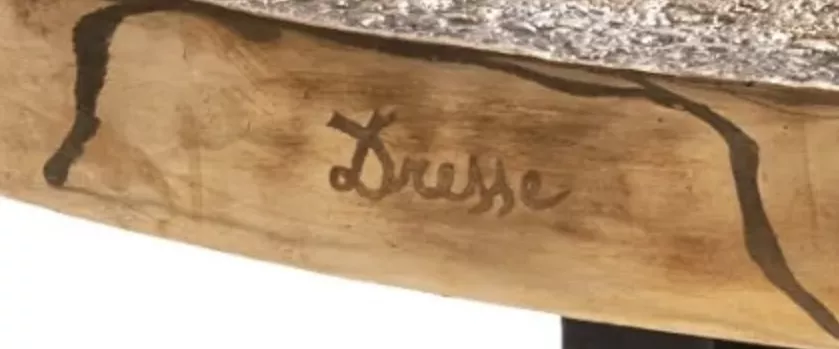
His signature
Although there are variations, here is a first example of his signature :
Expertise your property
If you happen to own a work by Fernand Dresse, request a free appraisal without further delay via our form on our website.
A member of our team will contact you promptly to provide you with an estimate of the value of your work, not forgetting to send you ad hoc information about it.
If you are considering selling your work, you will also be accompanied by our specialists in order to benefit from alternatives for selling it at the best possible price.
.Estimate in less than 24h
Discover in the same theme

Rating and value of paintings by Jean Buhot
Jean Buhot was a twentieth-century Orientalist painter who produced oil-on-canvas paintings that enjoyed relative success at auction.
Learn more >

Rating and value of works, fashion drawings by Georges Lepap...
Georges Lepape was a 20th-century illustrator and fashion designer, who produced drawings and posters that were successful at auction.
Learn more >

Rating and value of paintings by Marie Aimée Lucas Robiquet
Marie Aimée Lucas Robiquet is an Orientalist artist who produced a large body of work that is highly valued and appreciated.
Learn more >
Other works of designer furniture sold at auction

Estimated 2.500 - 3.500
Pierre CHAPO (1927-1986) Dining table, circa 1978, model T21D dite Sfax

Estimated 4.000 - 6.000
Roger CAPRON (1922-2006) Soleil rectangular coffee table, circa 1965

Estimated 500 - 1.000
BRUTALIST WORK (20th century) Dining table, circa 1960

Estimated 7.000 - 10.000
Pierre CHAPO (1927-1987) Coffee table, circa 1980, model T22C called Œil in solid elm wood

Estimated 3.000 - 4.000
Roger CAPRON (1922-2006), Suite of two coffee tables from the Y series, circa 1968

Estimated 8.000 - 12.000
Ado CHALE (b. 1928), Peppercorn Coffee Table, circa 1980

Secure site, anonymity preserved

Auctioneer approved by the State

Free and certified estimates
Frequently asked questions
-
Who is Fernand Dresse, and what is his artistic background?Fernand Dresse is a 20th-century Belgian artist known for his unique approach to lyrical abstraction and furniture design. A contemporary of figures such as Marthe Wéry and Jozef Peeters, he stands out for his fusion of modernist rigor and an organic celebration of materials, working primarily on paintings and furniture with richly textured surfaces. His work is part of a renewed tradition of European abstraction, characterized by an architectural attention to detail and a meditative sensitivity to materiality.
-
What is the price range for Fernand Dresse's works?Prices for Fernand Dresse’s works vary considerably depending on the type and rarity. His paintings range from €30 to €3,000, while his furniture—particularly his iconic tables—sells for between €2,500 and €30,000. One of his coffee tables sold for €30,000 at Piasa in 2022, confirming a steady rise in value and growing interest among collectors in his creations.
-
How can I authenticate and have a work by Fernand Dresse appraised?To authenticate and appraise a work by Fernand Dresse, submit a request for a free appraisal to Auctie's using our online form. A state-certified expert will contact you within 48 hours to examine your item, verify its authenticity, and provide you with an accurate assessment of its current market value—with no obligation on your part.
-
Is this a good time to sell a work by Fernand Dresse?Yes, now is a good time to sell a work by Fernand Dresse. The artist’s market value has been rising steadily and consistently for years, reflecting growing international recognition and increased collector interest in his furniture and paintings. Auction results confirm this positive trend and the lasting appreciation of his creations.
-
How does the sale of a work of art work at Auctie's?The sales process at Auctie's begins with a free, no-obligation appraisal conducted by our experts and licensed auctioneers. Once the appraisal is approved, we work with you to select the best sales strategies to achieve the highest possible price. We manage the entire process, from preparation and cataloging to the live auction, ensuring that the sale meets professional standards.
