



Here's why Van Cleef & Arpels jewelry prices are skyrocketing at auction

Key takeaways
- Between 2020 and 2025, Van Cleef & Arpels jewelry saw an average increase of 35% in value at international auctions.
- The median price per lot exceeded €120,000, with a sell-through rate of over 95% in 2024 and 68% of pieces sold above the high estimate.
- Transformable jewelry (Zip, Passe-partout) commands an innovation premium of +45%, while historic Art Deco pieces have appreciated by an average of 2.4 times over five years.
- Prestigious provenance (royal collection, celebrity) results in an average premium of 60% on the final price.
A booming market : the surge in Van Cleef & Arpels jewelry at auction
Between 2020 and 2025, jewelry signed Van Cleef & Arpels will record an average 35% increase in auction value on the international market, according to combined reports from Christie's, Sotheby's and ArtTactic.
Over the period 2023-2025, growth is segmented, with the High Jewellery category accounting for nearly 20% of overall luxury auction sales, up from 13% five years earlier.
Today, the average valuation of Van Cleef & Arpels pieces now exceeds that of Boucheron and Chaumet, and is approaching that of Cartier, with a median price per lot in excess of €120,000.
This dynamic can be explained by the convergence between symbolic capital, heritage rarity and aesthetic engineering, three variables that structure brand value according to a cultural economy logic.
The analytical framework therefore involves mobilizing a mixed model derived from the sociology of distinction and the theory of symbolic goods applied to the field of exceptional jewelry.
We see the emergence of a transnational collector-investor in the profiles of buyers of VCA jewelry, whose acquisition strategy is part of a logic of patrimonial diversification with a strong aesthetic component.
The average sale rate is over 95% for Van Cleef & Arpels lots in 2024, with 68% of pieces auctioned above their high estimate, signalling structural excess demand.
There is a certain narrative dimension, with the brand basing its value on a continuous stylistic coherence, articulating naturalism, technical innovation but also poetic myth. This continuity contributes to the collective memory of French luxury.
Each piece of jewelry acts as a material vector of cultural history, transforming possession into participation in an aesthetic narrative.
The aim here is therefore to understand how the House of Van Cleef & Arpels, through a combination of historical legitimacy, signature design and museological positioning, has acquired the status of a benchmark cultural asset on the global auction market.
Structural market analysis and segmentation of Van Cleef & Arpels
According to cross-referenced data from Christie's, Sotheby's and Artcurial, Van Cleef & Arpels jewelry sales in 2024 generated an estimated total of over 120 million euros, up +28% over two years.
Geneva accounted for 40% of auction sales, driven by institutional clients and colored diamonds. New York accounted for 35% of auctions, with a strong presence of private investors and American collectors.
Hong Kong and Paris cumulated 25%, revealing both Asian demand and the consolidation of the European pole.
If we segment chronologically :
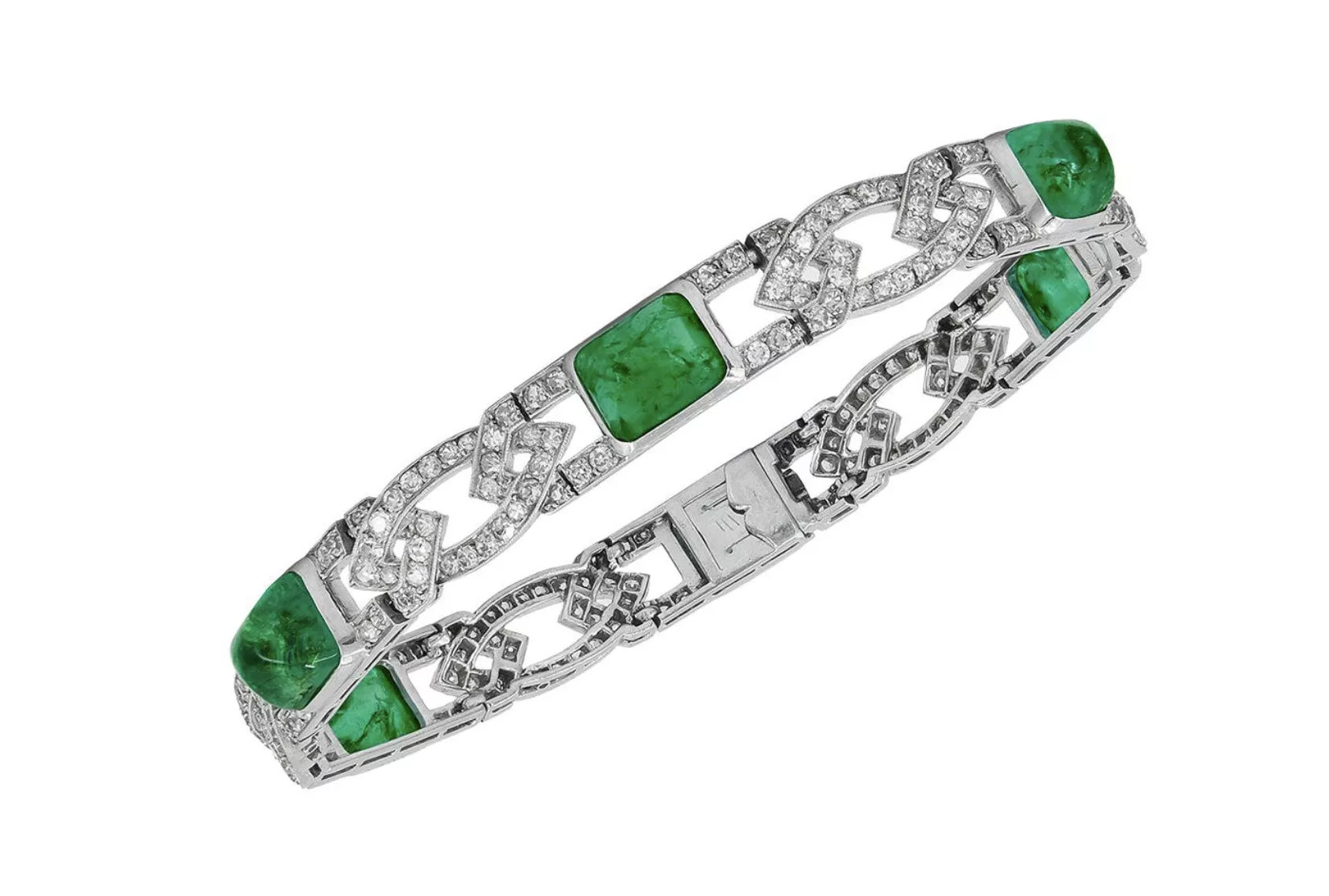
- The Art Deco period (1920 - 1939) has an average five-year valuation of x2.4, dominated by floral clips and geometric brooches
- The 1950-1970 period still shows strong liquidity today, especially for naturalistic and transformable jewelry (passe partout, Zip).
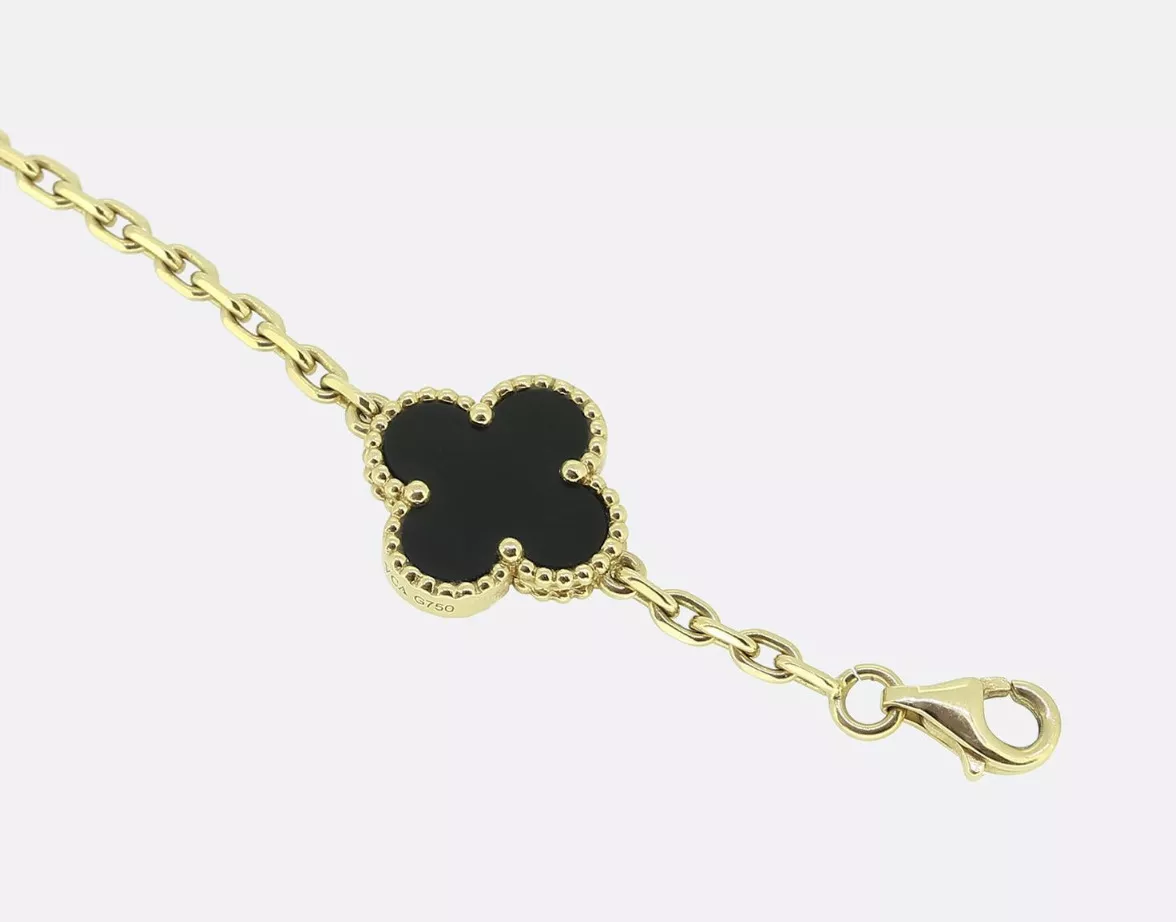
- The contemporary era (1980 - today) shows more moderate growth even if some collections like Alhambra jewelry clearly stand out from the crowd, we notice a significant premium for limited editions.

Concerning the typology of pieces, transformable jewelry and creations with mechanisms (necklaces Zip, Passe-partout bracelets) present an average innovation premium of +45% compared to static models.
The presence of GIA or SSEF certificates increases the final price by 15 to 30%. Natural premiums of Kashmir or Burmese origin also trigger high-intensity competitive bidding, very often above double the high estimate.
The average price per carat of a diamond signed Van Cleef & Arpels exceeds that of a comparable unsigned diamond by 25%.
The dominant profile of the auction buyer combines various factors : male or female, without too much significant difference, CSP++/UHNWI, often active in finance or culture, having already bought at auction.
The VCA signature functions as an indicator of confidence, comparable to an asset rating, reducing the volatility of the secondary market. The increase in sales is part of a general trend towards the materialization of financial wealth, where exceptional jewelry is becoming an aesthetic refuge value.
The market segmentation shows that Van Cleef & Arpels' outperformance is not cyclical but based on a cumulative value structure, which sits in the middle of history, technique and informed speculative demand.
Valuation drivers specific to Van Cleef & Arpels
Since the 2020s, the valuation of VCA jewelry has been based on a convergence between material rarity, stylistic singularity and symbolic brand capital, which follows a cultural economy logic.
The haute-joaillerie house selects gems of certified provenance (Burmese, Kashmir, Colombia), creating an asymmetry of supply that reinforces competitive tension at auction. Pieces containing natural stones see their price multiplied by 1.5 to 2.2 compared to heated gems of equivalent quality.
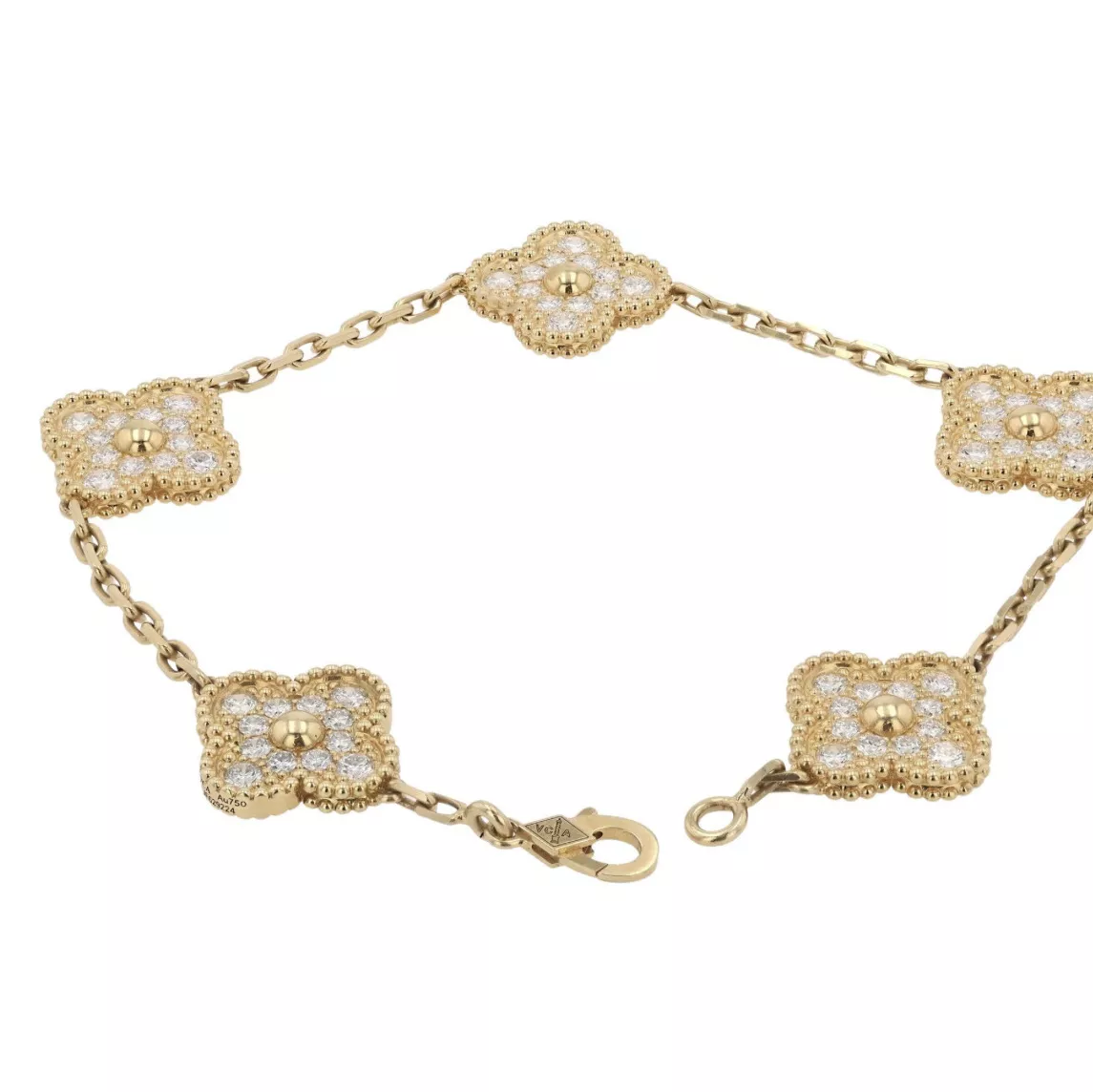
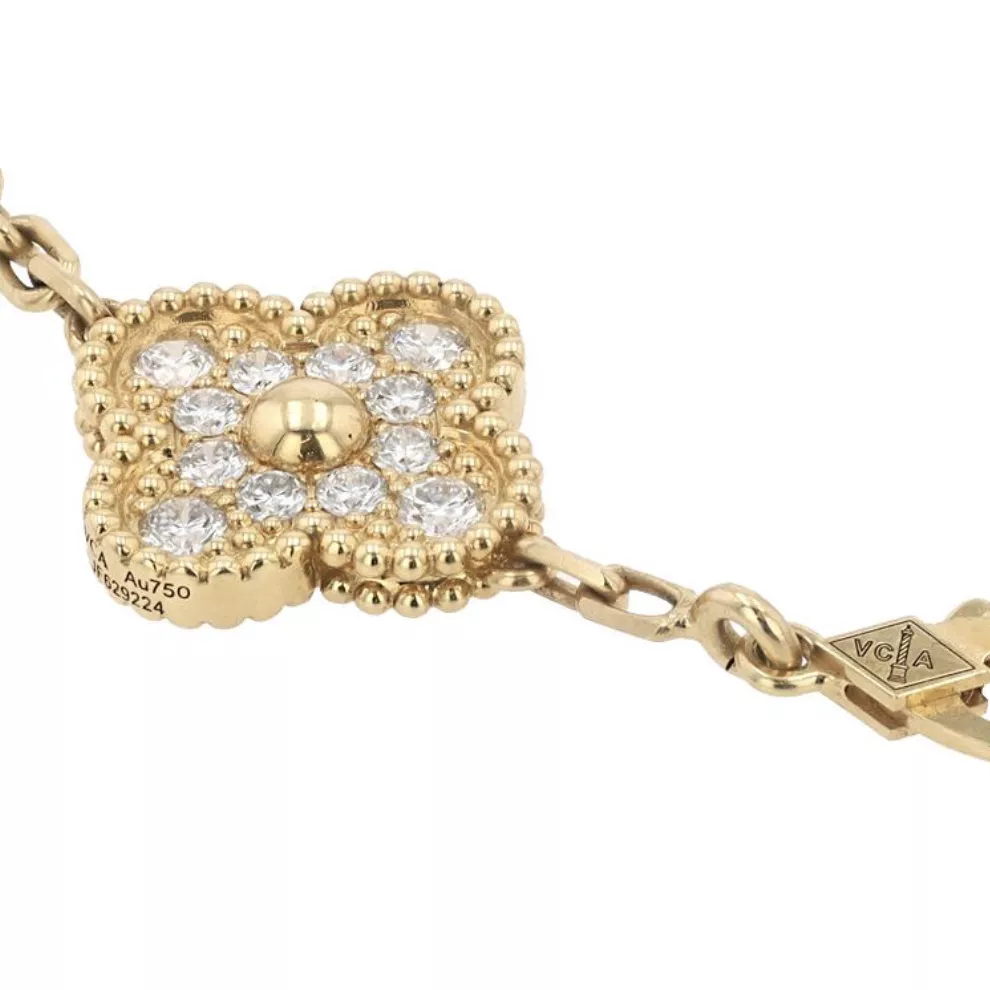
The identifiable formal vocabulary characterizes VCA design with poetic naturalism, floral arabesques, articulated curves and controlled asymmetry. The Zip and Alhambra collections are archetypal models.
The Mystery Set patent obtained in 1933 also illustrates a unique microstructural mastery insofar as VCA works with an absence of visible claws, a continuous surface and homogeneous light dispersion.
If the jewel holds a prestigious provenance such as a royal collection, celebrity or historic family, this can result in an average overbid of 60%.
Auctions also mobilize a psychology of prestige based on visible rarity and short temporality, where possession becomes a public validation of distinction.
Thus, the soaring prices of Van Cleef & Arpels jewels are not the result of irrational speculation but of an institutionalization of value where expertise, narrative and rarity converge in a single system of legitimization.
Perspectives and structural challenges for Van Cleef & Arpels
The global fine jewelry market is in a phase of upward consolidation, with projected growth of +10 to +12% per year in the " Fine Jewellery " segment by 2027 (Deloitte, Global Powers of Luxury Goods 2025).
Van Cleef & Arpels is now the third best-performing auction house, behind Cartier and ahead of Bulgari, accounting for almost 15% of the global volume of signed fine jewelry sold in 2024.
Asian buyers are on the rise (+22% year-on-year), along with young collectors from tech and finance backgrounds. The female investor segment is also growing, as these ladies represent 40% of active bidders on VCA lots.
Dematerialized auction platforms generate nearly 30% of the house's bids, facilitating a relative democratization of the luxury market. Data transparency reinforces heritage traceability and confidence in certificates of origin.
The house is currently working on a stylistic rationalization, with a return to historic models (Zip, Alhambra, Fée) that guarantee identity continuity.
As far as auctions are concerned, there is little correlation between VCA jewelry prices and financial indices, positioning jewelry as an inflation-hedging asset. The higher resale rate is maintained at 1.8 on the secondary market, which is naturally a sign of inter-cyclical stability.
The explosion in VCA prices at auction therefore reflects a lasting phenomenon of the transformation of jewelry into a certified cultural asset, where economic value merges with historical value, towards a capitalization of beauty.
Indicative bibliography
Bennett, David, and Daniela Mascetti. Understanding Jewellery. Woodbridge: Antique Collectors' Club, 2010.
Coffin, Sarah D., et al. Set in Style: The Jewelry of Van Cleef & Arpels. New York : Cooper Hewitt / Yale University Press, 2011.
Les Arts Décoratifs (dir.). Van Cleef & Arpels : The Art of Haute Joaillerie. Paris : Les Arts Décoratifs / Flammarion, 2012.
Papi, Stefano, and Alexandra Rhodes. 20th Century Jewellery and the Icons of Style. London: Thames & Hudson, 2013.
Snowman, A. Kenneth. The Master Jewellers. London: Thames & Hudson, 1990.
Meylan, Vincent. Christie's: Jewellery Archives Revealed. Woodbridge: ACC Art Books, 2016.
Scarisbrick, Diana. Chaumet: Parisian Jeweller Since 1780. Paris: Flammarion, 2016.
Cartier (RMN-GP, dir.). Cartier: Style and history. Paris: Réunion des musées nationaux-Grand Palais, 2013.
Kapferer, Jean-Noël, and Vincent Bastien. The Luxury Strategy: Break the Rules of Marketing to Build Luxury Brands. London: Kogan Page, 2020 (updated ed.).
Klemperer, Paul. Auctions: Theory and Practice. Princeton: Princeton University Press, 2004.
Estimate in less than 24h
Discover in the same theme

An update on the numbers of women artists who have become in...
The market is booming for women artists: 13% growth and that's only the beginning. We decode the figures for you.
Learn more >

Here's why French cubists are back on the market in style
French Cubists were long forgotten by the art market. Today, they are back on the market in great numbers. 24h estimate.
Learn more >

Abstract art: estimate and auction value
Appraisal and Valuation of Abstract Art: Understanding the Value of an Abstract Work and Selling It at Auction.
Learn more >
D'autres pièces de haute joaillerie vendues aux enchères

Estimated 10.000 - 15.000 €
BOUCHERON - "Ava" - White gold necklace set with a brilliant-cut diamond (1.56 cts)

Estimated 2.000 - 4.000
CARTIER, 18K (750 e) gold opening bangle bracelet

Estimated 1.500 - 3.000
CARTIER PARIS, Trinity, 2-tone 18k (750e) gold clip brooch

Estimated 3.000 - 5.000
CARTIER, Love, Wedding band in 18k white gold (750e)

Estimated 2.000 - 4.000
CARTIER Love model Pendant necklace in 18K (750e) white gold

Estimated 1.500 - 2.000
CHAUMET, Ring in platinum (850th), set with an oval faceted ruby

Secure site, anonymity preserved

Auctioneer approved by the State

Free and certified estimates
Frequently asked questions
-
Who is Van Cleef & Arpels, and why is its jewelry so sought-after at auctions?Van Cleef & Arpels is a French fine jewelry house founded in 1906, renowned for its signature design style that combines poetic naturalism, technical innovation, and transformable creations (the Zip, Alhambra, and Passe-partout collections). Its museum-quality status, historical legitimacy, and unique Mystery Set patent (which eliminates visible prongs) make it a leading cultural asset on the global auction market.
-
What is the price range for Van Cleef & Arpels jewelry at auction?The median price per Van Cleef & Arpels lot exceeds €120,000, with an average increase in value of 35% between 2020 and 2025. Art Deco pieces (1920–1939) have seen their value increase by a factor of 2.4 on average over five years, while convertible jewelry commands a 45% innovation premium compared to static designs.
-
How do you authenticate and appraise a piece of Van Cleef & Arpels jewelry?To authenticate and appraise a Van Cleef & Arpels piece, we recommend requesting a free appraisal from Auctie's. Our auctioneers and experts specializing in fine jewelry will examine the piece, verify its provenance and certificates (GIA, SSEF), and then provide you with a non-binding estimate range within 48 hours.
-
Is this the right time to sell a piece of Van Cleef & Arpels jewelry?Yes, this is a favorable time. The market is showing structural growth (+28% over two years in 2024), with a sell-through rate exceeding 95% and 68% of lots sold above their high estimate. Demand continues to outstrip supply, particularly for historic pieces, timepieces with mechanical movements, and those set with certified gemstones of prestigious provenance.
-
How does the sale of jewelry work at Auctie's?At Auctie's, we guide you every step of the way, from appraisal to auction. You submit your piece of jewelry for a free, no-obligation appraisal by our fine jewelry experts. Once we’ve agreed on the terms, we catalog the piece, include it in our next specialized auction, and offer it to an international clientele of collectors and investors at auction.
