



Rating and value of paintings by Gaston La Touche

Key takeaways
- A French academic painter (1854–1913) who specialized in portraits; his works sell for between €20 and €300,000, depending on the technique and the artist’s reputation.
- Oil paintings on canvas make up the bulk of his body of work, while drawings and prints are less common in his catalog.
- His style blends Impressionism, 18th-century courtly festivities, and Japonism, creating timeless compositions bathed in diffused light and pastel hues.
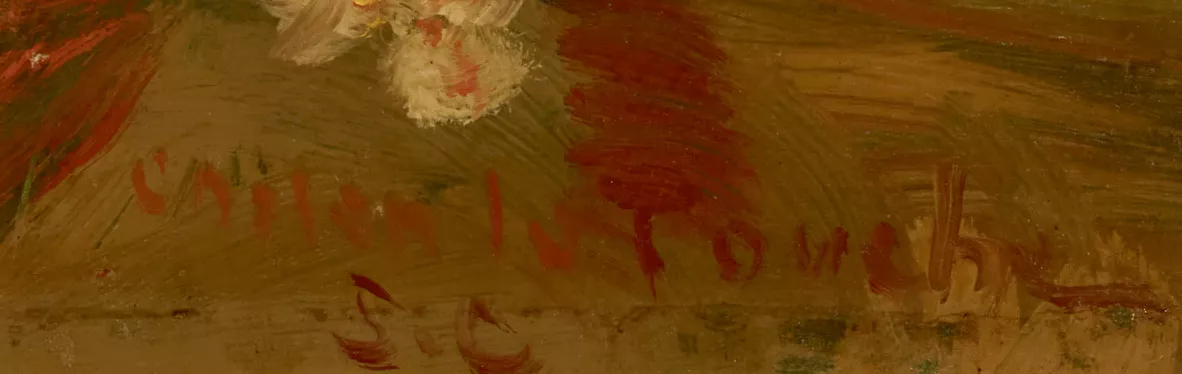
- The signature, written in a fluid hand, does not appear on all of his canvases, making authentication necessary before a precise estimate can be provided.
If you own a work by or after the artist Gaston de la Touche, and would like to know its value, our state-approved experts and auctioneers will offer you their appraisal services.
Our specialists will carry out a free appraisal of your work, and provide you with an accurate estimate of its value on the current market.
Then, if you wish to sell your work, we will direct you to the best possible arrangement to obtain the optimum price.
Rating and value of the artist Gaston de la Touche
A French academic painter par excellence, Gaston de la Touche devoted himself mainly to portraits. The bulk of his work is based on a wide range of paintings, but there are also drawings, on the other hand very few prints.
The prices at which his works are auctioned range from €20 to €300,000, a consequent delta but one that speaks volumes about the value that can be attributed to the artist's works.
In this case, his oil on canvas Les Pivoines, measuring 140 cm x 143.5 cm, sold for €300,000, whereas it was estimated at between €90,000 and €130,000.
Order of value from a simple work to the most prestigious
Technique used | Result |
|---|---|
Estamp - multiple | From €20 to €1,000 |
Drawing - watercolor | From €30 to €50,300 |
Painting | From €20 to €300,000 |
Estimate in less than 24h
Style and technique of Gaston de La Touche
Gaston La Touche is distinguished by a style in which light and color become the real protagonists.
Heir to the Impressionists in his concern for atmospheric effects, he nevertheless departs from their raw spontaneity to offer more worked, almost theatrical compositions.
His technique is based on the use of subtle glazes, which give his canvases a bewitching transparency and refined brilliance.
The palette, often dominated by soft, pastel hues, is enhanced by more vibrant touches, establishing a delicate dialogue between nuance and intensity.
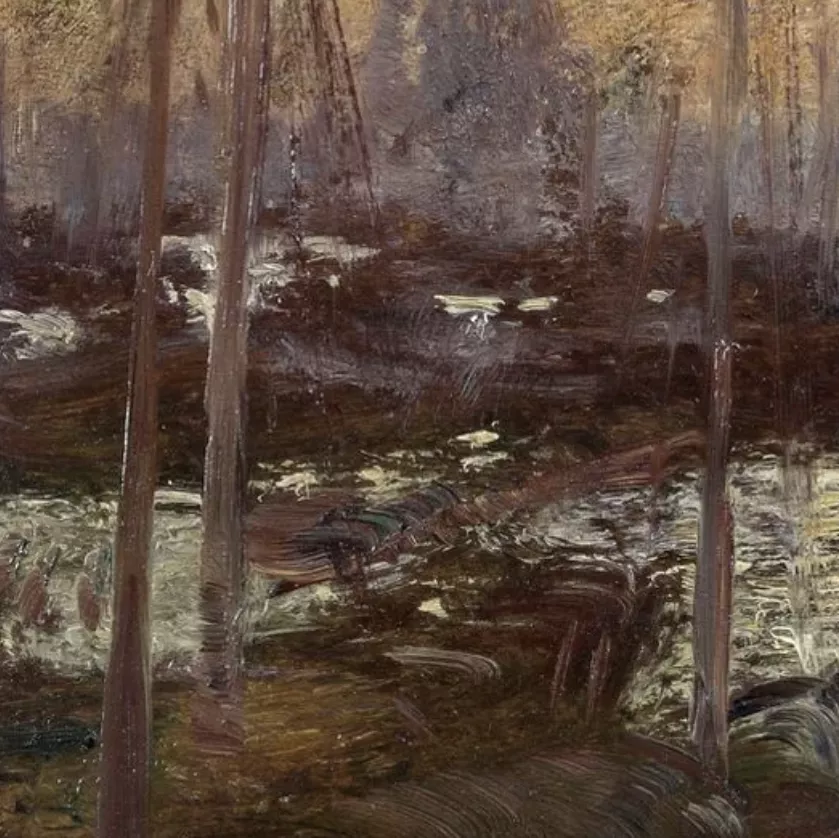
The female figures and bucolic scenes he favors seem bathed in a diffuse light, where contours lose their sharpness to give way to a hushed ambience.
Each element of the painting, whether the reflections of a pond or the silky textures of fabrics, is treated with a care that evokes the colorists of the XVIIIᵉ century.
With this blend of precision and reverie, La Touche creates a pictorial universe in which reality is transcended, leaving the viewer with the impression of a world suspended between grace and poetry.
The life of Gaston La Touche
Gaston La Touche was born in 1854 in Saint-Cloud, at the heart of a period when French art was undergoing profound upheaval.
From an early age, he showed a marked interest in drawing, encouraged by his parents, who supported him in his artistic vocation.
Although he began with dark, naturalistic scenes, influenced by his admiration for Édouard Manet and François Bonvin, his style soon evolved towards brighter painting, inspired by the XVIIIᵉ century.
From the 1890s, his career took off again when he adopted a delicate aesthetic, evoking the gentleness of fêtes galantes.
His works seduced collectors and critics alike, and he received numerous official commissions, notably for monumental decors.
Installed in Champigny-sur-Marne, he divides his time between his elegant compositions and the constant search for ideal light, captured in the gardens and landscapes that surround his studio.
His proximity to figures such as Puvis de Chavannes and Alfred Roll or Alexandre de Séon strengthens his position in the artistic circles of the time.
Until his death in 1913, he remained a painter appreciated for his ability to combine modernity and refinement, offering an ideal and timeless vision of life.
Focus on La Danse au Jardin
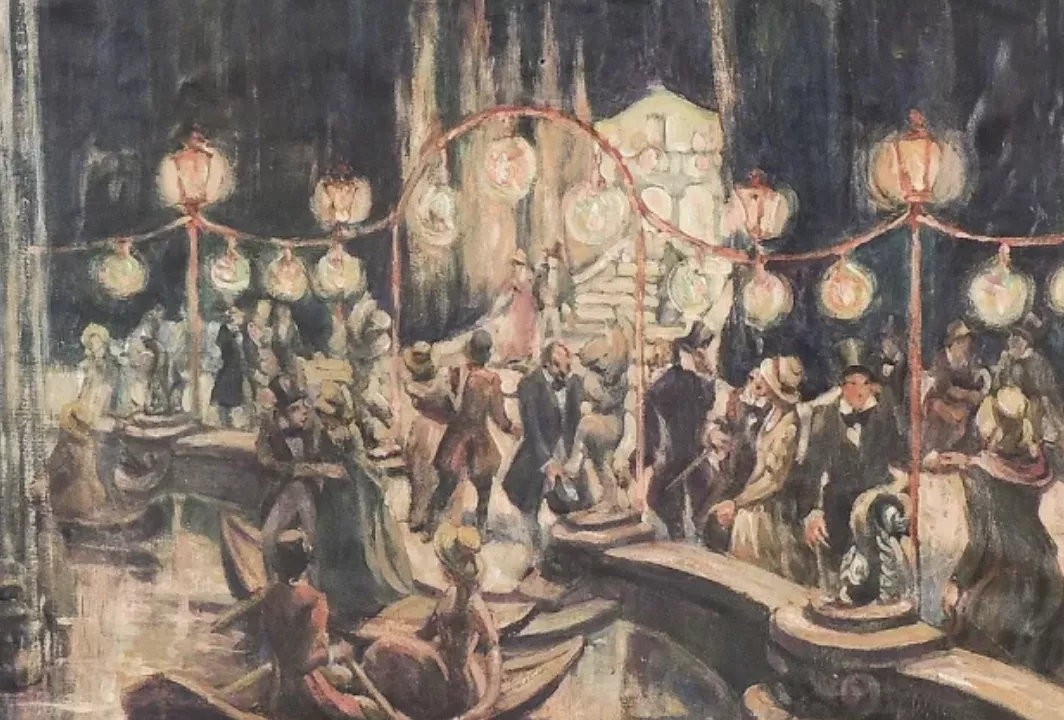
In La Danse au Jardin, Gaston La Touche reveals a virtuosity where visual brilliance and subtlety meet. This canvas, imbued with an atmosphere both festive and dreamlike, seems to escape any temporal anchorage.
The scene is peopled by graceful characters, dressed in costumes evoking the pastoral reveries of the XVIIIᵉ century, who blend harmoniously into a garden bathed in light.
This interplay of light shadows and shimmering hues reflects a rare mastery of chiaroscuro, while the artist's vaporous touches evoke a gentle fragility.
The choice of tonalities - deep greens punctuated by luminous pinks, golds and whites - lends the whole a chromatic balance that exalts the elegance of the moment captured.
La Touche doesn't just freeze a scene, he orchestrates a pictorial symphony in which every detail, from the movement of fabrics to the texture of foliage, participates in an overall harmony.
This painting illustrates his attachment to a painting that sublimates reality, flirting with symbolism through the evocation of a timeless celebration.
It also echoes his influences: the memory of Watteau and the fêtes galantes, or the diffuse trace of Impressionist lightness.
By celebrating the ethereal beauty of nature and simple pleasures, La Danse au Jardin embodies a veritable ode to idealized life, carried by a pictorial technique as delicate as it is precise.
Gaston La Touche's stylistic influences
The web of influences that runs through Gaston La Touche's work has not been sufficiently explored. While at times he evokes the festive breath of Watteau's fêtes galantes, he does not limit himself to a simple pastiche of the XVIIIᵉ century.
On the contrary, he infuses these heritages with a vitality specific to his era, tinged with Impressionist plays of light.
This way of capturing reflections in an almost musical radiance, where each nuance seems to dialogue with its opposite, is reminiscent of Renoir's chromatic delicacy.
Where Puvis de Chavannes joins him is in this quest for balance: a meticulous arrangement of figures and settings, where each element seems weighed to create visual serenity. But La Touche didn't stop there.
Fascinated by Japonism, he retained a certain decorative poetry, palpable in his floral arrangements and in the refinement of ornamental details.
All these influences, far from being disparate, are unified in a personal style where modernity and reminiscence respond harmoniously.
Thus, Gaston La Touche, while adhering to an artistic filiation, emancipates himself from it to weave a universe that is both singular and deeply imbued with the resonances of his time.
Gaston La Touche's imprint on his period
This aspect of Gaston La Touche has rarely been dwelt upon. For, at first glance, his art seems to be a declension of light and color, almost banal in its homogeneity.
But you have to take a closer look to perceive what his painting contributed to its time.
At a time when the world was modernizing, when art was divided between avant-garde and tradition, La Touche carved out a very special path for himself, that of a quiet aesthete, almost aloof from the great artistic revolutions
He did not seek to shock or unbalance, but rather to soothe, to offer a breath of fresh air in the often tense atmosphere of the late 19th century.
While his scenes of parks, gardens and festivals seem almost frozen in an ideal of the past, they nevertheless reveal a subtle modernity: that of an art that doesn't simply reproduce, but seeks to capture the very essence of light and color in a kind of suspension of time.
This is where his imprint lies: in this ability to redefine the perception of the everyday, to render the ephemeral eternal, without resorting to the artifices of novelty.
His influences are manifold: Impressionism with its taste for changing light, Symbolism in the search for atmosphere, and even a touch of realism in the precision of landscapes.
But he integrated them in his own way, without ever submitting to a school or movement.
In short, his work, far from being a simple retrospective, is a subtle commentary on his era, a gentle response to the violence of social and artistic change, echoing the quest for a rediscovered harmony so characteristic of the late 19th century.
Recognizing Gaston La Touche's signature
The painter didn't sign all his works, which doesn't make for easy expertise. When his works are signed, the signature appears in flowing script.
Know the value of a work
If you happen to own a work by Gaston La Touche, request a free appraisal without further delay via our form on our website.
A member of our team of experts and accredited auctioneers will contact you promptly to provide you with an estimate of the value of your work, as well as any relevant information about it.
If you are considering selling your work, our specialists will also be on hand to help you find alternatives for selling it at the best possible price.
.Estimate in less than 24h
Discover in the same theme

Rating and value of works, paintings by Friedrich Overbeck
Friedrich Overbeck was a German neoclassical painter who lived in Rome. His religious paintings are highly prized at auction.
Learn more >

Rating and value of paintings by Marius Borgeaud
Marius Borgeaud is a 19th-century luminist painter who produced paintings that are increasingly popular and valuable at auction.
Learn more >

Rating and value of paintings by Lady Elizabeth Thompson
Lady Elizabeth Thompson is a British artist who has worked on history and military scenes. Her works are very successful.
Learn more >
D'autres tableaux impressionnistes vendus aux enchères

Estimated 6.000 - 8.000
Mikhail Markianovich GUERMACHEFF (1867 - 1930) House under the snow, oil on canvas

Estimated 2.000 - 4.000
Jean DUFY (1888-1964) Vase of anemones, Watercolor

Estimated 600 € - 800 €
Henri ZUBER (1844-1909), Bridge at Artemare. Oil on canvas.

Secure site, anonymity preserved

Auctioneer approved by the State

Free and certified estimates
Frequently asked questions
-
Who is Gaston La Touche, and what is his artistic style?Gaston La Touche (1854–1913) was a French academic painter renowned for his portraits and his depictions of gardens and social gatherings. His style is characterized by a subtle mastery of light and color, combining the Impressionist tradition with inspiration from the 18th century. He used delicate glazes and a palette of soft, pastel hues to create refined, timeless compositions in which reality is transcended, giving way to a subdued and poetic atmosphere.
-
What is the price range for works by Gaston La Touche?Prices for Gaston La Touche’s works vary considerably depending on the type and quality: prints sell for between €20 and €1,000, drawings and watercolors for between €30 and €50,300, and paintings for between €20 and €300,000. For example, his oil on canvas *Les Pivoines* sold for €300,000, exceeding its initial estimate of €90,000 to €130,000. This wide range reflects the diversity and varying value of his body of work.
-
How can you authenticate a work by Gaston La Touche?To authenticate a work by Gaston La Touche, we recommend that you request a free, no-obligation appraisal using the form on our Auctie's website. A state-certified expert or auctioneer will examine your piece and provide you with their assessment within 48 hours. This appraisal will allow you to verify the piece’s authenticity, obtain an accurate estimate of its value, and receive all relevant information about it.
-
Is this the right time to sell a work by Gaston La Touche?Yes, now is a good time to sell a work by Gaston La Touche. His art, which combines modernity and refinement through an exceptional mastery of light and color, continues to attract collectors. Demand for high-quality academic painters from the late 19th century remains strong, and his works—particularly his paintings—maintain a stable and attractive market value.
-
How does the appraisal process work at Auctie's?Appraisals at Auctie's are free and non-binding. Simply submit your request via our online form, and a certified expert or auctioneer will contact you shortly. Within 48 hours, you’ll receive an accurate estimate of your artwork’s value along with all relevant information. If you’d like to sell, our specialists will then work with you to identify the best options for getting the highest possible price.
