



MAJOR REDISCOVERY OF AN EIGHTEENTH-CENTURY SÈVRES BISCUIT

Auctie's and Maxime Charron are pleased to present:
MANUFACTURE ROYALE DE SÈVRES, 18th century
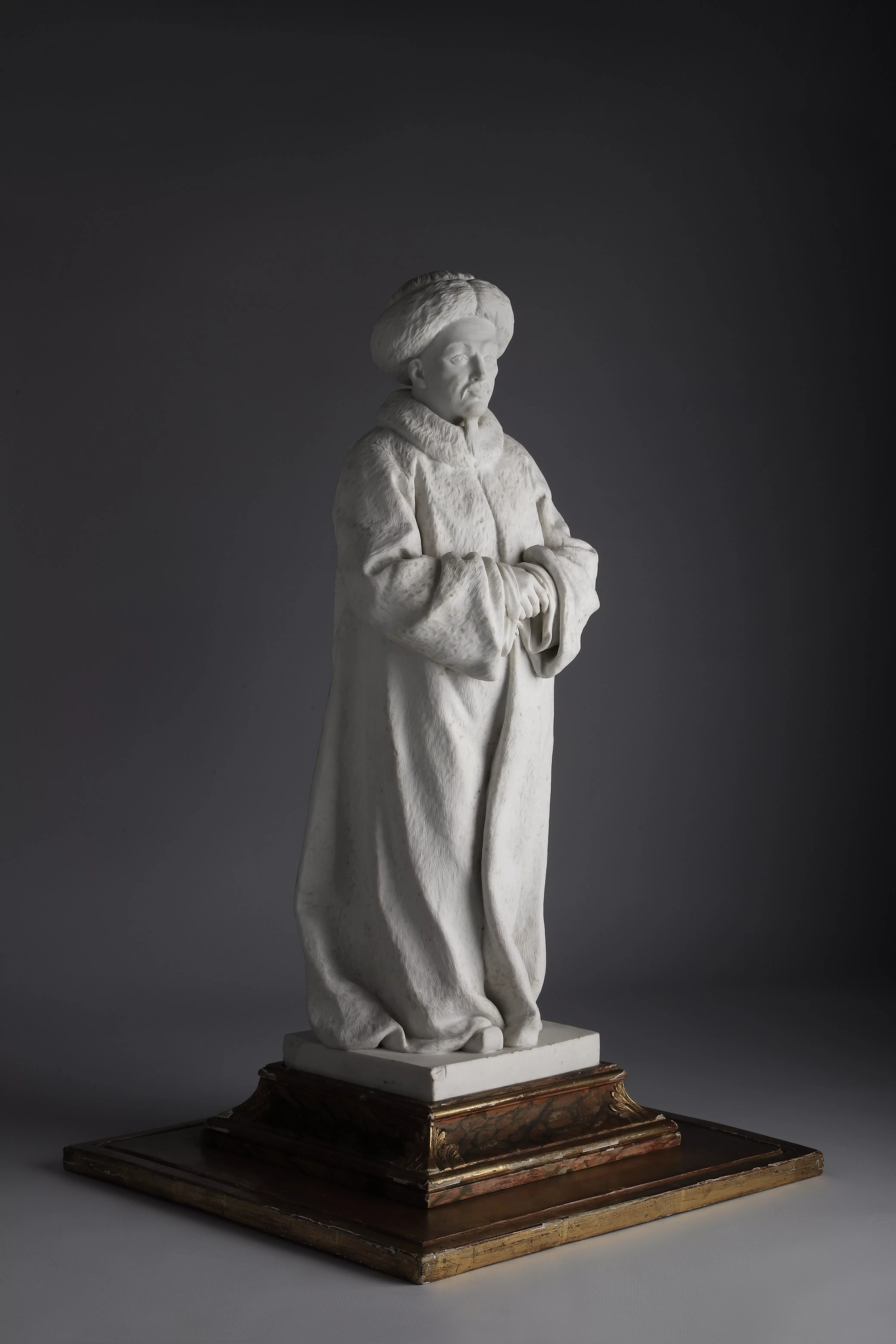
" The Emperor of China " - Portrait of the Emperor Qianlong (1711-1799)
Hard porcelain bisque.
Between 1775 and 1779.
Attributed to Josse-François-Joseph LE RICHE (1741-1812), under the direction of Louis-Simon BOIZOT (1743-1809).
Hollow marks on the base " B " (for Boizot) and " 9 " (mold number).
Some chips and misses on the base.
H. 40.5 x W. 14.5 x D. 14 cm.
Provenance
One of thirteen cookies with the portrait of " L'Empereur de la Chine " made by the Manufacture royale de Sèvres between 1775 and 1779, and one of only three known to date.
French private collection, cited in a certificate of appraisal from the Manufacture nationale de porcelaine de Sèvres on July 6, 1883: " L'Empereur de Chine / Modèle de Sèvres de 1760 à 1780 (sic) / Biscuit en porcelaine pâte tendre (sic), modèle très rare et d'une grande valeur. L. Lenoy, commis principal Musée Céramique de Sèvres ".
M. Poulet, antique dealer in Versailles.
Bought 6000 francs on December 14, 1929 by Madame la Comtesse Claude de Choiseul-Praslin, née Yvonne Tempez (1895-1982), from M. Poulet (invoice enclosed). Then to her godson (given around July 19, 1960), father of the current owner.
Related works
An example numbered " 20 ", H. 40.5 cm, is kept at the Musée des Arts Décoratifs, Paris (inv. 23723, Legacy Adèle Michon, 1923).
A copy numbered " 17 ", H. 40.6 cm, is preserved at the Museum of Fine Arts, Boston (inv. 2003.119).
The original 1775 terra cotta under Boizot's direction is preserved at the Musée National de Céramique, Sèvres (inv. MNC 12971).
List of the 13 recipients of the cookie of L'Empereur de la Chine delivered according to the archives of the Manufacture de Sèvres
Madame la duchesse de Mazarin, August 10, 1776 (Vy 7, fol. 118 v°).
Marie-Antoinette, Queen of France, in 1776 (Vy 6, fol. 208 v°).
Madame Adélaïde, aunt of Louis XVI, in 1776, at Versailles (Vy 7, fol. 128).
One copy sold for cash on December 21, 1776 (Vy 6, fol. 118).
One copy sold for cash on December 22, 1776 (Vy 6, fol. 120).
One copy sold for cash on December 27, 1776 (Vy 6, fol. 130).
Monsieur le prince de Croÿ (with a foot of 48 livres), on May 23, 1777 (Vy 6, fol. 186).
To the merchant Grouet, first half of 1777 (Vy 6, fol. 223).
Madame la comtesse d'Artois, December 28, 1777, at Versailles (Vy 6, fol. 246 v°).
Madame de Durfort, December 11, 1777 (Vy 7, fol. 111 v°).
One copy sold for cash on December 16, 1778 (Vy 7, fol. 58).
Monsieur L'ambassadeur de Sardaigne, April 27, 1779 (Vy 7, fol. 137).
One copy sold for cash on May 26, 1779 (Vy 7, fol. 144).
History
Different from the " chinoiseries " executed in the 18th century at the Manufacture de Sèvres, this statuette is not a fantasy figure but a genuine portrait, and not just any portrait, as it is that of the Chinese emperor Qianlong (reign, 1735-1796). It was inspired by a now-lost watercolor by Father Panzi, a Jesuit attached to the Peking court, lent to the factory by Secretary of State Henri Bertin (1720-1792). Bertin was a first-rate customer who did not hesitate to influence the artistic choices of Sèvres production, suggesting decorations and contributing models to the manufactory. A scholar with a passion for China, Bertin financed the publication of Mémoires concernant l'histoire, les sciences, les arts les moeurs, les usages, etc. des Chinois / Par les missionnaires de Pékin, edited by Joseph-Marie Amiot (1718-1794), published in fifteen volumes from 1776 to 1791 (a final volume was published in 1814). Martinet's engraving, featured on the frontispiece of the first volume of the collection, reproduces Father Panzi's portrait of Qianlong (see illustration). The Jesuit's watercolor was also used as a model for paintings on porcelain; in 1776, a first plate, painted by the painter Charles-Éloi Asselin, was sold to King Louis XVI for the considerable price of 480 livres (now preserved at the Château de Versailles (see illustration). A second was sent with a copy of the cookie of L'Empereur de Chine via Bertin as a diplomatic gift from King Louis XVI in 1781, but it seems that Mr. Panzi did not deliver them. Indeed, in a letter Amiot wrote to Bertin on November 15, 1784, he states: " I asked Mr. Panzi about the use he had made of the full-length statue of the emperor, and of the portrait painted on porcelain of this prince. He replied that he keeps the statue in his room and that he no longer remembers what has become of the portrait...". Bertin personally acquired a third plate on October 17, 1785 for the sum of 192 livres.
Probably made during 1775 (according to Tamara Préaud), the statue of " l'Empereur de la Chine " is attributed to the sculptor Josse-François-Joseph Le Riche, modeler at Sèvres from 1757 to 1801, under the direction of Louis-Simon Boizot, director of sculpture at Sèvres from 1773 to 1809. Although there are no archival documents to confirm this attribution, the presence of Le Riche's initials " LR " on one of the other two known examples (the one in Boston, see above) allows us to affirm it. The first cookie example to leave the Sèvres workshops was sold in August 1776 to the Duchesse de Mazarin, née Louise-Jeanne de Durfort de Duras (1735-1781), renowned for the collection of objets d'art she commissioned from the artists of her time. The work was offered at a price of 72 livres, a relatively modest sum but one that can be explained by the simplicity of the figure, which required seven molds for its manufacture, whereas the most ambitious groups required up to a hundred.
The production of small sculpture in cookie, i.e. without glaze, had ensured the manufactory the prestige of a new ceramic material, with a finely polished white surface reminiscent of marble. Its development from mid-century onwards was such that in 1757 the manufactory appointed a director of sculpture, a post held until 1766 by Étienne-Maurice Falconet (1716-1791), then replaced by the painter Jean-Jacques Bachelier (1724-1806) until 1773, and then by the sculptor Louis-Simon Boizot (1743-1809), who held it until his death.
Within this production, which was exported and imitated throughout Europe, The Emperor of China, despite the prestige of its main buyers, enjoyed limited success, with only thirteen copies sold (see above). The austerity of this portrait of a foreign sovereign, imbued with an ironic wisdom, undoubtedly baffled customers accustomed to more amiable creations (here, the Emperor wears a fur pelisse that only he could wear, and a black fur cap). But it didn't deter the manufactory from creating effigies of princes from faraway kingdoms, since in 1787 Boizot modeled a statuette of a full-length figure of a young Prince of Cochinchina " in order to pique curiosity with something new ". The first copy was sold to the king at the end of the year, at the same price as the Qianlong figure. To the best of our knowledge, the present model is the only one in private hands; only two other of the thirteen examples are known and located: one in the Musée des Arts Décoratifs in Paris and the other in the Museum of Fine Arts in Boston. The Arts Décoratifs copy has no incised lettering, while the Boston copy features Le Riche's initials; ours features the initial " B " of director Boizot. This mark alone proves that the piece was made at the Sèvres factory in the 18th century. As for the number " 9 " on the base, according to Antoine d'Albis, former director of the Manufacture de Sèvres, it may correspond to a mold number used to make the statue. Indeed, the sculptors at Sèvres used different molds for each work. The Musée des Arts Décoratifs model is engraved with the number " 20 ", while the Boston model is engraved with the number " 17 ". This extremely rare sculpture of the Qianlong emperor is one of the most important examples of the long-standing relationship between France and China. Various recent exhibitions devoted to exchanges between the two countries clearly demonstrate the importance of these ties, notably the one at Versailles in 2014 and the one at Beijing's Forbidden City in 2022; this is also the aim of the current exhibition " The Palace of Versailles in China ", which is being held at the Forbidden City from April 1 to June 30, 2024, to mark the 60th anniversary of diplomatic relations between France and China.
Literature
Émile Bourgeois, Le cookie de Sèvres au XVIIIe siècle, Paris, Goupiol & Cie, 1909.
- Tamara Préaud (art.), Sèvres, la Chine et les " chinoiseries " au XVIIIe siècle. The Journal of the Walters Art Gallery, vol. 47, 1989, pp. 39-52.
- Louis-Simon Boizot (1743-1809) : sculpteur du roi et directeur de l'atelier de sculpture à la Manufacture de Sèvres, exhibition catalog, Versailles, Musée Lambinet, Paris, Somogy, 2001.
- Cat. expo., La Chine à Versailles. Art et diplomatie au XVIIIème siècle, Château de Versailles, May 27 - October 26, 2014, Somogy, Paris, 2014.
- Cat. expo. (China), Three centuries of elegance: 1740-2015 - Manufacture de Sèvres. Jinsha Site Museum, Chengdu, China, October 17 - December 17, 2015.
- Videoconference given by Madame Chaoying LEE, Associate Professor at the Department of Ethnic Relations and Cultures at Dong Hwa National University (Taiwan), Amis de Sèvres, October 10, 2023: "Les cadeaux diplomatiques - sous forme de porcelaine - de la cour de France à l'empereur Qianlong, décrits dans la correspondance entre le ministre Henri Bertin et les missionnaires jésuites à la cour de Pékin, au XVIIIème siècle".
Expert: Maxime Charron
Inscrivez-vous avec votre adresse e-mail afin de recevoir les catalogues de nos futures ventes
