



Exceptional Tiara by Alexander Calder
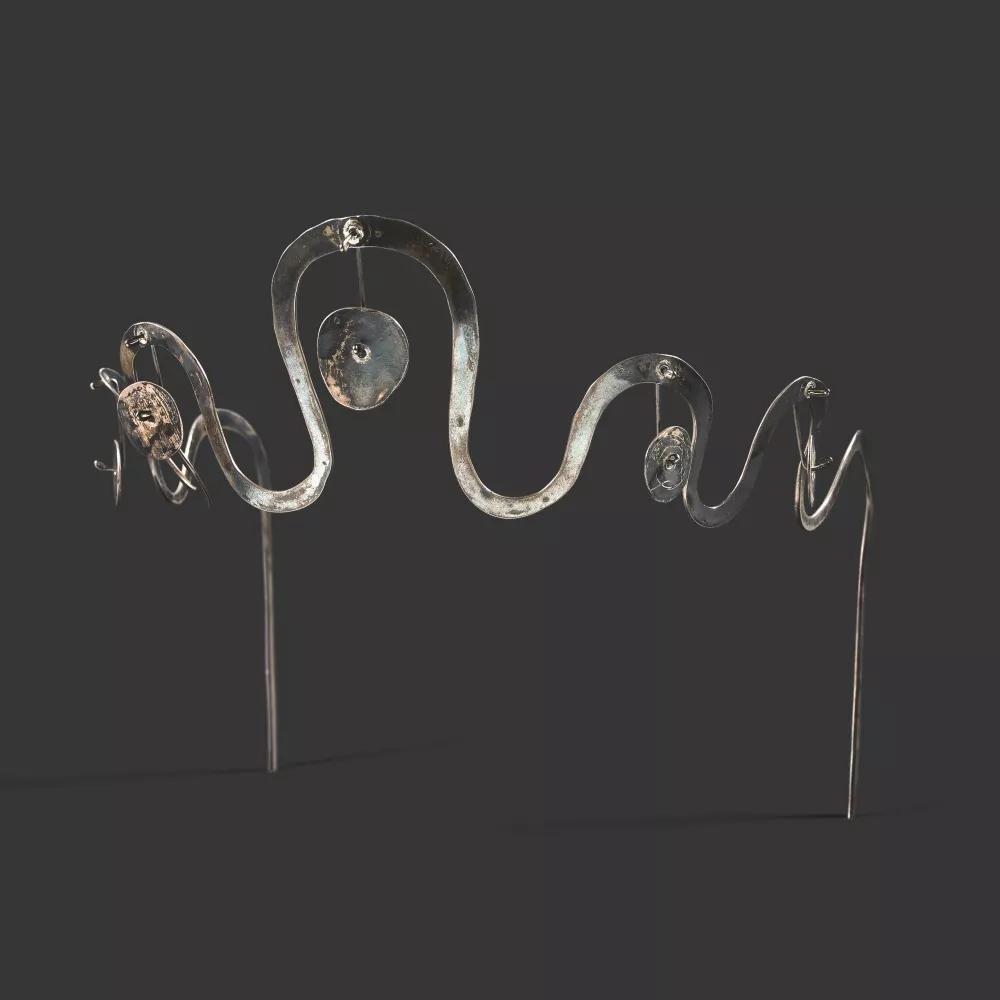
Alexander CALDER (1898-1976)
Silver tiara (min. 800) with wave motifs holding pendants
Weight: 29.9 g.
Provenance:
Gift made by Alexander Calder to the wife of a famous 19th-century painter.
Special Swiss collection
Alexander Calder: More than an artist, a precursor
Alexander Calder was born in 1898 in Lawnton, Pennsylvania, USA. He studied mechanical engineering before turning to art, and studied at the Art Students League in New York.
Calder began creating mobile sculptures in the 1930s. His first works were abstract sculptures composed of wire elements, but he soon began using other materials, such as metal and wood, to create more complex sculptures. His works are often associated with abstract art and the surrealist movement.
Calder's mobile sculptures have been exhibited in many prestigious museums, including the Museum of Modern Art in New York and the Centre Pompidou in Paris. In 1966, the Solomon R. Guggenheim Museum in New York organized a retrospective of his work, which attracted thousands of visitors.
Calder jewelry
In addition to his mobile sculptures, Calder also became interested in jewelry design. He began creating jewelry in the 1920s, and continued to do so throughout his life. His jewelry was often composed of cut and welded metal parts, and often featured mobile elements such as chains and pendants that moved with the wearer's movement.
Alexander Calder created jewelry for his wife Louisa, relatives and friends such as Peggy Guggenheim, Simone de Beauvoir and Georgia O'Keeffe. It was a highly personal practice in which he experimented with a new aesthetic, each piece as rare and specific.
As such, Calder's jewelry is often considered as highly as his stabiles and mobiles. In 2013, a necklace by the artist sold for $1,985,000 at Sotheby's in New York on November 14 and still holds the world record price for a piece of Calder jewelry at auction.
The Tiara presented by Auctie's
This silver tiara, elegantly combines Calder's use of geometric abstraction with the representation of symbolic forms, reminiscent of his mobile sculptures and gouaches. Waves are symbols of power, movement and universality. The emphasis on line and geometric forms is visible in the final aesthetic, and this was a major preoccupation for other modernist artists such as Jean Arp, Piet Mondrian and Wassily Kandinsky.
The raw aesthetic
The use of silver wire and suspensions recalls the influence of primitivism and the Golden Age bronze artifacts Calder discovered in Paris. Appropriating the iconographies of ancient cultures was a way for modernist artists to distance themselves from traditional Western art in order to find a new, "purer" aesthetic.
Inscrivez-vous avec votre adresse e-mail afin de recevoir les catalogues de nos futures ventes
