



Watch Value: Appraisal and Auction

Key takeaways
- The value of a watch depends mainly on the manufacturer (Patek Philippe, Rolex), the movement, and its original condition, and can range from 200 euros to several million.
- Iconic vintage watches such as the Rolex Submariner or the Omega Speedmaster range from 5,000 to 80,000 euros depending on the model and original condition.
- The inclusion of original paperwork and a case increases the value by 20 to 40% for the same model, while mechanical complications significantly multiply the base price.
Collectible watches, complications, and prestigious manufacturers: watch values vary significantly depending on the manufacturer, the model, and the original condition.
Below, you’ll find all our valuation guides dedicated to watches—collectible watches, chronographs, and timepieces from prestigious manufacturers. Each guide details the price ranges observed at auction and the factors that determine a piece’s value before you entrust it to our state-certified auctioneers.
Guides on this type of item
See all guides >
Marseille Auctioneer: Art Valuation – Aucties
Have your artwork, jewelry, and collectibles appraised in Marseille by the experts at Aucties. 100% free online appraisal within 24 hours. ✅
Learn more >

Rating and value of Cartier watches
Cartier watches are collector's items that are enjoying increasing interest on the auction market, and their value is rising.
Learn more >

Rating and value of Art Nouveau watches
Art Nouveau watches are collectors' timepieces that are highly valued on the auction market.
Learn more >

Rating and value of clocks and cartels
Antique clocks and cartels are very popular items on the auction market. They still have value. Estimates in less than 24h.
Learn more >
Understanding Watch Valuations
What Is a Watch’s Market Value?
The market value of a watch or clock refers to the reference value assigned to it by the secondary market at a given moment, resulting from a complex interplay between the brand, the movement, the mechanical complications present, the condition of the piece, the presence or absence of original documentation and the case, and current international demand.
The watch market is one of the most liquid and dynamic collectibles markets in existence, with its values driven by constant global demand—fueled as much by collectors passionate about precision mechanics as by investors seeking to diversify their portfolios with luxury items that embody strong cultural identity.
This market is unique in that it encompasses multiple price tiers: on one hand, grand complication watches from the most prestigious manufacturers—Patek Philippe, Vacheron Constantin, Audemars Piguet, A. Lange & Söhne, whose rare pieces regularly fetch substantial auction records at major sales in Geneva or New York.
On the other hand, mass-produced watches from well-known brands—Rolex, Omega, and TAG Heuer—offer an active and well-documented secondary market where enthusiasts of fine watchmaking find opportunities at very accessible price points.
In between, antique clocks and timepieces constitute a specialized segment whose value depends primarily on the quality of the movement and the richness of the case’s decoration.
Watches, pendulum clocks, and wall clocks: what timepieces are on the market?
The collectible timepiece market encompasses a considerable variety of timepieces, each with significantly different valuation criteria.
Contemporary wristwatches from major manufacturers constitute the most active segment, driven by intense global demand that has led certain iconic models—such as the Rolex Daytona “Paul Newman” or the Patek Philippe Ref. 1518—to fetch auction prices that far exceed their original selling prices.
Antique pocket watches, particularly 18th- and 19th-century haute horlogerie pieces adorned with painted enamel or gemstone motifs, constitute a heritage segment whose rarity and technical sophistication warrant a high level of expertise.
Clocks—whether Empire-style mantel clocks adorned with gilded bronze, precision regulators, regional comtoises, or Rocaille cartels—constitute a distinct market whose dynamics mirror those of the antique art market: the decoration of the case, the identity of the bronze artist or cabinetmaker who crafted it, and the quality of the movement are the three pillars of valuation.
Type of timepiece | Movement | Characteristics | Market demand level |
Contemporary luxury watch (Patek Philippe, Rolex, Audemars Piguet) | Automatic or in-house mechanical | Grand complication, limited edition, full documentation | Exceptional, very active global market |
Vintage watches (Rolex, Omega, other well-known brands) | Vintage mechanical or automatic | Iconic model, original dial, original bracelet | Very strong, international demand |
Antique fine watch (19th century and earlier) | High-precision spring-driven mechanical movement | Rare complications, enamel or gemstone decoration | Active market among specialized collectors |
Antique mantel clock (Empire, Louis XVI, Regency) | Balance wheel or spring-driven movement | Gilded bronze case, quality of the movement | Steady demand from interior designers and collectors |
Comtoise or regional regulator | Traditional long-pendulum movement | Heritage and regional significance, variable quality | Active, accessible market |
The criteria that determine a watch’s market value
A watch’s market value depends on a hierarchy of criteria, of which the brand is the first and most decisive factor: a rare Patek Philippe model, even in imperfect condition, will always be worth more than a watch from a less prestigious brand in perfect condition and with all its documentation.
The caliber, or internal movement, is the second fundamental criterion: so-called “grand complication” calibers—which incorporate a tourbillon, a perpetual calendar, or a minute repeater—represent feats of watchmaking engineering whose value far exceeds that of simpler calibers.
Finally, the condition of the watch is absolutely decisive: a watch whose original dial has not been repolished or replaced, whose hands are period-correct, and whose case has not been altered is consistently worth far more than a model of the same reference that has undergone any modifications, even minor ones.
The price ranges observed on the secondary market illustrate this variation. A mass-produced watch from a well-known brand can range from 200 to 5,000 euros. A vintage watch from an iconic brand, such as a Rolex Submariner or an Omega Speedmaster, ranges from 5,000 to 50,000 euros depending on the model and condition.
Highly complicated timepieces from the most prestigious manufacturers frequently exceed several hundred thousand euros, and some rare Patek Philippe models have fetched several million dollars at international auctions.
Estimate in less than 24h
Luxury, vintage, antique watches, or clocks: all timepieces appraised
The Hierarchy of Timepieces and Its Impact on Value
In the hierarchy of the collectible watch market, a grand complication watch from a prestigious independent manufacturer occupies the very top.
The Patek Philippe Ref. 5004 with minute repeater and perpetual calendar, the Vacheron Constantin Tour de l’Île, or the ultra-limited-edition Audemars Piguet Royal Oak Offshore are examples of pieces whose rarity and technical sophistication can lead to record-breaking bids at major auctions held by Christie’s or Sotheby’s in Geneva.
Just below that, iconic watches from major brands in their most sought-after versions—such as the white-steel Rolex Daytona and the first-generation Omega Speedmaster Moonwatch—constitute an active and well-documented market where prices are generally well established.
Category | Characteristics | Price Range | Market Demand |
Grand Complication (Patek Philippe, Vacheron, Audemars, rare) | Tourbillon, minute repeater, perpetual calendar, very limited edition | €100,000 — several million € | Institutional, international auctions |
Iconic vintage watch (Rolex, Omega, sought-after model) | Original dial, period hands, case not repolished | €5,000 — €80,000 | Very strong demand, active global market |
Contemporary luxury watch (with papers and case) | High-quality movement, like-new or perfect condition | €3,000 — €50,000 | Highly liquid, strong demand |
High-quality antique clock (Empire, Louis XVI) | Signed movement, gilded bronze case | €1,000 — €30,000 | Working condition; sought after by collectors and interior designers |
Standard mass-produced watch or quartz watch | Standard movement, mass-produced | €100 — €2,000 | Moderate, accessible market |
Automatic, mechanical, and collectible watches: the most sought-after
Among the most active segments of the collectible watch market, vintage mechanical watches from the 1950s to the 1980s occupy a particularly dynamic position, driven by a clientele of collectors passionate about mechanical watches who appreciate in these pieces both the craftsmanship of an era when manufacturers took pride in the precision of their movements and the distinctive aesthetics of dials and cases that reflect the design trends of their time.
The Rolex Submariner Reference 5513, the Omega Constellation Dual Calendar, and the large-case Longines Flagship are representative examples of this segment in its most sought-after forms.
Get a Free Watch Appraisal
A certified appraisal by a licensed auctioneer in less than 24 hours
Appraising a watch or a clock requires specialized expertise that can only be acquired through extensive experience in the watch market: identifying a specific model among thousands of different calibers and cases, examining a movement to assess its quality and condition, and detecting a replaced dial or non-original hands.
Auctie’s appraiser possesses this specialized watchmaking expertise, which is made available to you free of charge to provide a certified response in less than 24 hours.
Whether you want to know the value of an inherited watch, sell a watch collection, or compile an estate inventory, Auctie’s provides the accurate and well-reasoned appraisal you need to make an informed decision.
What You Need to Provide for an Online Appraisal
For a watch, clear photographs of the front, back, and sides of the case, as well as the dial and hands, are essential. The model number and serial number—usually engraved on the back or between the lugs of the case—must be provided.
Please specify whether the original paperwork and box are included or missing, as these items significantly affect the value. For a clock, photographs of the entire piece, the movement (if accessible), and any signatures or workshop marks are required.
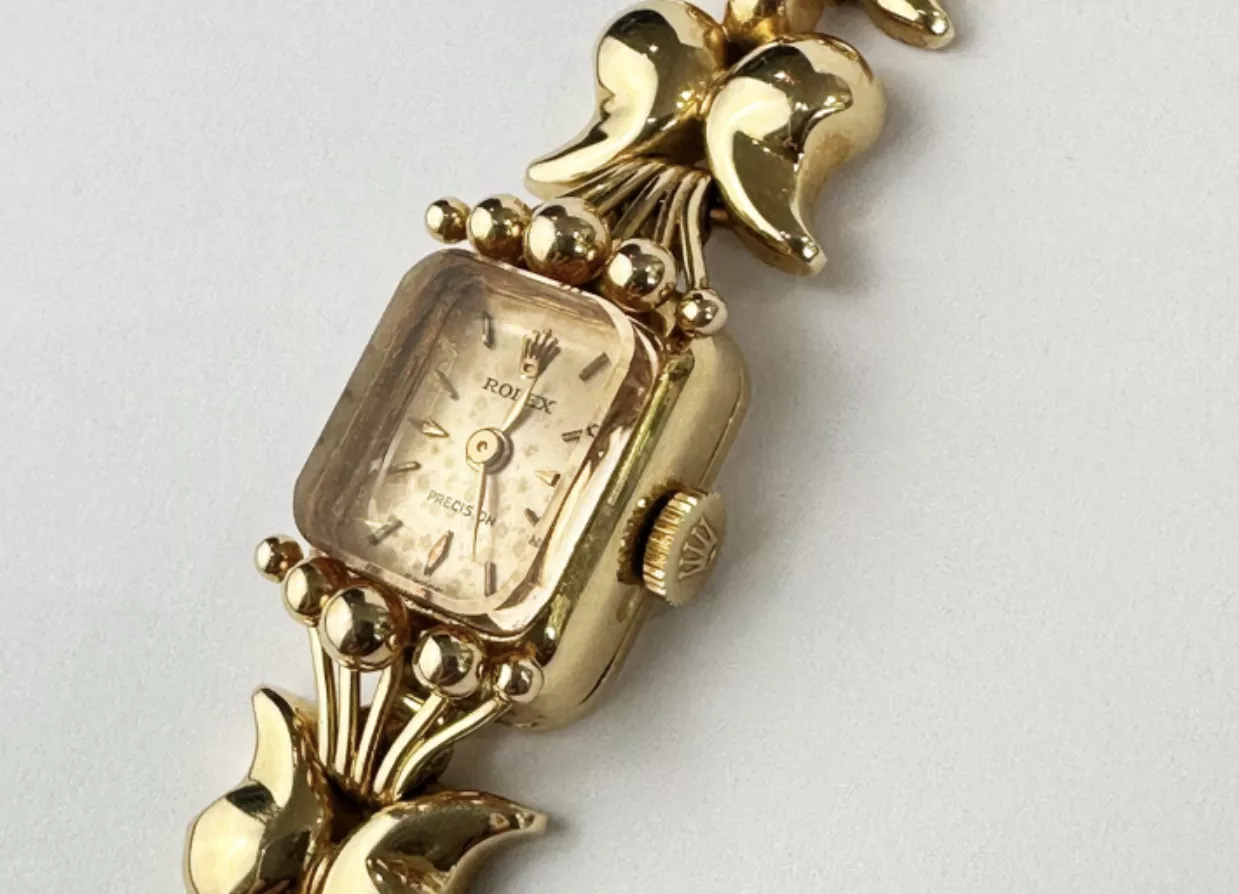
Brand, Movement, and Authenticity: The Pillars of Value
Brand, Caliber, and Complications: Their Impact on Value
Element | Impact on Value |
Brand (prestigious manufacturer vs. mass-market brand) | Primary factor in valuation; value difference can span several orders of magnitude |
Movement and complications (tourbillon, repeater, perpetual calendar) | Significant impact on value; grand complications multiply the base value |
Reference number (collector’s item vs. standard production model) | Major impact; some reference numbers are worth ten times as much as others from the same manufacturer |
Case (material: gold, platinum, steel) | Gold and platinum command a premium; steel may be more sought-after for certain vintage models |
Condition (unpolished, unrestored) | Critical for vintage watches; any intervention reduces the value |
Documentation, presentation box, condition, and rarity: their impact on value
The presence of original documentation—including the warranty booklet and certificate of manufacture—as well as the original box or case significantly increases the value of any collectible watch, particularly for contemporary pieces from major manufacturers: A Patek Philippe with its complete documentation and original case is consistently worth between 20% and 40% more than the same model without documentation.
Rarity is the other determining factor: certain models were produced in such small numbers that they are true collector’s items, whose rarity sustains a demand that is structurally higher than the available supply.
Selling a Watch at Auction with Auctie's
From the Starting Price to the Final Bid: How the Price Is Determined
An auction is the most effective way to sell a high-quality collectible watch or clock, as it exposes the item to direct competition among specialized collectors whose precise knowledge of the market allows them to immediately appreciate the value of a rare timepiece.
The reserve price, set in consultation with the seller based on a preliminary estimate, must be calibrated to spark a dynamic bidding process without stifling the ambitions of the most determined potential buyers.
Hôtel Drouot and Online Auctions: Reaching the Right Bidders
Auctie’s holds its auctions at Hôtel Drouot, which regularly hosts specialized watch auctions that attract an audience of particularly knowledgeable collectors and professionals.
Real-time online streaming makes it possible to reach bidders from around the world—an essential aspect for a market as globalized as that of collectible timepieces.
Estate Planning, Inheritance: Valuing an Inherited Watch or Clock
Estate Inventory and Distribution
Antique watches and clocks are frequently found in estates, sometimes without the heirs knowing their exact value, which can vary considerably depending on the brand, movement, and condition.
Auctie’s works alongside notaries to compile rigorous watch inventories, with each piece individually appraised by an auctioneer possessing the necessary expertise in horology.
Confidentiality and Anonymity
Auctie’s handles every case with absolute discretion. The owner’s identity is never disclosed to third parties without their explicit consent, and items may be offered for sale under complete anonymity if the consignor so desires.
Glossary of Watch Valuation and the Watch Market
Term | Definition |
Valuation | The estimated market value of a timepiece, determined based on auction results and demand. |
Caliber | Refers to the internal movement of a watch, identified by a number specific to each manufacturer. |
Automatic movement | A mechanical movement that winds itself through the natural movements of the wearer’s wrist. |
Mechanical movement | A spring-driven movement that is wound manually, generally associated with a longer watchmaking tradition. |
Complication | An additional function of a watch beyond telling time (date, chronograph, repeater, tourbillon, etc.). |
Case | The outer casing of the watch, made of steel, gold, platinum, or other materials, which protects the movement. |
Dial | The visible face of the watch displaying the time; its originality is crucial to its value. |
Bezel | A circular element surrounding the dial, often graduated (tachymeter, minute track) or decorated. |
Documents | The watch’s original documents (warranty certificate, booklet), which significantly increase its value. |
Case | The original case or box provided with the watch at the time of purchase. |
Attribution | Definite identification of a watch’s brand and movement. |
Provenance | The ownership history of a timepiece. |
Award | Awarding of the lot to the highest bidder at the conclusion of an auction. |
Reserve Price | The starting price set for the commencement of bidding on a lot. |
Estimate in less than 24h
Let Auctie's appraise your watch
A collectible watch tells a story: that of a manufacturer, a movement, an era, and sometimes an illustrious owner.
Understanding and bringing out the value of this story is the mission of Auctie’s watch expert, who puts their in-depth knowledge of the market and watchmakers at your service—free of charge and in complete confidence.
The appraisal is free, with no obligation, and you’ll receive a response within 24 hours—whether it’s a Patek Philippe grand complication or an heirloom mantel clock.
Discover in the same theme

Auctioneer Nanterre: Valuation – Aucties
Have your artwork, jewelry, and collectibles appraised in Nanterre by the experts at Aucties. 100% free online appraisal within 24 hours. ✅
Learn more >

Auctioneer Caen: Valuation – Aucties
Have your artwork, jewelry, and collectibles appraised in Caen by the experts at Aucties. 100% free online appraisal within 24 hours. ✅
Learn more >
Marseille Auctioneer: Art Valuation – Aucties
Have your artwork, jewelry, and collectibles appraised in Marseille by the experts at Aucties. 100% free online appraisal within 24 hours. ✅
Learn more >

Secure site, anonymity preserved

Auctioneer approved by the State

Free and certified estimates
Frequently asked questions
-
What are the main factors that determine a watch's value?The value of a watch depends first on its brand and prestige (Patek Philippe, Rolex, Omega, etc.), and then on its movement and mechanical complications (tourbillon, minute repeater, perpetual calendar). The condition of the watch is critical: an original, unpolished dial and period hands significantly increase the piece’s value. Finally, the presence of the original paperwork and box increases the value by an average of 20 to 40 percent.
-
What is the price range for an iconic vintage watch like a Rolex or an Omega?An iconic vintage watch (Rolex Submariner, Omega Speedmaster, sought-after models) with an original dial and period hands generally sells for between 5,000 and 80,000 euros, depending on the specific model and its condition. Grand complications from prestigious watchmakers frequently exceed several hundred thousand euros, with some reaching several million.
-
How do I get my watch appraised at Auctie's?The appraisal is free and non-binding. Please provide clear photographs of the dial, the back, and the sides of the case, along with the model number and serial number. Please specify whether or not the original paperwork and box are included. An auctioneer specializing in timepieces will respond with a certified estimate within 24 hours.
-
Is now a good time to sell a collectible watch?Yes, the vintage watch market is currently one of the most dynamic and liquid markets around, fueled by steady global demand from passionate collectors and investors. Vintage mechanical watches, particularly those from the 1950s through the 1980s, are seeing strong market activity, which ensures greater visibility and competition among bidders.
-
How does the auction process for a watch work at Auctie's?Auctie's guides you from the initial appraisal through to the final sale. After the appraisal, the reserve price is set in consultation with you, and the watch is then offered for direct bidding among specialized collectors. An auction is the most effective way to maximize the value of a high-quality timepiece, as it creates a dynamic of competition among buyers.
